The Power Of Curiosity In The Workplace
Episode Overview
Tim Reitsma opens this conversation with a simple but disruptive idea: most of the friction inside teams comes from a lack of curiosity, not a lack of information. He walks through how leaders default to dictating direction instead of asking questions, and how that habit quietly erodes trust. Tim connects this directly to the return-to-office and hybrid work debates many organizations were navigating at the time, pointing out that when companies stay silent, employees fill the silence with their own assumptions, usually the wrong ones. His prescription is refreshingly unglamorous: ask more, tell less, and treat every unclear situation as an invitation to get curious rather than to guess.
The conversation then turns personal. Tim shares a moment when a chronic health condition affected his ability to perform at work, and how a leader's curious, empathetic response, rather than a rigid performance conversation, changed the outcome entirely. From there he unpacks why curiosity looks different across individuals: some people think out loud in a room, others need time alone before they can contribute, and treating both as if they were the same is where most team design goes wrong. He closes with concrete habits for building a culture where people actually speak up, from sending meeting agendas in advance to swapping "why" questions for "what's going on" ones, and reflects on why authentic curiosity, aimed at understanding someone else rather than confirming your own view, is the harder and more valuable version to practice.
Episode Highlights
- Curiosity works best as a leadership habit, not a personality trait: asking "tell me more" instead of jumping to solutions surfaces the real problem faster.
- During major uncertainty, like return-to-office and hybrid work debates, employees will invent their own narrative if leaders don't communicate, and curiosity closes that gap.
- A personal story about disclosing a chronic health condition at work shows how a leader's curious response, not a rigid policy, determines whether someone feels safe being honest.
- People process ideas differently: some think out loud in meetings, others need time alone first, so team rituals need to make room for both styles.
- Practical habits for building a curious team include sending meeting agendas ahead of time, replacing "why" questions with "what's going on" questions, and deliberately leaving space for silence.
- Authentic curiosity, understanding someone else's perspective for its own sake, is different from self-serving curiosity aimed only at getting the answer you want, and the distinction matters for how leaders build trust.
About the Guest
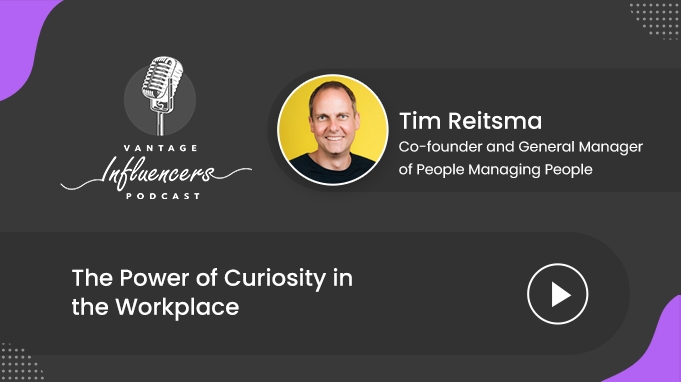
Tim Reitsma, Co-founder and General Manager, People Managing People
Tim Reitsma is the co-founder and General Manager of People Managing People, an online publication focused on building a better world of work. He brings experience across leadership, business strategy, people and culture, and operations, with a focus on building teams that are genuinely excited about their craft and their organization. Guided by values of faith, family, curiosity, and fun, Tim is also a coach, mentor, speaker, and active volunteer in his community. Outside of work, he spends time outdoors with his wife and two kids and mountain biking in the mountains around Vancouver, BC.
Host
Susmita Sarma, Vantage Influencers Podcast Host
What You Will Learn
- Why curiosity reduces ambiguity and fear on a team, and how silence gets filled with assumptions
- How to respond with curiosity instead of reprimand when someone isn't performing
- Why people process ideas differently, and how to design meetings that work for both styles
- Practical techniques for training a team to ask more questions, including reframing "why" into "what's going on"
- The difference between authentic curiosity and self-serving curiosity, and why it matters for trust
Key Topics & Timestamps
| Timestamp | Topic |
|---|---|
| 01:06 | Tim Reitsma's career path and introduction to People Managing People |
| 04:01 | Why curiosity matters more in a VUCA world |
| 06:40 | The link between curiosity and employee health and wellbeing |
| 09:31 | How to measure curiosity in the workplace |
| 11:15 | Practical ways to train employees to be more curious |
| 16:30 | Tim's closing advice for modern HR leaders |
Full Transcript
Click to read the full episode transcript
Welcome to the Vantage HR Influencers Podcast. This podcast is sponsored by Vantage Circle, the simple and AI-powered rewards and recognition platform for employee engagement.
Susmita Sarma: Hi, everyone. I'm your host, Susmita, and I welcome you to a brand new episode of the Vantage HR Influencers Podcast. In this episode, we'll talk about the power of curiosity in the workplace, how it is related to employee health and wellbeing, how we can measure curiosity, and also about training our employees to be curious. Please help me welcome my guest today, Tim Reitsma, the co-founder and general manager of People Managing People, an online publication focused on building a better world of work. Welcome, Tim.
Tim Reitsma: Thank you so much for having me. I'm really excited about our conversation today.
Susmita Sarma: Same here, and thank you so much for joining me today. Before we start with the topic, the power of curiosity in the workplace, it would be great if you can brief us about yourself and People Managing People.
Tim Reitsma: Yeah, thanks again for the opportunity, and a little bit about myself. So, if you look at my career, it is far from a straight line. It is a very squiggly line. I've had the opportunity to take various positions throughout my career, from sales, sales operations, tech support, quality assurance. I did a little bit of consulting in people and culture, spent some time as a director of people and culture, and now I'm the general manager at an online publication called People Managing People. At People Managing People, I just love my job. It's such an exciting opportunity to lead a team of passionate people who are really focused on how to build a better world of work. That is our purpose at our publication. We focus on this by covering topics around the employee lifecycle, including thought pieces, how-to guides, how to select the right software for your organization, and content focused on people leadership in HR, as well as running a podcast and an online community. So that's really what we're about from a publication perspective. Our goal is to build a better world of work, but also to put the how into the what and the why of people leadership. We often talk about what we need to do and why we need to do it, but the how is hard. That's where we spend a lot of our time focusing our publication around.
Susmita Sarma: Yeah, so when we initiated our conversation regarding this podcast recording, you suggested a topic about curiosity in the workplace. So I would like to know how you and your team are working to improve curiosity at the workplace for your clients.
Tim Reitsma: Yeah, curiosity is, for me, one of the integral things that make any team function. At People Managing People, I can sit there and dictate where we need to go, and people may or may not follow. But that's never been my style. I've always been a curious person, and I remember my mom saying that I used to ask too many questions. That's because I just wanted to figure out how things work, how things operate. That principle has always stuck with me, and I believe it's one of my core values. So the way I lead, and the way we've developed People Managing People, is built around this idea of curiosity. An example of that: we did quarterly planning recently, and we brought the whole team together and brainstormed ideas. I don't necessarily have the best ideas, and often the team has the best ideas. We then consolidate those ideas and put them into an action plan so we can execute on them. That's just an example of how we use curiosity to push our publication forward.
Susmita Sarma: Right. And especially in this VUCA world, don't you think curiosity is more relatable to workplace realities today?
Tim Reitsma: Oh, absolutely. I think we need to be more curious now than ever. Simply put, curiosity allows us to reduce ambiguity, fear, and us making up our own narrative. How often do we fill in the gaps when we don't have the right amount of information? Another example: right now there's so much talk, and there has been so much talk, about returning to the office, or hybrid work, or staying remote. I've heard of companies that still haven't communicated what's happening, and employees are getting anxious. They don't know, so guess what happens? If we don't encourage curiosity and encourage people to ask questions, we just make up our own narrative and our own reality, one that might not actually be reality. So that's just one example of how, even as organizations, we need to get curious about what is going on in our team's minds. What are they thinking? Listeners might be asking, well, how do I know what my team is thinking? Well, simple: ask. It's as simple as, hey, what's keeping you up at night? What about this organization, do you have fears around it right now? I'd be hard pressed to believe we'd get the right answers if we never asked the questions in the first place. We may think we have the right answers, but unless we start talking to our teams and asking them directly, that's where we get the real insights.
Susmita Sarma: So it's definitely adding a lot of value to organizational discussions, this curiosity among employees.
Tim Reitsma: Absolutely. We have so many unique individuals in our organizations who add so much value, and organizations are constantly changing. So we have this opportunity to get curious about our teams, about what's going on in their lives, and about their ideas on how to push the organization forward.
Susmita Sarma: Yeah, more or less, I think we're all curious, but some people don't prefer to talk about it, and some of us just ask questions very freely.
Tim Reitsma: Yes. I think as a podcast host, you have to have that value of curiosity for sure.
Susmita Sarma: Right. And very importantly, curiosity is also related to the health and wellbeing of employees.
Tim Reitsma: Oh, yeah, I don't think we can have one without the other. As a people leader, if someone on our team isn't performing, do we simply reprimand them, or do we get curious about what's going on? Definitely the second one. And if it's the second one, how do we go about doing that? We know what we need to do, we know why we need to do it, but how do we actually do this? It might be as simple as this: if a project isn't going well and we keep asking, "why is this not going well, why is it not on track," what's the immediate reaction we get? If I hear that tone of voice, if I hear that "why," I get a little defensive personally, and I don't think I'm the only one. What if we reframe that as "what's going on"? What's keeping this project from completion? What's taking it off track? What could we do to get it back on track? I think that simple reframe of a question brings out real conversation with people, because you're right, there are some people who just don't want to ask the question, and there are some, like yourself, who will just ask. For the people who aren't asking questions, that's where we need to spend some time unpacking and understanding. A simple story about health and wellbeing, a personal one: a while ago, a couple of years back, I was working for an organization, and I live with a chronic health condition called Crohn's disease. While I was working at that organization, my Crohn's disease came out of remission, and it was playing havoc on my wellbeing. I knew I needed to tell my boss, my leader, that I wasn't performing at 100%, and that I couldn't perform at 100%. I was nervous, a little afraid about the reaction, but he led with empathy and curiosity. What I mean by that is he asked, "what can I do to support you?" This is the CEO of the company. The next day he called me and said, "hey, I didn't know anything about Crohn's disease, so I spent the evening researching what it is, let's come up with a plan." We worked together on it. That, to me, is true curiosity, authentic curiosity, in action.
Susmita Sarma: Yes, so Tim, how exactly can we measure curiosity in the workplace? Is that even possible? Because as we've already discussed, there are some people who are very comfortable sharing how they feel and what they're curious about, but at the same time, there are people who don't feel like opening up.
Tim Reitsma: Yeah, and I'd ask, is that right or is that wrong? We're all wired differently, we're all different people, we all think differently. Some people can go into a brainstorming meeting and ask a lot of questions, process really quickly, and drive to a conclusion. Other people aren't able to process that way. I'm one of those people, I need to go away, think about something, and then come back. So as we design our organizations and our teams, we need to be aware that we're not all wired the same, we don't all think the same, and we don't all react the same. Are we encouraging the behavior of "go away and think about it," or do we just put everybody in a room and say "I need your best ideas now, go"? Simply taking that understanding as people leaders, once we know there are differences among our team members, it allows us to run our team meetings a little differently. Maybe we send out the agenda beforehand, which we should always do for meetings anyway, but also ask for insights around key areas of business ahead of time so people can prepare. I think that's really important.
Susmita Sarma: Is there any way that we can train our employees to be curious?
Tim Reitsma: Yeah, it's nothing new or earth shattering, but it's about normalizing asking questions. An example I like to use is my eight-year-old son. We'll be sitting around the dinner table, and I'll be telling a story about work or something else that interests me, and he looks at me intently and says, "Dad, tell me more." He's eight, and he'll sit there and listen, and the art of active listening is something he embodies. As leaders, are we constantly distracted by our devices or notifications? Are we just focused on the headline, needing a quick reaction, what's the problem, what's the solution, without actually getting curious about what's causing the problem, whether it's a symptom of something else? Another example: a good friend of mine, Matthew Gould, and I talk about giving feedback, and one of the ways to give and receive feedback is to get curious about it. "Tell me more." If I said, "hey, this project is off task," and stopped there as a leader, I probably did a disservice. I need to get curious and say, "tell me more." So how could we train employees? As simple as leading by example. As people leaders, we need to create that space. Some people might say we don't have the time or the capacity, we just need to move forward quickly. But think about what we're missing if we don't get curious. If we're doing quarterly planning, are the same problems continuing to come up quarter after quarter, month after month? We talk about a problem, then jump quickly to a solution, but do we actually spend the time to unpack what's going on? I think of an example working at an organization where a manager came in and said our people aren't engaged. One reaction could have been, "I don't believe you, they are engaged." Another reaction could have been, "tell me more about that, what's coming up for you, why do you think that?" If we just jump to a conclusion that people are disengaged, we might implement a new survey software and gather feedback, but are people really disengaged, or are they actually engaged? So how do we get curious before we jump to a solution for a problem we haven't quite identified? So again, how do we train for this? A few things. As leaders, we need to normalize this conversation. Think back to the last team meeting you had. Who did most of the talking? How many questions did you, as a people leader, ask, and who else on the team is also asking questions? When I reflect back on a recent team meeting, I realized I did most of the talking, so I need to practice switching my own narrative. Second is allowing space for questions, that little awkward silence, that awkward time. And third, I'd say, choosing your words wisely: "hey, tell me more," in the wise words of my eight-year-old son. As well as, instead of asking "why" something isn't happening, "why aren't you speaking up," try "what's holding you back" or "how can we encourage more collaboration." Those are the three things I'd suggest we bring into our workplaces, and watch that transformation happen.
Susmita Sarma: Yeah, so it's a lot about giving space to each other, in meetings and in group discussions, making your meetings a safe space for honest conversation.
Tim Reitsma: Yeah, often, reflecting on our conversation today, we're in this hyper speed mode, we're moving fast. So do we allow that space, that time? It's so important. I think back to my university days, when I studied business operations, and we were trained in a technique called the five whys. Now the five whys is great, but also the five whats: what's holding us back, what's holding people back from sharing? It's that space, like I was saying, we're so attuned to the highlights: here's the headline, here's what's going on, what's the solution, and then we leave a meeting. I know for myself, having the time to sit and reflect on it is something we're missing if we don't normalize that pause. We're missing so many, not just great ideas, but great insights from people who could then drive that action.
Susmita Sarma: Right, brilliant. That was a very nice conversation with you, Tim. Would you like to give any suggestions to the modern HR leaders who are listening to us today?
Tim Reitsma: Yeah, absolutely. I gave a version of this talk a few years ago, and it was really around authentic curiosity versus what I call self-serving curiosity. For me, authentic curiosity is really the art of removing distraction, paying attention to that individual or that team, and using the power of curiosity: "tell me more, let's unpack this." That's different from self-serving curiosity, where you're driving and striving for answers to questions that only help you. When you think about it, our organizations and teams are made up of unique individuals. As we talked about, people speak up in meetings and don't speak up in meetings, but there are also so many other factors that play into our team's DNA: our cultural influences, our upbringing, our faith, whatever that is, our core values, that's a big one. If we make the assumption that we're all the same, I think we're making a mistake. So we need to get curious. There's a well known book on cross-cultural differences that's a great place to start as we continue to expand globally, work remote, and hire from diverse places, organizations, and backgrounds. So what is the makeup of our organization as a modern HR leader? That's something we need to have conversations about and normalize in our organizations.
Susmita Sarma: Brilliant. Thank you for your words, Tim. And finally, I would like to know how our listeners can reach out to you.
Tim Reitsma: Yeah, definitely. I'd love to connect with anyone on LinkedIn, you can find me as Tim Reitsma, as well as by email at Tim at People Managing People dot com. I'd love to connect, and I'm naturally a curious person, so I'm really curious who's listening, and I'd love to hear from you. That's the best way to get a hold of us. Also, please check us out at People Managing People dot com, subscribe to our newsletter, join the community, and send me a note there as well.
Susmita Sarma: Thank you so much, Tim, for joining me today, and thank you for all the knowledge you shared. We hope to meet you soon.
Tim Reitsma: Well, thank you so much for having me. Yes, thank you again. Thank you, thanks.
Thanks for listening to the Vantage HR Influencers Podcast. Please subscribe to Vantage HR Influencers Podcast on Apple Podcasts, Spotify, and our YouTube channel for new episodes.
FAQ
What is authentic curiosity, and how is it different from self-serving curiosity?
Authentic curiosity means removing distraction and paying real attention to a person or team, asking "tell me more" to understand their perspective. Self-serving curiosity is asking questions only to get an answer that benefits you, not to genuinely understand the other person.
How can leaders reduce ambiguity and anxiety on their teams?
By replacing assumptions with direct questions. When leaders don't communicate clearly, especially around changes like return-to-office or hybrid work, employees fill the silence with their own narrative, which is often wrong. Asking something as simple as "what's keeping you up at night?" surfaces the real concerns.
Why does asking "what's going on" work better than asking why something isn't going well?
"Why" questions tend to trigger a defensive reaction, while "what's going on" or "what's holding you back" invites people to open up about the real obstacles without feeling blamed.
Can curiosity actually be trained across a team?
Yes. Practical habits like sending meeting agendas in advance, leaving space for silence after asking a question, and consistently saying "tell me more" instead of jumping to conclusions all help normalize curious behavior over time.
Related Reading
Also listen on