The Role of HR in Employee Development
Episode Overview
Ben opens with a distinction that reframes what employee development even means. For a long time, workplace training treated skill-building as a narrow exercise: teach someone how to do one task, then move on. Ben argues that model no longer holds up. As jobs change faster and work becomes less routine, training people for a single task leaves them exposed the moment that task changes. He makes the case that organizations need to prepare people for the job they will have next, not just the one they have today, which means building hard skills alongside human skills like creativity, compassion, and critical thinking that are harder to teach but far more durable.
The conversation also digs into how learning and development gets measured, and Ben is direct about where most programs go wrong. He pushes back on the idea that learning should feel easy or universally pleasant, arguing that real learning that changes behavior is often difficult, and that satisfaction scores are a weak substitute for tracking whether people actually perform differently afterward. He connects this to retention, citing research that shows most employees who leave a job do so because they saw no path to grow within the company, not because they wanted to leave in the first place. Diversity training, workplace bias, and the shift toward viewing development as tied to internal mobility all come up as pieces of the same underlying argument: development isn't a program HR runs once, it's an ongoing relationship with each employee's future.
Episode Highlights
- Employee development is shifting from narrow task training toward preparing people for the job they will have next, not just the one they have today.
- Hard skills matter, but Ben argues human skills like creativity, compassion, and critical thinking are the ones technology cannot replicate and the hardest to teach.
- High-performing organizations are twice as likely to measure learning outcomes and to plan how they will deploy learning before a program even begins.
- Real learning that leads to lasting behavior change is often difficult, and satisfaction surveys alone say little about whether performance actually improved.
- Diversity training works best when it creates space for open, judgment-free conversations rather than a one-way slide deck.
- Employees rarely leave a job on a whim. Most who quit do so after losing hope that growth was possible where they were, and a visible path forward changes that calculus entirely.
About the Guest
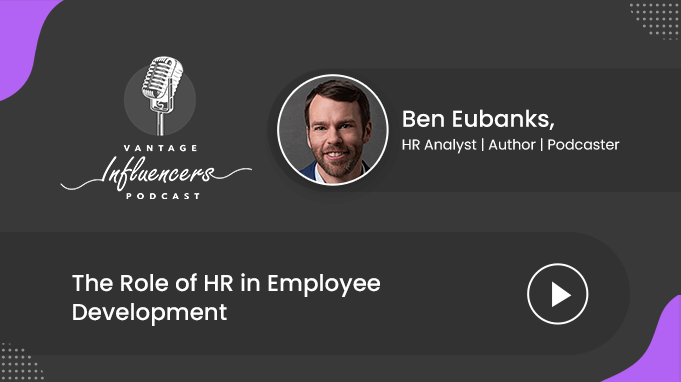
Ben Eubanks, Chief Research Officer, Lighthouse Research and Advisory
Ben Eubanks is the Chief Research Officer at Lighthouse Research and Advisory, where he works as a human capital management industry analyst, helping companies and vendors with strategy, content, and research on HR technology. He is also a co-founder of the HRevolution movement, an event that has drawn hundreds of attendees from around the world to explore the future of HR, work, and business. Ben has spent years speaking about linking HR strategy to business outcomes, corporate culture, and innovative HR practices.
Host
Susmita Sarma, Vantage Influencers Podcast Host
What You Will Learn
- Why employee development is shifting from single-skill training to future-readiness
- The difference between hard skills and human skills, and why the latter are harder to teach but more durable
- How high-performing organizations plan and measure learning outcomes differently
- Why diversity training works best when it creates psychological safety, not just information
- What the research says about why employees actually leave a job
- Where employee learning and development is headed next, including its link to internal mobility
Key Topics & Timestamps
| Timestamp | Topic |
|---|---|
| 00:58 | How Ben got started in HR |
| 01:31 | Inside Lighthouse Research and Advisory |
| 02:57 | The role of employee development in the modern workplace |
| 03:48 | How employers are evolving to upgrade employee knowledge and skills |
| 05:41 | How employee development has changed over the years |
| 06:43 | Diversity training and reducing workplace discrimination |
| 08:47 | How to measure the effectiveness of learning and development programs |
| 12:50 | What's next for employee learning and development |
Full Transcript
Click to read the full episode transcript
Welcome to the Vantage HR Influencers Podcast. This podcast is sponsored by Vantage Circle, the simple and AI-powered rewards and recognition platform for employee engagement.
Susmita Sarma: Hi, everyone. I'm Susmita from the Vantage HR Influencers Podcast, and in today's episode, we welcome Ben Eubanks, the Chief Research Officer at Lighthouse Research and Advisory, to discuss employee development. So, how do we keep our employees interested and motivated in their employee development programs? If they struggle to implement what they have learned in those development programs, what are the changes? How do we need to adjust as the nature of work changes, especially in these difficult times that the entire world is facing? So, let's begin. Welcome to the show, Ben.
Ben Eubanks: Thank you so much. I'm really excited to be here.
Susmita Sarma: Most welcome, and thanks a lot for joining me in this podcast today. So, before we start with the actual topic, would you like to introduce yourself and tell us how you came into HR?
Ben Eubanks: Well, unlike most people, I actually decided I was going to be in HR when I was a kid. I just didn't know what it was called yet. I tell everybody that I'm the older middle of four brothers. So, I have three brothers, and I had none of the position authority of being the oldest, but I had to get a lot of things done and make people broker deals, make people agree to things they didn't want to do, which is essentially what HR does every day. And so, I actually got my degree in HR, started out in the field, and loved it from the very moment that I first got to do it.
Susmita Sarma: Yeah. So, currently, you are into Lighthouse Research and Advisory. So, why don't you tell us more about it, and we'd love to know what do you do there?
Ben Eubanks: Sure. So, I worked in HR for years, and seven years ago now, I had a chance to step out of the day-to-day HR work and do more on the research side. And I'll be honest with you, I was leaving the best job I'd ever worked for, the best company, the best leader, best culture, like all the things. It seemed like the worst decision possible, but I really wanted to explore the research side because I wanted to make the determination if I could make life better for the employees under my care as an HR executive, or for the employees at potentially thousands of organizations if I could reach their HR leaders. And so, I started doing the research then and have loved it ever since. And the work we do at Lighthouse, two different things. On one side, we do research on the technologies, the software, the systems that are out there that help us support and serve our people. Also, we do research on the trends, best practices, what's happening. And so, we have some new data coming out on the great reprioritization here in the US and what's happening around that. And it's so much fun to dive into those things and help business and talent leaders understand how to make the next right decisions.
Susmita Sarma: So, basically, you help HRs to help their employees.
Ben Eubanks: Oh, yes, absolutely.
Susmita Sarma: For how many years have you been serving HR?
Ben Eubanks: It is seven plus years now.
Susmita Sarma: Okay, so I think it's a long time. So, what role do you think employee development plays in the modern workplace, coming to the topic today?
Ben Eubanks: In the modern workplace, one of the key things we're seeing in our research is talent development, employee growth, mobility, those things all wrap into this. We actually did a study in the last six months that showed that for those employees that said their company supported them the most in the last year, they were three times more likely to say that if they said their company offered them the right amount and type of training opportunities. So, training doesn't just fit into helping someone go from skill A to skill B or to a new proficiency level. But it's about creating this environment where I can be successful, and I can contribute in the most full way possible. So, employee development is a really critical piece of just how that relationship works with the people we're trying to take care of as employees.
Susmita Sarma: Right. As you mentioned that, you know, dealing with this COVID time, to deal with any kind of changing times and unforeseen circumstances, it's necessary to update one's knowledge, right? So, we cannot use the same skills in every situation. And also, in order to withstand severe competition, we must stay up with the latest innovations. So, how do you see the role of employers changing when it comes to upgrading employees' knowledge?
Ben Eubanks: For a long time, the focus for employers was, "I need to train this person to do this job." But increasingly, we're seeing that the workforce wants, and employers are leaning into this idea that we'd be training people for the job, not just the one they're doing today, but they're going to have tomorrow. And so, how do we prepare them for that? How do we ramp up their skills and prepare and get them ready for that? How do we make sure that they're not just focused on the hard skills, the technical things, but also the key human skills, as we call them. I don't call them soft skills because they're really hard, right? But they're human skills like compassion and creativity and critical thinking. Those things are not easy to teach, but it's possible to develop them in the workforce. And I see employers really shifting to look at those kinds of things because when you think about the research that I did for my book on artificial intelligence in HR, one of the big things that came out of that was in the history of the world, essentially, every time a wave of technology comes through, whether it's mechanical or digital, the work that's left behind is more human focused than ever before. An algorithm, an AI system, those things can't replicate the things that make us human, right? The way we collaborate with each other, the way that we're creating and dreaming new ideas, those things are the skills that we should be developing in ourselves, but also in our people, if you want to future-proof them for whatever comes next.
Susmita Sarma: So it's definitely evolving over the years, right?
Ben Eubanks: My goodness. Absolutely, yes. Again, I can remember the very first job I had in my entire life, I worked for my parents and they have a machine shop. So they build things and they make things, lots of big, heavy equipment in there. And I still can't tell you what all those things do, but I remember the very earliest days I was learning to do these small things, and the way they trained me was, you've got to be able to do this one skill to do this one task. And again, today, especially we're seeing more and more knowledge work, more deskless workers, things like that. Teaching you how to do one little narrowly defined skill may help you in the moment, but tomorrow you're going to likely be doing something different. The agility, the speed of change, all those things wrap into that. Teaching someone these really finite skills, it's not bad, right? There's not a problem with that, but that's the only thing you're teaching them. You're leaving this big chunk of what they need to know to be successful off of the agenda.
Susmita Sarma: Right. So again, when diversity training programs are part of employee development, I mean, it is now becoming more of a business need as most companies realize the benefits of a varied workforce. So diversity and inclusion initiatives are developed and diversity task groups are formed. And accordingly, diversity training has been conducted in the workplace. So how important do you think diversity training programs are in reducing the risk of workplace discrimination?
Ben Eubanks: I think broadly, diversity training is a valuable tool, especially when it goes beyond just a set of PowerPoint slides and it puts people in situations. It gives them examples. It gives them scenarios. It allows them to speak freely and openly, create some psychological safety around those discussions. I think those are the most productive mechanisms there. I saw a neuroscientist speak a few years ago, and one of the things that he was very clear on is that our brains can't see our own bias. I can't see my own bias. You can't see yours. Whoever's listening into this podcast right now, you can't see your own bias. Even if you've been trained, if you've been told it's there, we just physically can't do that. And so he said the most powerful tool you can use then is creating a group around you where you feel safe enough to gently but kindly and firmly call someone out whenever you see, "Hey, you know, you made that decision. Did you realize this is how it looked?" Or when you said that, "I just want you to know here's how it made me feel," being able to have those open conversations with each other without fear of reprisal or fear of retribution. That's the critical piece of that. And while it's easy to say, well, learning happens in this space and diversity happens in that space, learning together socially gives us a chance to create some of that safety, some of those areas where we can have those conversations and support each other without having to feel like it's this very rigid and structured, click from one slide to the next, without actually changing someone's behaviors.
Susmita Sarma: Glad you shared that. That's really interesting to know. So Ben, how can we measure the effectiveness of a learning and development program?
Ben Eubanks: Well, goodness gracious, how can we measure that? There's a couple different things that we've seen in our research. Number one, if you're a high performing organization, and by high performing, I mean you have better revenue, better employee retention, better employee engagement, which are all metrics that those of us that lead and care about talent, we want all those metrics. We want those numbers. Those companies that are high performing are twice as likely as their low performing peers to measure the learning outcomes of the work that they're doing there. They're also twice as likely to plan and prepare for how they're going to deploy learning in the organization. So there's a lot of planning and measurement that goes into those things. Number one, before I tell you how to measure it, I'm going to go ahead and advocate that you can't wait until you're halfway through, until you're done, to decide you want to measure. If you're going to measure something, you need to decide that before you begin, because by the time you're done with it, some of those opportunities you might have had to measure a baseline and compare against, those are gone because the training's already begun. So you've got to really think about this in advance. Be very proactive. In terms of how you measure it, the most basic measurements are, are you happy with that? Did it meet your needs? You can do some basic surveys, but that's all you're doing. Again, you're leaving the really important stuff off of the agenda. So it's, are people changing their behaviors? Are we seeing an improvement in performance? Are we seeing some sort of outcome in terms of return? One of the things that I lean really heavily on is that learning is not about learning. Learning is not about engaging people. Learning is about performance. And we've been kind of taught that we need to make sure that it's easy and frictionless and always a happy experience. And the research actually shows real learning that leads to different and better results is sometimes hard. It's sometimes challenging. Think about this: if you had a teacher in college or high school, or a professor at university, that was really hard, but when you finished that class, you're like, "Wow, I learned a whole lot." That wasn't always a pleasant and happy experience, but by the time you get to the end, you see the fruits of all that work and all of that labor that you went through. And that's the thing I want people to think through: it's really easy to say, "Was that training good? Did you like that training? Please rate it on a scale of one to 10." But it's much harder, and also much more important, to say, "Did it lead to the right outcome? Did it change that person's behavior? Did they actually perform better?" And so on.
Susmita Sarma: So it's definitely going to show on the performance, right?
Ben Eubanks: It should, it should. If it doesn't, hey, that gives us a chance to fix it, hopefully.
Susmita Sarma: That is the ultimate objective of any learning and development program, isn't it?
Ben Eubanks: It should be. Again, there's been this big wave in the last couple of years that said, well, learning is about engaging your people. There was a study by Chief Learning Officer two years ago, and the number one thing that Chief Learning Officers said they were held accountable for was employee engagement. That was the metric that their company said, this is your job, you're doing your job well, or you're doing your job poorly, was employee engagement. And the challenge there, I've talked to several leaders in the audience at an event I was at and asked, does that resonate with you? And they said, yeah, we're kind of held accountable for that. But the problem is we're responsible for about 5% of someone's engagement. The other 95% has to do with their manager relationship, other talent practices, how well we reward them and recognize them for their efforts. So they're being held accountable for something that's outside of their span of control. But performance is something that is definitely within our scope as learning and talent development leaders to really impact and leave a positive outcome there.
Susmita Sarma: Brilliant. Thanks for sharing this information, Ben. So moving on to the next question, that's the final question that I have for you: how do you see the future of employee learning and development? What can we expect from it in the coming years?
Ben Eubanks: I've kind of alluded to this already a bit. A couple of different things I did not talk about. Number one, our new research shows that two out of every three employees, so if you line up your employees in front of you, three of them, two of those three people would agree that they have left a job at some point in their career because they did not see an opportunity to grow and develop within the organization. Two out of three. However, the data showed that 90% of them would have stuck around if they had some sort of path ahead. So we've talked a lot about developing a skill and helping someone perform on the job. We haven't talked about moving them inside the business into other roles as they mature, as they grow, as those opportunities present themselves. And so I would encourage those listening in to be thinking about that lens as well, because the research shows, as I said, they don't just want that, they don't just crave that. They have left the job, which for an employee is the last option, the last resort. They don't just leave jobs for fun. They leave jobs when they give up hope. There's actually an amazing psychologist, Dr. Henry Cloud, who wrote a book called "Necessary Endings," and he said anything needs to come to an end, whether it's a personal relationship or an employment relationship, when you give up hope that it's going to get better, that it's going to change. And so when an employee gives up hope that things are ever going to get better, that's when they leave. But if we have the opportunity to help them understand the other career opportunities inside the business, to understand what skills they have and how those relate to other areas, that's where I see learning and development really going: where we understand more deeply each skill, each person, what they have to offer, and we can actually tap into that. Because when you think about it, when you get a job offer, that feeling that you feel deep in your heart, someone wants me, someone desires what I have, that's a really powerful feeling. When you think about it through the lens of developing them and moving them within the business, you recreate that feeling all over again, because you say, "I didn't just want you back then, I want you now and for the future, based on the skills and the strengths and the capabilities you bring to the table." That's a really powerful moment to connect with people, to engage them, but also to elevate their performance.
Susmita Sarma: Yeah, I would encourage you to stay on top of some of the data for the research. It's very easy for us to get, to be heads down, working on the tasks and the things that we've been assigned.
Ben Eubanks: I've been guilty of that as an HR leader, where I'm focused on things and I kind of look up and realize, "Whoa, those things have changed around me," and I didn't realize it because I was so busy and so wrapped up in my work. So I would encourage all of you out there to take a moment. If it's today, give us tomorrow. If it's this week, to step back a little bit and think about some of the things that you've heard today. Am I teaching people the skills that have a very short shelf life that are going to expire? Am I teaching people the skills that are going to last for a long period of time? Are we giving people access and transparency into the opportunities that exist in the business so that they can level up and we can retain them and they can perform better, and all those kinds of things. So those are some of the suggestions and encouragement that I can give to the audience.
Susmita Sarma: Brilliant. So how can listeners reach out to you?
Ben Eubanks: So the easiest way is research@lhra.io. That's our email address over at Lighthouse Research and Advisory. You can Google Ben Eubanks and you'll find me. Thank goodness my name is unique enough to be able to do that. I love connecting with people on LinkedIn, and it's just a great opportunity to serve the community. As I mentioned, I have a clear passion, hopefully that's come through in this conversation, for serving in the space, and any time I can help someone to make a better decision or understand what's happening in the world from the research, I'm happy to do that.
Susmita Sarma: Okay, I'll put that up in the show notes. Thanks for all your valuable insights, Ben. Thanks a lot for joining me on the Vantage HR Influencers Podcast.
Ben Eubanks: Thank you so much for the opportunity. I really appreciate it.
Thanks for listening to the Vantage HR Influencers Podcast. Please do subscribe to Vantage HR Influencers Podcast on Apple Podcast, Spotify, and our YouTube channel for new episodes.
FAQ
What is the biggest shift in employee development, according to Ben Eubanks?
Ben argues the focus has shifted from training people to do a single, narrowly defined task to preparing them for the job they will have next. That means building both hard skills and human skills like creativity, compassion, and critical thinking, since technology cannot replicate those human capabilities.
How should companies measure the effectiveness of learning and development programs?
According to Ben, effective measurement has to be planned before a program begins, not after it ends. Rather than relying on satisfaction surveys, organizations should track whether behavior actually changed and whether performance improved, since high-performing companies are twice as likely to measure learning outcomes than their lower-performing peers.
Why do employees actually leave their jobs?
Ben cites research showing that two out of three employees have left a job at some point because they did not see a path to grow within the organization, and that 90% of them would have stayed if a clear path had existed. He frames leaving as a last resort, something that happens after an employee has given up hope that things will improve.
What makes diversity training effective at reducing workplace discrimination?
Ben says diversity training works best when it goes beyond slide decks and creates real scenarios and psychological safety for open conversation. Because people cannot see their own bias, he argues the most powerful tool is a group environment where colleagues feel safe calling out blind spots directly and kindly.
Related Reading
Also listen on