Unlock Your Potential: Self-Discovery with MBTI
Episode Overview
Dr. Mohamed joins this episode to unpack the Myers-Briggs Type Indicator (MBTI) and why it has become one of the most widely used self-awareness tools in workplaces around the world. He walks through the four core dichotomies (extraversion versus introversion, sensing versus intuition, thinking versus feeling, and judging versus perceiving) and explains how each preference shapes the way people gather information, make decisions, and recharge their energy. Rather than treating MBTI as a rigid label, he frames it as a starting point for self-discovery, one that helps people recognize their own patterns before trying to understand anyone else's.
The conversation moves quickly into practical territory: how a mismatch between a sensing manager and an intuitive employee can create friction that has nothing to do with performance, and how naming that difference through MBTI can defuse it. Dr. Mohamed shares real coaching and team-building scenarios where groups assumed they had a collaboration problem, only to discover they simply processed information and made decisions differently. He also connects MBTI to career alignment, arguing that job satisfaction often comes down to whether a role matches a person's natural preferences, and closes with concrete advice for HR professionals who want to bring MBTI into hiring, training, and retention conversations.
Episode Highlights
- MBTI is a preference tool, not a pass or fail test, and everyone uses all four dichotomies to some degree.
- Extraversion and introversion describe where a person draws energy from, not how sociable they are.
- Sensing and intuition shape whether someone prefers concrete detail or big-picture thinking, which can cause friction between managers and reports.
- Thinking and feeling describe how decisions get made, either through objective logic or through impact on people.
- Team-building exercises that surface MBTI differences can turn "we don't work well together" into "we simply process things differently."
- Matching roles to natural preferences, such as placing a detail-oriented person in a numbers-heavy function, tends to boost both performance and job satisfaction.
About the Guest
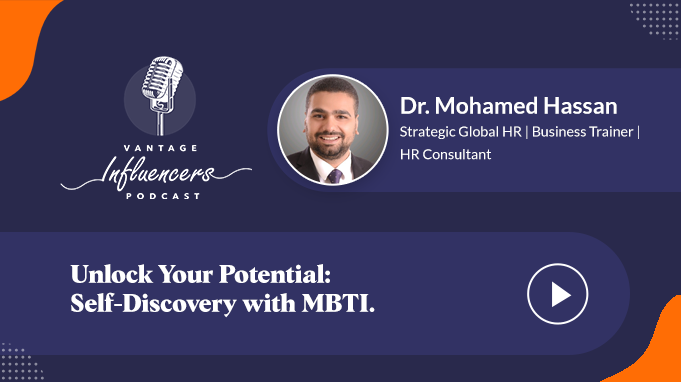
Dr. Mohamed Hassan, Talent and Compensation Analyst Consultant
Dr. Mohamed is a strategic HR leader specializing in compensation planning and rewards management, with a career built across multiple organizations in the Middle East. He holds a DBA, MBA, and CIPD Level 5, along with certifications in MBTI, PSI Assessment, Balanced Scorecard, KPI Practitioner, and Hogan Assessment. Alongside his consulting work, he is a freelance business trainer and career coach, delivering workshops for government entities, universities, and pharmaceutical companies, with a focus on aligning HR strategy with business outcomes.
Read our blog on: The Ultimate Guide To Employee Rewards and Recognition
Connect with Dr. Mohamed Hassan on LinkedIn.
Host
Susmita Sarma, Vantage Influencers Podcast Host
What You Will Learn
- What MBTI is, and why it is a preference indicator rather than a test with right or wrong answers
- How the four MBTI dichotomies (extraversion/introversion, sensing/intuition, thinking/feeling, judging/perceiving) shape behavior at work
- Why mismatched preferences between managers and employees can look like a performance issue when it is really a communication gap
- How MBTI is used in coaching and team-building sessions to build mutual understanding
- How aligning roles with natural preferences can improve career satisfaction and performance
- Practical steps HR professionals can take to introduce MBTI into hiring, training, and retention
Key Topics & Timestamps
| Timestamp | Topic |
|---|---|
| 01:12 | Dr. Mohamed's 13-year journey across HR roles in the Middle East and his path into compensation and rewards |
| 02:53 | What MBTI is, its four core dichotomies, and how it functions as a preference tool |
| 09:56 | How MBTI is used globally, including in Fortune 100 companies, and how coaching sessions are structured around it |
| 12:03 | A real example of using MBTI to guide a career rotation decision |
| 13:24 | Using MBTI in team-building activities to resolve team friction |
| 16:35 | How Dr. Mohamed discovered and became certified in MBTI |
| 18:01 | Tangible benefits of MBTI in workplace functions and compensation strategy |
| 20:24 | MBTI's role in identifying ideal career paths and aligning roles with natural strengths |
| 22:00 | Practical advice for HR professionals on integrating MBTI into hiring, training, and retention |
Full Transcript
Click to read the full episode transcript
Welcome to the Vantage HR Influencers Podcast. This podcast is sponsored by Vantage Circle, the simple and AI-powered rewards and recognition platform for employee engagement. Have you ever wondered how understanding your personal prototype can unlock your potential? Well, today we will explore how MBTI can reshape team dynamics, enhance collaboration, and guide individuals in aligning their careers with their unique strengths. So whether you are an HR professional looking to integrate MBTI into your practices or simply curious about self-discovery, this conversation brings really valuable insights.
Hello listeners and welcome to another episode of the Vantage Influencers Podcast. I'm your host, Susmita.
Susmita Sarma: Welcome Dr. Mohamed Hassan with us today as we dive into a very enlightening discussion. A trailblazer in compensation and rewards management, Dr. Hassan will share his professional journey and the transformative power of Myers-Briggs Type Indicator MBTI in the world of HR. Welcome to the show, Mohamed.
Dr. Mohamed Hassan: Thank you.
Susmita Sarma: Okay, so Mohamed, you have an impressive background spanning over 13 years in human resources. Would you want to elaborate on your professional journey for us? Some of the specific experiences or influences that guided you to specialize in your critical area of HR?
Dr. Mohamed Hassan: Yeah, sure. My name is Mohamed Hassan, I have almost 13 years of experience in human resource. I graduated from the faculty of education, English department, in 2010. Then I moved to work in different organizations, multinational, in human resource, in the Middle East region. In Egypt, then I moved to the Emirates, Sweden, Libya, Iraq as well. I finalized my master's in human resource, and I'm now finalizing my doctorate degree in human resource and strategic management. In addition to that, I'm certified in different tools regarding talent management, which focus on developing people, including BSI UK, MBTI, which we'll talk about today, DISC as well, in addition to Hogan Assessment. And I'm now working with one of the big government institutes in the UAE, responsible for building and shaping culture transformation within this organization.
Susmita Sarma: Thank you for sharing that insight into your career journey, Mohamed. It's clear that your path has been shaped by a wealth of experience. Now moving on to our topic, for our listeners who might not be familiar with the Myers-Briggs Type Indicator, could you provide a detailed overview of what exactly it is, how it functions, its core components, and how it is typically used in various contexts, especially in the workplace?
Dr. Mohamed Hassan: Yeah, sure. MBTI is an abbreviation for Myers-Briggs Type Indicator, and it's not a test, it's just a preference tool that can give us some insights and indicators. Each one of us has a preference to deal with the outer world or the inner world. So we use MBTI to help people build self-awareness within any organization, and once you discover yourself, you have to move to the next step to control it and manage yourself. After that, you will be able to build relationships and understand others, and manage the relations between you and others based on your understanding. That's why it's very good to know yourself through MBTI. Once you go through the assessment, you will discover whether you are extraversion or introversion, based on where you need to gain your energy. We are using both of them, but each one of us has more preference towards one. For example, if I am extraversion, I need to go to my friends and people to gain more energy. But if I am introversion, I need to go and relax on my own, so I gain my energy from my inner world.
Then we have another dichotomy, which is sensing or intuition. This is about dealing with information. Sensing people like to go for details, they prefer to have information through detailed numbers. Intuition people need to look at the big picture. So if you are extraversion and intuition, you gain your power by interacting with people and you look forward to the big picture, thinking about insights and what's ahead. But sensing people who prefer sensing focus on details and numbers. So if I know myself as sensing, I need to know that another partner in my organization may be intuition, and I have to figure out how to deliver the data and give them insights. This is what I faced with my manager, for example. He is a sensing person, but I am intuition, so when I present anything to him, I try to detail the insights and show him what is behind them.
Another dichotomy is related to decision-making, which is thinking or feeling. People who prefer thinking take decisions based on objectives, one plus one equals whatever it equals, without focusing on who will be affected. But a feeling person takes decisions based on the people who will be affected and involved in the process. So if I am a feeling person, I have to recognize that another partner may be a thinking person, and I have to present my data, information, and logic to be able to take the decision together.
The last dichotomy is judging or perceiving, which is about dealing with the outer world. Judging people need to see the world very organized, according to a timeline. If you ask them to go out immediately without a plan, they may not be comfortable. Perceiving people like to try different things, search, and figure out different ways of doing something. They don't like deadlines, and they are empowered by working under pressure at the last minute.
Once we figure out these preferences, it helps people understand themselves and understand others, and start to know that we are different. All of us use all of these dichotomies, extraversion or introversion, sensing or intuition, thinking or feeling, judging or perceiving, but we have preferences that make us feel comfortable in a certain way. That's why we use MBTI in coaching and in team-building activities.
Susmita Sarma: So it's all about four key dimensions that you've mentioned, extraversion versus introversion being the first, sensing versus intuition the second, then thinking versus feeling, and judging versus perceiving being the last one, and each of these preferences results in a specific personality type.
Dr. Mohamed Hassan: Right, yes. Maybe an ISTJ or an ENFP, and that determines how that particular individual perceives the world and makes decisions, how they receive new information, how they take decisions, how they deal with the outer world, and how they gain their energy.
Susmita Sarma: So MBTI is used widely, as you mentioned, in coaching and team-building activities. How exactly is it used, can you give a quick description?
Dr. Mohamed Hassan: You know that most Fortune 100 companies use it, and it's used widely for personality assessment for more than two million people worldwide each year. It's translated into two thousand languages and used in more than 70 different countries, US, Canada, Mexico, South America, the Middle East, Japan, Korea, New Zealand. So how do we use it? First, we invite people for a discovery session. When I have a coaching session, I have to make a discovery session for our client. We start, they go through the assessment, which is an online assessment through the MBTI website. Once they finalize it, they receive the report, and we start from there. I listen to them, what is your problem, what do you need to discover, and then I make a reflection on the report.
For example, one of our employees was already paying attention to his precision, but he is not a sensing person, his preference is toward intuition. He gains more energy focusing on the big picture rather than dealing with numbers and figures. Once we agreed in the session that this was not a preference job he felt comfortable with, even though he could do it and do excellent work, he was exhausted and very tired afterward and could not complete his day. So we took the decision to change his rotation, moving him toward recruitment and talent acquisition, and we discovered that the next year he became one of the top performers. So it's a great journey starting from MBTI, where he discovered his abilities, and based on that we put together an action plan for a rotation and a career interest program matching his preferences. Because if you are working in a job that matches your preferences, you will feel the passion and feel that you can do more and more. Imagine someone who really likes numbers and figures working in a role that has nothing to do with that, versus someone with intuition and feeling working in a role like marketing, where you will find them building relationships and excelling.
That is what we perform in coaching sessions and team building. In team building, we build a scenario based on the assessment after a group of people go through it. For example, I ran a team-building activity for a team that was not harmonized. The manager complained that they could not work together, and each one focused only on their own task. We went through the assessment journey with them, and in the briefing session we discovered that they did not have a problem, they just did not understand that they were different. For instance, when a manager asked someone to turn their report into more detail, the employee felt the manager just did not want to say good job. That is why they were not working well together. After conducting some team-building activities around building trust, including a game about showing the way, we gave them the differences for each one of them and explained why they were acting the way they were. For example, the manager was asking for more detail because he trusts figures and insights, so understanding that helped the employee realize they could go the extra mile with more detail to excel in their career. That was the conclusion of the session, reflecting on what came out of the team-building activities. For example, one person said they liked to work on their own, which is because they are a pure introversion preference, so they like to work alone, but they had to understand that others need to interact with people because they are extraversion. That is what we do in different countries and different organizations that are using MBTI.
Susmita Sarma: I'm sure there must be some valuable benefits we get from integrating this approach into general workplace functions. But before that, Mohamed, I would want to know how exactly did you explore the MBTI framework, and how did you start thinking this would influence your approach to HR and contribute to your professional development? Is there any background story?
Dr. Mohamed Hassan: Yeah, sure. I'm interested in self-development each year, so I look at new trends and tools that help discover and develop people. I found that one of my colleagues was already certified in MBTI, so I went through one of the providers in the Middle East to gain this certification and become an MBTI practitioner. I discovered that this tool has been used since 1980 and has developed over the years into what we have right now. I started using it while working on assessment centers for high-potential employees and for succession planning, and then it started being used more in culture transformation projects and team-building activities. Now, as a career coach, I use it in my career coaching sessions as well. It is very beneficial for each person to discover themselves, build self-awareness, and help their organization and HR discover people's abilities too.
Susmita Sarma: And if we talk about the tangible benefits, what have you observed from integrating this approach into general workplace functions? How does it enhance or refine the strategies we employ in managing compensation and rewards?
Dr. Mohamed Hassan: They asked me a lot when I joined the organization, why are you using MBTI as one of the assessment tools, because we already have other tools. I said it is a reliable and valid tool because it is recognized worldwide. It is not a new tool that is untested, it has been used since 1943, and there is a lot of research behind it, so when I speak about MBTI, I have valid results. No one can say this is not my personality, but after you dig deeper with them, you will discover the report is right. That is why I use MBTI, and in addition, it builds credibility with people once they discover themselves and build a development plan based on that self-awareness. It is a great journey to go through.
Susmita Sarma: And it has proven to significantly improve team dynamics and foster better collaboration within an organization.
Dr. Mohamed Hassan: Yes, within the organization and in normal life. In any coaching session, you have to make a discovery session based on an assessment, because it will give you numbers, figures, and a report. A person cannot understand themselves except by going through a valid assessment tool to discover their roots, and after that you can build on that assessment and complete the work. That is why MBTI is a very beneficial tool for us.
Susmita Sarma: It also serves as a valuable tool for individuals in identifying their ideal career path.
Dr. Mohamed Hassan: Yes, I use it to help people discover their career path.
Susmita Sarma: So it can basically align roles with an individual's natural strengths and preferences.
Dr. Mohamed Hassan: Yes, yes.
Susmita Sarma: And that probably leads to greater satisfaction in the job and career fulfillment, right?
Dr. Mohamed Hassan: Yes, yes. Imagine that I am working in a function that matches my preferences, it will be very positive for me personally, I will feel comfortable with what I am doing, and I will excel in that. Why are we not excelling in what we do sometimes? Because maybe we don't like what we are doing. When you discover yourself, you can indicate what you need to do to excel in your career and what job matches your preferences.
Susmita Sarma: Thank you, Mohamed, for those insights, some really useful perspectives that you have shared. And finally, for HR professionals contemplating the integration of MBTI into their own practices, what practical advice or strategies would you want to offer to ensure effective implementation, and how can they best leverage MBTI to enhance their HR functions and overall effectiveness?
Dr. Mohamed Hassan: Yes, first of all, you have to be certified in MBTI to be able to recommend the tool and have all the information you need to use it in your workplace. Secondly, you have to know exactly where to use this tool. From my experience, we use this tool in assessment centers for high-potential employee programs and fresh graduate programs, to help people discover themselves. We also use it in training and development, building team activities based on MBTI preference reports for the team, and in career coaching sessions. Now most organizations are moving to build career coaching centers within the organization, to help employees go through a career ladder that matches their preferences. So I advise all HR professionals to integrate MBTI as one of the tools in their assessment center, used across different areas starting from discovering high-potential employees, supporting culture transformation, and integrating it into team-building activities and career coaching sessions. You can use it to help employees discover themselves and build a career where they can excel. This is our role in any organization's human resource function, we have three main responsibilities: hire, train, and retain. While hiring, you can use MBTI, though it should not be the base for decision-making, it will just support you in taking the right decision. In training, you use it for team building and to make filtration decisions for successors and employees. In retaining, if you understand the preferences of employees, you can retain them by changing their career ladder, moving them from one function to another based on their preferences, and they will see how they excel in that.
Susmita Sarma: Thank you so much, Mohamed, for those insightful closing thoughts. It has been a pleasure having you on the podcast and exploring the nuances of MBTI and its impact on HR practices. I'm sure it will certainly help our listeners understand how to use MBTI effectively in their workplace. Your experience and expertise have provided a lot of valuable information for us. Thank you.
Dr. Mohamed Hassan: Thank you, thank you actually, it was my pleasure to participate with you.
Susmita Sarma: Thank you. And to our listeners, if you're interested in learning more about Mohamed's work and want to explore more about MBTI, be sure to check out his LinkedIn profile. The link is provided in the show notes of this podcast. Thank you so much.
Dr. Mohamed Hassan: Thank you.
FAQ
What is the Myers-Briggs Type Indicator (MBTI)?
MBTI is a preference tool, not a pass or fail test, that helps people understand how they gain energy, process information, make decisions, and deal with the outer world. It is built around four dichotomies: extraversion/introversion, sensing/intuition, thinking/feeling, and judging/perceiving.
How is MBTI used in team-building and coaching?
Facilitators run participants through the online MBTI assessment, then use the resulting report to run discovery and briefing sessions. In team settings, this often reveals that friction between colleagues comes from different information-processing or decision-making preferences rather than an actual performance problem.
Can MBTI help with career alignment?
Yes. When a role matches a person's natural preferences, such as placing someone with a strong preference for detail and numbers into a data-heavy function, they tend to report higher satisfaction and stronger performance than in a role that runs against their preferences.
How should HR professionals start using MBTI?
Get certified in MBTI before recommending it to others, then identify specific use cases such as high-potential assessment centers, team-building activities, and career coaching sessions. MBTI should support decisions in hiring, training, and retention, not replace them.
Related Reading
Also listen on