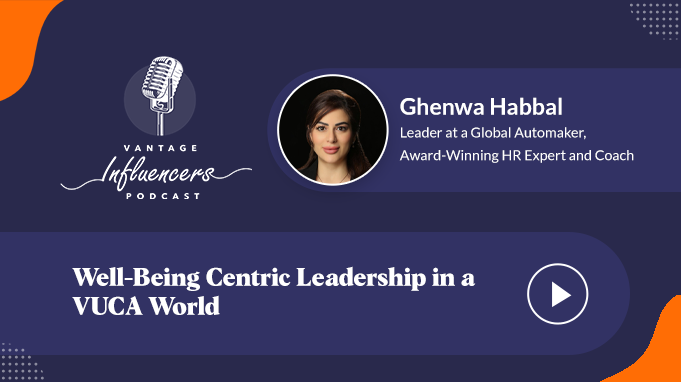
Well-Being Centric Leadership in a VUCA World.
Episode Overview
Ghenwa Habbal opens this conversation with a challenge to how most organizations think about workplace well-being: free snacks, step challenges, and an office pool table are not what leading with well-being actually means. For her, leadership and well-being are not two separate levers a business can pull independently, they are as interconnected as the head, heart, and gut are within a single body. In a world defined by volatility, uncertainty, complexity, and ambiguity, she argues that leaders who treat the two as separate problems are solving the wrong one. That means building human-centered policies around parental leave, hybrid schedules, and remote flexibility that go beyond the legal minimum, and creating a psychologically safe space where people can say out loud that they're struggling without fear of judgment.
The conversation then turns to what compassionate leadership looks like in practice, drawing a sharp line between empathy, recognizing what someone else is going through, and compassion, feeling it enough to act, whether that means covering a grieving colleague's workload or simply asking a team for help with grace. From there, the discussion moves to three skills that will define future leaders: learning to unlearn old assumptions, mastering clear communication across dispersed teams, and building resilience that goes deeper than simply bouncing back. The episode closes with grounded, personal advice on protecting one's own well-being, from finding the right support system to staying curious by talking regularly with younger generations.
Episode Highlights
- Leadership and well-being aren't separate systems, they operate together the way the head, heart, and gut do within a single body, and businesses that treat well-being as a perk rather than a policy are missing the point.
- Human-centered policies, from parental leave to flexible summer remote work, help organizations stand out in a labor market that no longer accepts a rigid nine-to-five.
- Empathy means understanding someone else's struggle, but compassion means feeling it enough to act, whether that's covering for a grieving teammate or simply asking for help with grace.
- Psychological safety starts one relationship at a time, tailoring communication to each team member instead of leading everyone the same way builds the trust that makes people feel safe to speak up.
- The three skills future leaders need most are learning to unlearn old assumptions, mastering clear communication, and building genuine resilience rather than just bouncing back from setbacks.
- Protecting personal well-being is an ongoing practice, not a finished state, and it often starts with getting the right support, whether that's a health coach or simply staying curious by talking to younger generations.
About the Guest
Ghenwa Habbal, Regional Talent Management & Employee Experience Manager
Ghenwa Habbal is a multi-award-winning HR leader, coach, and a trusted voice on LinkedIn for leadership and well-being. With 19 years of experience in human capital and a background in Business Psychology, she leads Culture, Diversity, Equity and Inclusion, Well-being, and Strategic Human Capital initiatives as Regional Talent Management & Employee Experience Manager at a Fortune 500 automaker, and has been based in Dubai for the past 15 years. She is also active in Corporate Social Responsibility work that supports community-driven, sustainable growth.
Connect with Ghenwa on LinkedIn
Host
Susmita Sarma, Vantage Influencers Podcast Host
What You Will Learn
- How to build human-centered policies that support well-being without sacrificing business outcomes
- The real difference between empathy and compassion in leadership
- Practical steps for creating psychological safety on a diverse team
- The three skills that will define successful leaders in a VUCA world
- How to protect your own well-being while showing up for your team and community
Key Topics & Timestamps
| Timestamp | Topic |
|---|---|
| 01:28 | Ghenwa joins the show and reflects on her career journey, from starting out in her family's travel business at 15 to two decades in HR and coaching |
| 04:53 | Why leadership and well-being can't be treated as separate levers, and what "leading with well-being" really means beyond office perks |
| 09:48 | Building human-centered policies, flexible hybrid work, and a psychologically safe space where people can openly say they're struggling |
| 13:11 | The difference between empathy and compassion, and why leaders need both to earn lasting trust |
| 17:44 | Practical ways to foster psychological safety by tailoring communication to each team member |
| 22:24 | The three skills future leaders must build: learning to unlearn, mastering communication, and resilience |
| 27:33 | Ghenwa's advice for protecting personal well-being while staying engaged with community and continuous learning |
Full Transcript
Click to read the full episode transcript
Welcome to the Vantage HR Influencers Podcast. This podcast is sponsored by Vantage Circle, the simple and AI-powered rewards and recognition platform for employee engagement.
Welcome to another exciting episode of the Vantage Influencers Podcast. Today we're diving deep into the dynamic intersection of leadership, well-being, and the unique challenges of our VUCA world. Our exploration will take us through the evolving landscape of leadership strategies and how to adapt to the ever-changing environments that we face.
Susmita Sarma: I'm your host, Susmita, and for the discussion today we are honored to have Ghenwa Habbal with us, a leader at a global automaker, an award-winning HR coach and expert. She is a trusted voice on LinkedIn and an influential figure in leadership and well-being. Her journey has taken her from the heart of the Middle East to the vibrant hub of Dubai, where she continues to inspire and empower through her extensive workshops and coaching sessions. Ghenwa, welcome to the show.
Ghenwa Habbal: Hello, thank you for hosting me.
Susmita Sarma: Thank you for joining me. How are you today? It's fantastic to have you with us.
Ghenwa Habbal: Thank you. I'm really excited for the podcast and excited to share more about my experience, my learnings, and tips and hints that might serve your community of learners and listeners. Thank you for having me once again.
Susmita Sarma: Thank you. So you have had such a diverse and impactful career journey, Ghenwa, from starting out in the travel and tourism industry to your current role in coaching and leadership development. Could you share with us some key milestones and experiences that have shaped your corporate journey?
Ghenwa Habbal: Well, that is an interesting deep dive, and I definitely need more than a podcast to share it all. But I literally started my career really young. I was fifteen years old when I stepped out of school to start working and supporting my family, and I found myself working with my father to help establish his travel and tourism organization. I really started adopting an entrepreneurial mindset from that age, which has served me a lot throughout my career and my time in the corporate and business environment.
Slowly but surely, once I got a grip on how the travel and tourism industry works, I found myself keen to go back to school and continue my educational journey, and right after I graduated from university. Throughout university I had jobs just to keep some money coming in. A lot of the learning happened throughout that cycle of my life, from understanding how corporate work operates to managing and maneuvering my way through a turbulent environment, and also juggling between jobs and education. So multitasking came to me at a really young age as well.
Later, after graduation, I joined the corporate world, and that's where I really found myself dealing with people, with humans, because people are my passion. I believe that no business in the world can thrive without its people, and if we don't invest the right energy into our people, we can't expect successful business outcomes. So slowly and surely I found myself climbing the leadership ladder, traveling around the region to set up businesses, projects, and international assignments, until I officially relocated and found a new home for myself in the UAE, in Dubai specifically, where I've been based for the past fifteen years. It's been a journey of exploration, and throughout these years there have been a lot of milestones and remarkable lessons that today aren't just lessons, they actually guide the future that I'm carving out for myself. So thank you for asking me this question.
Susmita Sarma: Given your rich background and experience, Ghenwa, let's delve into the topic of leading with well-being in a VUCA world. You have been a prominent advocate for creating inclusive cultures and navigating VUCA environments. How do you see the relationship between effective leadership and fostering well-being, especially in today's rapidly changing world?
Ghenwa Habbal: Okay, so I don't personally see leadership as a standalone element and well-being as a standalone element. These two elements don't operate separately, I see them integrating together. It's more like the human body, you have the head, you have the heart, and you have the gut, and it's the same when it comes to businesses. We need leaders in the business who come well-equipped with a well-being mindset, and I know a lot of organizations today, when they speak about well-being, say, yeah, we have a very nice office, we have a pool table, or we go out for a jog, or we do step challenges. Yes, that's a great well-being activity, but that's not the ultimate or the pinnacle of what leading with well-being really means.
When I talk about leading with well-being, I'm talking about, from a systems or organizational perspective, having policies and procedures in place that are human-oriented, human-centered. What does that mean? It means looking at maternity or paternity leave. Labor laws all over the world have their set dates, but why don't organizations go above and beyond if they really want to stand out in the market? That's something to consider, because a lot of people, especially when I'm talking from a regional perspective, there are a lot of experts and the younger generation also stepping into the marketplace and becoming parents. So how do we, as organizations, make sure we're bringing in the right talent, but also setting policies and procedures that are family-friendly, that are ESG-centric, that are sustainable, that support the well-being of our people?
The nine-to-five job is no longer the only option, and I see a lot of organizations, especially after the pandemic, still pushing for people to come back to the office, which is fine, I understand, but the world has proven that people can deliver on their objectives even when they're miles away from the face time we love, because it makes us feel in control. If we step away from the control aspect and look at it from the human aspect, and say, okay, my people have been away from the office for a while, I can tell today as a leader who is able to perform remotely and who isn't, and the question is, if that person isn't able to perform remotely, were they actually performing when they were in front of me in the office, yes or no? If that's the case, then going back to systems and organizations, because we're adopting a hybrid work environment, a lot of policies can be implemented, like allowing people to work from their home countries during the summer break. Why not allow that hybrid model to be a bit more flexible, so you don't need to commute to the office twice a week, but instead you come in during the normal working weeks two or three times, and if it's summer and you want to work remotely for two or three months, why not, as long as there are no tax, legal, or financial obligations preventing it? Organizations can consider that as an option.
So when I talk about leading with well-being, I also need to consider the human aspect of my people. Do I have a psychologically safe environment where my people can come and say openly, you know what, I'm having a hard time, I'm actually suffering from anxiety right now? Am I, as a leader, accepting that, or am I putting a stigma on it? What am I doing, how am I thinking, am I supporting or am I judging, or am I influencing my team to support that? How do I lead with the head, the heart, and the gut simultaneously?
We always work on elevating our KPIs when it comes to our brain, but we never work on enhancing our heart-generated KPIs, because when you lead from the heart, and there's an intelligence there, this is when you're able to create a psychologically safe environment, a happy environment, where people are open, people are happy to commit to work, people are excited to deliver, and it's no longer perceived as just a job but as an environment where I can join because this company echoes my belief system, because the company offers me freedom of choice, because my leader empowers me. That's what's happening when it comes to leading with well-being at its core.
People, employees, have also started to realize that work-life balance and flexibility are probably the most important things left in our lives now. This reminds me of a survey a well-known organization ran recently, where they asked employees what they would prefer, a promotion or the ability to work from home.
Susmita Sarma: I'm interested, what was the percentage?
Ghenwa Habbal: It was a very high percentage, work from home won by a landslide. I don't remember the exact number, but it was very high.
Susmita Sarma: That says a lot.
Ghenwa Habbal: Exactly, so we're realizing now what's important to us, because it's just one life. We're not robots operating in a system, we're humans, and being human means you serve a certain organization but you also have a life outside of it. When businesses and leaders understand that an employee in the organization also has a life, it makes so much sense, because we're human beings, not human doings.
Susmita Sarma: Very true, very true, human beings. Yesterday we had a session with a physician, a mental health physician, and she was talking about human beings versus human doings, and we kind of forget about that. Really incredible and valuable insight. Thank you, and empathy is something we often mention as a crucial trait for leaders in turbulent times, so how can leaders effectively demonstrate empathy while also steering their teams through challenging situations?
Ghenwa Habbal: I like that question, because empathy is what makes every human alive, it's when you say, yes, I'm not a robot. But what really stands out for me, and what I think of as the next level beyond empathy, is compassion, and I think that's the ultimate. Empathy, by definition, is when you put yourself in another person's position, understand it, and perhaps try to help that person through a certain struggle or a period of time where they need further direction. Compassion, for me, is much more than this. Compassion is when you're not only putting yourself in someone's shoes, but actually feeling it, the way that when you tell some people your eye is hurting, suddenly their eyes hurt too. They feel your pain, they don't just see it. That's another level.
Coming back to business, compassion stands out because if you have a team member, say one of fifteen on your team, who has lost a parent or a family member, why not give them that period of time to grieve? A month off won't hurt you if you're a well-rounded leader, you can take on the work yourself, or split it among the rest of the team. When you ask people nicely, and you tell them we need your help with something because a teammate needs support, people will come together and help, no matter how much work they already have, because that team member has lost a family member. It depends on how you say it. If you're following a command-and-control style of leadership, which belonged back in the 1900s, people today will simply say, sorry, I'm busy. But because we operate in such a VUCA environment today, where the human aspect, human emotions, and well-being are so present, you can't turn your eye away. When you ask in a nice, empathetic, compassionate way, trust me, people will raise their hands and run to support you, because they know it's reciprocal.
So back to your question, empathy plays a crucial role in effective leadership because leaders who are empathetic are the ones who thrive in a VUCA environment, because they get the support and the advocacy of their people. Nobody wants to work for someone who isn't empathetic or compassionate. Leaders have to remind themselves that on their back they carry a backpack, and that backpack is their reputation, their legacy. My question, and this is what I always ask the people I coach, is, if I had to unpack your backpack, what would I find inside it? What kind of reputation? Would I find followers who advocate for you, or people running away because they don't want to be led by you? Leaders have to remember that they're humans too, and they're leading humans, leading businesses through the power of people.
Susmita Sarma: That's a nice point, and building on that, I think we'd also want to discuss psychological safety, another key aspect of effective leadership, making sure team members feel safe to voice their concerns and ideas.
Ghenwa Habbal: There are a lot of strategies organizations and leaders can adopt to create a psychologically safe culture, and psychological safety isn't one-size-fits-all. As leaders, we have to think about whether we're dealing with every person on our team the same way. My team is diverse, and diversity means uniqueness, which means when I'm talking to someone, I have to adopt a unique way of communicating with them. Once I find the communication approach that works, it helps create a certain trust, and I work on enhancing that trust on a one-to-one basis. That's when I start succeeding in building the basics of psychological safety, because I can't deal with everyone the same way, and understanding that helps leaders a lot.
Sometimes we get busy and fall into the trap of managing instead of leading, but leaders can foster a culture of psychological safety by starting with the basics, tailoring their communication approach to each person rather than generalizing how they speak with their people. Your people come from different backgrounds, especially in our region, there are over two hundred nationalities in this country, and you're likely dealing with at least ten different nationalities every day. These people come from different educational backgrounds, and their well-being has been shaped by different experiences and upbringing. My well-being spectrum might not be as strong as someone else's, so as a leader I need to understand where my people sit on that well-being spectrum, and where I sit on their trust index. Based on that, I create a culture of psychological safety.
I want my team to be able to come to me and say, I don't feel like working today, my mind isn't operating at its best, and I need some time off, and I want to be able to say, yes, please go, and I want them to feel comfortable doing that, with ease and confidence, knowing they won't be judged. That's how I personally think about psychological safety and the strategies for creating a psychologically safe environment. VUCA has been surrounding us for at least the past ten years now, a decade of VUCA, and everybody has been working around it. Because of these turbulent environments, leaders have to be more open about it. So I'll leave it here, hopefully the audience listening to this podcast will start thinking of better ways to embed, create, and foster psychological safety within their teams. The baseline has always been, and will always be, fostering a culture of trust and transparency in organizations.
Susmita Sarma: Always. And looking ahead, Ghenwa, if I asked you about the three most essential skills or qualities that future leaders must cultivate, what would they be?
Ghenwa Habbal: Three things come to mind as we're speaking. The first is learning to unlearn. We always advocate for learning, and sometimes we say the ultimate way to learn is to go to university, to study, or to pursue a doctorate, but I've come to realize that learning happens all around us, three hundred and sixty degrees. Every experience, every adversity, comes disguised with a lesson in it. The power of adopting a growth mindset means being able, as a human, to wipe off what you've learned at some point and make space to learn something new, keeping a fresh lens. So learning to unlearn, keeping agile ways of thinking, and staying open to the experiences and journeys happening around you, that's skill number one.
Number two, I'd advocate for communication. We're operating in a world that's geographically dispersed, but more connected than at any point in our lives because of the technology available. If you're unable to communicate clearly, your message is going to struggle to land. Mastering the art of communication, sending clear messages across to your community, your society, your team members, is going to be pivotal for your success and for your relief as a leader, because when you're cascading a task and there's a communication obstacle, you're going to run into challenges, the task might not reach its target at the pace required, or you might not get the right result because of improper communication. So communication is a pivotal skill.
And the last one is resilience. People ultimately define resilience as your ability to bounce back from setbacks as quickly as possible, that's probably the most common definition. As someone who coaches and trains on resilience, and as a psychometric assessor in the domain, not only for individuals but for organizations as well, I'd say resilience isn't just about bouncing back quickly, it's a mix of things that lead to your resilience. It's about how you, as a human, operated during that setback. How did you think? How did you operate? What did you do in that space? Did you push people away, or did you reach out for help? The more resilient you are, the better you're able to first lead yourself, and then lead the people who work with you, and eventually lead an organization to success. So if I have to summarize it in three words, it's learning to unlearn, mastering the art of communication, and being as resilient as possible, because that's the way forward for your own well-being and the well-being of the society around you.
Susmita Sarma: You put that so well, Ghenwa. And finally, I hope communication here was clear.
Ghenwa Habbal: Yes, very much, thank you so much.
Susmita Sarma: Time is ticking and we have just five minutes left. As someone who believes in the power of building connections and giving back to the community, what would be your piece of advice to our listeners on maintaining personal well-being, Ghenwa?
Ghenwa Habbal: Personal well-being. I'm not one of those people who can tell you I've mastered well-being, I'm human, which means I make a lot of mistakes. When I tell you I take care of myself when it comes to exercising and eating healthy, do I do this three hundred and sixty-five days a year? Of course not. Sometimes when I'm stressed, I binge eat, because my brain is hardwired to that activity. So what do I do? I actually looked for a health and fitness coach to help me understand my relationship with food. Make sure you understand your relationship with food, because a lot of us today, and I say this from personal experience as someone who was once obese, need to get on good terms with it. For me, food was my go-to zone for relaxing or numbing my brain, but then I realized the only person being penalized for that was me. So how do I change? Change comes from pain, that's how people evolve in life, you struggle at a certain point, you feel the pain, and then you decide to change, and that change journey is when your resilience is really tested.
I found someone who could help me enhance my relationship with food, and someone who could help me enhance my relationship with exercise. I had to test different things out, the same way you test drive a car before buying it, whether that's the gym, or Pilates, or HIIT classes, or belly dancing. I love to dance, I believe dancing is an international language similar to music, and there's a certain intelligence to it because you're able to manage and control how your body works. So focus on finding what works for you, and don't forget to read, you can start with small bites of reading, because reading activates your brain no matter how old you are, reading keeps you young.
What I've also found is that when you speak with the younger generation, your brain becomes very active and you feel a lot of sparks. As someone who advocates for youth, and is aware of the generations from baby boomers to Gen Alpha and soon Gen Beta, throughout my career the only time I really learn about new things is when I communicate with young people. Communicating with the youth has kept me sharp when it comes to innovation, creativity, and taking care of myself, because I always want to stay young, to think young, because learning doesn't have an age. As I grow older in years, I still want to make sure I give back to the community by learning more, doing more, giving more, and that's one way for me to take care of my own well-being as well.
So if you're a binge eater like myself, get a health coach. If you don't know what you need to do when it comes to exercise, there are plenty of resources and research online about what exercise does for your body, so just exercise, whether it's swimming, dancing, diving, hiking, or trekking, do something that keeps your body active. And always make sure you communicate with the youth regularly, because that's where the learning happens, and if you really want to adopt a future-thinking mindset, you have to speak with the youth, because when you speak with the older generation, what you learn is resilience, the power of staying firm.
So to summarize the advice, always try to communicate with the youth, because they're the community that will help you adopt a futuristic mindset so you can serve your community better. If you need to fix your relationship with food, get a health coach, and if you don't know what your hobbies are, test drive everything that comes your way, just like test driving a car before you purchase it. As someone who works for a global automaker, I always say that leaders need the heart of an engineer and the brain of a business psychologist, and I advocate for that combination in any environment, because when you have both, that's when you start embedding a psychologically safe environment as a leader, and that's when you learn how to take care of yourself, because you understand that your brain, which is the engine, won't perform if you don't feed it good fuel, and feeding it good fuel is how you manage well-being well. Last but not least, operate from the heart, keep an open mind, because that's the only way to thrive in a VUCA environment. We have to remember we're not defined by our titles, especially once we reach a certain age or retirement, we're defined by the reputation we spoke about earlier, the legacy we leave behind. So take care of yourself and others, so others can take care of you as well.
Susmita Sarma: That's a brilliant point to wrap up this conversation, Ghenwa, but this is just one episode, and we definitely want to come back to discuss this further. Thank you so much for this conversation, we've covered so many dimensions of the VUCA world, and what stands out to me is how seamlessly you integrate them into a unified approach, it truly captures the essence of navigating the complexities of a VUCA environment, and it's incredibly impactful. I really appreciate our discussion today.
Ghenwa Habbal: Thank you so much, I really appreciate your input, your insights, and your feedback. Again, VUCA is not the monster, there's always a way to keep that monster in check, so think clearly, keep an open mind, thank you so much.
Susmita Sarma: Hope to meet you again soon for another episode.
Ghenwa Habbal: Thank you, let's do that.
FAQ
What does "leading with well-being" actually mean?
It means treating leadership and well-being as one integrated system rather than two separate initiatives. Ghenwa Habbal argues that well-being goes beyond office perks like step challenges or a pool table, it requires human-centered policies, from flexible parental leave to hybrid work options, that show up in how a business is actually run.
What is the difference between empathy and compassion in leadership?
Empathy is putting yourself in someone else's position and understanding their struggle. Compassion goes a step further: it means actually feeling that struggle enough to act on it, whether that's covering a grieving teammate's workload or simply asking for help with grace.
What skills will future leaders need most in a VUCA world?
Ghenwa Habbal names three: learning to unlearn old assumptions and stay open to new ones, mastering clear communication across dispersed teams, and building genuine resilience, which she defines as how you think and act during a setback, not just how quickly you bounce back from it.
How can leaders build psychological safety on their teams?
By tailoring communication to each individual team member rather than treating everyone the same way. Ghenwa Habbal explains that psychological safety is built one relationship at a time, through trust that lets people say when they're struggling without fear of judgment.
Related Reading
Also listen on