What Great Onboarding Actually Looks Like in 2026
Episode Overview
Onboarding used to be a checklist: a laptop, an orientation deck, a coffee with HR. In this conversation, that checklist gets thrown out the window. Aakash walks through why onboarding today has to work as a 90-day journey rather than a single first-day event, and why the shift is really about moving from compliance to culture, from paperwork to personalization, and from a one-size-fits-all program to something that feels designed around the individual joining.
Much of the discussion centers on how companies keep onboarding human when so much of it now happens on a screen. Aakash shares specific tactics teams are using to make remote and hybrid joiners feel seen from day zero, from peer welcome videos to digital onboarding journals to culture kits sent straight to a new hire's home. He also tackles the AI question directly: rather than treating automation as a threat to HR, he frames it as a spotlight that shows where teams are wasting time or missing signals, freeing people up to handle the parts of onboarding, like empathy, rituals, and connection, that a chatbot never will.
Episode Highlights
- Onboarding in 2025 is a 90-day experience, not a first-day event: the shift is from compliance to culture, paperwork to personalization, and one-size-fits-all to journey-based design.
- Remote and hybrid onboarding gets a human upgrade through peer welcome videos, randomly paired "meet and eat" chats, digital onboarding journals, and culture kits delivered to a new hire's home.
- Delivering every enabling tool, laptop included, on day one instead of staggering it over weeks signals that a new hire is valued from the start.
- AI's real role in onboarding is amplifying HR, not replacing it: personal nudges, chatbot-handled FAQs, and predictive alerts on disengaged hires free people up for empathy and rituals.
- Employees with a strong onboarding experience are 65 to 70% more likely to stick around long term, and companies should track sentiment at the first week, day 30, and day 90 marks rather than waiting for exit interviews.
- A well-designed onboarding journey also has to account for moments that matter most, like normalizing imposter syndrome in the first 30 days and building deliberate support paths for women returning to work and persons of determination.
About the Guest
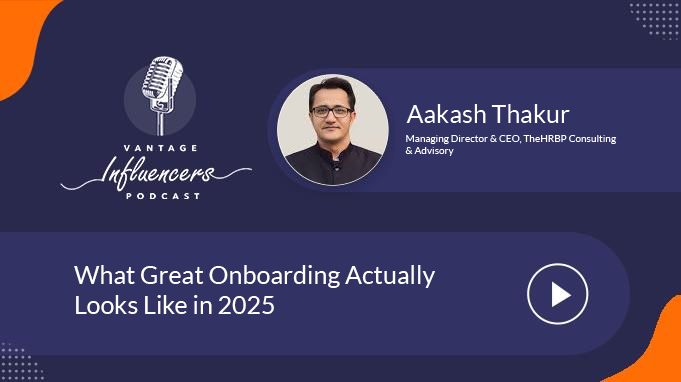
Aakash Thakur, Managing Director & CEO, TheHRBP Consulting & Advisory
Aakash Thakur is a Global Leadership, Talent, and HR Transformation Advisor, currently partnering with organizations to craft future-ready people strategies and build high-impact, inclusive cultures. With over two decades of experience, he has held leadership positions such as VP & Head Corporate HR at Vardhman Textiles, Director & Head HR South Asia with Omya, Head – Corporate HR CoE (Total Rewards) at Aarti Industries, part of the Corporate HR team at Reliance Industries, and Group Head – HRD & OD at AGC in the UAE. He also contributes meaningfully to the academic and national policy space, serving as Industry Expert in Behavior-Based Safety (BBS) at IIM Mumbai, Board Member at SPICSM – Rashtriya Raksha University (under the Ministry of Home Affairs, Government of India), and holds honorary positions on the Academic and HR Advisory Boards at IIMT Studies. Additionally, he serves as Advisor and Life Member at the Forum of Behavioral Safety (BeSafe) India. A trusted thought leader and keynote speaker, Aakash was recently recognized as one of the Impactful HR Leaders at the ET EDGE HR Transformation Summit 2025 by ET Edge – Bennett Coleman & Co. Ltd. (The Times of India) and Median Research & Consulting Pvt. Ltd. He continues to blend human insight with business foresight to help organizations reimagine HR as a force for growth, purpose, and social good.
Connect with Aakash on LinkedIn
Host
Sanjeevani Saikia, Vantage Influencers Podcast Host
What You Will Learn
- How the definition of great onboarding has evolved since 2018-2020, and why it now runs as a 90-day journey instead of a single event.
- Practical, low-cost ways to make remote and hybrid onboarding feel personal, from peer welcome videos to digital onboarding journals.
- Why delivering all productivity tools on day one, instead of staggering them, changes how a new hire feels about the organization.
- How AI can support onboarding through personal nudges, chatbot-handled FAQs, and predictive alerts, without replacing the human touch.
- What impact strong onboarding has on retention and engagement, and when to start tracking success.
- How to design an onboarding journey that accounts for imposter syndrome, women returning to work, and persons of determination.
Key Topics & Timestamps
| Timestamp | Topic |
|---|---|
| 01:44 | Aakash's corporate journey so far |
| 08:48 | Kicking off the conversation on what great onboarding looks like in 2025 |
| 11:05 | Creative ways companies are making onboarding feel personal and connected, even from a distance |
| 17:49 | How tech is improving the process while keeping the human touch alive |
| 23:28 | Why great onboarding is key to keeping employees engaged long-term, and when to start tracking success |
| 26:52 | What the "perfect" onboarding experience in 2025 would look like and the moments that matter most |
| 33:31 | Message from Aakash for our listeners |
Full Transcript
Click to read the full episode transcript
Welcome to the Vantage HR Influencers Podcast. This podcast is sponsored by Vantage Circle.
I'm sure you remember what onboarding looked like just a couple of years back. You know, starting a new job used to mean getting a laptop on the very first day, a quick orientation program, and maybe some awkward intros over coffee. But now the whole onboarding scene has changed to quite an extent. In fact, it's a whole different game now with AI taking over with more remote work and people first cultures being prioritized by organizations. The whole thing has really changed the employee experience.
So today we're diving into what great onboarding really looks like in 2025, what's changed, and what matters more than ever. And most importantly, how are companies getting it right? And are they really getting it right? And to help us unpack this, we have with us Akash Thakur, someone who's been in the HR space for years and bring some rich real world insights into what employees truly need when they're just getting started. So let's begin our conversation with Akash.
Sanjeevani Saikia: Hi, Akash, it's a pleasure to have you on the show. Thank you so much for making the time. Before getting into the heart of the discussion, I always like to start with the person behind the perspective. So for me, as well as our listeners, could you walk us through a corporate journey so far? What's shaped your path and brought you to where you are today?
Aakash Thakur: Good morning, Sanjeevni. Thank you so much for having me here. You know, I started my career journey around 18 years back. And likewise, any other management trainings I entered in an Alliance Industries Limited. And fortunately, fortunate enough to get the opportunity to work in a full-fledged greenfield project. And that is again into the oil and gas and petroleum business. And I was posted in Visakhapatnam area in Andhra Pradesh, that's the place called Kakinada. It was a full-fledged oil and gas basin project, which has got onshore terminal, the offshore drilling and rigging happening for oil wells, and then the shore base facilities plus the cross-country pipeline, gas pipeline around 1500+ kilometers. So I worked there, got amazing exposure of greenfield and managing large-scale operations there.
From there, I got exposure into doing multiple activities of, you know, IMS standards and then got into the business transformation project. And then we worked very extensively on people track for the entire manufacturing setup of Reliance, worked on the governance and performance management systems, worked on the processes, systems and data part of it in business transformation. Then within Reliance itself, I got an opportunity to work and I got selected into the corporate HR center of excellence for learning and development, and especially into the e-technology area. I got the opportunity to work on one of the best systems and softwares available for e-technology.
And from Reliance, I went into a major chemical, Indian multinational company called Aarti Industries Limited at Quartet in Mumbai, joined them as the lead or head of the learning and development and supported the organization in their strategic HR initiatives, worked there for around three years and then got an opportunity to get into international market. So I joined a major retail organization in UAE in a place called Abu Dhabi, as the head of their group HR development and the organization development. I could taste the technology directly where I implemented it and then we made the entire HR digital in that place within two years of time.
I went again to Aarti Industries Limited after this stint of two years here and then I joined them initially as the head of business HR in their manufacturing operations for a particular zone which was under major projects in Gujarat and then to their corporate office. Again, I say that it was a great opportunity to create their center of excellence for total rewards and performance from scratch. So that was the department which I was given and then apart from this department, I was also heading their group HR digital portfolio. I was also heading the group corporate communications. For some time, I was also head of corporate HR in that place and one of the major activity which was given to me was a greenfield research and technology center where I was also the head of their business HR and to manage the entire research and technology center.
Worked there for another three plus years and then got into this international Swiss company, 140 year old specialty chemicals minerals and mining organization called OMEA and I joined them as the director and the chief of HR for their South Asia area and worked there for around three plus years and then in a hustle to come towards my native area, I joined an organization, I think India's largest textile organization, Wurthmann Textiles. I headquartered in Punjab and served there for around one and a half year. It was an amazing experience, a huge organization with around 33,000 people on board and I was there as the vice president and head of corporate HR for them. We did a lot of work in terms of assessment centers, development centers, L&D interventions or creating a center of excellence of corporate HR in that place and let ESG initiatives and in that place contributed from HR side as much as I can and then I'm an advisor and a lifetime member of the behavioral based safety forum of India. I am industry expert also for this program in IAM Mumbai and for that reason I have also introduced this intervention at Wurthmann Textiles and we covered from top to bottom everybody there.
From there on I think I wanted to get into some kind of career break and I took that career break in July, in the first week of July and here I am, I am now doing things at my own. I am helping organizations currently in terms of their HR strategy, their learning strategy and I'm currently based in Dubai and I'm also operational in India. That's all about my journey.
Sanjeevani Saikia: Thank you so much Akash for sharing your journey with us. I must say it's really incredible and once again thank you so much for sharing this with me as well as our listeners. Now with your permission I'd like to begin today's discussion on the topic and we're really excited to know what great onboarding looks like in 2025. So with your permission, let's begin.
Aakash Thakur: Absolutely, absolutely Sanjivni. We have seen such a shift over the past few years, especially with how much workplace and workforce has changed. What we used to call great onboarding back in 2018 or even back in 2020 is no longer the same. Things have changed to quite an extent I believe. Now employees are looking for more meaning, real purpose and most importantly more connection at their jobs.
Sanjeevani Saikia: So let me ask you this. How would you say the definition of great onboarding has evolved in 2025 compared to just a few years ago?
Aakash Thakur: I think that's a great start. Your great onboarding defines the journey of any employee in any organization and it also defines to me the culture of the organization. A few years ago if you really go back, great onboarding meant orientation slides or coffee with HR or maybe a team lunch. Now when we reach to this time and in 2025 onboarding is not just a first day event. It's just a 90 day experience. It is no longer about just telling people what the company does or it's about helping them feel why they belong here. We have now probably shifted from compliance to culture, the paperwork to personalization and one size fits all to a journey based onboarding. It's very less about teaching people how to survive and more about empowering them to thrive, to contribute and to connect from day zero with the organization. I hope that gives you a little perspective on this.
Sanjeevani Saikia: Yes, yes it does. While we are on that, there's also this whole remote hybrid reality we are living in. You're not always walking into a buzzing office on your very first day. You're logging in even from your bedrooms. So also it naturally begs the question, how do companies make onboarding feel less robotic and more human in nature? What are some creative ways companies are making onboarding feel personal and connected even from a distance? So what do you have to say about that, Akash?
Aakash Thakur: So I think it's a hybrid world where your teammate could be in Hyderabad or Helsinki or just hiding behind camera or on Zoom. What I can tell you is that what great companies are doing or what is expected from companies to do in such a setup. You might have heard about pre-onboarding welcome videos from peers. Normally what happens in the organization is that when somebody joins, they get an onboarding video from CEO or maybe they get a kind of letter from the CEO or the promoter or the chairman of the company welcoming them. I think great companies are, you know, when we make our efforts to make onboarding feel personal and connected from especially a distance. If you get videos or welcome videos from your peers, it gives you a different feeling.
All right. When you are hybrid, when you are remote, I remember that we did this when I was in an Omia that, you know, we used to have coffee meetings. So we used to randomly create a meeting with our fellow directors or maybe some of the heads in the organization. And then we say that, OK, let's connect for an informal meeting. Let's have different talks or let's have meet and eat randomly paired kind of meetings or chats to break the silos.
We can also have digital onboarding journals. What I mean by this is that new hires, they record their first 30 days, write, scribe it, or maybe anyways, they record their initial journey. And then at some time they start reflecting on it and then we drive this purposely. And then another different level experience can be we deliver the culture kits to the homes of the employees. Maybe it can have anything like snacks or storybooks or a QR coded welcome from their future team.
I remember that wherever I have been as the head of HR, I have tried to make day one very, very meaningful or very, very much, you know, experience led. I believe that, you know, there is nothing called engagement that's more about experience, how you make somebody feel it is everything in terms of onboarding. And on day one, I used to tell people, you know, when you give some kind of onboarding kits to people, sometimes it stretches to a month's time. Sometimes you are giving a laptop after five days or maybe a diary on the day they join and then gradually you keep on delivering things if you are giving it anyways. Why not to give it on day one? And then just put extra efforts, make sure that the day employee joins us, you have his entire enabling productivity tools on the table in front of him on or her on the day one. So it takes a little extra effort, but it gives an amazing experience to the person who comes and joins the organization. They feel valued.
Now, it's also not about presence. It's about presence of mind. And then companies are designing for moments that matter and not just meeting that that fill the time. So I think experience is very important. And like I said, presence of mind, how you can do it in a better way is something we should target in this.
Sanjeevani Saikia: Yes. You know, I have a question here. Do you customize the whole onboarding process on the basis of like, you know, seniority level? Do you customize it? For example, you know, people who are at the entry level have a different kind of an onboarding and people who are at the senior level may have a completely different onboarding experience. So do you do you really customize it?
Aakash Thakur: I think, you know, sometimes it varies. It varies. Definitely, it will vary. Ideally, why it varies is because, you know, organizations typically they have different type of things for different level of people. For a senior, senior person or a senior leader, they probably I'm just giving a rough example. All right. For example, for a senior leader, they probably have a tablet and then a laptop as well for middle level managers. They probably have just a laptop or maybe for entry level person, they probably have a desktop. And that's all. So that's that kind of a difference is always going to be there in the organization because the utility and the accessibility or you can say the ease of doing things is going to be varying on different levels in the organization. And yes, it has been into the practice and we have been doing it. Largely what we should target is that we should enable people to operate from wherever they are, extending access to their mobile devices or to their personal computers. It should not be a problem. It's a cloud world today. Only thing is that the organization have to ensure from their side that their security protocols or their confidential protocols are very nicely embedded in the systems so that nobody can play around it.
Sanjeevani Saikia: Now moving on, we generally talk about AI and technology and how AI is reshaping pretty much everything around. So we cannot not talk about AI when we're connecting it or trying to understand the whole onboarding process and the onboarding experience. So speaking of technology, you know, AI is obviously a game changer in every corner of HR, including onboarding, I'm sure. But here's the thing. While automation can make the process much faster and more efficient, there's also a risk of losing personal human touch. So I think it's important for me to ask you this question, Akash, how can AI and automation really improve onboarding without losing the human touch? Because I think at the end of the day, the human touch really matters while you're trying to provide a great onboarding experience or a great employee experience for that matter.
Aakash Thakur: Absolutely. I think this is one of the most interesting topic in the world today. I want to make a revelation. I want to make one thing very clear, at least what I feel. It is not, you know, AI is not here to replace HR. It's here to amplify it. When I say this, let's get one thing straight. AI is not a threat to HR. It's a spotlight. It shows us where we are wasting time, where we are missing the signals, and where we can show up more human, you know. When we talk about onboarding in an AI era, you know, it's like a tool for us to be more strategic, more empathetic, and more impactful than ever before, because this is something which AI cannot deliver. AI is a tool that operates on global database. It does not have, as of now, the ability to innovate, to do creative stuff, you know, it will do only that which is available somewhere in the world in the data. And not every kind of data is applicable to each kind of geographies. So human empathy, human touch, or maybe, you know, some kind of psychological things, they are there always. And the way we impact people is very important.
How AI can help us is by creating some kind of personal nudges. For example, it sends this kind of messages to people, "Hey, today your first leadership meet. Here's who's attending it." Or maybe Chatbot is handling your frequently asked questions, so that the humans can handle the emotional part of the organization. It can help you with predictive analytics. It alerts the managers when a new hire is disengaged, or is not satisfied with something, or maybe struggling with something. And AI driven content delivery, it adapts learning modules of each hire's pace, or probably recommends the new hires or people that what is the area of development for this individual, and it can recommend what kind of courses this person should have.
Now, when we have all of this, we should remember that automation should handle the routine. And an HR can focus on rituals, like having a welcome call, or maybe a handwritten note, or maybe the mission which we are driving in the organization, what's the story behind it. Technology, definitely, it gives us a scale. When I say technology gives us scale, humanity gets you stickiness in the organization. Now, the real question is, is not, will AI take over HR? Or the real question is, what part of HR are you ready to amplify? Strategy, empathy, or probably the speed? And that's the power we are talking about.
Sanjeevani Saikia: So Akashiv lucidly explained the impact of AI on onboarding. So yeah, thank you so much again. Moving on, let's talk about outcomes. Because at the end of the day, the result really matters. Because again, onboarding isn't just about the first week. You know, I suppose it's not just about the first week. It's the start of a much longer story. And I think sometimes companies underestimate how big of an impact that early experience has on that employee. It quite a lot makes a decision whether the person will stick with your organization for longer or not. So I want to ask you here, what impact does onboarding has on retention and engagement? And when should companies actually start tracking success? And how do they do it most importantly?
Aakash Thakur: I mean, a great question. I think a solid onboarding is not just a warm hug. You know, it's a very, very strategic lever of the organization. Employees with great onboarding experience are very high. I mean, let's say 65 to 70% more likely to stay for a longer period of years with the organization. And engagement scores of new hires, they shoot up when onboarding is intentional, but not mechanical. What we miss in this is that we become mechanical in the process, but we miss the intentions about it.
Now, how to track or when to track the success? When we talk about it, let's say we break, you know, the initial 90 days of an individual and then we should see it when we get into any organization. What are the areas where we always feel disconnected? Now, I with my experience can say that there should be an emotional check-in in the first week or maybe at the end of the first week with the new hire. And a new hires question always is going to be, do I feel welcome in this organization? Whether somebody bothers, you know, I have joined here or nobody cares that what is happening with me, whether I'm fully ready to take up things or whether I have been issued with things which are going to help me to do productivity. And then let's say day 30, where we should check with the new hire about the role clarity, the confidence, whether all the productivity tools are delivered to the individual. And if there are some kind of questions, queries, we should resolve them as soon as possible. And then quickly day 90 check-in, where we or the individual start when they have started journaling things, they can really measure their contribution. We can also see that what is the cultural alignment of that person and what are the early wins which this person have acquired over these 90 period.
You know, we should not wait for the exit interviews to figure out what went wrong in the organization. We should start tracking from day zero. Onboarding, like I said earlier, is our first cultural diagnostic in the organization. It is an intervention that tells the world that what this organization is all about. It is a very important, you know, intervention.
Sanjeevani Saikia: I think you have highlighted a very crucial point here, that onboarding is the first cultural diagnostic. I think that's going to be, you know, a great takeaway from this response of yours. Now, moving on, I would like to get a bit imaginative here. You know, we've talked about remote work, we've talked about AI and employee engagement. You know, if we could map out the perfect onboarding experience in 2025, what would it really look like? So, you know, my question to you is if you were to design the ideal onboarding journey in 2025, what would you surely include and which moments do you think matter the most in this entire roadmap? What do you have to say about this, Akash?
Aakash Thakur: I think, you know, some of the areas when I say in an onboarding, the aspects of personal and psychological area are very important for the organization or for head of the facility to ensure that they are addressed. Some of the aspects when we say the forward thinking companies are doing in terms of the interventions and onboarding are buddy systems. They are the emotional anchors, not just the guides in the organization. Like I earlier stated, week one, week and then day 30, journaling and then day 90 kind of experience.
And then day 30, what I really want to say in this is to normalize the imposter syndrome. When I say imposter syndromes, the first 30 days in a new job are emotionally charged with any individual. New hires often feel that they are faking till they make it, even if they are more than qualified for that job. So that's the imposter syndrome and the silent killer of the confidence.
Now, you know, when you start creating this kind of a culture in the organization that somebody has to do journaling and have to work on that for next 30 days, what happens is that, you know, it serves a lot of purposes. But when I have to be brief about it, I can say that it serves a purpose of giving a very good reflection and reflection. It helps employees to track their growth. It helps them to celebrate very small wins and to win the process challenges. It also helps the second perspective. Second purpose is like normalization when the employees realize that others also felt unsure or lost or not enough. Early on, it reduces self doubt and it reduces the isolation also because he has been capturing everything over the period of time.
You know, when I say another thing which can be a peer sharing, you know, it should not be mandatory but kind of optional. It's a very safe place. When you complete your 30 day mark peer or your buddies or small groups, they voluntarily share the reflections that how they have supported the individual or how the individual have reached out to them and how are they feeling about him or her being in the team or maybe the HR or managers they surface if there are patterns emerging during this period. What it helps is that it builds the psychological safety. It boosts the emotional intelligence and it validates the vulnerability that turns whether am I good enough into well, I'm not alone at this moment.
We are seeing companies encourage this first 30 day generally. I have seen it very often that companies are doing it not as a homework but as a kind of mirror that helps new hires to catch those little wins. They probably would have otherwise missed them and gives them a space to admit what they don't know. And then when they find out others felt the same way, that's when this syndrome, like I said, you know, imposter, if it starts to lose its power.
Also, I think, you know, some of the areas where in onboarding probably can be helping the women who are returning to the work. What is the kind of, you know, paths that we should be following and then how we are helping her to then come back to the job again, whether there is a mentor who has been assigned to the person, whether there is a community group in the organization which is cheering her on. And then that is that is also one very important area.
And then special considerations for people who have, you know, with its special abilities in in Middle East, a very beautiful word like in India, we call it. And in this place, they call it PODs, persons of determination. So, you know, what kind of possibilities we have created for them in terms of onboarding or making them feel like everybody else in the organization and not making them feel that they have been given specific, you know, potential. They should also feel that they are part of the team.
Sanjeevani Saikia: I had a lovely conversation with you, Akash. Unfortunately, we have reached the end of today's episode. But before we sign off, do you have any last thoughts for our listeners, any message for our listeners? I'm sure they'd love to hear it from you. And for those who would like to stay in touch with you post this episode, can you tell them the best way to reach out to you, Akash?
Aakash Thakur: Yeah, thank you so much. Since it has been a great discussion and sharing of thoughts from both sides. My last message in this is for the people who join the organizations, it is a very important message. And we should tell the new hires as HR people that you are not expected to prove yourself immediately in the organizations. You are expected to learn, connect and grow. This message alone reduces the 50% of anxiety. The rest is handled by the organization's culture, compassion and good coffee, virtual or probably in physical. That's my message. People can reach out to me on LinkedIn. I'm very much available there. It's a clear handle. LinkedIn.com/n/akashtakur. There's no dot in between. And that's how it is. Thank you.
Sanjeevani Saikia: Again, very well said, Akash. Thank you for giving us this message. And thank you so much for joining us in this episode. You know, it's a pleasure to have you on the show and do stay in touch.
Aakash Thakur: Thank you. Pleasure speaking to you, Sanjivni.
FAQ
What does great onboarding look like in 2025?
Great onboarding runs as a 90-day experience rather than a single first-day event. It shifts from compliance to culture, from paperwork to personalization, and from a one-size-fits-all process to a journey designed around the individual joining.
How can companies make remote onboarding feel more personal?
Tactics include peer welcome videos, randomly paired informal chats across teams, digital onboarding journals where new hires record their first 30 days, and culture kits delivered directly to a new hire's home.
Can AI improve onboarding without losing the human touch?
Yes. AI works best handling routine tasks such as personal nudges, chatbot-answered FAQs, and predictive alerts on disengaged new hires, freeing HR to focus on rituals like welcome calls, handwritten notes, and sharing the organization's story.
How does onboarding affect employee retention?
Employees with a strong onboarding experience are 65 to 70% more likely to stay with an organization long term. Companies should track sentiment at the first week, day 30, and day 90 marks rather than waiting until exit interviews to learn what went wrong.
Related Reading
Also listen on