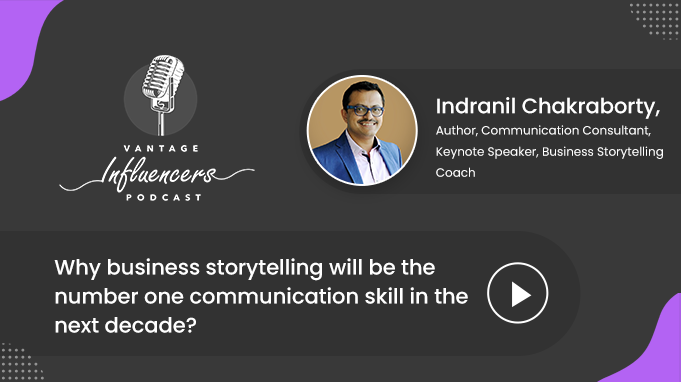
Why business storytelling will be the number one communication skill in the next decade?
Episode Overview
Indranil opens this episode by making a bold claim: business storytelling will be the number one communication skill of the next decade, and it is worth taking seriously. His argument starts from a simple premise. Communication has always been the most important part of any job, whether you are pitching an idea to investors, convincing a team to follow a new direction, or simply trying to get noticed for your work. What changes the game is a specific communication tool that hits all three requirements of effective communication at once: being easy to understand, easy to remember, and easy to retell. Stories do all three naturally, which is why Indranil sees them as the sharpest available upgrade to the way people and organizations communicate.
The conversation moves through what that looks like in practice, from a simple three-step method for building storytelling skill (instruction, imitation, and practice) to why storytelling carries outsized value for roles that spend the most time communicating with people, including HR, sales, and leadership. Indranil also digs into a problem every HR leader will recognize: employer brand claims fall flat when they are just assertions. A leader can say the organization invests in its people, but that claim only becomes believable when it is backed by specific stories about real employees. That distinction, between telling people something and showing them through a story, runs through the entire episode.
Episode Highlights
- Indranil argues that communication has always mattered, but stories win because they are easy to understand, easy to remember, and easy to retell, making them the sharpest tool for business communication in the next decade.
- He breaks storytelling ability into three learnable inputs: instruction from a mentor, book, or course, imitation of someone who does it well, and consistent practice.
- Storytelling matters across every function, not just HR or sales, though the leverage is highest for roles like HR, sales, and the C-suite that spend the most time communicating with people.
- On employer branding, Indranil explains why bare assertions like "we invest in our people" fail to build trust, and why specific stories about real employees are what make a workplace culture believable.
- He shares the serendipitous path that led him to leave a long corporate marketing career and start his own storytelling consultancy, and how his book, Stories at Work, began almost by accident.
- He closes with career advice: prioritize finding a great boss over a great job title, and learn to listen more than you speak.
About the Guest
Indranil Chakraborty, Founder, Story Works
Indranil Chakraborty is the founder of Story Works, a business storytelling consultancy that helps leaders and organizations use the power of stories to make their business communication more effective and memorable. He is the author of Stories at Work and holds an MBA from IIM Lucknow. Before starting Story Works, Indranil spent over two decades in marketing and sales, beginning his career in brand marketing before moving into entrepreneurship.
Connect with Indranil on LinkedIn
Host
Rohit, Vantage Influencers Podcast Host
What You Will Learn
- Why storytelling will be the number one communication skill of the next decade
- The three-part yardstick for good communication: concise, memorable, and retellable
- How to build storytelling skill through instruction, imitation, and practice
- Why storytelling matters across every function, not just HR or sales
- How specific employee stories build a more credible employer brand than broad claims
- What led Indranil to leave a corporate career and start his own consultancy
Key Topics & Timestamps
| Timestamp | Topic |
|---|---|
| 00:00 | Introduction |
| 02:53 | Business storytelling as a skill set in organizational communication |
| 06:24 | How to improve storytelling capabilities |
| 08:05 | How storytelling can help build the HR function |
| 10:46 | How storytelling can help leaders boost employee experience |
| 15:30 | Business storytelling in a downturn |
| 17:27 | Indranil's journey from marketing and sales to storytelling |
| 21:51 | About Indranil's book, Stories at Work |
| 24:30 | Indranil's favorite HR leader |
| 25:38 | Indranil's favorite business book |
| 26:34 | Advice for young HR leaders |
Full Transcript
Click to read the full episode transcript
Welcome to the Vantage HR Influencers Podcast. This podcast is sponsored by Vantage Circle, the leading employee benefits and engagement platform.
Rohit: Hi, this is Rohit from the Vantage HR Influencers Podcast, and today I'm joined by Indranil Chakraborty, founder of Story Works, who has worked with several well-known brands. He is also an author and an alumnus of IIM Lucknow. Welcome to the show.
Indranil Chakraborty: Thank you. Thank you for having me.
Rohit: I wanted to understand how you got into a brand marketing career, and what you learned from such an illustrious corporate career.
Indranil Chakraborty: Well, how did I get into brand marketing? The first part of my education was almost by default. Remember, I grew up in the years before the internet, when everything was governed by what elders and society thought was the right thing to do. If you did well in science, you took science classes in 11th and 12th grade. If you did well there, you became either an engineer or a doctor. If you did well in the engineering entrance exam, you became a computer science engineer. So, following that path, I became a computer science engineer.
It was in my second year of engineering that I heard about something called the MBA. I realized I loved software but hated hardware, and I couldn't see myself spending hours in front of a computer forever. So I sat for the CAT exam and got into IIM Lucknow. That's where I got exposed to the various streams you could pursue, and marketing was one that excited me. I got lucky at the end of campus placements, because in those days what was then called Hindustan Lever was the number one brand to join, and I got selected. That's where my journey as a marketer started.
Hindustan Lever has been, and I think still is, more than just a company to me. I think of it as a finishing school for marketers. It's a great place to learn sales and marketing. So it started by default, and then it moved into something I loved.
Rohit: You've mentioned that business storytelling will be the number one communication skill of the next decade. How can people, whether they're differentiating themselves in a corporate career or on an entrepreneurial journey, use this to their advantage in the years ahead?
Indranil Chakraborty: I think it has always been a very important skill, and what I mean by that is communication itself. Take an entrepreneur: from the moment they come up with an idea, they have to sell that idea to potential investors, to potential employees, and to customers if they're in B2B. How do you sell ideas? You communicate.
On the corporate side, when you're an individual contributor, you need to sell yourself first, because no one buys your product, idea, or service until they buy you. You need to sell yourself and your ideas to get recognized and to get the go-ahead to do things. As you rise in the organization, you continue to do that, but you also need to sell the kind of work you need your team to do. You need to communicate.
Communication is going to remain important to almost every job, and for most jobs, it's the most important element. So we need to figure out what helps us communicate better. When I say "better," I mean three things. Can I communicate in a way that's both concise and fully understandable? Can I communicate in a way that people remember what I told them, not just in that moment but days or weeks later? And third, as I rise in the organization, there are only so many people I can communicate with directly, so can the people who hear my message go and retell it to others?
That, to me, is the yardstick of good communication. If you have all three, you end up being able to connect, engage, and inspire. Now think about stories. What do stories do? Stories are easy to understand. There's rarely a story you can't understand. Stories are easy to remember, and stories are easy to retell. So everything we just discussed about good communication is exactly what stories deliver. Business storytelling is about harnessing the power of stories in day-to-day business communication, making your communication easy to understand, easy to remember, and easy to retell by using stories or story structures.
Rohit: What are some ways someone can improve their storytelling? A lot of business managers are used to presentations and showing numbers, so what structure can help them build storytelling ability?
Indranil Chakraborty: I think any kind of speaking skill, whether it's storytelling or public speaking, which I also do a lot of work in, is learned through three things. You learn through instruction, meaning someone tells you the best practices or approach. You learn through imitation, which means you see someone do it well and decide to do it the way they do. And third is practice, practice, and practice. There's no getting away from practice.
So if anyone wants to get better at any kind of communication, whether it's simple everyday communication, public speaking, or using the power of stories, they need to do two things: find someone, a book, or a course that will teach them how to do it, because you're unlikely to figure out the science of storytelling entirely on your own. There are enough people who've spent enough time working out the steps and procedures. So instruction is first, imitation is second, and practice is third. Like the roughly 2,000 people who've gone through the 95 or so programs we've run so far, anyone can harness this power in a business situation by focusing on just these three things.
Rohit: Since human resource management is such a crucial part of business, how does storytelling apply there specifically? Is it equally relevant for HR leaders trying to retain talent as it is for other functions and roles?
Indranil Chakraborty: I honestly don't think storytelling is any more or less required for any particular function. Let's take R&D, for example, a fairly niche role in an organization. Even there, you need to be able to deliver your message in a way that's concise, clear, and easy to understand. You need to be able to communicate in a way that people remember well after the presentation, because if they can't remember it, there's no use to it. And you want your message not only remembered, but retold, so that someone who heard you can go and tell someone else what you told them.
So these three elements of communication are just as relevant to someone in R&D as to someone in HR. Where I think the leverage is higher is in HR, sales, or the C-suite, and here's why I chose these three: they spend much more time communicating with other human beings than, say, an R&D person does. If you look at how much of an 8 or 10-hour day someone spends working alone or in small groups versus how much time HR leaders, the C-suite, and salespeople spend communicating, that percentage is higher for these three, and so is how critical communication is to their jobs. So wherever communication becomes important, and this isn't just about millennials or any particular generation, it's about how you can communicate more powerfully to human beings. Storytelling can be a very powerful tool for that.
Rohit: Let's go deeper into employee experience and engagement. Over the last decade or so, people have been changing jobs more frequently, which is a good thing for both employers and employees. How can effective storytelling by leaders help improve employee experience and engagement?
Indranil Chakraborty: Let me answer this by saying that an organization, or a place to work, is like a brand. Just as a light bulb brand or a car brand needs to explain to people why they should buy it, an organization needs to be able to explain why people should join and why they should stay. That's what people call an employer brand.
Now, if you want people to stay in your organization, the first thing you need to do is articulate the reasons people should join and stay. Let's say one reason is that you give people high responsibility early. Another might be that you invest disproportionately in people's growth compared to the rest of the industry. And a third might be that the purpose of your business, in terms of its impact on human lives, is far greater than at many other organizations.
Once you've come up with these positive, high-minded reasons for people to join and stay, the question is how you communicate them. Because when you go to someone and say, "We're an organization that gives people responsibility early," or "We're an organization that touches and changes human lives," or "We help people learn, grow, and invest in their growth," people first of all don't believe you. And even if they partially believe you, they'll forget it within two minutes, because what you've made are assertions, and assertions are never credible.
Now, someone listening to this might say, "But that's how every company talks about itself or its products. We're the best at this, the fastest at that, this is the best product." Just imagine, for a minute, moving from products or employers to a human being. If a person walked up to you and said, "Hi, my name is so-and-so, and I'm extremely trustworthy," would you believe them? It sounds ridiculous, and it's the same thing when a company says it gives people responsibility early. Why is that any different from a person saying "I'm trustworthy"?
So if a company wants to communicate that it gives people responsibility early, invests in learning, or is purpose-driven, what it needs to do is go back to stories. If a company genuinely gives people responsibility early, there should be a hundred examples of that. If it genuinely invests in people, there should be a hundred examples of employees it has invested in. So instead of an assertion, tell me a story about a few employees who were given high responsibility early, and let me arrive at the conclusion myself that this company really does give responsibility early.
When it comes to employee engagement, one way people get engaged with your company is by experiencing it directly and getting to know who you are through that experience. But the other way is that even before they experience you, they can hear stories of other people's experiences and believe it through that.
Rohit: That's interesting, and thanks for the examples. But even as a company's growth or economy shifts, it's easier during good times. Take an industry like automobiles, which has gone through a slower period because of new technology like Uber and other ride-hailing apps. In a case like that, where leaders haven't experienced this kind of downturn before, what kind of storytelling should a leader use so that the right message gets across to both leaders and employees in that organization?
Indranil Chakraborty: Let me divide this into two parts: content and delivery. I'm not the best person to decide what the content of that senior person's message should be, someone trying to convince people to stay the course even though the company isn't doing well. Unless I'm in that situation myself, drawing on my own experience, it would be impossible for me to hand out a generic formula.
So let's assume that any good leader, depending on the situation, knows what they want to communicate. What storytelling does is help that person deliver the content they've already decided on in a way that's easy to understand, easy to remember, easy to retell, inspirational, and sticky. Business storytelling doesn't help you come up with the content. It's about how you deliver that content in a very sticky way.
Rohit: You've had a long, illustrious career in marketing and sales before moving into entrepreneurship. So why did you start your own storytelling consultancy?
Indranil Chakraborty: It's always easy to explain things logically when you look backward. I could construct an extremely coherent life path leading up to it, but it was never that neat. A lot of it was serendipity, a lot was luck, and a lot was circumstantial.
But if I had to point to a few elements that got me there, in no particular order: anyone who's known me over the 21 years I worked would tell you I've never liked being controlled or told how to do things. I was perfectly fine with companies or bosses telling me what they wanted achieved, but I always rebelled the moment they told me how to achieve it, because I felt that was my business to figure out. That kind of mindset was always going to start feeling constrained in a formal, structured corporate setting. So over the years, I kept thinking maybe I should go and do something on my own.
That was one thing sitting in the back of my mind. Another, built up over the previous 8 to 10 years, was that I wanted to move to Goa, though there was no obvious way to do that since no big company would give me a job there. And the third piece was that I had been exposed to storytelling back in 2013. I won't get into the full story of how that happened; anyone interested can read the book. I was trying to embed values, which is a very abstract thing, and figure out how to get everyone in an organization to understand what we had articulated as our values. I wasn't managing to do that for close to a year, and then I discovered storytelling, and using it to embed values was magical.
So these three things came together: something that excited me and was new, something I could pursue on my own, and something that would let me move to Goa. That's really how I got into the entrepreneurial path. We did move to Goa, but after three years, the lack of infrastructure there drove us back to Bombay.
What I built helps leaders and organizations be more effective and more memorable in their business communication, by harnessing the power of stories and story structures to make it stickier. This isn't about any one type of communication. It's every communication you do in an organization from morning to evening, whether it's a one-on-one, a presentation, a speech, or a client meeting. When it comes to leaders, we teach people how to harness the power of stories in business. And when organizations want us to do it for them, we help them craft key messages like strategy, vision, values, and employer brand. That's really what it does.
Rohit: You also wrote a book called Stories at Work. What made you write it?
Indranil Chakraborty: I had never been a writer. Back in 2013, I was talking to a person who was really responsible for my writing, someone known as IG, who was one of the founding editors of Forbes India when it launched and has since started a new venture called Founding Fuel. I was talking to him about the power of stories, and being a journalist, he found it interesting and suggested I write something. I had never written anything before, not even a blog, aside from emails and proposals, but I gave it a shot and then forgot about it.
A few months later, someone told me they liked an article I'd written in Mint. I said I hadn't written anything in Mint. They said it was there, with my photograph and everything. So I went and bought a copy, and it turned out IG had been asked to curate two pages for Mint. Among other well-known writers, he included my piece on storytelling. It was well received, so one article led to another, and at some point it crossed twenty articles.
Somewhere down the line, a commissioning editor at Penguin read those articles, liked the style, and called to ask if I would write a book. It hadn't really crossed my mind before that call, but if that call hadn't come, I don't think the book would have happened. So again, serendipity has been my best friend. The book was later shortlisted in the business and management section of a book awards process. That shortlisting happens partly on book sales and partly on a jury, but the final selection is by public vote on the awards website, and the winner will be announced in January of the following year.
Rohit: I wanted to ask, who's your favorite HR leader or favorite CEO?
Indranil Chakraborty: I honestly don't have a favorite, and that's not me ducking the question. I think many people bring different facets to business. One of my batch-mates from HUL is now, I believe, one of the world's most renowned HR leaders, and I've seen her grow both as a professional and as a person over the years; I think she's doing a brilliant job. There are several other people I've met over the years who are great in their own right. So it's difficult to point to just one favorite. Many people bring different perspectives, value, and qualities to what they do.
Rohit: Do you have a favorite business book?
Indranil Chakraborty: I suffer from a Japanese condition called tsundoku, which is the habit of buying far more books than you could ever read. My room right now is filled with books. But let me pick one out, among the great books I'd recommend: since we're talking about communication, one book I think everyone should read is Made to Stick by Chip and Dan Heath. If you ever read one book on communication, that should be it.
Rohit: My final question: do you have any advice for young HR professionals or people just starting out?
Indranil Chakraborty: My advice isn't just for HR professionals, it's for anyone joining the workforce in any function. Looking back at my own experience, if I could go back and talk to myself on the first day of my job, I'd tell myself two or three things. First, try to find the best boss you can. Don't worry too much about the job itself or the company, because in the early years, it's the best boss who determines how good you become. It might be hard to actually do this, but if you have to keep changing jobs, change them to get a better boss, not just a better job.
Second, learn to listen much more than you speak. If I had done these two things, I would be even further along today as a professional. As people say, you're given one mouth and two ears for a reason. Those are the two pieces of advice I'd give.
Rohit: Where can people reach out to you, and where can they find your book, Stories at Work?
Indranil Chakraborty: Stories at Work is available on Flipkart and Amazon, including the Kindle version, if they just search for it. The best way to reach me is on LinkedIn. I respond to every message. They can search for Indranil Chakraborty on LinkedIn, and I'm happy to start a conversation with anyone interested in communication or storytelling.
Rohit: Thank you so much for coming on the show and for giving us your valuable time.
Indranil Chakraborty: Thanks, Rohit, for having me. Thank you so much.
FAQ
Why will business storytelling be the most important communication skill of the next decade?
Because stories are easy to understand, easy to remember, and easy to retell, they meet all three requirements of effective communication at once. As people rise in an organization, they can only communicate directly with so many people, so a message that spreads through retelling reaches further than a plain statement of fact.
Is storytelling only useful for HR, sales, and leadership roles?
No. According to Indranil, storytelling is just as relevant to someone in a niche function like R&D as it is to someone in HR. The leverage is higher for roles that spend more time communicating with people, such as HR, sales, and the C-suite, but the underlying skill applies to every function.
How can someone actually improve their storytelling ability?
Indranil breaks it down into three learnable steps: instruction (learning from a person, book, or course), imitation (observing someone who does it well), and practice. He emphasizes there is no substitute for repeated practice once the basics are in place.
Why do employer brand claims like "we invest in our people" often fail to land?
Because they are assertions, and assertions alone are rarely believed or remembered. Indranil argues that organizations need to back these claims with specific stories about real employees, since a story about an employee who was given real responsibility is far more convincing than the claim itself.