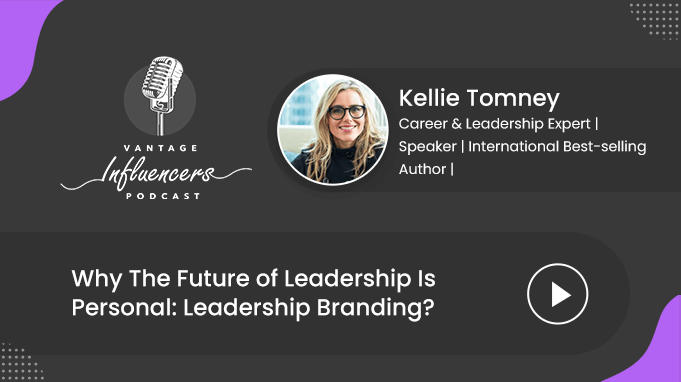
Why The Future Of Leadership Is Personal: Leadership Branding
Episode Overview
Kellie Tomney joins this episode to make the case that leadership itself is becoming a personal brand exercise. She argues that as automation and AI take over more technical and functional skills, what remains uniquely valuable in a leader is not their expertise but their personal brand: how people describe them, the reputation they carry into a room, and the trust they build over time. Drawing on Jeff Bezos's well-known definition of personal brand, "what people say about you when you're not in the room," she explains why the art of leadership, not just the science of it, is what future proofs a leader's career and their organisation.
The conversation moves through three keys to building a personal leadership brand: authenticity, alignment and activation, and connects each one to real engagement outcomes like retention, profitability and inclusion. She also walks through the three most common personal branding mistakes leaders make, from faking authenticity to staying one-dimensional, and explains why social media has made personal branding non-negotiable for leaders at every level, not just the C-suite.
Episode Highlights
- Kellie explains why the "art" of leadership, the personal brand around a leader, is what remains irreplaceable as technical and functional skills get automated.
- She breaks down the three keys to building a personal leadership brand: authenticity, alignment, and activation, and how each connects to engagement and retention.
- Kellie discusses why leadership branding is one of the most effective employee engagement tools she has seen, tying it to profitability, inclusion, and stronger workplace culture.
- She unpacks what thought leadership really means and how it differs from simply being an expert in a functional area.
- Kellie shares the three most common personal branding mistakes leaders make: faking authenticity, not leveraging their brand for the organisation, and staying one-dimensional.
- She talks about how social media and constant online visibility have made a managed personal brand essential for leaders at every level, not just senior executives.
About the Guest
Kellie Tomney, Author of FUTUREPROOF YOU
Kellie Tomney is an international bestselling author of FUTUREPROOF YOU and a sought-after speaker and coach specialising in future-proofing careers, leadership and organisations. She works with senior executives, leaders and business owners to help them build an authentic personal and leadership brand, drawing on a career that spans corporate leadership roles in branding and transformation before she founded her own coaching and consulting practice. Her work focuses on helping leaders amplify their purpose, brand and impact so they can navigate change and build more fulfilling, future-proof careers.
Host
Susmita Sarma, Vantage Influencers Podcast Host
What You Will Learn
- Why personal branding is becoming the most important leadership skill as technical expertise gets automated
- The three keys to building a personal leadership brand: authenticity, alignment and activation
- How leadership branding drives measurable employee engagement outcomes like retention and profitability
- What separates genuine thought leadership from simply being knowledgeable in your field
- The three most common personal branding mistakes leaders make and how to avoid them
- Why social media has made a managed personal brand essential for leaders at every level
Key Topics & Timestamps
| Timestamp | Topic |
|---|---|
| 00:14 | Introducing Kellie Tomney and today's topic: personal leadership branding |
| 00:40 | Kellie's journey through corporate HR, talent acquisition and transformation |
| 03:47 | How Kellie defines a leader's personal brand |
| 06:15 | Why a personal brand matters more than ever for leaders |
| 10:55 | Three keys to a personal leadership brand: authenticity, alignment, activation |
| 15:00 | What thought leadership actually means |
| 17:00 | Where employee engagement fits into leadership branding |
| 19:35 | The impact of social media on leadership personal branding |
| 20:50 | Three common personal branding mistakes leaders make |
| 24:20 | Kellie's suggestions for HR leaders |
| 29:00 | How to connect with Kellie Tomney |
Full Transcript
Click to read the full episode transcript
Welcome to the Vantage HR Influencers Podcast. This podcast is sponsored by Vantage Circle, the leading employee benefits and engagement platform.
Susmita Sarma: Hi everyone, this is Susmita Sarma from the Vantage HR Influencers Podcast. In today's episode, we will discuss why the future of leadership is personal. Let's talk about leadership branding. I have Kellie Tomney with me, an international bestselling career and leadership author of FUTUREPROOF YOU, and coach for Women and Leaders. Welcome to the show, Kellie.
Kellie Tomney: Thank you, Susmita, great to be here.
Susmita Sarma: Okay, so before we start with the topic today, please brief us about your journey in the corporate world.
Kellie Tomney: I was really interested in brands and people, even from school days. So I studied marketing and HR in university and really had a passion for leadership. That started early on. Then I had a 15 year career in HR, talent acquisition and transformation, and I started coaching even in a leadership capacity early on with leading companies. I really loved that, and I did a lot of judging for awards, and I really enjoyed my corporate role and world. But it changed overnight, as a lot of people are finding worldwide right now. Things can change very, very quickly through no fault of your own. So in a day, I went from earning a big salary to none, having a house to having no fixed address, having a corporate career to having none. I really felt the effects of future proofing. I'd been future proofing organisations, but I hadn't future proofed my own leadership or myself, so that wasn't very smart of me. I'd been fixing organisations and those sorts of things, which I imagine a lot of HR listeners on the podcast will relate to. But this whole concept of future proofing really came about because we can do so much for organisations, but if we haven't really thought through what the future plan is for them, what are the different options, it can really be a very tough ride back. So I started my consulting business during the GFC and made that my mission around future proofing organisations, leaders and careers. And now I've done it for 12 years, helping organisations and leaders across the world remain centered while the world changes around us, and really make the most positive impact that we can. So that's the journey to future proofing, if you like, and being able to relate to our HR listeners. I've been there, I really love the field and love partnering with leading HR people that are on the podcast.
Susmita Sarma: Okay, amazing. So Kellie, coming to our topic, why the future of leadership is personal, we'll be talking about leadership brand today. So firstly, how do you define a leader's personal brand, or what is a leader's personal brand?
Kellie Tomney: One of the simplest definitions Jeff Bezos had was that it's what people say about you when you're not in the room. That typically starts to get people thinking, okay, it's not just what I think of myself, it's what others think of me. Everyone has a personal brand, whether they manage it or not. It only takes about seven seconds for someone to form a personal brand impression, and about two seconds online for people to make an assumption about someone's personal brand. So we're very quick to judge, unfortunately, with our minds. It's really the total experience of you, it's how people describe you, it's your reputation, it's how people introduce you to others, it's what they say about you when you're not in the room, it's the experience they've had and expect to have with you. So it's not only their past experience but also the future experience of that brand. It's the size and strength of your network, it's the unique value that you contribute to a company, your social circle and a community. So it's every interaction. It's like a product brand or a product experience, we have a personal brand and a personal leadership experience as well. And it builds over time and it's defined by others' perception of you, good, bad or otherwise. So everyone has one, but it's whether they leverage it for the greatest impact that makes the standout difference. So it is something that actually every leader has in them, and you have to work on it for a better place.
Susmita Sarma: Yes. Yes. So why is it so important for leaders to have a personal brand?
Kellie Tomney: History tells us, in the science of leadership, that a lot of it is replaceable. Technical skills, functional skills, those are being automated. We've got artificial intelligence, so our real functional skills are replaceable. The art of leadership, where it's the art, is where the unique personal brand and the unique value of your leadership is not replaceable. So it's so important for us right now, as we have all of this change in the world and in our organisations, for leaders to be able to think, what is my personal brand, my art of leadership? Of course, we keep developing the science of our leadership, the functional technical skills, we've got to always keep up to date there. But the art of leadership, the vision, the purposeful leadership, being influential, being really engaging, helping our teams and organisations get to that next level of achievement, success and legacy for the organisation, that is through someone's personal brand. So the science of leadership alone won't future proof your leadership or organisation. That's being replaced. What isn't going to be replaced is who you are. If you think about it, like the lead cyclist in the Tour de France, and you're halfway up the mountain and you look around and realise you've lost your team, it's a challenging ride, it can be really overwhelming, there's so much to do. So leaders typically focus on the technical and the science, what they know. But you look around and realise you've actually lost your team. They aren't there when you need them because you haven't truly engaged, you haven't really brought them along with you, you haven't maximised their potential, you don't understand what motivates, scares and excites them, what their purpose is. So they are not inspired, they don't feel valued. And you realise your team don't care about how fast you are, but they do care how much you care. You can't just keep speeding up and doing more on your own, you do need others. That's where the personal leadership brand really comes in, to help our leaders truly inspire, engage and connect with their employees, particularly now. The whole world has been disrupted, along with countries, industries, companies, and people's professional and personal lives. So for leaders, it was a tough role before, but now with these pandemic times, the targets are even harder to achieve, people's expectations have got even more, and there's so much restructuring happening. We can't keep putting more people on, businesses are really stretched, so we've got to engage more than ever. Multiple studies and research show that people want authentic leadership, they want connection, they want vision, engagement and to feel valued, and personal brand is one of the tools that does that.
Susmita Sarma: As you mentioned, that people want more connection in this remote working structure, the role of leadership has changed drastically, I believe.
Kellie Tomney: It really has. People are isolated and disconnected, and they've got tough things happening in their family and their community. So we can't be a leader just from a space of technical expertise anymore, we've got to really connect and be whole leaders and connect with our whole employees.
Susmita Sarma: Right. So Kellie, you have so much knowledge in this area, so it would be lovely if you could share some personal branding strategies for leaders.
Kellie Tomney: Yes, I'd say the top three, there's a lot more than that, but the top three keys for leaders to future proof themselves and the organisation. Firstly, they've got to future proof themselves, their own leadership, because they influence and impact so many around them. So the first key is authenticity, that's around leaders being able to be themselves, bring their whole selves to work, so that others are able to do that as well. We unlock their best selves and then they're able to be really true to their own values. What's happened over these times is that people's values have really changed too, what they valued a few years ago may be different to what it is now. So it's checking in on what's really authentic for you now as a leader. Then the next key is alignment, actually looking at what's the big difference that you want to make as a leader in your career, in your organisation and in your world. I'm finding, and I imagine people on the podcast are finding this too, that employees want to do more. There's been a huge increase over time, we've got big world problems happening and people want their organisations to do more and to contribute more. So what we do is help them with their career purpose, their leadership purpose, and match their unique strengths to what's valued in the market, not only now but also for the future, because the skills and things that were valued in the past are different now. So we check in and make sure that we're future aligned. The next key is activation, so once leaders know the big difference they want to make in their leadership, how do they activate it? How do they get into their power zone as a leader? How do they stay focused on the highest value and highest impact priorities to amplify their impact? HR listeners on the podcast are so busy, they were busy before, and now they're overwhelmed with people issues and wanting to help people in their organisation. There's just a huge amount to be done. But when we really step into our power zone and focus on the highest value, highest impact things, that allows leaders to be the most impactful, influential, adaptive, growing and valuable that they can be. So there are those three keys, and when they come together, they amplify people's impact. My book has particular activities that people can work through to define their future proof leadership brand.
Susmita Sarma: Okay, so then Kellie, thousands of people are doing it now, so what exactly is thought leadership?
Kellie Tomney: So what exactly is thought leadership? We're hearing more of it these days. It's where people provide their unique thinking, their own intelligent insights and guidance based on their experiences, their expertise, their viewpoints and what's got results in the past. Many develop their thought leadership based on years of experience in their discipline or function, then they test and trial it with different approaches and see what really works. That's what I've done too, and they then become a go-to expert in their field. Typically, a thought leader should be continually learning, innovating and adapting in their field to keep adding the highest value in what they do and offer. Standout thought leaders typically have developed their thinking and want to share it with the world. So like myself, I developed a bestselling book and a methodology. You've got a respected reputation in the industry and you're sharing your expertise to help more leaders, people and organisations. So thought leaders typically can be authors, speakers, paid mentors, coaches, facilitators, and they set the pace for the industry and the future. They have the leading edge ideas, and the best ones know how to inspire, influence and lead others. They've built long term credibility and reputation by solving big problems in the world.
Susmita Sarma: Right. Okay, so then coming to our genre, which is employee engagement, where does employee engagement stand in leadership branding? Is it important?
Kellie Tomney: I believe leadership branding is one of the most effective tools for employee engagement that I've ever seen in my whole career, in either HR or consulting. The reason why is because people can get their heads around a brand, they know what it's like as a product, they know what it's like as an experience, and then they can think of themselves as a brand. It really helps us connect. As we know, engagement is all around connection, really getting that extra from people. What we've found is that initially productivity improved with less commuting and working from home, but what we're finding now in the stats is that individual and team engagement is reducing because people are not as connected. We're not as connected with our work colleagues, and we may not understand the vision of the future anymore, or know what the latest strategies are. So leadership branding allows us to really connect, it gives people much more purpose, and they really know what their priorities are to engage and how they are making a big difference. The strategies, when I've implemented these, build leadership pipelines for the organisation. We unlock 50 to 95% more potential in people because they're more engaged. We get more profitability, people want to work with these companies, we get better inclusion and better gender statistics, and we just have a much more inclusive and thriving workplace because people are able to be more themselves and are able to work on the things that are much more impactful for the organisation and for their team, which means they're much more engaged.
Susmita Sarma: Right. Then Kellie, if we talk about social media, which is very popular now, what effect has social media had on leadership personal branding?
Kellie Tomney: It's had a huge impact. There's been a huge increase, the world of social media, the globalisation of work and the internet of things were well and truly on the rise before the last couple of years, and this has really been accelerated, with leaders now more accessible, available 24/7. We can look up anybody online nowadays and get a snapshot of their leadership brand, so it's definitely had a huge impact there. Clients and customers check before meeting, whether online or in person. So it's more obvious now if someone has a personal brand that they are managing, and it's expected that you have an impactful, professional, engaging LinkedIn profile at the very least.
Susmita Sarma: So then what are the three most common mistakes leaders make when it comes to personal brand?
Kellie Tomney: The number one mistake I see most commonly is where people try and fake it. There's that saying, "fake it till you make it," but I don't believe in that with personal branding, it really doesn't work. We spot a fake a mile away, and as we said, to engage people, they want to connect with someone who's authentic, who's real, and we really crave authenticity in ourselves and in others. So if a leader is faking their personal brand, it just doesn't work, and it devalues everything they do and say. We're not going to follow someone who is inauthentic. If we're up that mountain and our leader is cycling and they're not authentic and not really engaging with us, we're not going to give our absolute best to them. So definitely don't fake it, have an authentic personal leadership brand, that's number one. Number two is where people don't leverage it for their organisation or their leadership. People are expected now to be a role model and ambassador for their organisation, and this is at all levels of leaders, not just the CEO getting their LinkedIn profile done. It's the whole organisation, to attract the very best hires, to engage employees internally and externally, and to build connections internally and externally. So just doing the work internally isn't enough anymore. Not personal branding, and being invisible, is really outdated. It's essential for leaders in particular to have an impactful personal leadership brand internally and externally. Saying personal branding is just for getting a job is really old world thinking, it's expected for leaders to be up to date and future proofing the organisation. The third mistake I see is being really one dimensional, versus being a whole leader. Just having your job title or your role at work isn't engaging at all, that technical expertise isn't being a leader. So we want to really leverage your whole personal brand. I get that this is hard to do, people ask how do I do it, and that's why I've shared the how in my book, so in each chapter they've got how to build their future proofing leadership brand, so that they can step by step work it through for themselves.
Susmita Sarma: Okay, so finally, what would be your suggestions for the HR leaders listening to us now?
Kellie Tomney: Someone listening to this podcast, I absolutely imagine they are smart, ambitious to make more impact, they know their organisation needs a strategy to be more sustainable, more limitless and agile, and aligned to growing, and they want something more meaningful and impactful. You've probably tried many different initiatives, which I have too, so I get it. What I know is that a leadership brand strategy, whether that's a program, coaching for your key talent, or giving out the book to people, some of my clients give it out to every employee, is a way to develop people and get them connecting right now. It's something that's put organisations in really good stead for future proofing, or if you just want to start now, it will give a huge lift to your leaders and the organisation. So I would really consider helping your leaders and your talent get from feeling overwhelmed, they've got the managing and trying to lead their teams, their teams have really got big challenges, whole of life at the moment, and we want to help them get really clear and confident about who they are now, what they stand for, why they lead, and where they're leading the organisation and the team. This gives them a real practical and purposeful tool to work out what their personal brand is now, how to leverage it to benefit the organisation, their team and their whole self, and how they can make the most impact during these times and into their future career. A lot of people have got 30 years, 20 years, 10 years still in their career, and they want to make the biggest contribution they possibly can. So this helps them get really clear on who they are now, what their brand is and what their value is, and makes sure that it's the most effective and maximised it can be. It's also helping them position and prepare for the future, and making sure your employees are always adding to their future. So I would suggest leadership programmes, executive coaching, access to a development programme online for your staff, books for all staff, there are a lot of different ways you can activate this in your organisation, which gets really exciting and engaging for people. So I would educate them, and then amplify it. Once you've got leaders getting clearer about what their leadership brand is, you can start really leveraging this, and what you start to see is you become a standout organisation, recognised by your peers, by industry and by community as a really positive, purposeful, impactful legacy that you're leaving with your leaders and as an organisation. That really amplifies your organisation's impact, and that's essentially what people want to come to work for, they want to make an impact, they want to really contribute, and that lifts up engagement for everybody. So for the HR listeners, please get in touch, I'd love to connect and help in any way, because together we really do achieve so much more.
Susmita Sarma: Right, amazing. So, how can our listeners reach out to you?
Kellie Tomney: Look, email me directly, I know listeners here are innovators, they want to collaborate, they want to partner, they are smart people, and I'm really happy to connect. Kellie shared her email address for listeners who want to reach out directly (details in the show notes). If you're interested in talking more about your organisation and your leaders, I'm really happy to offer a complimentary consult to Vantage HR Influencers Podcast listeners. Just reach me on LinkedIn, it's Kellie Tomney on LinkedIn, or Kellie Tomney on Instagram. I'm always sharing the latest thinking, client stories, strategies and tips. So let's connect and make a really big impact in the world.
Susmita Sarma: Right, so that was great connecting with you, Kellie. Thanks a lot for joining me on the Vantage HR Influencers Podcast.
Kellie Tomney: Oh, my pleasure, my absolute pleasure. Thank you for having me.
Thanks for listening to the Vantage HR Influencers Podcast, where we engage with HR influencers about human resources. Please subscribe to the Vantage HR Influencers Podcast on Apple Podcasts and Spotify for new episodes.
FAQ
What is a personal leadership brand?
According to Kellie Tomney, a personal leadership brand is the total experience others have of a leader: how people describe them, the reputation they carry, what colleagues say about them when they are not in the room, and the value and trust they build over time. It is shaped as much by future expectations as past experience, and every leader has one whether or not they manage it deliberately.
Why does personal branding matter for leaders now?
As technical and functional skills become increasingly automated, the personal, human elements of leadership such as vision, influence and authentic connection become the parts that cannot be replaced. Kellie explains that a strong personal brand helps leaders engage teams that are dealing with more disruption, more remote work and higher expectations than ever before.
What are the three keys to building a personal leadership brand?
Kellie outlines three keys: authenticity (being true to your own values and bringing your whole self to work), alignment (connecting your purpose to what your organisation and the market value now and in the future), and activation (focusing on the highest-impact priorities that let you operate in your power zone as a leader).
What mistakes do leaders commonly make with personal branding?
The three most common mistakes Kellie sees are faking authenticity instead of being genuine, failing to leverage a personal brand for the benefit of the organisation, and staying one-dimensional by leading only through job title or technical expertise rather than as a whole person.
Related Reading
Also listen on