For years, organizations have obsessed over survey frequency. Quarterly or annually? Pulse surveys every month? In reality, the best employee surveys are not defined by a calendar, they are defined by a moment.
Employees don't experience work the same way throughout their journey. A new hire, an employee celebrating five years, someone receiving a promotion, and a person walking out the door all see your organization through a different lens. Asking them the same questions at the same time produces average data instead of meaningful insight.
The strongest listening strategies recognize these shifts. They capture feedback when employees have something new, relevant, and valuable to say. In this blog, we'll explore the four career moments that generate the most actionable feedback—onboarding, work anniversaries, performance reviews or promotions, and exits—and the questions that turn each survey into better decisions.
Why Survey Timing Matters More Than Survey Frequency?
One of the biggest misconceptions about employee surveys is that running more of them leads to better insights. It rarely does. What matters most is whether the survey reaches employees when their experience is still unfolding, not weeks or months after it has already shaped their opinion.
The same question asked at different stages of the employee journey tells a different story. For instance, if you:
- Ask a new hire whether they feel supported, and you measure the quality of your onboarding.
- Ask that same question during a promotion cycle, and you learn how well you're developing talent.
- Ask it during an exit, and you're looking at the cumulative experience.
The question hasn't changed. The context has. Surveys don't prevent turnover on their own, but well-timed surveys often reveal the warning signs while leaders still have an opportunity to respond.
This is also why fixed survey calendars often disappoint. Employees quickly recognize when a survey appears simply because it's "that time of the month." Responses become shorter, participation declines, and feedback loses the context that makes it useful. Surveys tied to meaningful career moments feel different because employees have something real to reflect on.
The Four Employee Lifecycle Stages to Survey
There are four career moments where a survey earns its place, and each one asks a different core question of the employee. The table below maps the four stages, why each moment matters, what to focus on, and the format that fits.
| Stage | Why This Moment Matters | Primary Question Focus | Format |
|---|---|---|---|
| Onboarding (Days 1 to 90) | First impressions set long-term engagement before habits harden | Role clarity, belonging, early friction | Short pulse |
| Work Anniversary | Tenure prompts honest reflection on staying or leaving | Recognition, growth, loyalty | Short pulse |
| Appraisal and Promotion | Feedback is fresh and emotionally charged right after the review | Fairness, career path, manager support | Short pulse |
| Exit | The last honest data point before someone leaves | Reason for leaving, management, recognition | Longer form |
These four are not the only types of employee surveys you might run, but they are the ones tied to a specific career moment, which is what makes their answers so much sharper than a generic annual poll.
You do not need to run all four at full depth from day one. Start with the two that map to your biggest problem, usually onboarding if you lose people early, or exit if you lose them later, and add the others once the rhythm is established. The aim is a light, connected system, not four heavy forms competing for the same tired inbox.
Below, we walk through each of the four stages, complete with sample questions you can use right away, and show you how to interpret the responses across the entire employee lifecycle rather than treating each stage in isolation.
1. Onboarding Surveys (Days 1–90)
Onboarding surveys should go out at day 7, day 30, and day 90 to catch first-impression drop-off before it becomes disengagement. The first ninety days are when a new hire decides, often quietly, whether the job matches what they were promised.
Roughly 20% of employee turnover happens within the first 45 days on the job. (SHRM)
A meaningful share of turnover happens inside the first year, and much of that decision is made far earlier than the resignation itself. Waiting for the annual survey to find out is waiting too long. Three short check-ins across the first quarter give you a moving picture instead of a single blurry snapshot.
Keep these surveys short. A new hire has enough to absorb without a forty-question form. Focus on three things:
- Whether employees understand their role
- Whether they have the support and resources to succeed
- Whether they feel connected to their manager, team, and the organization
Together, these three conversations create a far clearer picture than a single survey ever could.
| Sample Question | Type |
|---|---|
| I have a clear understanding of what is expected of me in my role. | |
| I have the tools and resources I need to do my job effectively. | |
| My manager has been available and helpful during my first few weeks. | |
| The role matches what was described to me during the hiring process. | |
| I feel welcomed and supported by my team. | |
| I understand how my work contributes to the team's goals. | |
| What has been the most confusing or frustrating part of your first few weeks? | Open-text |
| What is one thing that would have made your onboarding experience better? | Open-text |
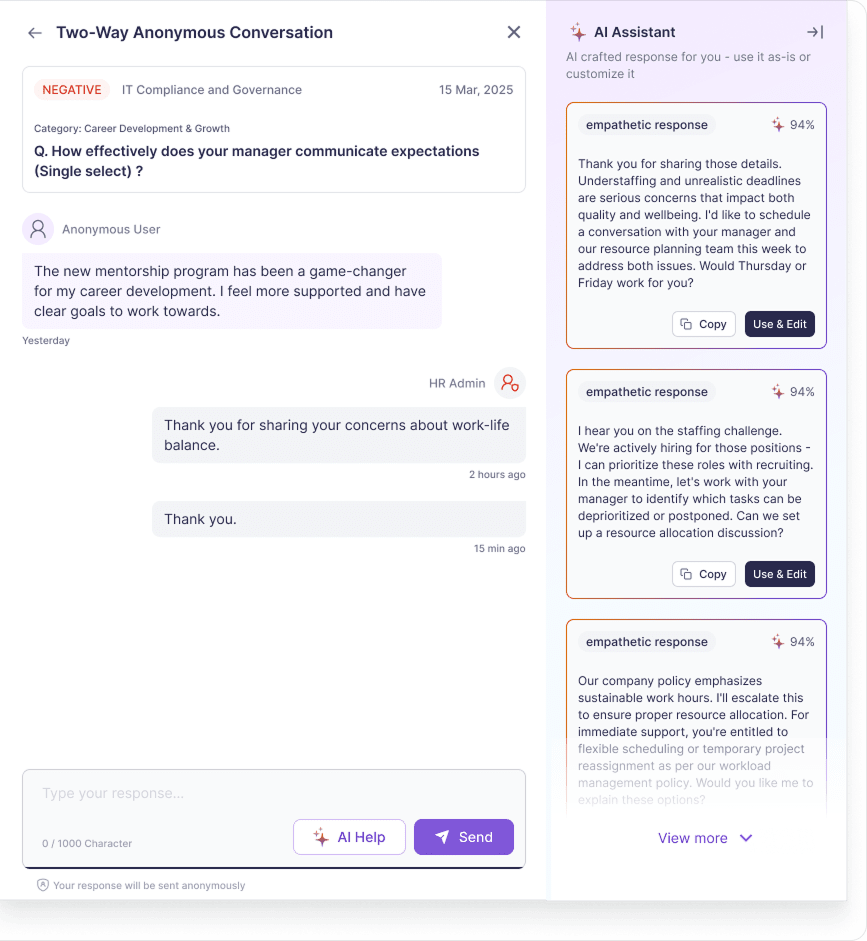
One lesson I've seen repeated over the years is that silence from new hires should never be mistaken for satisfaction. During the first few months, employees are still earning trust and learning the unwritten rules of the workplace. Anonymous surveys create the psychological safety needed to capture honest feedback before small concerns become lasting impressions.
2. Work Anniversary Surveys
Work anniversary surveys are best sent within the week of the anniversary date, when tenure-linked reflection is highest. It is the moment employees pause to think about what they have accomplished, what they have learned, and whether they still see a future with the organization.
This is also the survey most closely connected to recognition. A work anniversary survey and a recognition moment are really asking the same question from different perspectives, and that is whether the employee still feels valued.
Run the survey every year and you begin to build a meaningful record of how that answer changes over time, making it easier to spot shifts in commitment long before they show up as disengagement or attrition.
| Sample Question | Type |
|---|---|
| I feel recognized for my contributions since my last work anniversary. | |
| I have grown professionally in this role over the past year. | |
| I see a clear path for my continued growth here. | |
| I would recommend this company as a great place to work. | |
| What would make you excited to spend another year here? | Open-text |
| What is one thing that would improve your experience going forward? | Open-text |
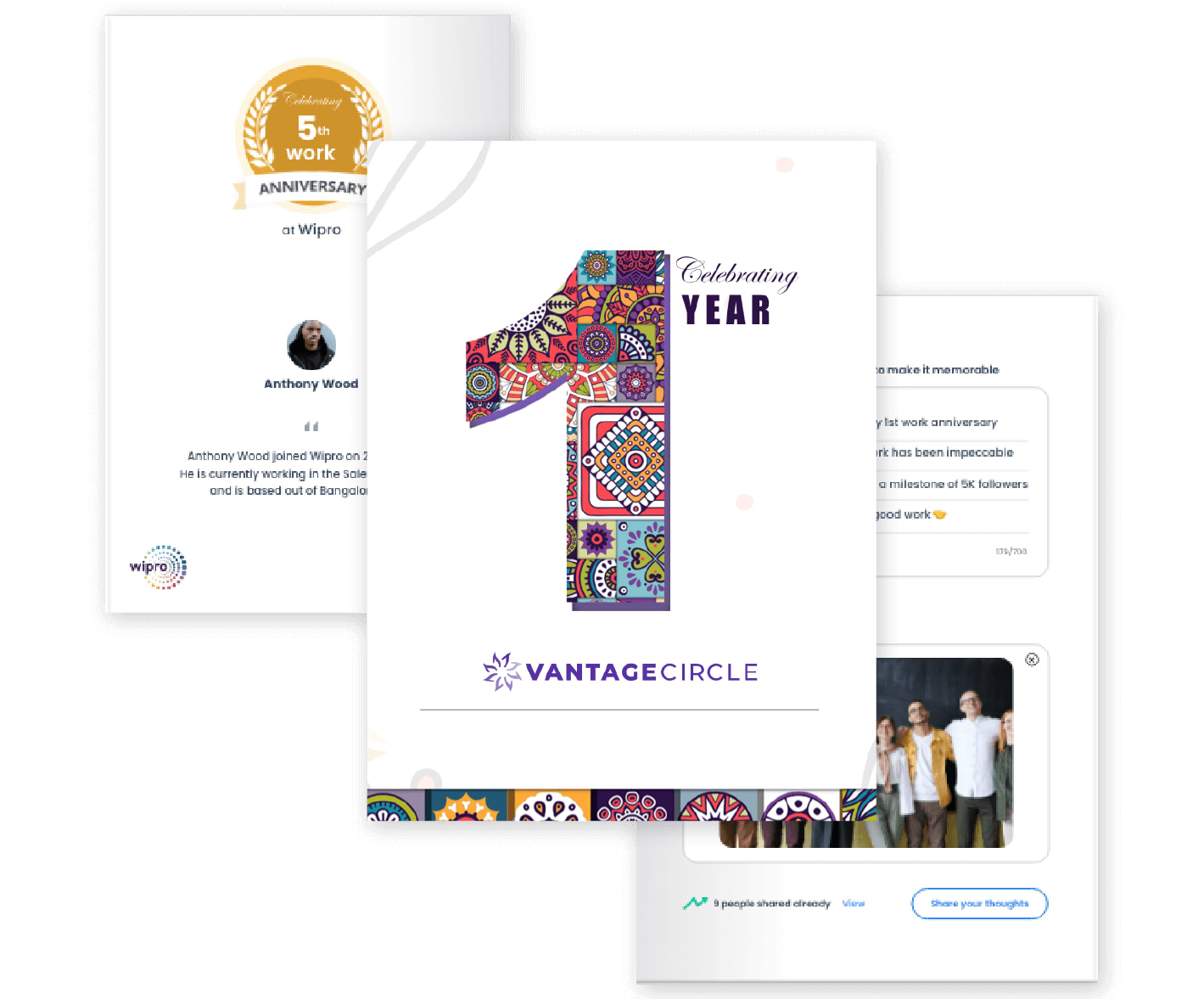
The survey is only half the conversation, though. Employees are far more likely to believe their feedback matters when it is followed by visible action. Pairing the survey with a meaningful anniversary celebration or an automated Long Service Award can turn the milestone into a moment of reflection, appreciation, and renewed commitment.
3. Appraisal & Promotion Surveys
Appraisal-stage surveys should run immediately after the review conversation, while the feedback is still fresh, not weeks later.
A performance review is one of the most emotionally charged moments in the working year. How an employee feels walking out of that conversation, whether the feedback landed as fair, whether they can see a path forward, tells you a great deal about whether they will stay. So, capture it before the feeling fades.
Keep the survey light and send it within a day or two of the review. This is a temperature check, not a second appraisal. What you are really measuring is whether the review left the person clearer and more motivated, or quietly deflated.
A promotion that lands badly, or a strong review that comes with no path attached, can push a good performer toward the door faster than a poor one. The answers here also tell you something about your managers, since a pattern of low scores under one team usually points to how the feedback was delivered rather than to the people receiving it.
| Sample Question | Type |
|---|---|
| The feedback I received felt fair and specific. | |
| I understand what I need to do to reach the next level. | |
| My manager clearly explained the reasoning behind this review. | |
| I feel supported in achieving my career goals here. | |
| What part of the review felt unclear or unfair, if any? | Open-text |
| What would help you feel more confident about your next step? | Open-text |
4. Exit Surveys
Exit surveys are your final opportunity to understand why an employee is leaving. Ask about their primary reason for leaving, the quality of management support, and whether they felt recognized. Their responses become even more valuable when compared with what they shared during onboarding and work anniversary surveys, revealing how their experience changed over time.
Unlike an exit interview, which is a live conversation suited for follow-up questions, an exit survey is a written form that encourages greater honesty and generates data you can compare across employees. The best approach is to use both together.
Send the survey after the employee gives notice but before their last day, when the experience is still fresh. Keep it short, assure confidentiality where possible, and organize questions into clear categories. This makes it easier to identify patterns and uncover the real drivers of turnover.
| Category | Sample Question | Type |
|---|---|---|
| Reasons for Leaving | What is the primary reason you are leaving this company? | Open-text |
| Reasons for Leaving | How long had you been considering leaving before you decided? | Open-text |
| Reasons for Leaving | Would you consider returning to this company in the future? | |
| Management & Support | My manager provided the support I needed to do my job well. | |
| Management & Support | I received regular, constructive feedback from my manager. | |
| Management & Support | How would you describe your relationship with your manager? | Open-text |
| Culture & Resources | I had access to the tools and resources I needed to succeed. | |
| Culture & Resources | I felt included and valued as part of the team and culture. | |
| Culture & Resources | What would you change about the culture here? | Open-text |
| Growth & Compensation | I had clear opportunities for growth and advancement here. | |
| Growth & Compensation | My compensation was fair relative to my role and the market. | |
| Growth & Compensation | What could the company have offered to keep you? | Open-text |

Vantage Influencers Podcast
HR needs to recognize and respond to different career stages and life events, not treat every employee the same way at every point in their tenure.
Featuring Tim Gregory · HR Executive, formerly Delta Air Lines
Listen to the EpisodeHow to Compare Answers Across the Employee Lifecycle
An exit survey tells you why someone left. A series of well-timed surveys tells you when they started leaving.
The framework is straightforward. Keep a small set of questions consistent across every stage of the employee lifecycle. Ask employees how supported they feel, whether they receive meaningful recognition, and whether they see a future with the organization. Then compare how those answers change over time.
The patterns are often surprisingly clear. If an employee's scores steadily decline from onboarding to their anniversary and finally to their exit, the problem has likely been building for months. If the scores remain strong until they suddenly collapse after a reorganization, a leadership change, or a missed promotion, you've identified a specific moment that altered their experience. The exit survey alone cannot tell you the difference. But looking across the employee journey can.
Imagine two employees who both leave with an exit score of 3 out of 10. One began at 9, slipped to 6 by their second anniversary, and finally reached 3 before resigning. The other stayed at 8 for years before dropping straight to 3 after a team restructure. The outcome is the same, but the diagnosis isn't. One points to a gradual erosion of the employee experience; the other points to a single event that changed everything.
The real value emerges when you compare these patterns across an entire team or department. When similar patterns emerge within a department, you're looking at an organizational issue, not an individual one. Platforms like Vantage Pulse help surface these trends through department-level insights, turning isolated survey responses into actionable workforce intelligence.
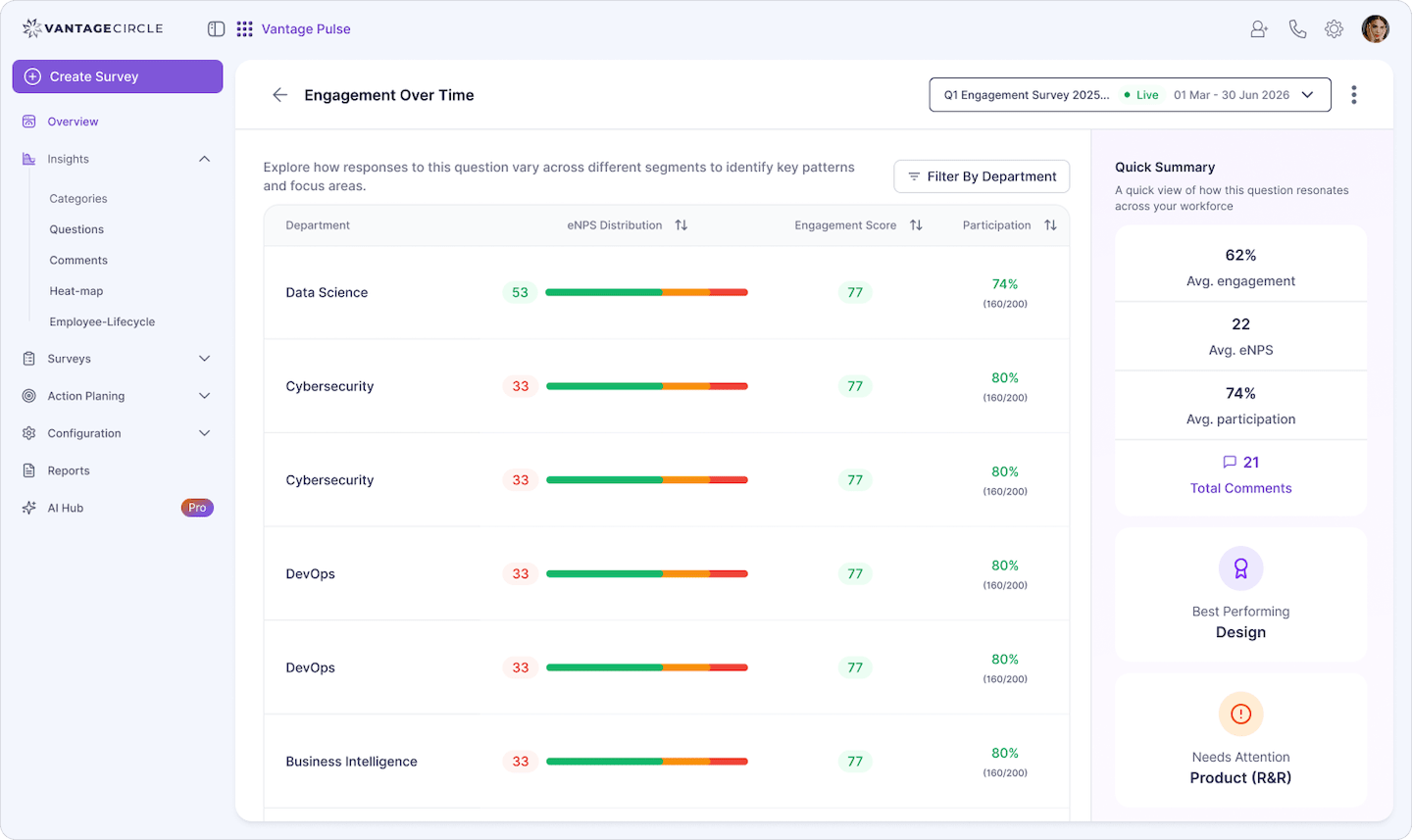
As you build each stage of your survey program, it also helps to maintain a shared set of core questions alongside stage-specific ones. That consistency is what makes meaningful comparisons possible. It turns employee feedback into a continuous record of the employee experience rather than a collection of disconnected surveys.
Conclusion
The right employee survey question depends entirely on which career moment you are measuring, so match the stage to the question set above rather than defaulting to a single annual survey.
Start with the one or two stages where you are losing people now, keep a consistent core of questions across all of them, and act visibly on what you learn so people can see that answering honestly changes something.
FAQs
What are Good Exit Questions?
Good exit questions uncover why an employee is leaving, how they experienced their manager, whether they felt recognized, and what the organization could have done differently.
What makes a Good Exit Survey?
A good exit survey is short, confidential, and focused on actionable topics like leadership, recognition, career growth, workload, and culture.
What not to say at an Exit Interview?
Avoid defensive responses, arguing with feedback, or asking employees to name individuals unless necessary. The goal is to listen objectively, thank them for their honesty, and use their insights to improve the employee experience.
What are the 5 C's of Employee Engagement?
The 5 C's of Employee Engagement are commonly defined as Care, Connect, Coach, Contribute, and Celebrate.

Shikha Gogoi is a Content Marketing Specialist focused on SEO-driven content around employee engagement, recognition, and workplace culture, helping build people-first workplaces.
Connect with Shikha on LinkedIn.