
Most organizations state equality as a value on a careers page and never check whether it holds up in outcomes. Equality in the workplace means every employee gets the same rules, the same access, and the same respect for their differences, in hiring, pay, promotion, development, and recognition. This guide covers what it actually means, its 4 core principles, how it differs from equity, the types and examples HR is most often asked to explain, how to promote it, and a short audit you can run to see whether your workplace is actually equal, not just says so.
What Is Equality in the Workplace?
Equality in the workplace means every employee gets fair treatment, equal access to opportunities, pay, and resources, and equal respect for their differences, regardless of gender, race, age, religion, disability, or background. In the United States, the Equal Employment Opportunity Commission (EEOC) enforces this under Title VII of the Civil Rights Act of 1964.
Equality is about the inputs: the same rules, the same access, the same starting line for every employee. It is the floor that inclusion at the workplace and belonging build on top of. You can give everyone an identical rulebook and still fail to make them feel like they belong, which is why equality, diversity, equity, inclusion, and belonging (DEIB) work as a set rather than as substitutes for one another. If you are unfamiliar with how those pieces fit together, our guide to what DEIB means in the workplace breaks down the full framework.
The 4 Core Principles of Workplace Equality
Workplace equality rests on 4 core principles: equal treatment, equal access, equal pay, and protection from discrimination.
| Principle | What It Means in Practice |
|---|---|
| Equal treatment | The same standards and consequences apply to every employee, regardless of role, tenure, or personal relationship with the decision-maker |
| Equal access | Every employee has the same access to information, tools, mentors, and decision-makers, not just the ones already in the loop |
| Equal pay | Employees in the same role, level, and experience band are paid the same, checked in practice, not assumed from the pay policy |
| Protection from discrimination | Hiring, discipline, and promotion decisions rest on performance and conduct alone, never on a protected characteristic, backed by a process employees can actually use |
Tying recognition to these principles, not only to output, is what turns equal treatment from a poster into a practiced behavior.
Equality vs Equity in the Workplace
Equality means giving every employee the same treatment and access. Equity means adjusting support to each employee's circumstances so outcomes end up fair. Equality is identical inputs; equity is calibrated inputs aimed at the same finish line.
| Dimension | Equality | Equity |
|---|---|---|
| What it does | Gives every employee the same treatment and access | Adjusts support to each employee's circumstances so outcomes land fair |
| A workplace example | Every new hire gets the same one-week onboarding | An employee returning from parental leave gets extra ramp-up time during that same window |
| When to use it | As the baseline for every policy and process | Where the baseline demonstrably does not land the same for everyone |
The short version: equality gives everyone a chair. Equity makes sure the chair actually fits. You need the chairs first, which is why equality is the floor and not the finish line.
The confusion comes from stopping at the input side. Give two employees the same training budget and you have treated them identically, but if one also has caregiving responsibilities that make evening sessions unusable, that budget produces two very different real opportunities. Most workplaces need both: equal rules as the baseline, and equity wherever that baseline does not land the same way for everyone. For the deeper breakdown, see our guide to workplace equity.
Types of Equality in the Workplace
Equality in the workplace shows up in 5 forms: equal opportunity, equal pay, equal treatment, equal access, and equal respect for difference.
| Type | What It Covers | Where It Breaks Down Most Often |
|---|---|---|
| Equal opportunity | Access to the same starting chances in hiring, promotion, and stretch work | How roles get sourced, and who gets considered first |
| Equal pay | The same pay for the same role, level, and experience | Negotiation-based offers and off-cycle adjustments |
| Equal treatment | The same standards, rules, and consequences applied to everyone | Enforcement that depends on who is doing the enforcing |
| Equal access | The same access to information, tools, training, and decision-makers | Access that runs through informal relationships instead of a defined process |
| Equal respect for difference | The same baseline courtesy and accommodation regardless of background | Day-to-day interactions, long before it ever shows up in a policy |
Equal Opportunity
Equal opportunity means every employee gets a genuine shot at the same roles, promotions, and stretch assignments, not just an open application form. It starts with who gets a first look before a role is ever posted internally.
Equal Pay
Equal pay means employees doing the same job at the same level are paid the same, regardless of gender, negotiation skill, or when they joined. It is the type most often assumed rather than checked, which is why closing the gender pay gap takes a deliberate review, not a policy statement.
Equal Treatment
Equal treatment means the same rules and consequences apply to everyone, including the people a manager likes working with most. It is the type that erodes fastest, since it depends on consistent enforcement rather than a written standard.
Equal Access
Equal access means every employee can reach the same information, tools, mentors, and decision-makers, instead of that access flowing through whoever already has the right relationships. It is easy to state as policy and easy to miss, since informal access rarely shows up in any system you would think to audit.
Equal Respect for Difference
Equal respect for difference means the same baseline courtesy and accommodation regardless of gender, religion, disability, or background. Gender equality in the workplace and religious diversity are both slices of this type, and both tend to break down in everyday interactions long before a written policy.
8 Examples of Equality in the Workplace
Equality in the workplace looks like structured interviews that score every candidate on the same criteria, salary bands published by role, promotion decisions reviewed for group-level gaps, and development programs open to every employee on the same terms.
| Example | What Equal Looks Like | What Unequal Looks Like |
|---|---|---|
| Hiring and interviews | Every candidate is scored against the same structured criteria | Interview questions and scoring shift from person to person |
| Pay and salary bands | Salary bands are published by role and level | Pay is negotiated case by case, with no published range |
| Promotion and stretch assignments | Promotion criteria are applied consistently and reviewed for group-level gaps | Stretch projects go to whoever a manager already has in mind |
| Access to learning and development | Every employee can enroll in the same training and mentorship programs | Development budget quietly follows tenure or personal rapport with a manager |
| Meeting participation and airtime | Every voice gets a turn, and interruptions are managed the same way for everyone | The same few people dominate discussion while others get talked over |
| Recognition and rewards | Recognition is distributed on the basis of contribution and checked across teams | Recognition clusters around whoever is already visible to one manager |
| Workplace accommodations | Disability, religious, and caregiving accommodation requests follow one documented process | Accommodations depend on which manager you happen to ask |
| Scheduling and flexibility | Flexible-work policy applies the same way regardless of role or seniority | Flexibility is granted informally to some employees and denied to others doing the same job |
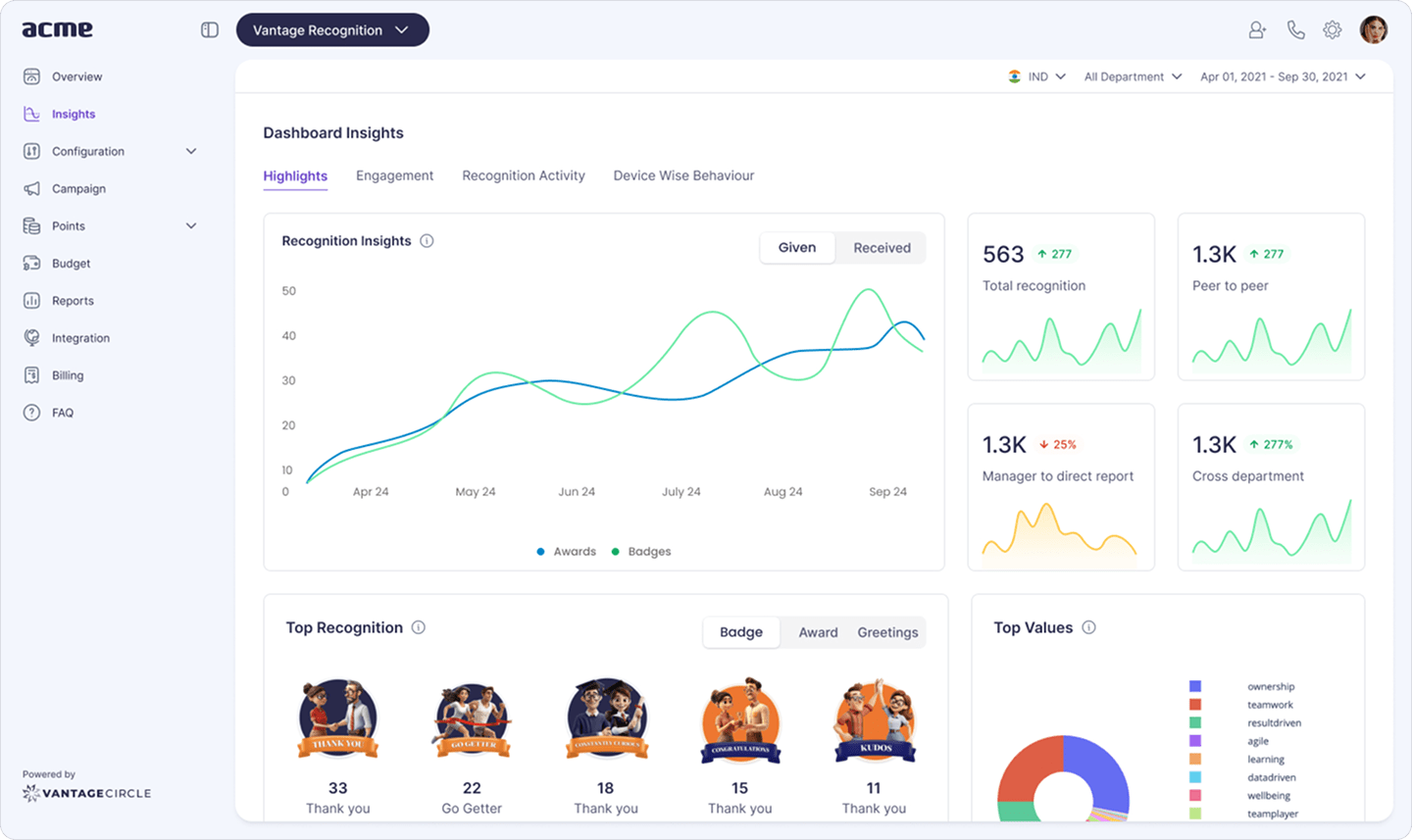
Recognition is one example that is easy to state and hard to verify. Vantage Recognition's insights dashboard shows whether appreciation is actually reaching employees evenly across departments and tenure bands, or concentrating in the teams a few managers already notice.
Why Equality in the Workplace Matters
Equality in the workplace matters because it widens the talent pool, reduces costly turnover and legal exposure, and raises discretionary effort, since employees who believe the playing field is level invest more in the outcome.
Companies in the top quartile for gender diversity on their executive teams were 39% more likely to financially outperform bottom-quartile peers in 2023, up from 15% in 2015, and the same 39% gap held for top-quartile ethnic representation (McKinsey, Diversity Matters Even More, November 2023). That gap has widened over time, not narrowed.
Fair treatment shows up directly in engagement, too. Employees who strongly agree they receive fair and equitable recognition are six times as likely to say their organization is fair to everyone, and seven times as likely to say they have adequate opportunities for advancement (Gallup, in partnership with Workhuman, October 2022). It is exactly why employee engagement and fairness perception need to be tracked together.
The legal exposure is real as well. The EEOC received 88,531 discrimination charges in fiscal year 2024, up more than 9% from the previous year, and secured almost $700 million for over 21,000 workers, the highest recovery in the agency's recent history (EEOC, FY2024 Annual Performance Report). An unaudited pay or promotion process is a live liability, not a theoretical one.
How to Promote Equality in the Workplace
Promote equality by removing bias from hiring, pay, and promotion decisions, auditing outcomes rather than policies, and giving every employee equal access to development and recognition.
Standardize Hiring and Interviews
Score every candidate against the same structured criteria, in the same order, before comparing notes as a panel. Structured interviews are one of the simplest ways to catch a hiring process that quietly favors candidates who remind the interviewer of themselves.
Publish Pay Bands and Run Regular Pay-Equity Checks
Publish salary bands by role and level, and check compensation against them at least once a year, not only when someone raises a complaint. Most HR teams still have room here: only 61% of HR leaders say they conduct pay equity audits at all, and just 54% of those review pay annually once they start (SHRM, March 2025). Closing the gender pay gap specifically usually starts with this exact audit.
Review Promotion and Project-Assignment Outcomes by Group
Look at who actually gets promoted and who gets the stretch assignments, broken out by group, not just at the overall rate. A process can look fair in aggregate and still be quietly uneven for one team once you segment it.
Open Development and Mentorship to Everyone on the Same Terms
Make training, mentorship, and stretch opportunities available on the same terms to every employee, instead of letting them flow informally to whoever a manager already sponsors. Representation in the hiring pipeline only holds if the development pipeline behind it, backed by diversity and inclusion programs, is just as open.
Distribute Recognition Deliberately, Not by Manager Habit
Manager recognition is the most bias-prone channel, because it runs on one person's line of sight. Opening a peer-to-peer channel alongside it widens who can be seen and recognized. Across Vantage Circle customer accounts, recognition and reward-point activity is rarely as evenly distributed as the policy assumes, it tends to concentrate in the teams and individuals a handful of managers already notice, which is exactly why checking the distribution catches what a policy review cannot.
Put a Written Equality Plan and an Owner in Place
Write down the plan, from recruitment through pay and promotion, and assign a specific person to report on it every quarter. A plan with no owner tends to quietly slip; a named owner and a fixed cadence gets it treated like a missed revenue number.
How to Check Whether Your Workplace Is Actually Equal
Check workplace equality by comparing outcomes, not policies: pay by role and level across groups, promotion rates by group, recognition distribution, and a fairness-perception score from an anonymous pulse.
| What to Check | How to Check It | Warning Sign |
|---|---|---|
| Pay by role and level | Compare compensation across groups within the same role and level, not company-wide averages | A gap only appears once you segment the data, not in the topline number |
| Promotion rates by group | Track who gets promoted from each level, by group, across multiple review cycles | One group is consistently slower to advance despite similar tenure and performance |
| Recognition distribution | Pull recognition and reward-point data by department, tenure, and seniority | Recognition concentrates in a handful of teams or individuals a few managers already notice |
| Fairness perception | Run an anonymous pulse question asking directly whether employees believe they have an equal shot | Scores diverge sharply by team while the company-wide average looks fine |
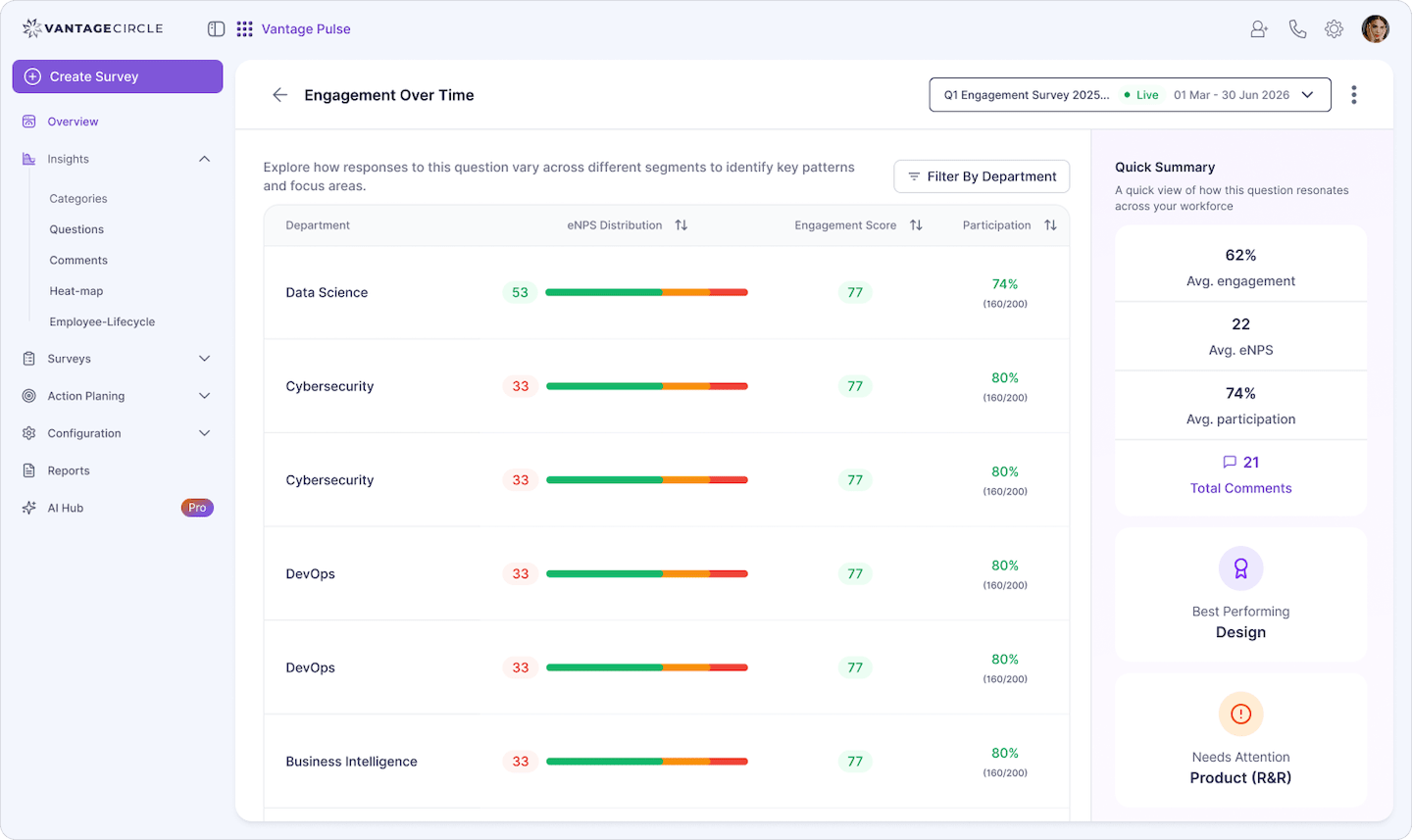
A policy audit cannot tell you whether employees believe the outcomes are actually fair, only an anonymous Vantage Pulse survey can. Across Vantage Pulse benchmark data, employees who report believing they have equal access to opportunities consistently score higher on every other engagement dimension than employees who do not, which is why that one fairness question belongs on a regular pulse survey cycle, not just the annual engagement survey.
Run this checklist this quarter, and treat any gap that shows up in more than one check as the one to fix first.
- Pull pay by role and level, segmented by group, not just the company average.
- Compare promotion rates by group over the last two review cycles.
- Pull recognition and reward-point distribution by department, tenure, and seniority.
- Run one anonymous pulse question asking whether employees believe they have an equal shot at opportunities.
- Line up all four side by side. A gap that shows up in more than one is the one to act on first.
What Unequal Treatment Looks Like, and What to Do
Unequal treatment at work means being disadvantaged in hiring, pay, assignments, discipline, or promotion because of a protected characteristic rather than performance.
Three steps matter more than the rest. Document specifics as they happen, including dates, what was said, and who else was present. Raise it through a formal channel, your manager, HR, or an ethics line, rather than only mentioning it informally. And know that the EEOC complaint route exists if the internal process goes nowhere. Our guide to discrimination in the workplace covers the legal threshold in more detail.
Frequently Asked Questions
What does equality in the workplace mean?
Equality in the workplace means every employee gets fair treatment, equal access to opportunities, pay, and resources, and equal respect for their differences, regardless of gender, race, age, religion, disability, or background.
What are examples of equality in the workplace?
Examples include structured interviews scored on the same criteria for every candidate, published salary bands by role, promotion decisions reviewed for group-level gaps, and development programs open to every employee on the same terms.
What is unfair treatment at work?
Unfair treatment at work means being disadvantaged in hiring, pay, assignments, discipline, or promotion because of a protected characteristic rather than performance or conduct.
What is the difference between equality and equity in the workplace?
Equality means giving every employee the same treatment and access. Equity means adjusting support to each employee's circumstances so outcomes end up fair. See our full breakdown of workplace equity for the deeper version of this distinction.
The Bottom Line
Stating that your company values equality is not the same as checking whether it holds up in outcomes. The organizations that get this right treat equal pay, equal access, and equal recognition as numbers to audit on a schedule, not values to state once in a handbook and revisit only when someone complains.

Lupamudra is a content marketing specialist at Vantage Circle, where she has written 50+ articles on employee recognition, rewards, and workplace culture, alongside employee engagement, diversity and inclusion, and HR compliance topics, including how India's tax rules apply to recognition and rewards programs.
Connect with Lupamudra on LinkedIn.