Count the decisions a team lead makes before lunch on an ordinary Tuesday. Which ticket goes first. Whether a $200 refund needs her sign-off. Who covers Friday's late shift. Whether the client deck goes out today or after one more review. The tally passes a few dozen before noon. The afternoon brings its own.
By 5 p.m. she is still deciding, just not as well. The refund she would have questioned at 10 a.m. goes through with a thumbs-up. The shift question gets pushed to Monday. Psychologists call that slide decision fatigue.
Very few of those calls needed her. Cutting the pile is the fix with the strongest evidence behind it. It starts with how your team handles decision-making at work.
Key Takeaways
- Decision fatigue is real enough to show up in data from doctors, judges, bank officers and stock analysts.
- The "willpower is a fuel tank" explanation has not survived large replication attempts.
- Managers carry the heaviest load because approvals and exceptions route through them.
- Sorting your decisions into decide once, delegate, automate and keep removes most of the pile.
- Recurring calls like milestone awards are the easiest ones to take off a manager's plate for good.
What Is Decision Fatigue?
Decision fatigue is the drop in the quality of a person's decisions after a long stretch of making them. As the hours pile up, people lean on defaults and push choices to tomorrow. Some approve whatever ends the conversation fastest. At work, it shows up most in roles where small calls queue up all day.
In psychology, decision fatigue is a decline in the ability to make choices and regulate behavior after a run of earlier decisions. Grant Pignatiello and two colleagues reviewed 17 studies on it in a 2018 concept analysis. The most visible signs they describe are behavioral. People put decisions off or go passive. Many fall back on the default option.
Their review also lists what feeds it. A long series of decisions is the obvious one. Time of day and lack of sleep show up too.
The idea grew out of Roy Baumeister's willpower research in the late 1990s. It reached a wide audience in August 2011 through John Tierney's New York Times Magazine story on the subject. Baumeister and Tierney published Willpower together later that year.
Decision Fatigue vs Decision Overload vs Analysis Paralysis vs Choice Overload
These four terms describe four different moments. The table below pins each one down.
| Term | What happens | Typical work example | Quick fix |
|---|---|---|---|
| Decision fatigue | Judgment slips after many decisions in a row | Waving through the last five expense claims at 5:30 p.m. | Move hard calls to the morning |
| Decision overload | One person receives more decisions than they can handle well | Every leave request, refund and shift swap routes to a single team lead | Hand routine calls to the team |
| Analysis paralysis | Overthinking one choice until it stalls | Three meetings about which survey tool to buy | Set a deadline and a "good enough" bar |
| Choice overload | Too many options for one choice | A 40-item reward catalog where nobody picks anything | Trim it to a shortlist |
Decision overload is usually where decision fatigue starts. A lead who fields questions from eight people all day is running on fumes by mid-afternoon.
6 Common Signs of Decision Fatigue at Work
"Whatever you think" is the clearest sign. When a manager says it to a question that deserves an opinion, the tank is usually empty for the day.
- "Whatever you think." Once in a day is fine. Six times after 3 p.m. means the manager has stopped weighing in.
- Decisions slide to "let's pick this up Monday." By Monday, new ones have stacked on top.
- The status quo wins by default. The same vendor gets renewed. The old process survives another quarter because changing it means one more decision.
- Snap approvals. A request that would get three questions at 10 a.m. gets a thumbs-up emoji at 5 p.m.
- Short fuses in late meetings. Small disagreements feel bigger than they are.
- Second-guessing tiny calls. Rereading a two-line email four times before sending it.
The end-of-day approval queue
Sign-offs saved for "when I'm free" usually land after 4 p.m. That is the end of a long session, the slot where the studies below found the weakest calls. If your approvals pile up there, move a block of them to the morning.
The signs are easy to miss in yourself. Your team usually notices first. An anonymous question in Vantage Pulse such as "Where do decisions get stuck waiting for one person?" gets franker answers than a team meeting will.
Is Decision Fatigue Real? What the Evidence Says
The pattern shows up in real workplaces. The popular explanation for it, that willpower drains like fuel, has not held up well.
The study everyone cites involves parole judges. Shai Danziger, Jonathan Levav and Liora Avnaim-Pesso tracked more than 1,100 rulings by Israeli judges (PNAS, 2011). Favorable rulings started near 65% at the start of each session. By the next meal break they had fallen close to zero. After the break, they jumped back up.
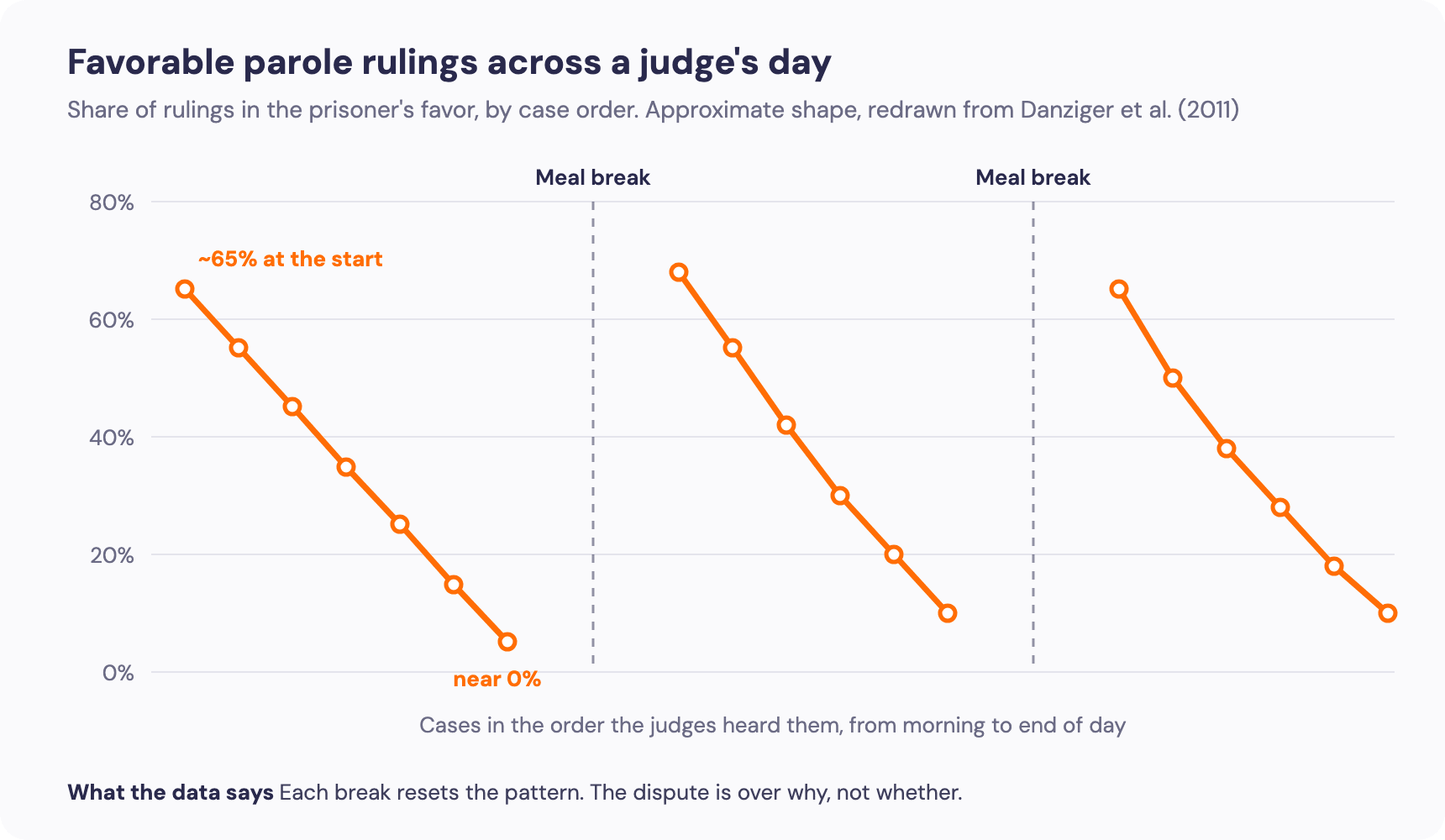
Source: Vantage Circle, redrawn from Danziger et al., PNAS, 2011
Keren Weinshall-Margel and John Shapard challenged the study the same year. They argued that case order wasn't random. Prisoners without a lawyer, for example, tended to appear late in a session. The original authors replied that case order and the meal break still predicted rulings in their reanalysis.
The lab evidence looks weaker. In 2016, 23 labs ran the same ego-depletion test on 2,141 people. The effect came out at d = 0.04, close to zero (Hagger et al., Perspectives on Psychological Science). Kathleen Vohs, a longtime Baumeister collaborator, led a second test across 36 labs. It found no reliable effect either (Vohs et al., Psychological Science, 2021).
Field data tells a different story. At Brigham and Women's Hospital in Boston, a team led by Jeffrey Linder studied 21,867 visits for acute respiratory infections. Antibiotic prescribing rose hour by hour through each four-hour clinic session (JAMA Internal Medicine, 2014). In the fourth hour, the odds of a prescription were 26% higher than in the first.
Stock analysts show it too. David Hirshleifer and three co-authors found forecasts get less accurate with every forecast an analyst has already issued that day (NBER paper, later published in the Journal of Financial Economics, 2019). Later forecasts also hug the consensus more closely.
Then there's banking. At one major bank, 30 credit officers handled 26,501 loan restructuring requests over a month. Approvals dipped around midday and recovered later (Baer and Schnall, Royal Society Open Science, 2021). The authors estimated the cost at $509,023 in lost repayments for that one month.
Doctors
26%
higher odds of an antibiotic prescription in the fourth hour of a clinic session than in the first
Linder et al., 2014
Stock analysts
Every forecast
already issued that day made the next one less accurate and closer to the consensus
Hirshleifer et al., 2019
Bank credit officers
$509,023
estimated lost repayments in one month, linked to the midday dip in loan approvals
Baer and Schnall, 2021
| Claim | What the evidence shows | How confident to be |
|---|---|---|
| Judges rule harsher as a session wears on | Strong pattern in one dataset, with a live dispute over case order¹ | Moderate |
| Willpower runs out like fuel | Two large multi-lab replications found no reliable effect² | Low |
| Sugar restores decision-making power | A 2016 meta-analysis found the glucose studies show signs of reporting bias³ | Low |
| Decision quality drifts during long work sessions | Seen in doctors, stock analysts and bank officers⁴ | Fairly high |
| A break resets the pattern | Clear in the judge data, suggestive in the bank data, rarely tested directly⁵ | Moderate |
Sources: ¹ Danziger et al. 2011; Weinshall-Margel and Shapard 2011. ² Hagger et al. 2016; Vohs et al. 2021. ³ Vadillo, Gold and Osman, Psychological Science, 2016. ⁴ Linder et al. 2014; Hirshleifer et al. 2019; Baer and Schnall 2021. ⁵ Danziger et al. 2011; Baer and Schnall 2021.
I went back and forth on how much of this section to keep. Most readers came for the fixes. I kept it because the fixes make more sense once the snack-and-nap advice is off the table.
For a manager, the argument over mechanisms changes very little. Whatever the cause, the last calls of a long session get the least care.
What Causes Decision Fatigue?
Volume is the main cause. Too many decisions land on one person with no recovery between them.
Unclear ownership keeps the volume high. When nobody knows who owns a call, it escalates by default. Missing defaults do the same thing more quietly. The same kind of request gets decided from scratch every week. Then come interruptions. A manager pulled out of a budget review to answer a scheduling question pays a price to switch back.
One McKinsey number shows how much of that load is admin. Middle managers say they spend nearly a full day every week on administrative work. Nearly half their working time goes to tasks that aren't managing at all. Both figures come from McKinsey's 2023 survey of more than 700 middle managers.
Habits make it worse. A manager who reviews every step teaches the team to bring every step to them. Our guide to micromanagement covers how that loop gets started.
Decision Fatigue in Leaders and Managers
Managers carry the heaviest decision load on most teams. Approvals and exceptions route through them, plus every quick question nobody else wants to own.
Three in four HR leaders say their managers are overwhelmed by how much the role has grown. The figure comes from Gartner's July 2024 survey of 805 HR leaders. Note who answered. HR leaders rated the managers. The managers themselves weren't asked.
Founders and CEOs often deal with it by deleting whole categories of choice. Barack Obama told Michael Lewis he wore only gray or blue suits as president (Vanity Fair, 2012). "I'm trying to pare down decisions," he said.
A manager's version of the gray suit is structural. It means deciding which questions never reach your desk at all.
Left alone, the load becomes one of the quieter routes to manager burnout. Higher up the org chart, it feeds leadership burnout.
How to Reduce Decision Fatigue at Work: 6 Practical Moves
The most reliable fix is to make fewer decisions. Decide recurring calls once and hand routine ones to the team. Let software handle anything that runs on a schedule. Keep the hard calls for the hours when you're fresh.
1. Sort your decisions: decide once, delegate, automate, keep
Take 20 minutes with last week's calendar and inbox. Write down every decision you made, including the tiny ones. Then give each one a label.
Decide once covers questions that keep coming back with the same answer. Write the answer down and share it.
Delegate is for calls where someone closer to the work knows more than you do.
Anything that happens on a date or follows a fixed rule goes under automate.
Keep is whatever is left. For most managers it's a short list. That list is where the job actually is.
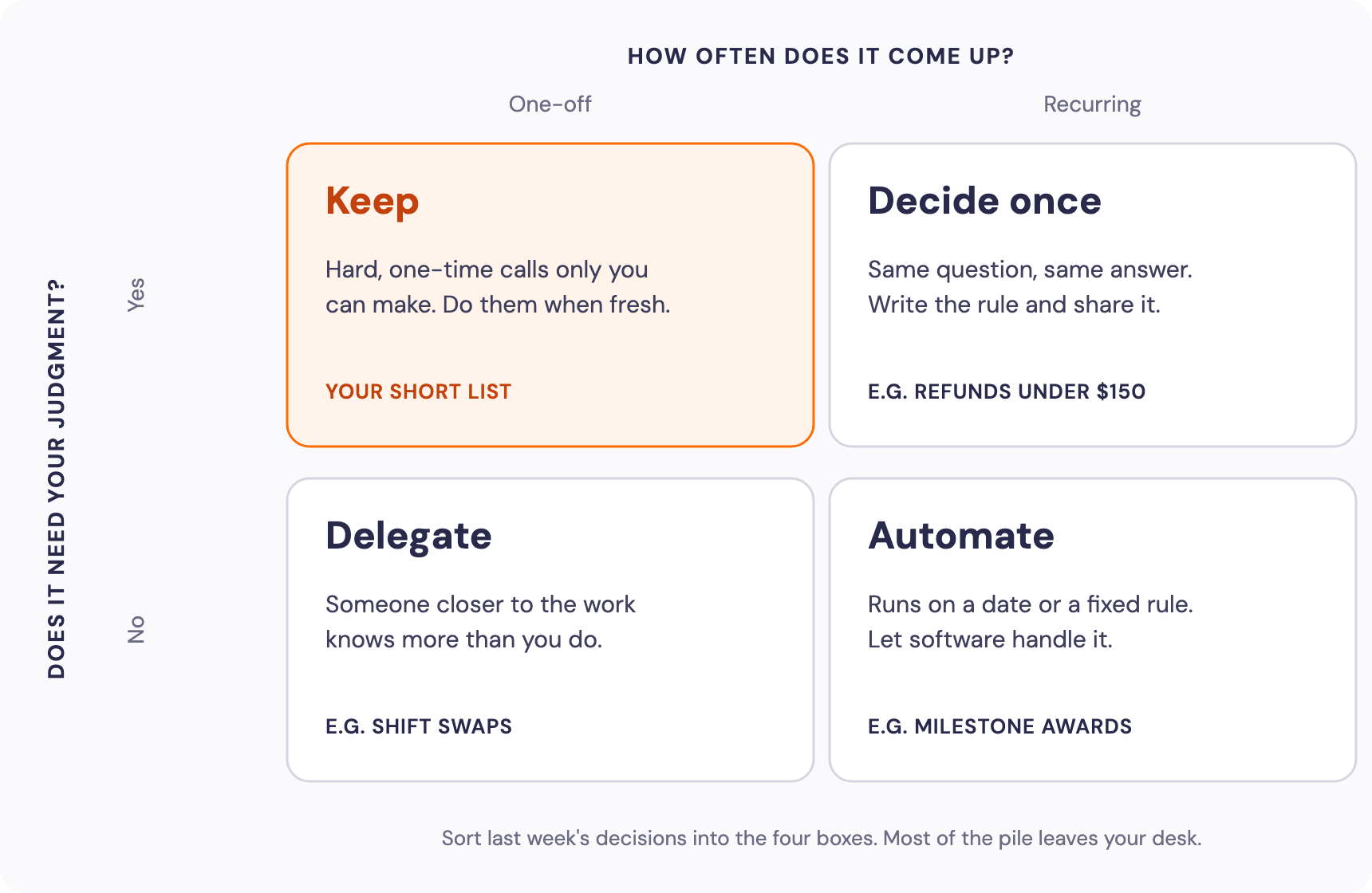
Source: Vantage Circle
2. Push routine decisions down
Sixty-one percent of managers say at least half their decision-making time is used ineffectively. McKinsey found that in its 2019 survey of more than 1,200 managers. One CEO in that research was still making hiring calls four levels below him.
Siddhartha Das, Head of HR Operations for Global People Services at Reckitt, names the calls that should move first.

VANTAGE INFLUENCERS PODCAST
"There could be certain decisions which can be decentralized and these are [primarily] around processes and systems in a BAU environment, which is like business as usual environment."
Siddhartha Das, Head of HR Operations for Global People Services, Reckitt
Listen to the EpisodeRecognition is an easy place to start. With peer-to-peer recognition, the manager stops being the only person who decides who gets thanked. Teams that already have real autonomy in the workplace take to this quickly.
3. Set decision rules your team can use without you
A rule turns a recurring decision into a lookup. "Refunds under $150 don't need my sign-off" removes a whole category from your day.
Elizebeth Mack, Principal and Workforce in Transactions Leader at BDO USA, works with companies going through mergers and acquisitions. Leaders in a deal often don't have answers for months. Her advice for that situation applies to any team.

VANTAGE INFLUENCERS PODCAST
"The critical piece is to communicate that you don't necessarily have the answers, but here's the decision-making framework you're using. And what we love to do is identify some guiding principles."
Elizebeth Mack, Principal and Workforce in Transactions Leader, BDO USA
Listen to the EpisodeCompany values can work the same way. When award categories in Vantage Rewards are tied to values, "Did this show ownership?" is a faster question to answer than "Is this worth recognizing?"
4. Automate the recurring calls
Anything that happens on a date or a rule shouldn't need a fresh decision. Recognition is a good test case. Many companies still run it by hand.
72% of Alberta organizations still manage recognition manually, and only 9% use a fully digital platform, according to Reimagining Recognition (CPHR Alberta × Vantage Circle, 2025).
Every manual program depends on someone remembering a date and choosing a reward each time. A manager with ten direct reports has 20 work anniversaries and birthdays a year to track. In Vantage Rewards, automated milestone awards go out on the date with the award already set. Managers also get a recognition budget up front. They decide who deserves recognition. Whether they're allowed to give it is already settled.
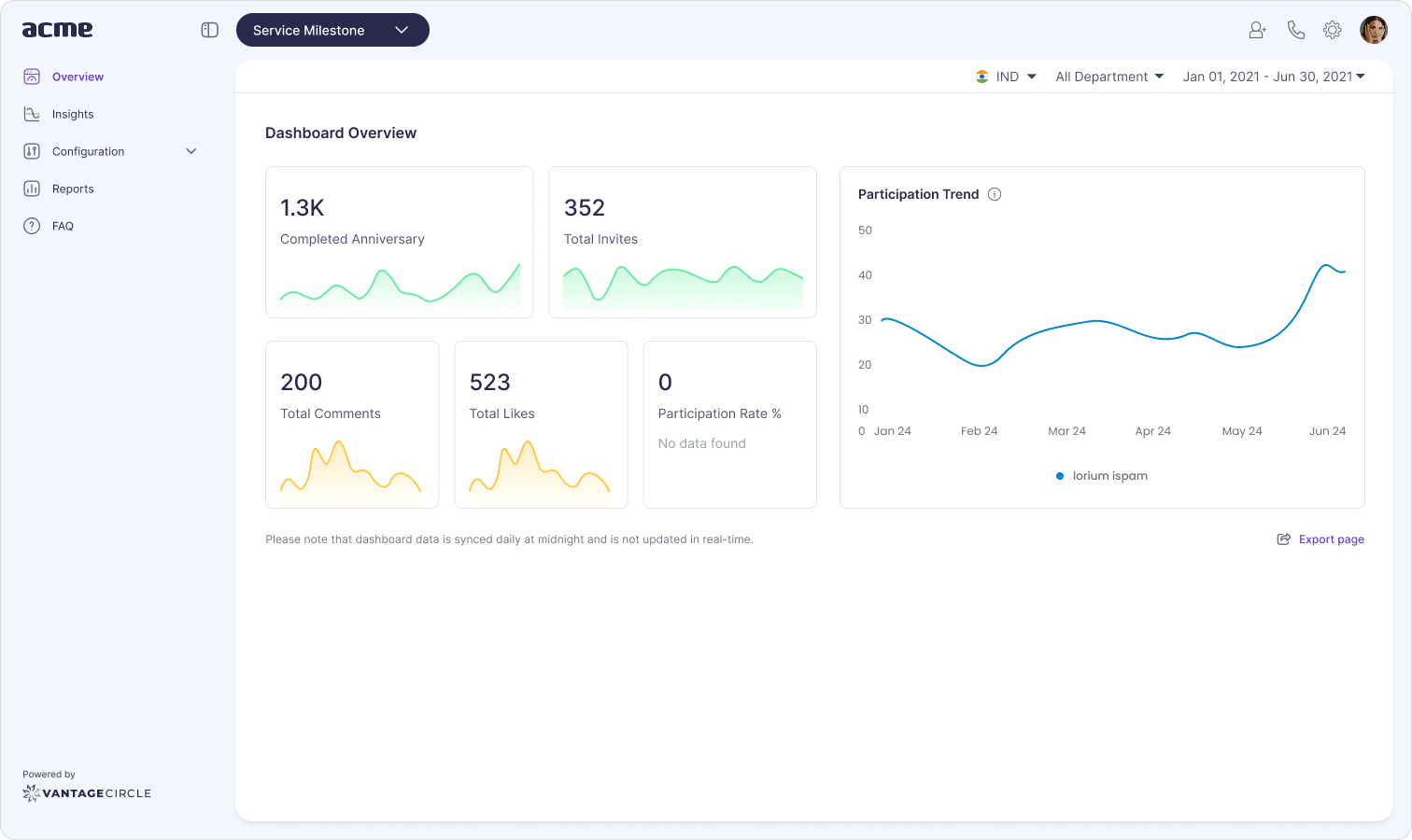
Source: Vantage Rewards
5. Put the hard calls first and batch the small ones
Remember the prescribing data. The fourth hour of a session got the worst calls.
Book the hiring decision or the budget cut for your first hour. Put expense approvals in one 20-minute slot after lunch. More time management techniques help here, especially time blocking.
6. Protect recovery between decision blocks
In the parole data, favorable rulings recovered after each meal break. Ten minutes away from the screen between decision-heavy blocks is the cheapest fix on this list.
People want that protected time. Work-life balance benefits such as technology-free hours ranked as employees' third most valued benefit. That comes from Aon's 2025 Human Capital Employee Sentiment Study of more than 9,000 employees in 23 geographies.
A five-question decision audit for this week
- Which decisions did I make more than twice this week with the same answer?
- Which ones did someone on my team know more about than I did?
- Which happened on a fixed date?
- Which did I make after 4 p.m.? Would I make them the same way at 10 a.m.?
- What one rule would remove the most questions from my inbox next week?
Conclusion
Most decision fatigue at work is built into how the work is set up. Change the setup and the tired, late-afternoon version of your team has fewer calls to make.
Run the five-question audit this week. Hand off two recurring decisions by Friday.
FAQs About Decision Fatigue
What is mental fatigue?
Mental fatigue is the tired, foggy feeling after long periods of focused thinking. Decision fatigue is one specific kind. If it lasts for weeks, look at workload and employee burnout. A doctor is the right next call.
How to deal with extreme indecisiveness?
Shrink the choice to two options and give yourself a deadline. Then pick the one you can defend in a single sentence.
What are the symptoms of decision fatigue?
Putting decisions off is the most common one. Snap approvals late in the day come a close second.
What are examples of decision fatigue?
A doctor prescribing more antibiotics late in a clinic session. A manager approving every request after 5 p.m. without reading it.
How do you overcome decision fatigue?
Make fewer decisions. Start with the recurring ones.

He has worked in the human resources environment and has elevated recognition and rewards through his insightful and detailed writing. He aims to enhance the practice of Recognition in the workplace with new ideas and innovation that will help shape the work culture. For any related queries, contact editor@vantagecircle.com