Most management by objectives programs I've audited look healthy in January. Objectives get agreed, signed and filed in the HR system. Then nobody opens that file again until the year-end review. By then the targets have quietly turned into a bonus negotiation.
So this one's for the HR leads and people managers still running objective-based reviews, or a bonus plan bolted on top of them. I'll go through the five steps first. Then four objective sheets I'd actually hand a manager. After that, where management by objectives breaks, plus the reward fix I keep coming back to: stop paying people for safe targets.
What Is Management by Objectives (MBO)?
Management by objectives (MBO): A performance-management approach where a manager and an employee agree on a few specific, measurable objectives, check progress through the cycle, and judge performance on the results at the end.
Drucker coined the phrase back in 1954, in The Practice of Management, and older textbooks sometimes call it management by planning (MBP).
In practice, it changes the question a manager asks at review time. "Were you busy?" stops mattering much. The question becomes whether the agreed result showed up.
Peter Drucker's Original Idea
Drucker's full phrase was "management by objectives and self-control." The second half gets dropped from most HR decks, and it's the part doing the heavy lifting.
If I helped write my own target, I don't need a manager hovering while I go after it. I know what done looks like, because I wrote half of it. Hand me an objective I never discussed, though, and it's an instruction with a deadline stapled on.
The Core Principles of Management by Objectives
Six principles show up in almost every working version of MBO.
- Cascading objectives. Company goals get carved up until every person holds a piece of one.
- Joint goal setting. The employee has a real say in both the objective and the target. This is what makes management by objectives a participative management style.
- Measurable results. Numbers, mostly. Or a plain yes/no, like "new payroll system live by March."
- A fixed time frame. Usually a year. Sometimes a half.
- Ongoing feedback. Managers look in during the cycle, usually monthly, because a December-only conversation can't change a single result.
- Results-based evaluation. At review time you hold the outcome up against the target you both signed.
How Does the Management by Objectives Process Work? 5 Sequential Steps
The management by objectives process has five steps, run in order, and the last one loops back into the next cycle.
I've watched teams skip step 3 because it's the slow one. They end up handing out targets from the top and still writing MBO on the folder.
Step 1: Define Organizational Objectives
Leadership picks the company objectives first. Each gets a measure and one person's name on it. Three to five is plenty. Revenue growth. A retention number. A product launch date.
Go past five and the cascade below usually turns to mush by spring.
Step 2: Cascade Objectives to Departments and Teams
Each department rewrites the company objectives in terms of what it can actually move. Say the company wants better retention. HR ends up owning regretted attrition, and Customer Success owns renewals. Managers then set team goals that sit between those department numbers and each person's sheet.
One check I like. Ask any team lead which company objective their goal feeds. A pause, or a vague answer about "growth," usually means the cascade broke somewhere above them.
Step 3: Agree Individual Objectives With Each Employee
Agree each person's objectives with them, face to face, one person at a time. The manager brings the team objective. The employee brings a view on what's realistic and what they'd need to get there. By the end there are three to five objectives on the sheet, and the weights add up to 100%.
Employee involvement carries real weight at this step. McKinsey's 2024 performance management survey of roughly 1,200 employees in 11 countries found people felt more motivated, and rated the whole system as fairer, when they were involved in setting their goals. Goals updated during the year scored better too. Across the sample, 72% named goal setting as a strong motivator.
Why the A in SMART originally meant "Assignable"
SMART goes back to a 1981 Management Review article by George T. Doran. In his version the A was Assignable, sitting between Measurable and Realistic. Assignable just meant somebody's name goes on it. Somewhere along the way templates switched to "Achievable," and nobody asks who owns the thing anymore. Worth checking your own SMART goals template for an owner field.
Step 4: Monitor Progress and Give Feedback at Check-ins
Most management by objectives cycles break at this step. Objectives get agreed in January and discussed again in December. The employee spends eleven months guessing.
The same McKinsey survey puts a number on the cost. Only 21% of respondents who had no development conversations felt motivated by their company's performance management. Give people ongoing feedback and that jumps to 77%.
Twenty minutes a month is enough, honestly. Where are you against target? What has changed since we set it?
That second question is the one managers skip. And it's the one that keeps an objective honest when the market moves.
Silence between check-ins costs more than most managers think. In The Recognition Effect, a study of 5.7M+ employees by Great Place To Work® India and Vantage Circle, 96% of employees who felt all four recognition signals were motivated. Among those who felt none, motivation fell to 8%. Retention followed the same curve, from 97% down to 10%.
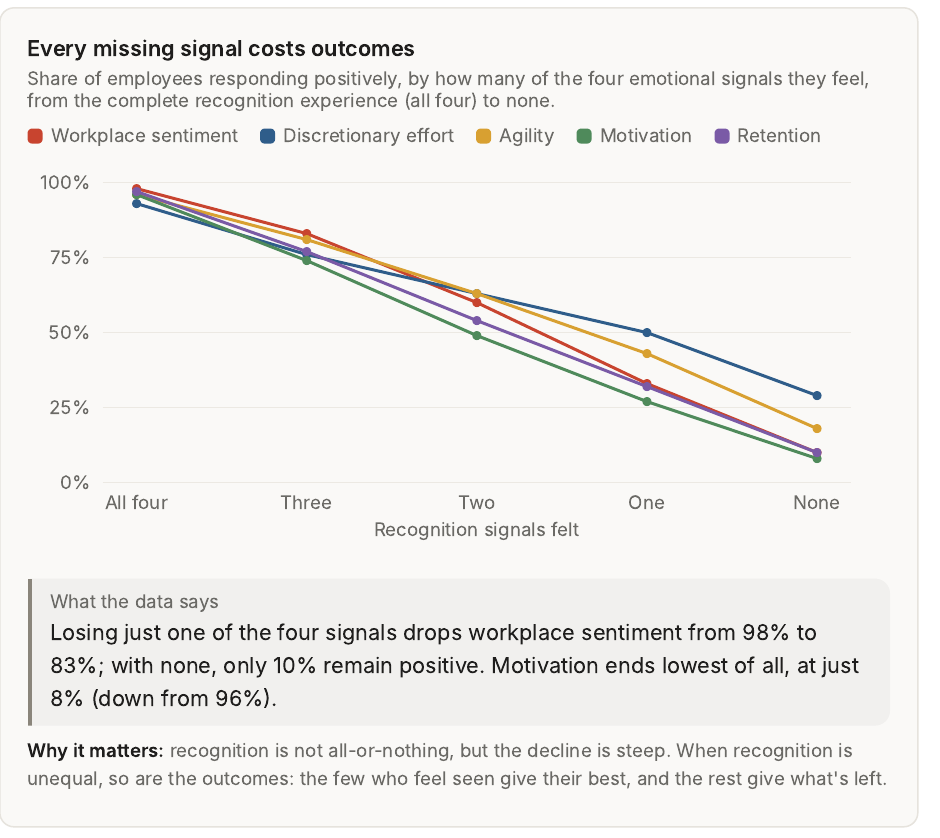
Source: The Recognition Effect, Great Place To Work® India × Vantage Circle, 2025.
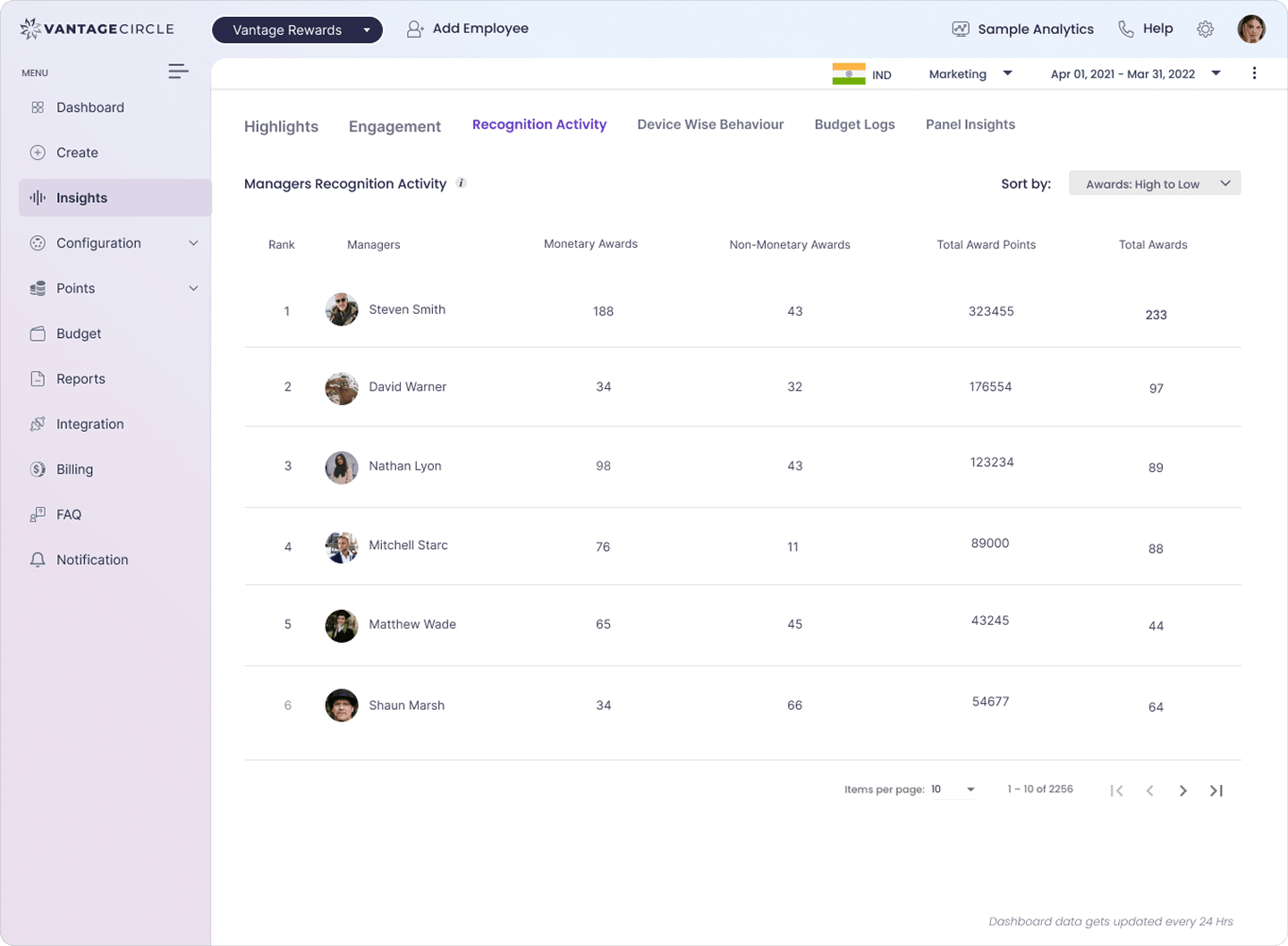
I'd also use the check-in to thank people for progress. Someone clears a milestone in May, hears about it in May, and still has seven months to build on it. With Vantage Rewards, HR can also see which managers are actually giving that mid-cycle recognition through the manager recognition report.
Step 5: Evaluate Results and Reward Performance
At cycle end, you score each objective by its weight. A rep who hit 92% of an ARR target weighted at 50% banks 46 points, for example. The total goes into the performance review and, at plenty of companies, straight into the bonus.
One process detail deserves more attention than it gets. Iris Bohnet's team at Harvard Kennedy School got an accidental natural experiment out of a multinational financial firm. In 2016 a glitch kept employees' self-evaluations hidden from their managers. That year, manager ratings tracked self-ratings far less closely than usual. Bohnet and her co-authors published it in 2025 in the Journal of Economic Behavior & Organization. My fix is boring but it works: managers write their score first, then open the self-assessment.
Favoritism tends to show up at award time, in the big end-of-cycle awards. A small panel reading nominations against written criteria fixes most of it. It also holds up when Finance asks why Sales got three awards and Ops got none.
Management by Objectives Examples: 4 Worked Objective Sheets
Each objective in the four sheets below carries an outcome, a number, a date, an owner and a review rhythm. The four sheets below are illustrative. Swap in your own numbers.
| Function | Objective | KPI / Measure | Target & Deadline | Weighting | Check-in Cadence | Paid vs Recognized |
|---|---|---|---|---|---|---|
| Sales | Grow new mid-market revenue | New annual recurring revenue closed | $1.2M by Dec 31 | 50% | Monthly pipeline review | Paid: revenue against target. Recognized: partner-sourced deals, coaching a new rep |
| HR / People | Reduce regretted attrition in engineering | Regretted leavers as a share of headcount | Below 8% by fiscal year-end | 40% | Quarterly | Paid: the attrition target. Recognized: stay interviews run, manager coaching sessions |
| Customer Success | Protect revenue in top 50 accounts | Gross revenue retention | 94% by Q4 close | 50% | Monthly | Paid: the retention number. Recognized: saving an at-risk account mid-cycle |
| Engineering | Speed up checkout | 95th-percentile checkout latency | Under 300 ms by Sep 30 | 40% | Every sprint review | Paid: the latency target. Recognized: documentation, unblocking another team |
A KPI (key performance indicator) is just the number you check to see if the objective landed.
Sales MBO Example
In sales, "MBO" often has a narrower meaning. It's the slice of variable pay tied to objectives other than quota, such as launching a new segment or building a partner channel. The example above keeps revenue as the paid objective. Pipeline-building work goes in the recognized column. Otherwise quarter-end pressure eats it every single time.
HR MBO Example
HR objectives get vague fast. "Improve retention" can't be scored. Narrowing it to regretted leavers in one function, with a percentage and a date, gives the HR business partner something they can actually own. The stay interviews are recognized because they're the work that moves the number, months before the number moves.
Customer Success MBO Example
Retention is lumpy. One lost enterprise account can wreck a year of good work. That's why the mid-cycle save gets recognized the week it happens, even though the paid outcome is only scored at Q4 close.
Engineering MBO Example
Ask an engineer about management by objectives and you'll often get an eye-roll. Latency is easy to measure. The documentation somebody wrote last month, or the afternoon spent unblocking another team, sits on nobody's scorecard. Those habits disappear first once a bonus rides on one number.
Advantages of Management by Objectives: 6 Proven Benefits
The main advantage of management by objectives is alignment, since every person can trace their objectives up to a company goal. Most of the other benefits come out of that.
1. Clear Alignment With Company Strategy
A support rep and the CFO end up chasing the same three or four outcomes. Less effort leaks into side projects nobody asked for, and more employee productivity lands where it counts.
2. Role Clarity and Less Ambiguity
Nobody finds out in December what they were supposed to be doing in March. That alone takes a surprising amount of anxiety out of the year.
3. Higher Commitment Through Participation
Edwin Locke and Gary Latham spent decades on this. Their finding, roughly: hard, specific goals beat "do your best," as long as the person actually accepts the goal. That last condition is why the step 3 conversation matters. The same reasoning sits behind goal setting for employees generally.
4. Objective, Results-Based Appraisal
Reviews anchored to agreed targets leave less room for likability bias. It's one of the more defensible modern performance appraisal methods for that reason, provided the targets themselves were fair.
5. Stronger Manager and Employee Communication
Management by objectives forces at least two real conversations a year. In weak teams that's more than they were having.
6. Better Use of People's Strengths
Objectives get negotiated one person at a time, so a manager can bend them toward what each person is good at. A strong analyst gets the forecasting objective. The natural relationship-builder gets the partner channel. The team target stays put, and only the split changes.
Disadvantages of Management by Objectives (MBO): 6 Practical Limitations
The biggest disadvantage of management by objectives is that once pay rides on hitting a target, people set safe targets and ignore whatever sits outside the scorecard. Here are the six problems I run into most.
1. Sandbagging: Safe Targets When Bonuses Depend on Them
Sandbagging: Deliberately negotiating a lower target than you could reach, so that hitting it, and the bonus tied to it, is close to guaranteed.
If a bonus depends on hitting a target someone helped set, expect them to argue that target down in the planning meeting.
A 2024 experimental study by Victor Gonzalez-Jimenez, Patricio Dalton and Charles Noussair tested exactly this. When a cash bonus was attached to meeting a self-chosen goal, participants set more conservative goals. That weakened the motivational benefit goal setting usually brings. It's a lab study, so I wouldn't stretch the effect size to a sales floor. The direction matches what every comp manager has watched happen in planning season, though.
2. Tunnel Vision: Unmeasured Work and Teamwork Get Ignored
MBO measures individual objectives. Helping a colleague hit theirs rarely shows up anywhere. Give it two or three cycles and people stop helping, or at least stop helping where anyone can see.
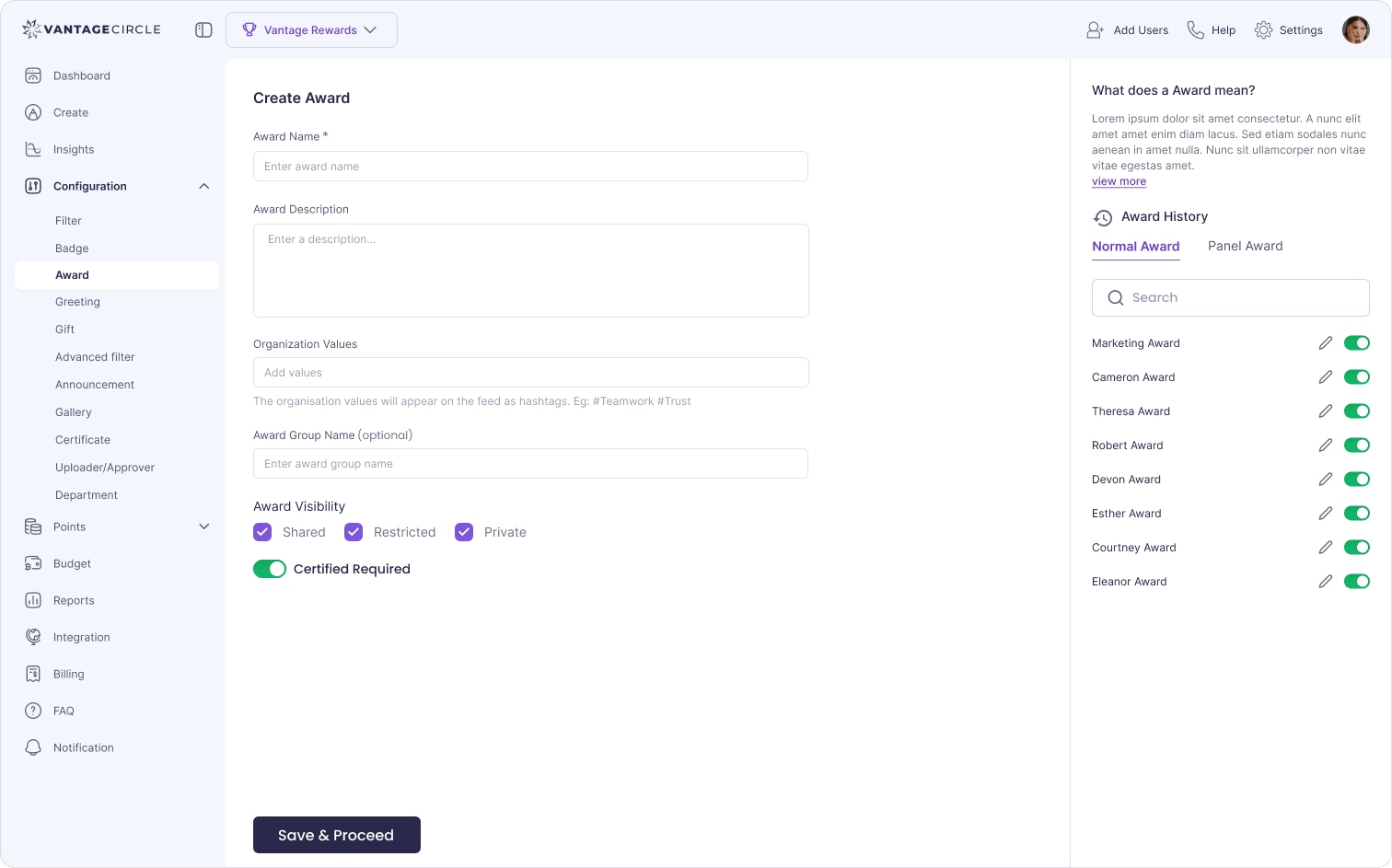
This is where peer-to-peer recognition earns its keep. A colleague thanks you for covering their client call, it's logged, and your manager can actually see it at review time.
3. Rigid Annual Cycles in Fast-Changing Markets
An objective set in January can be obsolete by April. Classic MBO has no built-in way to change it without looking like a failure.
4. Heavy Paperwork and Manager Time
Every objective needs drafting, negotiating, tracking and scoring. Managers are already stretched. Gartner's April 2026 survey had 47% of managers saying they're working harder than a year ago. And just 39% of employees rated their manager as good at clear developmental feedback. Pile a long objective form on top of that and the check-ins get cut first.
5. Top-Down Objectives Disguised as "Joint" Ones
The participation step gets faked more than any other. A manager fills in the form, sends it over, and calls the employee's silence agreement. Everything Drucker said about self-control stops applying the moment that happens.
6. Quality and Ethics Traded for Quantity
When the number is all that's paid, some people will hit the number by any means available. Closed tickets that weren't really solved. Deals pulled into the quarter with discounts nobody approved.
How to Make Management by Objectives Work: Pay for Results, Recognize Progress
The fix is to split the two jobs, so compensation pays for the agreed results and recognition covers progress and behavior during the cycle. Stuff both into one bonus and you get the sandbagging and the tunnel vision from the section above, together. Split them and the bonus can stay tied to outcomes while recognition covers everything the bonus can't see.
| What happens | Rewarded through pay | Rewarded through recognition |
|---|---|---|
| The objective is hit | Yes, through the bonus or variable pay formula | Optional public thanks at close |
| A milestone is reached mid-cycle | No | Yes, at the check-in where it happens |
| Someone helps a peer hit their objective | No | Yes, ideally peer-nominated |
| Values-aligned behavior under pressure | No | Yes, tagged to the company value |
| An ambitious goal is attempted but missed | Partial payout at most | Yes, so stretch attempts aren't punished |
That last row is the one that changes behavior. If a missed stretch goal earns nothing but silence, nobody sets one twice.
Gartner's numbers back this up, and the multiplier is big. In its 2023 survey, employees whose high-performance actions got recognized were 5.7 times more likely to reach optimal performance. McKinsey's 2024 survey found something adjacent. When nonfinancial rewards were in the mix, employees were more likely to say the whole system helped company results.
First-party data points the same way. In The Recognition Effect (Great Place To Work® India × Vantage Circle, 2025, 5.7M+ employees), 91% of employees in high-recognition cultures reported feeling motivated, against 73% in emerging-recognition cultures. Discretionary effort, the extra work no objective sheet captures, came in at 90% vs 78%.
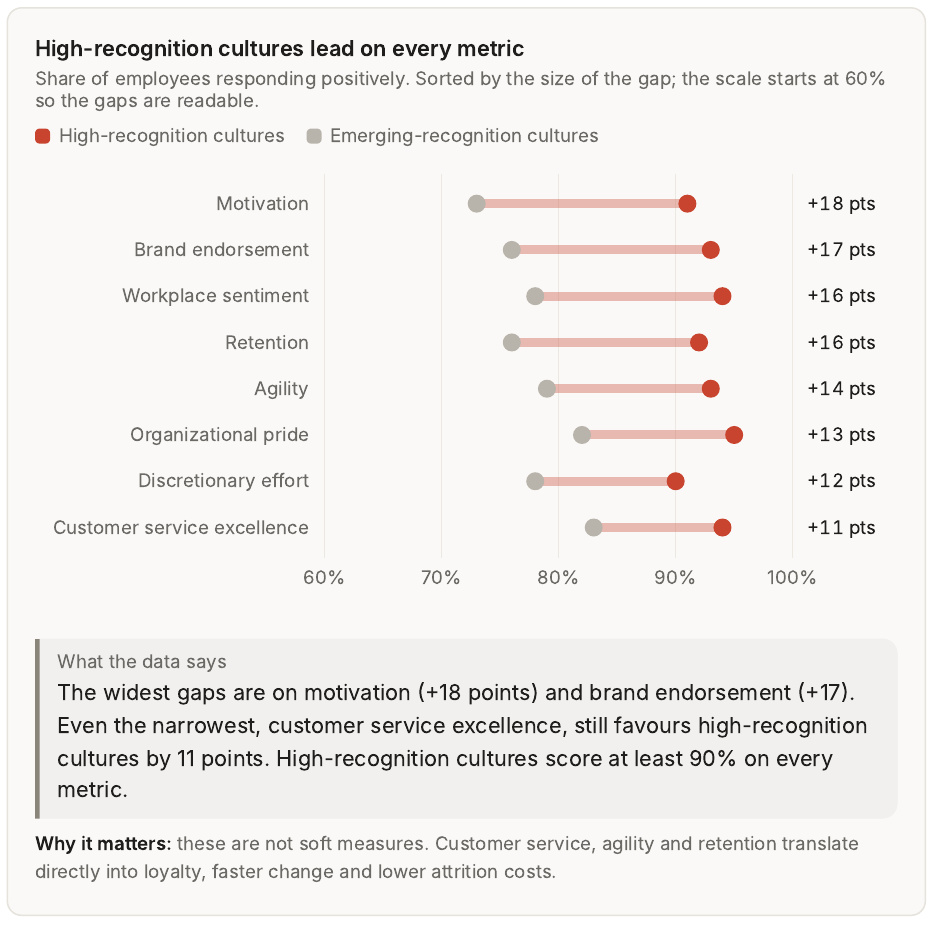
Source: The Recognition Effect, Great Place To Work® India × Vantage Circle, 2025.
Three practical moves cover most of it:
- Recognize at every check-in. A milestone noticed in month four does more than a paragraph in the December review.
- Tag recognition to company values. Pay rewards what was achieved. Values-tagged recognition rewards how, which keeps a hit target from excusing poor collaboration.
- Pay on the committed target, never the stretch. Recognize the stretch attempt separately, win or lose.
Your compensation planning handles the first column of that table. Recognition handles the second. Both sit inside the broader objectives of performance management.

Management by Objectives (MBO) vs OKR: What's the Difference?
Management by objectives runs on an annual cycle and feeds straight into appraisal and pay. OKRs (Objectives and Key Results) are quarterly, public, and kept away from compensation on purpose.
OKR (Objectives and Key Results): A goal-setting framework that pairs a qualitative objective with a short list of measurable key results, usually set every quarter and shared openly across the company.
| Dimension | MBO | OKR |
|---|---|---|
| Origin | Peter Drucker, 1954 | Andy Grove at Intel, 1970s, later popularized by John Doerr |
| Cycle | Usually annual | Usually quarterly |
| Visibility | Private between manager and employee | Public across the company |
| Target style | Achievable, committed targets | Stretch targets, where about 70% completion often counts as success |
| Link to pay | Directly tied to appraisal and bonus | Deliberately decoupled from pay |
| Best fit | Bonus-linked roles, sales, stable targets | Innovation teams, fast-moving priorities |
This comes up in nearly every comp-planning discussion I've sat in. Where I land: if pay genuinely has to follow a measurable result, sales or account management say, stay with management by objectives. If the team is exploring and a miss teaches you something, OKRs fit better.
A lot of what people like about OKRs is just visibility. You don't need to switch frameworks to get some of it. Post milestone recognition on a company-wide social feed and the whole floor sees progress mid-cycle. That's a cheap dose of transparency in the workplace.
Is Management by Objectives Still Relevant Today?
Yes, when leadership actually commits to it. Set objectives top-down and forget them till year-end, and management by objectives fails.
The best evidence here is from 1991, and nobody has really beaten it. Robert Rodgers and John Hunter's 1991 meta-analysis in the *Journal of Applied Psychology* pulled together three decades of MBO studies. Where top management was highly committed, productivity gains averaged about 56%. Where commitment was low, the average gain was about 6%.
That's the same framework producing close to a tenfold gap, and what changed was whether leadership treated it as real.
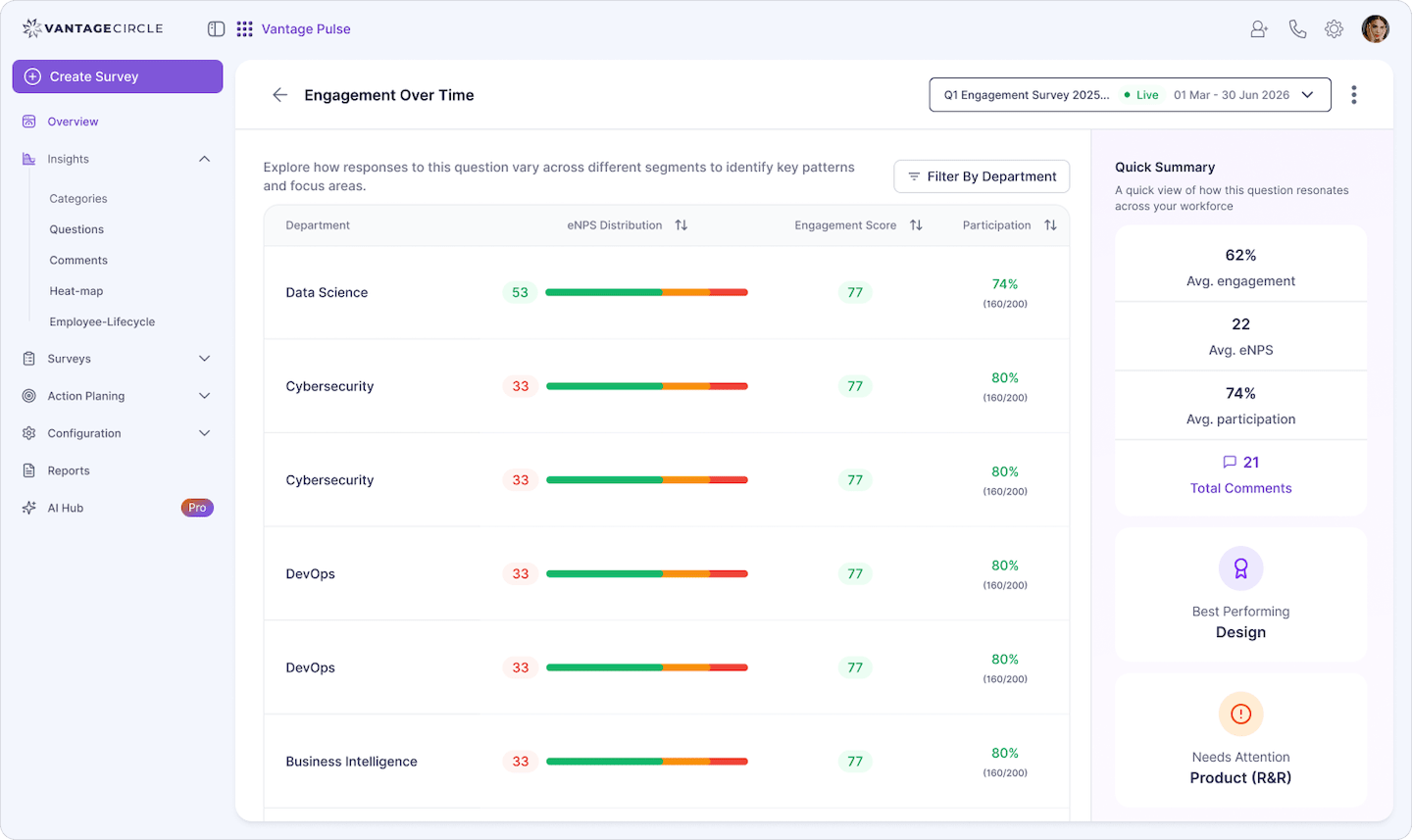
Participation is the other thing to watch, and it's measurable. A two-question pulse survey covers it. Do employees understand their objectives? Did they have a real say in setting them? Vantage Pulse breaks the answers down by department, which shows where "joint" goal setting has slid into top-down assignment.
Conclusion
OKR vendors gave management by objectives a rough reputation, and part of it was earned. Plenty of us have filled in an annual objective form and never looked at it again until December.
Drucker's basic move still works, though. You agree the outcome with the person doing the work, and you judge on results.
For your next cycle, change one thing. Put recognition into every check-in, keep it out of the bonus, and let Vantage Rewards handle the logging.
Frequently Asked Questions
Q. What is meant by management by objectives?
A. It's a way of running performance where you and your manager agree a few measurable objectives up front, then get judged on whether you hit them. Drucker named it in 1954. You'll also see it called management by planning (MBP).
Q. Is MBO still relevant today?
A. Yes, with a condition. It works when leadership is genuinely committed and objectives get revisited during the year. Rodgers and Hunter's 1991 meta-analysis found productivity gains of about 56% under high top-management commitment and about 6% under low commitment.
Q. What does MBO mean for goals?
A. Your goals get written with your manager, they carry numbers, and your review gets scored against them. Each one should trace back to a team goal.
Q. What is Peter Drucker's concept of management by objectives?
A. He called it "management by objectives and self-control." The self-control half is the point. Help write your own objectives and you can run your own work toward them.
Q. What are the 4 steps of MBO?
A. Depends on the textbook. A common four-step version goes set objectives, plan the action, monitor, evaluate. This guide uses five because it splits objective setting into a company step and a one-on-one step. That one-on-one is where most programs fall apart.
Q. What is the difference between MBO and KPI?
A. Management by objectives is the system. A KPI (key performance indicator) is one number inside it, and usually each objective gets one. Some companies add KRAs (key result areas) on top, which are just the broad buckets of a role.

He has worked in the human resources environment and has elevated recognition and rewards through his insightful and detailed writing. He aims to enhance the practice of Recognition in the workplace with new ideas and innovation that will help shape the work culture. For any related queries, contact editor@vantagecircle.com