HR As The Strategic Anchor In Times Of Change
Episode Overview
Amrita Singh opens this conversation with a claim that reframes the whole episode: COVID was the single event that permanently rewired what HR is for. She traces a shift from a compliance-driven function built around hiring and retention to one that sits at decision-making tables, shapes workforce strategy, and is judged on data rather than gut feel. Citing research projecting a sharp rise in global spending on HR technology, she argues HR has moved from policy enforcer to change catalyst, and from administrator to architect of culture, responsible for designing the experiences employees carry with them through disruption.
She backs that framing with a personal story: talking a CEO out of writing off an employee who wanted to leave to care for a parent, and watching that employee return months later. For her, that is what empathetic HR looks like under pressure, a stance that has to hold even while leadership pushes for results and employees look for reassurance. She also lays out what goes wrong when HR is left out of major transitions early: messaging that lands wrong, resistance that could have been anticipated, and damage to trust that outlasts the change itself. Looking ahead, she pushes HR to treat its own upskilling as non-negotiable, from people analytics and AI ethics to hiring for skills over pedigree, arguing that a function asking everyone else to reskill has to do the same work on itself.
Episode Highlights
- HR has shifted from a policy-enforcing back-office function to a strategic advisor that sits in decision-making conversations and helps shape workforce strategy.
- Amrita cites research projecting global HR technology spending to rise from $24 billion to $35 billion as evidence of how central HR tech has become to the function.
- She describes HR as having to act as both a steadying, nurturing presence and a business partner, holding employee reassurance and business results at the same time without dropping either.
- A personal story about a CEO nearly losing a valued employee shows how empathy, not policy, resolved the situation and brought that employee back after a sabbatical.
- When HR is excluded from planning major change, Amrita warns that communication timing goes wrong, resistance rises, and the resulting damage to trust and culture outlasts the change itself.
- She closes with a call for HR leaders to build their own future-readiness: people analytics, AI ethics, skills-based hiring, and personal resilience, not just for the workforce they manage.
About the Guest
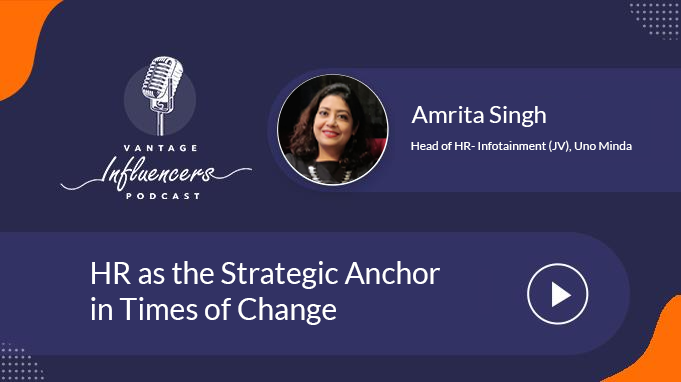
Amrita Singh, Head of HR – Infotainment (JV), Uno Minda
Amrita Singh is a new-age HR leader with close to two decades of experience across global HR functions, sectors, and geographies. A postgraduate from the Tata Institute of Social Sciences, Mumbai, she began her career in industrial relations with GMR Delhi International Airport, India's first PPP airport project, before moving into HR and supporting the development of Gurugram's Rapid Metro. She has since led HR through service, infrastructure, IT/ITES, and auto manufacturing, helping organisations scale operations, build teams, and establish a values-driven, inclusive culture wherever she has worked. She is a certified EQ practitioner and a SHRM Senior Certified Professional, and completed her Strategic Human Resource Management programme at IIM Ahmedabad. Outside of work, she writes poetry and listens to music.
Connect with Amrita on LinkedIn
Host
Sanjeevani Saikia, Vantage Influencers Podcast Host
What You Will Learn
- Why Amrita Singh believes COVID permanently rewired HR's role, and what "strategic anchor" means in practice
- How HR can balance reassuring employees with keeping the business on course during major change
- What empathetic HR leadership looks like when a crisis is actively unfolding
- How to protect, and even reshape, company culture when change makes it feel fragile
- What tends to go wrong when HR isn't brought into the planning stages of a major transition
- Which skills, from people analytics to AI ethics, HR leaders need to build for themselves to stay future-ready
Key Topics & Timestamps
| Timestamp | Topic |
|---|---|
| 02:03 | Amrita's corporate journey across airports, metro rail, IT, and auto manufacturing |
| 04:29 | How HR's role has evolved during major disruptions like COVID |
| 08:30 | What "strategic anchor" really means for HR in practice |
| 11:19 | Balancing employee support with business priorities during change |
| 15:29 | What empathy in HR looks like at the height of a crisis |
| 18:30 | Protecting, and reshaping, culture when it starts to feel fragile |
| 21:48 | What goes wrong when HR isn't brought in early enough during major change |
| 25:29 | Skills HR leaders need to build to stay future-ready |
| 30:17 | Amrita's closing message for listeners |
Full Transcript
Click to read the full episode transcript
Welcome to the Vantage HR Influencers podcast. This podcast is sponsored by Vantage Circle, the simple and AI-powered rewards and recognition platform for employee engagement.
We often hear people say HR is evolving, but when you really zoom into moments of big change, like rapid growth, layoffs, restructures, or mergers for that matter, it's quite clear that HR's role isn't just evolving, it's actually being tested and maybe even redefined. The expectations placed on HR go way beyond policies and payroll now. They're expected to lead through ambiguity, navigate emotional waters, and still keep everything moving forward.
Hi, I'm your host Sanjeevani Saikia, and you're tuning in to the Vantage Influencers podcast. Today, we're diving into what it truly means to lead HR in times of change, not just from a strategic lens, but from a deeply human one. Joining me is Amrita Singh, Head of HR Infotainment at Uno Minda. With rich experience across fast-paced, high-impact environments, she brings a grounded perspective on what it takes to steer people, culture, and processes through complexity, while still keeping empathy at the centre. So, let's start the discussion today.
Amrita Singh: Hi, I'm Amrita. How are you?
Sanjeevani Saikia: Hi, Sanjeevani. I'm doing very well. How are you?
Amrita Singh: I'm fine.
Sanjeevani Saikia: First of all, thank you so much for joining in. It's a pleasure to have you on the show. Again, thanks so much for making the time. Before we dive into the main conversation today, I'd love to get to know the person behind the insights. So, could you share a bit about your professional journey so far and what led you to where you are now?
Amrita Singh: Of course, Sanjeevani. And in fact, I'm sure everybody thinks like that, but I do believe my journey has been very, very interesting, the way it has navigated. So, hi, everybody, I'm Amrita Singh. I completed my master's and specialised in criminology from the Tata Institute of Social Sciences, Mumbai. Took up an assignment in IR when GMR Delhi International Airport was getting privatised, and spent good quality years, three years into IR, and then a couple more months into HR. And then from there, moved to a head HR role. I took over the first fully privately funded metro service, and spent a good nine years there. So I've been working in different infrastructure domains, from airport to metro, then did a bit of a stint in textile manufacturing, moved from there and joined an IT company, did a couple of years, five years actually, into IT. And now the last two years have been spent in auto manufacturing. So it's been a pretty interesting journey. I moved around sectors, and every sector has its own challenges and its own learnings, and I'm just enjoying the journey.
Sanjeevani Saikia: Wonderful. Thank you so much for sharing your journey with us. So, with your permission, Amrita, I'd like to delve into today's topic.
Amrita Singh: Of course. Let's move.
Sanjeevani Saikia: Great. You know, whenever companies are going through some kind of a major shift, whether it's restructuring, growth, or even downsizing for that matter, HR is often right in the middle of it all. And suddenly, it becomes way more about how HR communicates, how they keep people grounded, and how they move the business forward without losing their people along the way. So Amrita, I'm curious, how do you think HR's role has really changed during times like these? How have they evolved as strategic anchor in times of change, which is a topic of discussion today? What would you like to say?
Amrita Singh: Thank you. It's a great question, I think. So, see, it has evolved dramatically. I think I have a flair for the dramatic. And I would say that if there was this one big transition that has completely changed the way we think HR, that has to be COVID. Of course, a couple of disruptions here and there has continued to evolve us into something completely different. So, be it digital transformations, mergers, global crisis, or shifts to hybrid work, HR is now evolving beyond the narrow definition of finding, acquiring, retaining talent. Modern HR has become more about data analytics, leadership strategies, being there. And companies are realizing this. There is research which has been done by Fortune Business Insights, and they have projected the increase in spending on the global HR tech market from $24 billion to $35 billion. So just imagine, it's huge. HR doesn't, I don't think, sit on the sidelines anymore. It's at the very core of business resilience, transformation, and innovation.
And if you look at it like that, there's a lot of focus that's going to be right on data-driven decision making, diversity, equity, inclusion, and now belonging, the need for continuous learning, upskilling, reskilling, development, to address the newer age requirements. So HR was initially a policy enforcer. It's now a change catalyst. It leads the change narrative, right? How do you communicate your position? How do you engage your employees? How do you reduce resistance? It's not just changing it, it's actually driving it. We've become strategic advisors. We sit at decision-making tables, shaping workforce strategies. We are not just hiring anymore, Sanjeevani. I think we are now looking at building capabilities, not for today, it's working on a future tandem, right? It's working to find future-fit talent. And it's creating an ecosystem, actually, through either talent mobility within the organization, how you upskill, how you identify your pipelines. There's just so much work happening on gig economies, automation, restructuring, and all of that.
We have now become architects of the culture. You have to design experiences that you want your employee to take back, to design experiences that will further help the organization in growing and succeeding. We are not relying on gut feel anymore. I think it's a very data-driven approach that everybody is taking. We're predicting attrition, optimizing performance, measuring cultural alignment. How do you do that? Obviously, you partner with technology. If you look at it like that, I think it's a great time to be an HR professional.
Sanjeevani Saikia: Absolutely. I hope I've answered your question.
Amrita Singh: Yes, you have.
Sanjeevani Saikia: You have mentioned HR as a catalyst for change and as architect of culture. So you rightly pointed it out, and I agree with what you have said. Now moving on, the term "strategic anchor" sounds strong and admirable, and it gets used a lot when talking about modern HR. But when you're in the middle of a crisis or a big shift, I was wondering, what does that actually look like in real time? Is it about being a decision maker, a connector, or a culture guard? You have already mentioned architect of culture. So what exactly is it when people say HR should be the strategic anchor? How do you view that?
Amrita Singh: See, I think we've seen this happen live during COVID. Nobody knew what was going to happen. Not you, not I, not the leaders, not the elderly, not the young people either. But still, everybody was looking towards HR on how to manage this crisis. I think the only people who were working round the clock were either IT, of course leadership, and HR. HR because they had to control the narrative. There were people who were scared, people who did not know what to do, how to come to work, how their family was going to be supported, how they were going to go to their hometowns and all. So at that point of time, I think the strategic anchor terminology got very rooted into HR as a paradigm. And it's figuring out how you will succeed, and it's going to be very tough. You've rolled up your sleeves, you've determined that you and your team are going to win the game, beat the competition, grow a sustainable company that provides wealth, keeps everybody safe and happy. But succeeding requires intentional decisions. They have to support the best chance for a company to achieve. Intentional will be inferred as proactive and committed, not just reactive anymore. It's not flavor-of-the-month leadership, this is absolute hard work, it requires a fair amount of elbow grease, if you may say.
Strategic anchor means you have to act as a filter, ensuring that your choices are aligning with the organization's fundamental purpose and long-term goals. It's not lofty, it's not a glamorous role. I think it has to show up in real, practical ways every day. In HR, it becomes visible through consistent, intentional choices across systems, policies, procedures, behaviors. And it has to be a true north. It ensures that no matter what the crisis or the initiative or the development, everything pertaining to an organization in terms of people, whether it's hiring, performance, culture, you stay connected, you stay rooted. Thank you.
Sanjeevani Saikia: Yeah, now I believe it's a good time to ask you, how does HR strike that balance between supporting people while also keeping the business on course? Because during times of change, the tension is real, and employees are looking for reassurance while leadership is, again, pushing for results. And HR is expected to hold both hands without dropping either. So how do they strike that balance?
Amrita Singh: I think we have to play, you know, somebody once said that HR is the mother of an organization. And I don't think that person could be terribly wrong. My first reaction to that comment was, no, you can't say that. But actually, if you look at it like that, it's tough enough that you have to provide, as well as providing, a very nurturing, very challenging environment as well. So you definitely have to work with your business goals, right? Know what matters to the organization the most, whether it's cost control, talent retention, or innovation. And any strategy that involves people has to be aligned with a bigger goal, a bigger vision. So all of what you're doing has to directly support those goals, because you can't be talking culture and strategy if there's no money on the table. The business has to run, the business has to make money.
And of course, having said that, people will also look up to you to be the nurturer. So you have to ensure there is transparent communication. You have to reduce fear, you have to reduce bias, especially in times of ambiguity and uncertainty. There's just so much anxiety. And we should be leading the way with open, two-way communication, you encourage feedback, so people can respond, people can ask questions without being fearful. And of course, agility. You have to maintain that agility as HR, because I asked this question at a forum, and there was no show of hands. The question was, before COVID, how many times have you reevaluated your policies and processes? And in a group of around 100 people, probably one or two people raised their hands. That was the level of our agility, right? We were so happy with the books and the laws and the policies that we had made. But you can't do that anymore post-COVID, I think, every year. In fact, some organisations have to reevaluate it as soon as last quarter, maybe. So what was working for you last quarter may not work now. You have to provide more flexibility, work on team structures around morale, performance, smaller-scale initiatives, all of that.
Having said that, of course, managers are also carrying a lot of the thrust of the strategy your organisation is hinging upon. So the expectations from managers have grown multifold. You have to equip them, give them the tools and the support so that they can, in turn, guide their teams through disruption. You have to work on leadership behaviour, to model resilience and empathy. And I remember during COVID, a lot of organisations started talking about empathy very differently. From what it looked like earlier, there was a complete 180-degree shift. So empathy, everybody's talking about it, you go to a platform called LinkedIn and everybody's talking about empathy and leadership. So I think things have really changed, and it's being looked at as HR's role to do that. And while HR can be at the centre of it, it will have to ensure that every leader mirrors the culture that you want the organisation to have.
Sanjeevani Saikia: Yeah. So as you've mentioned empathy, I'd like to ask this question. What does empathy in HR look like at the time of crisis? When you say empathy, and when I put it in this particular context, when times are changing or when things are going down south, how does empathy really look, in an HR perspective?
Amrita Singh: See, I think empathy really means understanding the other person's point of view, in a short definition. But what really happens in an organisation is, because all of us have to drive our own results, achieve our own goals and KPIs, sometimes the other person's perspective ceases to matter. So I'm just saying, be a little kind, be empathetic, try and understand where the other person is coming from. And that has to continuously be the reason.
So for example, a couple of years ago, my CEO got really angry at an employee who wanted to leave the services of the organisation, despite the fact that we had really invested in that employee, whether it was promotions or a huge lot of other things. And that person wanted to leave for his father's treatment. It actually reached a point where I had to sit down with the CEO, and I said, see, eventually the talent will come back, you may still rehire that talent, but the kind of relationship you've had, you're going to spoil it by not being able to listen to that person. And in fact, had it been anybody else in that place, they would have done the same thing for their parents. So just that perspective shifted gears, and eventually we had that employee rejoin us after a sabbatical of six months. I think that's the magic of empathy, you just have to be kind enough to listen to the other person. And of course, there are cultural gaps, there are maybe thought differences, so all of those things have to come into play while you give the other person that platform to be able to say what they really want to say, and understand where they're coming from.
Sanjeevani Saikia: Yeah, I think what you've said right now was actually hard-touching, in a sense, because understanding your employee's point of view, I think you win them at the very moment you do that. It's not always about what top management has to say, what employees have to say also is something that is very crucial. And I think you've highlighted a very important point here. Now moving on, I don't know if you'll agree with me on this or not, but change somewhere always messes with culture to a certain extent, rituals get dropped, and most times values get blurry too. And soon people start saying it doesn't feel like the same company anymore. So in scenarios like these, when culture feels fragile, what role should HR play? And more importantly, can change actually be a moment to reshape culture for the better?
Amrita Singh: Of course, that is a very interesting question actually, and whenever organizations have gone through major transitions or major changes, there is uncertainty, disconnect, and skepticism all around you. Proactive effort has to happen. But the problem is, if leaders are busy taking the decisions that safeguard the organization and people's interests, there has to be somebody, like I said, if HR is the mother of the organization, there has to be somebody to step in and see both paradigms and then move accordingly. Otherwise, you risk your culture becoming very fragmented. So you have to play a very critical role, not just in protecting, but also in evolving that culture. That is your real lab experiment, actually happening in times of resilience, and HR people love to say that word, resilience. But that is the opportunity for you to create organizational resilience. So you assess your current cultural state, you use surveys, interviews, maybe focus groups, to understand what people are really fearing, really valuing, really wanting, right? You identify core elements you want to preserve, that you will need to evolve, sustain, and scale. In the future, you have to map yourself culturally: what is current, and what are you going to aspire for? And of course, you have to be transparent about it. You have to act as a communication bridge between leadership and employees. You have to develop a very clear narrative about why we're changing, how it's aligning with the organization's mission, values, and the vision of the future.
You have to ensure consistency, and I really like that word. I have yet to come across any other function as focused on consistency as HR, I think that's our sword, the magic wand. So it has to be consistent, it has to be timely, and of course, like I said, it has to involve empathy at all levels. I think those are some things HR can very clearly do when culture tends to take a hit. And just talking about it isn't going to help, you have to actually go to the grassroots level and, like I said earlier, roll up your sleeves at that moment.
Sanjeevani Saikia: Yeah, absolutely. Shifting gears, I find it interesting that HR is expected to fix problems, communicate or negotiate with employees, but most of the time they're not included in the planning stages when big shifts happen. This may not be true every time, but most of the time. The delay often leads to preventable missteps, especially when people's reactions aren't considered upfront. So in your experience, Amrita, what tends to go wrong when HR isn't brought in early enough during major change?
Amrita Singh: Not involving HR, or excluding them, has a major repercussion. I think it leads to very costly, very cascading, very big losses for the organization. You run a risk of damaging your entire ethos, your morale, your very cultural fabric of the organization. And of course, it will have an impact on the talent you retain or attract. So things like restructures, mergers, growth, or maybe a not-so-great side of the organization, downsizing, a lot of things can go terribly wrong. The communication strategy can go terribly wrong, the message will be unclear, mistimed, it can fuel confusion, mistrust, create a lot of issues where we could have managed with a few manageable ones. Employees will put up resistance if you don't anticipate concerns. And who are the people who can anticipate concerns? It's only HR. Otherwise, there'll be unaddressed fears, lack of engagement, people will be completely disconnected. And HR represents a very strong, sustainable arm of the organization in terms of managing compliances, labor laws, documentation, knowledge management, what worked, what did not work, all of that. So if those things aren't done, these can prove to be very costly failures.
Of course, I talked about the damage to morale and culture. If you allow your employees to feel blindsided, devalued, we will appear tone deaf, and I think that's a massive failure of sorts, especially because just prior to that happening, you would have invested every cent of your energy into creating that culture of trust. And then something goes wrong and you don't involve HR, things just start to go downhill from there. Changes get mishandled, people will be ready to leave, you'll find it difficult to get high performers to join you, reputation gets damaged, and top talent will probably never look at the organization the same way. Of course, operations get disrupted too. HR also tends to coordinate what goes where, what roles change, and it ensures continuity. Without this, the organization will be scrambling, whether it's changes in tools, structures, or roles. It reduces the effectiveness of any change, and of anything you're wanting to do with the organization and the strategy. A lot of times we hear the statement, but we don't realize the ramifications of it. Peter Drucker once said, culture eats strategy for breakfast. So HR therefore has to be brought in. If you don't allow your culture to be part of the strategic decision you've taken, and don't address that part, it's not going to be successful.
Sanjeevani Saikia: True. I think, again, you've highlighted something very critical here. So thank you so much, Amrita. We are almost arriving at the end of today's episode, so I guess it's the best time to ask you, looking ahead, what should HR leaders be learning to stay future-ready?
Amrita Singh: See, if you ask this question to CEOs, it will have a different answer. If you ask this question to CFOs, they'll say HR doesn't understand finance. But moving along, I think there are largely a couple of things we can do as HR people to remain and to ensure that we are future ready. Because if you're at the helm of driving upskilling and reskilling for other people, you might as well do that for yourself. You have to focus on strategic, technological, and human-centric capabilities. You have to really get into AI and people analytics, because whether you like it or not, it's going to be the future very soon, it's already the future. You have to learn how to utilize people analytics to make data-driven decisions, and that could have an impact on your talent, your hiring, DEI, engagement, retention, everything. And ethics in AI is going to be a very big field, I think that's something we need to be really prepared for. How do we manage biases, how do we create transparency, how do we continue to win the trust that employees and the organization have in us?
And definitely, when we talk about workforce planning, there was a time people used to hire for premium institutes and premium degrees. Now things are changing to a level where you're just hiring for skills, not degrees, not the pedigree you bring to the table. So you have to learn the entire skill taxonomy, how to develop that, and ensure your workforce is aligned with what your strategy looks like. There are tools like talent marketplaces, internal mobility platforms, that you can use to continuously drive upskilling and reskilling. But you have to know those tools first. Any digital transformation, HR tech, ten years ago the HR job descriptions looked very similar, and now the moment you pick up a job description, they'll ask you for proven expertise on a whole range of these new-age tools. It could be Workday, it could be SAP, maybe SuccessFactors, Oracle, all of that. So you have to stay on top of HR automation, learn maybe some low-code, no-code platforms, and understand how you support HR initiatives and continue to bring in agility.
So when I talk about agility, you have to understand organizational agility, lead the change management. Change management in itself is a huge science that I think every HR person has to go through. And internally, psychologically, you need to work on your own resilience, how you respond, how you communicate, before you illuminate the path for other people. If the workforce model is completely changing, you have to work on hybrid work strategies to anticipate the problems of tomorrow. You have to learn more about how it's not just physical well-being anymore, it's mental well-being and digital well-being too. How do you study trends in freelancing, gig economies, fractional positions that have come into the core? Learning to design inclusive, remote, and hybrid cultures, you have to move DEI beyond compliance, it's not just DEI anymore, it's building belonging and inclusiveness, embedding inclusion strategies within the very fabric of your organization.
So there's a lot if you really talk about how we can work on ourselves. But having said that, I think the message is very strongly that you have to think beyond full-time employees, how you work into an ecosystem that will help you manage fluidity, cross-boundary collaboration, all of that, while also working on understanding your own productivity, your own systemic burnout, your own trauma as well. You don't only have to focus on everybody else, but also on how HR people are building their own resilience and keeping themselves future-ready and updated.
Sanjeevani Saikia: Great, wonderful. Some really critical tips for our HR listeners here, provided by you. So once again, I'd like to thank you for that. We've reached the end of today's episode. Do you have any final message for our listeners? I'm sure our listeners will be delighted to hear it from you. Also, please let them know the best way to reach out to you.
Amrita Singh: Of course, I think I'm very active on LinkedIn, so it's a great way to reach out to me. But I think if there was one message, please treat yourself like you would want other people to treat you, and like you would want to treat other people around you. And that, exactly what I said, you have to also learn how to manage your own well-being before you start taking care of others. And remember, it's a short span that we all get on this wonderful earth, and we have to make it a good journey, one that you and the people who come into contact with you and are connected with you enjoy. So I think take it easy.
Sanjeevani Saikia: Yeah, I think that's a great message for our listeners. I'm sure they'll be able to resonate with this episode as well as your final message. Thank you so much for joining today, it's a pleasure to have you on the show, and we hope to stay connected with you in the future.
Amrita Singh: Of course, and it was a pleasure to talk about so many things, I had a great time chatting with you. Thank you so much.
Thanks for listening to the Vantage HR Influencers podcast. Please do subscribe to the Vantage HR Influencers podcast on Apple Podcasts, Spotify, and our YouTube channel for new episodes.
FAQ
What does Amrita Singh mean by HR as the "strategic anchor" in times of change?
She describes it as HR acting as a filter that keeps every decision, whether in hiring, performance, or culture, aligned with the organization's fundamental purpose and long-term goals. It shows up not in grand gestures but in consistent, intentional choices across everyday systems, policies, and behaviors, especially when a crisis or major initiative is underway.
How should HR balance supporting employees with keeping the business on course during change?
Amrita frames it as holding two responsibilities at once: staying anchored to business goals like cost control, retention, or innovation, while also reducing fear and bias through transparent, two-way communication. She argues HR also has to model agility itself, since policies that worked a quarter ago may no longer fit a fast-changing situation.
What happens when HR isn't included early in a major organizational change?
Amrita says exclusion leads to costly, cascading problems: unclear or mistimed communication, resistance that could have been anticipated, damage to trust and culture, and difficulty retaining or attracting talent afterward. She points to Peter Drucker's line that "culture eats strategy for breakfast" as the reason HR has to be part of the decision, not brought in after the fact.
What skills does Amrita Singh say HR leaders need to build for themselves?
She names people analytics and AI ethics as urgent priorities, along with shifting toward skills-based hiring over degrees and pedigree. Beyond technical skills, she stresses that HR leaders need to work on their own resilience and well-being, since a function asking everyone else to reskill and adapt has to do the same work on itself first.
Related Reading
Also listen on