HR's Role in Making Acquisitions Work
Episode Overview
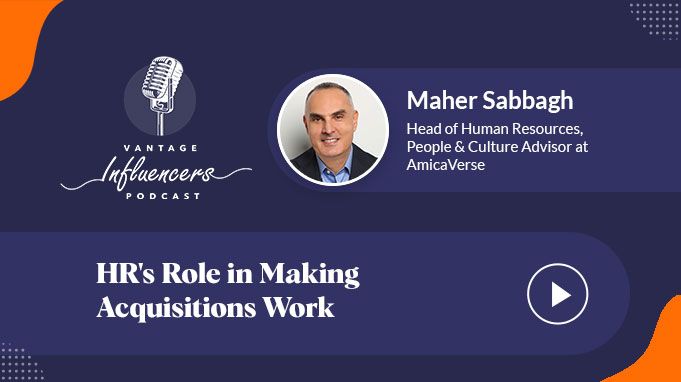
Most conversations about acquisitions focus on valuations, synergies, and integration timelines. Maher Sabbagh has spent his career watching what actually breaks those plans: people who feel blindsided, leadership teams that never quite align, and cultures that clash long before anyone notices the warning signs. In this episode, he makes the case that HR cannot be a rubber stamp on deals that are already signed. It needs a seat at the table from the very first confidential conversation, working alongside finance, legal, and sales to shape how the acquisition actually gets executed on the ground.
Maher argues that culture, communication, and honesty are the three forces that decide whether an acquisition succeeds or turns into a prolonged, bumpy ride. He walks through what day-one engagement should look like, why transparency beats reassurance when employees are anxious about their future, and how balancing speed with sensitivity keeps difficult decisions like layoffs or leadership changes from destroying trust. He also reflects candidly on a past integration where waiting too long to make a leadership call cost him dearly, and what he does differently now.
Episode Highlights
- HR should be part of acquisition discussions from the earliest confidential stage, not brought in once terms are already set.
- Bringing HR in late creates a firefighting dynamic that misaligns the HR agenda with the business agenda and slows delivery.
- Culture is not HR's sole responsibility, but HR acts as the engine that helps different nationalities and working styles blend under one set of shared values.
- Balancing speed and sensitivity during tough calls like layoffs depends on HR understanding the business model and communicating transparently.
- Day-one engagement, honesty about what will and will not go well, and consistent communication are what rebuild employee trust during uncertain transitions.
- A past experience of delaying a difficult leadership decision taught him that giving people too much benefit of the doubt can quietly damage the business.
About the Guest
Maher Sabbagh, Head of Human Resources and People & Culture Advisor at AmicaVerse
Maher Sabbagh is a global HR leader with nearly three decades of experience driving large-scale people transformations across the Middle East, Africa, South Asia, and Europe. He has held senior HR leadership roles with multinational organizations including Japan Tobacco International, where he supported market expansions, acquisitions, and workforce transformations across Jordan, Iran, Dubai, Sudan, and Bangladesh, and most recently served as Head of People & Performance at EDGNEX Data Centers (DAMAC Group), leading HR strategy across the MENA, EU, and Asia-Pacific regions. His expertise spans M&A integration, leadership development, organizational design, and building HR functions from the ground up.
Connect with Maher on LinkedIn
Host
Shabana Shahnaz, Vantage Influencers Podcast Host
What You Will Learn
- Why HR needs a seat at the table from the earliest, most confidential stage of an acquisition
- What cultural sensitivity looks like when blending teams from different nationalities and working norms
- How to balance speed and sensitivity when acquisitions require difficult decisions like layoffs or leadership changes
- Practical ways to build employee trust during uncertain post-acquisition transitions
- How people strategy connects directly to business recovery and performance after an acquisition
- The leadership lesson that changed how Maher approaches integration decisions today
Key Topics & Timestamps
| Timestamp | Topic |
|---|---|
| 01:59 | Maher's professional journey across HR leadership roles worldwide |
| 03:54 | Why HR should be involved in acquisition discussions from day one |
| 06:37 | Getting culture right in the first three months after an acquisition |
| 09:11 | Balancing speed and sensitivity through tough integration decisions |
| 11:15 | Rebuilding employee trust during uncertain transitions |
| 13:44 | Aligning people strategy with business recovery and growth |
| 15:30 | The integration mistake that reshaped Maher's approach |
| 17:34 | Final thoughts on HR's real role in acquisitions |
Full Transcript
Click to read the full episode transcript
Welcome to the Vantage Influencers podcast. This podcast is sponsored by Vantage Circle, the simple and effective recognition platform for employee engagement.
Shabana Shahnaz: Welcome to the Vantage HR Influencers podcast. I'm your host, Shabana Shahnaz, and today's conversation is about HR's real role in acquisitions, not as a support function, but as a strategic force driving integration, culture, and performance turnarounds. Joining me today is a leader who has not just witnessed acquisitions, but has led people transformations across some of the most complex markets in the world. Maher Sabbagh is a globally experienced HR leader with nearly three decades of experience across the Middle East, Africa, and Asia. He has played pivotal roles in multiple large-scale organizations, acquisitions, business restructurings, and post-merger integrations across organizations like Japan Tobacco International, DAMAC Group, and other multinationals, Fortune 500s, and family-owned businesses. From transforming newly acquired organizations into high-performing multinationals to rebuilding trust, culture, and leadership alignment across thousands of employees, Maher brings a rare hands-on perspective on what truly makes acquisitions succeed from a people's standpoint. Maher, it's a pleasure to have you with us today. Welcome to the show.
Maher Sabbagh: Thank you very much, Shabana. Appreciate being here and thanks for the invitation. Good morning, good afternoon, good evening to all your audience and listeners all over the world. I'm glad to be here and looking forward to contribute and to share some of my experiences with your amazing audience. Hopefully, we can spread the knowledge and share the information.
Shabana Shahnaz: Thank you. Of course, exactly. But before we dive into the conversation, Maher, would you like to share a bit about your professional journey so far?
Maher Sabbagh: Yeah, that would be my pleasure. I've been in the HR field since the early 2000s. In fact, I started my career in 1997, and I started with multinationals, in a global American beverage manufacturing company. Then I moved to FMCG retail and spent about 21 years in the tobacco business, with assignments across Lithuania, Estonia, Latvia, Jordan, Iran, Sudan, and Bangladesh. After that, I moved from tobacco into agrochemicals, where I worked across African markets, in addition to the UAE. I covered Lebanon, Nigeria, Tanzania, and Kenya, setting up HR departments, leading transformation, and integrating businesses. I've also done some work in fintech business services, given how fast the fintech business in the UAE and the region is growing. I've had real estate experience as well, and technology and data center businesses. Currently, I'm here offering my services and experience, having been in the UAE since 2007. It's been like home for us here for 18 years. And here I am, doing HR support and service across the region. So this is me in a nutshell. I'm also a married husband and father of two children.
Shabana Shahnaz: Amazing. That is such an interesting journey. Great, so I think we are good to go for the conversation today. Maher, I would start with the very first question. From your experience, at what point do you think HR should truly step in during an acquisition? And what are the challenges or risks organizations face when they bring their HR in too late?
Maher Sabbagh: Very important one. To me, HR usually, when we start discussing an acquisition project, should be among the first at the round table of discussion. Our input is not only transactional, being part of the process. We have to lead the process. So wherever I've done acquisitions, I've always been the head of HR responsible and engaged in the project from the very beginning, from the early discussions at the confidential level, just to be part of the overall process. It's very important, and it should happen at the very early steps. Frankly, when HR is brought in too late, it becomes a kind of firefighting approach, which isn't recommended. We end up with shortages in the outcome, misalignment between the HR agenda and the business agenda, and it can hinder and hamper the speed of delivery. What's more important, it impacts the synergy and harmony at the top level, at the management team. Also, when HR comes in a little late, it takes time to understand the business, the culture, and the environment, and how to integrate and lead post-merger. Even before the merger, before the acquisition, HR is very much needed to understand the business model, the organization, and to plan the manpower resources, how to approach and check on the talent available in the business, current talent, and what will be needed in the future. All of this needs to be there. What's also important, Shabana, is having HR at the round table with other business stakeholders, whether it's sales, finance, marketing, or legal. They all play a role in ensuring implementation and leading this process. So HR is a key integral function that needs to be part of this process.
Shabana Shahnaz: Speaking of culture, cultural integration is often cited as one of the biggest reasons acquisitions fail. What can you say about getting culture right? What does that look like in the first three months post-acquisition?
Maher Sabbagh: Culture is one of the key pillars to ensure success of the post-merger integration process. To me, culture is not the sole responsibility of HR. However, HR is the engine that makes sure things are running and understands the different cultures, whether it's different nationalities leading the business into the new acquisition. This is where HR needs cultural sensitivity and understanding, trying to blend those different cultures and backgrounds together, bringing them to one table under one set of business values and core behaviors to ensure everyone is heading in the right direction. If cultural misalignment happens, I won't say the integration will fail, but it will be a bumpy, rough ride. It might hamper and delay the deliverables and the stability of the new organization. To me, cultural understanding is very important, and the key role of HR is to have the cultural skill and sensitivity to understand how to bring people together. As a simple example, in some cultures you shake hands, in others you don't. Some cultures bow, some don't use the local language, others prefer it. You need to factor those things in, even when it comes to key events and ceremonies. The way you talk to people matters too, especially in a merger or acquisition where different nationalities come together. This is where you need to create a safe space for that cultural mix, one built on openness and acceptance. My role as HR is to bring that acceptance and create alignment so everyone leads according to the overall business values and objectives.
Shabana Shahnaz: Right, so I think from your answer I really get the idea that the impact of culture is very real. That makes me want to move to the next question. How do you think HR can balance speed and sensitivity during integration, especially when tough decisions like layoffs or leadership changes are unavoidable in acquisitions?
Maher Sabbagh: Yeah, this is something I feel strongly about. When it comes to integration and difficult decisions, I'm a big believer that HR needs to be a business partner, meaning HR needs to understand the operating model and the business model. Once we have that understanding, we're able to speak the commercial language with our stakeholders, whether internal or external. We need to equip ourselves and our people with deep business knowledge so we can plan and talk commercially, whether at the executive committee level or with external stakeholders. To bring speed into implementation through tough decisions, communication is another very important element. When we communicate openly and transparently, share the pros and cons, and share the plans with everyone so people feel engaged and understood, things go smoother than expected. In a nutshell, a solid communication strategy combined with understanding the business model and the operating model, those three together ensure that difficult, unavoidable leadership situations can be managed professionally in a way that serves the business while ensuring fairness and integrity.
Shabana Shahnaz: Correct, I got that. Speaking of employee trust, that often takes a hit during an acquisition. What are some of the effective ways HR can build confidence and engagement during uncertain transitions?
Maher Sabbagh: I'll share this from personal experience. To ensure employee trust and acceptance post-integration, remember that people are thinking, "Oh my god, what will happen to me? What's next? These new people coming in, are they going to fire everyone?" Usually, day one makes a big difference, the first day you engage with employees. In my experience, I gather everyone on day one, what we call closing day. We bring everyone together, and I share what the organization will look like, what's in it for our people, why we're here, and what the values are. I bring everyone to accept those values, and we share the plans. At the end of the day, transparency and communication are very important. That creates a high level of ownership. Honesty is important too, because in every integration, some people will be happy and some won't. You cannot please everyone, we're not in the business of pleasing people. But when people know the reality, that some will be happy and some will be disappointed, and that whoever doesn't make it through this journey will be handled fairly and professionally and will know the reason why, that matters. It's important to explain to people why, and during those rough patches, it's important that the new business supports people who are being made redundant or are leaving, because that reflects on the image of the new company and its employee value proposition. To me, it comes down to sharing, supporting, properly explaining, and ensuring continuous engagement, which grows ownership, and ensuring that those who aren't successful during the process are handled fairly and professionally.
Shabana Shahnaz: Okay, great, so honesty and communication are among the keys to employee trust. I love how your perspective was on what genuinely happens, not just in theory but in practice. Maher, when an acquisition is meant to drive a performance turnaround, how can HR ensure people strategy directly supports business recovery and growth?
Maher Sabbagh: To me, as I said, it's very important to be part of the business setup process from day one. That way you understand how to support the business, how the business is thinking about growth, expansion, and stability. When you're part of the process from day one, in every engagement with employees you know the end result you want to achieve, which is business growth. That's what gives HR the ability to hold and balance this process. Turning the business around after an acquisition is one of the challenging things, because every acquired business tends to see some kind of drop due to the psychology, the morale of the people, and the ambiguity of the situation. But when HR is involved, engaged, and talking to people, sharing the plans and communicating, you'll see the curve gradually going up. It's a known pattern: post-merger and acquisition, you have a drop, then some anxiety, and then things stabilize and the business starts to perform and grow.
Shabana Shahnaz: Okay, got your point. Well, I think I have just one last question for you. Looking back, what is one lesson or one mistake from an acquisition journey that fundamentally changed how you approach integrations today?
Maher Sabbagh: One thing that's very important for me is to ensure at the early stage of any acquisition or merger that there's synergy among the top management, the executive committee team who will lead the business. I've been through one experience where it was difficult to manage a multicultural team because I wasn't involved at the beginning of the selection process. I would correct my approach by speaking up sooner, saying this needs to change, we should stop here and really look into these things. It's not that it wasn't eventually done, it was, but at a later stage, after saying "let's give more chances" too many times, and that affected and impacted the business. Eventually the decision was taken to stop everything, rebuild our internal structure, and put the right management team together. The mistake, or the regret, is that I should have acted at the early stage, but I wanted to give people the benefit of the doubt, and it turned out that wasn't the right call. That's where I had the wrong diagnosis. But I recovered with a strong diagnosis by taking immediate action and discussing openly with the team, and that created trust between employees and management after forming the new management and openly addressing where we had fallen short.
Shabana Shahnaz: Got that. I'd love for you to end this conversation with a reflection. Before we wrap up, would you have any final thoughts on this whole topic, HR's real role in acquisitions?
Maher Sabbagh: Yeah, I look at the role of HR in acquisitions as more than transactional. I see it as leadership, where HR needs to commercially understand the business to secure a seat at the round table. Again, it comes down to the operating model, the business model, creating trust, leading cultural change, and establishing a high level of trust across the organization. HR needs to walk the talk and always be available to address and overcome business challenges. HR plays a bigger role than just tasks and ticking boxes. HR is the function behind the scenes that makes sure the machine stays lubricated and keeps delivering. HR needs to think in a wider scope, look at the end result from a business perspective, and ensure integrity of the process. My role as HR is to keep raising the flag, highlighting and reminding people to stay on track, whether that's employees or the business, because it might not be recognized now, but if something happens in the future, everyone looks back at HR and asks what was done and how. One last thought: from an HR perspective, I always join forces with all of management, with finance, with the CEO, on budgeting and planning, rationalizing the numbers. I engage with sales, marketing, and all the projects to ensure we're here to support. I always say we are your internal consultant, giving you the right tools to make the right decisions so the business can continue growing and delivering.
Shabana Shahnaz: That was amazing. Thank you for sharing such honest and experience-driven insights. Thank you so much, Maher, once again. To our listeners, if you enjoyed this episode, make sure to follow the Vantage HR Influencers podcast for more conversations with leaders who are shaping the future of work, leadership, and people strategy. Maher, I thank you once again for this lovely conversation, I had a great time.
Maher Sabbagh: Thank you so much, same for me. Pleasure. Thank you very much. See you soon.
Shabana Shahnaz: Great, great. Thank you. Until next time.
Thanks for listening to the Vantage Influencers podcast. Be sure to subscribe on Apple Podcasts, Spotify, and our Vantage Circle YouTube channel for the latest episodes.
FAQ
When should HR get involved in an acquisition?
HR should be part of acquisition discussions from the earliest, most confidential stage rather than being brought in once the deal terms are already set. According to Maher Sabbagh, HR needs a seat at the round table alongside finance, legal, and sales from day one, because early involvement allows HR to understand the business model, plan workforce needs, and avoid the firefighting approach that comes from being brought in late.
Why does cultural integration make or break an acquisition?
Cultural misalignment does not automatically doom a deal, but it does turn integration into what Maher Sabbagh calls a bumpy, rough ride that delays deliverables and destabilizes the new organization. HR's role is to bring cultural sensitivity to the process, helping different nationalities and working styles align around one shared set of values.
How can HR build employee trust during an acquisition?
Trust rebuilds through day-one engagement, honesty, and consistent communication. Maher Sabbagh describes gathering all employees together on the first day to explain what the organization will look like, sharing plans transparently, and treating employees who don't make it through the transition fairly and professionally.
How does HR's role in an acquisition connect to business performance?
When HR is part of the process from day one, it can align people strategy directly with the business's growth goals. Maher Sabbagh notes that acquisitions typically see a dip in morale and performance before stabilizing, and HR's continuous engagement with employees is what helps that curve move back upward.
Related Reading
Also listen on