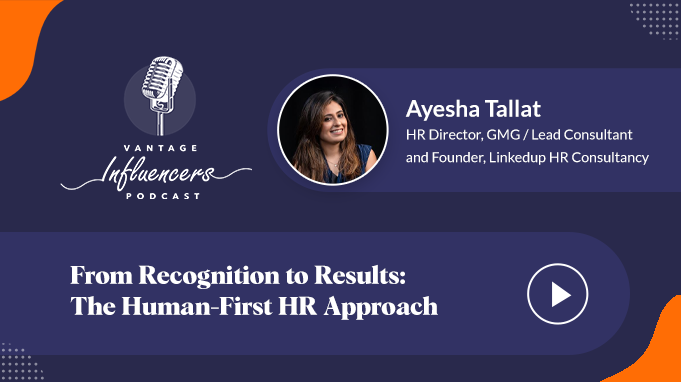
From Recognition to Results: The Human-First HR Approach
Episode Overview
Ayesha Tallat opens the conversation with a question that reframes how most organizations approach HR: what happens when policies are designed around people first, rather than fitting people into rigid processes? She argues that human-first HR is less a new philosophy and more a return to the literal meaning of human resources, treating people as the resource worth protecting rather than a category to be processed. That shift, she explains, does not start with HR alone. It starts with leadership modeling small, consistent acts of appreciation that make employees feel genuinely seen, and it is this everyday behavior, not annual reviews or big-budget initiatives, that sets the tone for engagement and culture across an organization.
From there, the discussion moves into why this approach matters for the bottom line. Ayesha connects human-first practices directly to retention, innovation, and reduced burnout, pointing out that even well-paid employees leave when they don't feel valued or supported in their personal priorities. She is candid about why so many organizations struggle to act on this: recognition often gets treated as crisis response, reserved for counteroffers and exit interviews, rather than built into daily habits. She also makes the case that leadership vulnerability, not authority, is what earns trust from teams. The conversation closes with three concrete moves any HR team can start immediately: humanizing existing policies, embedding recognition into daily rituals, and breaking down the hierarchies that keep leaders and frontline employees at a distance.
Episode Highlights
- Human-first HR means designing policies and processes around people first, rather than forcing people to fit into rigid systems.
- Culture change starts with leadership, not HR alone; small acts like making employees feel genuinely seen can kick off a broader engagement culture.
- Recognition-driven HR directly impacts retention, innovation, and burnout, especially in high-mobility talent markets.
- Many organizations only reach for recognition during a resignation crisis instead of building it into daily practice.
- Leaders who show vulnerability, sharing real work challenges instead of just authority, build stronger psychological safety with their teams.
- HR professionals need three things to stay relevant today: agility, data-driven storytelling, and empathy applied at scale.
About the Guest
Ayesha Tallat, Founder and Lead HR Consultant, LinkedUp
Ayesha Tallat is Founder and Lead HR Consultant at LinkedUp, where she partners with organizations across the Middle East, Pakistan, and Southeast Asia as a fractional HR leader, helping them build high-performing, people-centered cultures. She has spent over 17 years leading HR for multinational corporations, family-run businesses, and startups, bringing a background in IT and finance to how she designs HR strategy. Outside of work, Ayesha is a certified life and career coach, an off-road adventurer, animal lover, and globe-trotter passionate about helping individuals design meaningful careers.
Connect with Ayesha on LinkedIn
Host
Shabana Shahnaz, Vantage Influencers Podcast Host
What You Will Learn
- Why human-first HR starts with leadership behavior, not HR policy alone
- How recognition habits impact retention, innovation, and burnout
- The biggest barriers preventing organizations from building a recognition-driven culture
- Why leadership vulnerability builds psychological safety and trust
- The three skills HR professionals need to stay relevant: agility, data storytelling, and empathy at scale
- Three practical steps any organization can take to become more human-first today
Key Topics & Timestamps
| Timestamp | Topic |
|---|---|
| 01:09 | Ayesha's professional journey and path into HR |
| 02:04 | Defining human-first HR and how it differs from traditional HR |
| 03:22 | How a human-first HR mindset shapes employee engagement and culture |
| 05:57 | The role of human-first HR in long-term organizational performance |
| 07:45 | Common barriers to recognition-driven, human-first HR |
| 11:15 | New skills and mindsets HR professionals need today |
| 17:13 | Three practical steps to start a human-first HR approach |
Full Transcript
Click to read the full episode transcript
Welcome to the Vantage Influencers podcast. This podcast is sponsored by Vantage Circle, the simple and effective recognition platform for employee engagement.
Let me start today's episode with a question. What if the secret to stronger business performance wasn't found in bigger budgets or stricter policies, but in something as simple as recognition? When people feel genuinely seen and valued, they don't just show up. They try. That's exactly what today's guest, Ayesha Tallat, has been championing. With over 17 years of experience leading human resources across MNCs, startups, and even family-run businesses across the Middle East, Pakistan, and Southeast Asia, Ayesha blends business strategy with a human-first approach. Today, as the founder and lead HR consultant at LinkedUp, she partners with organizations as a fractional HR leader, helping them build high-performing cultures where people actually want to show up.
Shabana Shahnaz: Ayesha, a very warm welcome to the podcast. I'm so excited to dive into this conversation with you today. But before we dive in, would you like to share a bit about your professional journey so far?
Ayesha Tallat: Sure. Thank you so much, Shabana, for the warm introduction. I'm feeling happy about how you introduced me. And sure, definitely, I think you've covered most of it. I'm an HR professional operating out of the Middle East. I'm originally from Pakistan, and I have about 17 years of HR experience, working for different companies. I think the interesting part could be that I studied IT and finance, and I ended up building a career in HR, so a bit of a blend of all the worlds, I would say. And now I'm excited to have my own firm, LinkedUp HR consultancy, which focuses on human-first HR.
Shabana Shahnaz: Amazing. That's so good to know. So let's set the tone of the podcast today with the very first question. What does human-first HR mean to you, Ayesha? How does it differ from the traditional HR approach?
Ayesha Tallat: That's a very interesting question, Shabana. Thank you for asking. So definitely, when we talk about HR, human resources, we call human beings resources. However, when we get into the rigmarole of the corporate world, we forget that we are dealing with people. And we as HR, I'm talking about my HR self, forget sometimes that we're talking about people here as part of the resource of the organization. So human-first HR is about designing your company's HR policies, processes, everything, keeping your talent and your human as a resource in mind, rather than having a rigid process and policy and then fitting people into it. It's about having an agile approach where we design the whole system around the people who deliver your talent. That's what I call a human-first HR approach.
Shabana Shahnaz: Okay, that's very genuine. It's such a refreshing way to look at it. It really shows how HR is actually moving beyond processes into something which is more people-centered. So let's talk about what that means for culture. How does a human-first HR mindset directly impact employee engagement and the overall workplace culture?
Ayesha Tallat: Sure. What I have seen in my little humble experience throughout my career is that I've seen all kinds of organizations. I've seen MNCs, I've seen family businesses, I've seen consultancies, I've seen startups. So I believe engagement is part of the success formula, and it's literally a free-of-cost ingredient that any organization can blend into their culture and strive for success. What I feel is that having a human-centric HR organization, and making it part of your culture, is the key ingredient to being successful in today's time. The world is moving so fast with AI, with ChatGPT, and with people moving away from people to systems, which, by the way, I'm doing myself as well. So what's important is the engagement of whatever people you have left in your organization. And when I say making it part of the culture, it comes from leadership. It's not a standalone HR activity to perform, it's your leadership team that drives the culture. HR is the trigger factor, and leadership is the enablement factor. This combination has to work for the organization to have a culture-rich environment. And when we talk about human-first, something as small as leadership making people feel seen is enough to kick off the engagement culture. We work day in and day out, we do operations, seventy percent of our job at whichever level is operations. However, making people feel seen by valuing what they are contributing is the job of leaders. This is a very small, minute human-first HR step that, if leaders start doing it and HR builds a culture of recognition around these little factors, it can really play a big role in shaping the engagement of the organization.
Shabana Shahnaz: Correct. I agree the connection between engagement and culture is powerful. And recognition doesn't just change how employees feel, it changes how businesses perform overall. So moving on to our next question, what role does human-first HR play in driving organizational performance and success in the long run?
Ayesha Tallat: I think it's directly linked. Human-first HR boosts retention, accelerates innovation, and reduces burnout, factors that impact the bottom line. In a region like the Middle East, where talent mobility is high and competition is extremely intense, organizations that prioritize human-first approaches win by becoming the employer of choice and sustaining long-term performance. When I look at market trends and real-time data from different experts and surveys, even the strongest talent is leaving organizations within two to three years. Why is that happening? They're getting paid well, and sometimes they're switching for small changes, like wanting to focus on their peace of mind, their well-being, or their family life. So I think it's important to have human-first HR from day one a person joins, so they feel valued in terms of financial stability, feel valued and excited to go to work and contribute, and really feel part of the family. That comes from driving this as a culture, recognizing the uniqueness of people and the talent they bring to the table, which will drive organizational performance and long-term success.
Shabana Shahnaz: Correct, I agree. But then many companies talk about valuing employees but fall short in practice. In your experience, what are the biggest barriers you've seen to taking a recognition-driven, human-first HR approach?
Ayesha Tallat: That's a very good question. I think there's a bit of a conventional approach where people wait: this person wants to resign, so we increase their salary to retain them, or they wait for the resignation to come in and then offer a counteroffer to retain that person, and there's a bit of chaos in the organization. HR sometimes thrives on that, retaining this employee and doing this and that, which has become part of their DNA. However, that's a very short-term solution. There are so many practices where devotion and loyalty matter, that's definitely not to be undermined, it's very important, but recognition is the key part. And recognition, when I say it, is not just the annual increment or the annual rating, it has to become a habit of everyone in the organization. Something as simple as a thank-you card or a public acknowledgment on a platform like LinkedIn is very powerful. Leaders should also start thinking this way. I'm not saying it's not happening or that it's a unique concept I'm introducing, all of this exists, nothing is new, it's just that we have to make it part of practice. Sometimes internally, people get so used to standard ways of working and the pressure of P&L that external consultants like ourselves need to get engaged to bring focus in a dedicated way to this area, where employees feel valued. Another important part, and being a certified life and career coach, I speak to a lot of executive leaders, and I feel there's a sense of fear when it comes to modeling vulnerability. I've always seen teams thrive when their leader is vulnerable. I'm not saying share your family problems or personal issues, but share your own challenges at work, not by talking badly about your boss, but describing the challenge you're facing so your team member can help you deliver on it. It makes that person feel valued, acknowledged, and gives them a sense of belonging with the manager, because the manager is providing psychological safety. That's a small win, but it's a big one. Leaders can really go a long way if they change how they deal with their team and bring a bit of vulnerability and openness rather than just being senior, authoritative figures. I've had such inspiring leaders throughout my career as my bosses, and I feel that really contributed to my success as well. These are the small things that, through focus, can really have a big impact on an organization's culture.
Shabana Shahnaz: Correct. Those challenges are very real, and they often go unspoken. But what you said is completely inspiring, because when leaders act differently, cultures actually shift. But HR professionals themselves also need new tools or new ways of thinking to make this real. So what new skills or mindsets do HR professionals need today to practice human-first HR effectively?
Ayesha Tallat: Definitely, I strongly believe HR mindset and HR knowledge, if not updated, could be a huge challenge for the success of the organization going forward. It's the right time for HR professionals, including myself, to update and upgrade, and realize how we can really bring value to the bottom line and have a positive impact on the P&L of the organization. When I say this, the instant reaction many HR people have is cost effectiveness, cutting costs, headcount reduction, because HR can play a big role there. But stop, pause, I'm not advocating for that, I'm not saying it's right or wrong, it's the need of the hour, and if it's needed, it should be done. But it's also about understanding business acumen, understanding which policies can really be the driver of business success. While designing these policies, which can bring value to the P&L, we don't have to lose empathy. Empathy is the core and heart of HR professionals, so keeping empathy in mind while designing policies, but also ensuring flexibility around how things can be treated differently. For example, salary structure policies: a lot of struggling or startup companies are now moving from a fixed, cost-heavy salary to incentive-based policies, which works out well. Or even in salary structure, a lot of companies are getting open to employees working with other employers part-time or on weekends, if that could be another source of income, why not have that policy in your organization, if you feel your salaries aren't best practice? Or take working flexibility: remote working hours are now the trend, MNCs are offering remote working hours per month from which an employee can work from home. I know so many professionals, including my sister, who don't want to leave their organizations because they want to work for a company that's flexible. She has young children and wants to be home while still being a working mom, so if a company offers slightly less money but has that policy, she'd be more open to it. So these are some examples. Now, when we talk about trending practices, I think we have to scale up agility, moving away from rigid systems and rigid policies to be adaptive to practices that reflect changing employee needs. For example, recently, for a very big airline company, we delivered training on AI and HR, and I was happy to see the vulnerability of the entire HR team to learn AI, and how they could create dashboards in AI and use it to their advantage rather than fearing that AI is going to replace them. I was so happy to see we set the tone right, and that openness really helped them adapt these examples. They were really happy with the output of the dashboard they created in about fifteen minutes in a session. So agility is number one. Number two is a data-driven approach: HR has to work with data, and that's one of the key links between HR and P&L. They need to understand all kinds of data available in the company, whether it's marketing data, P&L data, or numbers data, not just HR data, but data from outside HR, the data the business operates on, and use it to build their HR story. So the first is agility, the second is data-driven storytelling, using analytics to highlight the human impact on company performance. And number three, I'll repeat myself, is empathy at scale. In competitive environments, empathy is becoming a bit of a shadowed approach, it has to be put at scale, not just listening to individuals, but using their input to design your systems, policies, and culture, and using it to the organization's advantage rather than just gathering information. So these are some of the points and practices that I think are very important in these times, and that can really have a positive impact for an HR professional to grow within this market.
Shabana Shahnaz: Absolutely, I completely agree with all your points, that HR shouldn't take a backseat when it comes to the changing role of HR. That's a very valuable perspective. Thank you so much, Ayesha, I'm really enjoying this conversation, but before we wrap up, let's leave our listeners with some practical steps they can act on right away. If I ask you what three simple actions organizations can take today to move toward a more human-first HR approach, what would you suggest?
Ayesha Tallat: Sure, I think, first of all, humanize your policies and processes. Review existing policies and processes through the lens of employee experience and adjust them to be more people-friendly. Again, I'm not preaching that companies should give out all benefits or take out benefits, you should definitely link it to the company's P&L and understand what's happening, but there are smaller elements you can play with to bring a big impact. So, number one, humanize your policies. Number two would be embedding recognition in daily rituals. A reward should be there, but start your day with daily recognition rituals, it could be linked to company values, performance, or behaviors, but have it as a discipline of the organization, recognizing people, and don't do it for the sake of doing it, do it on genuine and authentic criteria. That's another small win to bring in the human-first HR approach. And the third is to remove the hierarchies. I'm not saying everybody in the organization should or shouldn't be accessible, what I'm saying is, in terms of hierarchies, make people accessible to each other through listening, through creating listening platforms as HR, implementing regular open feedback sessions, taking care of employees based on their feedback, and connecting top leaders and their challenges to frontline team players and their challenges, removing the barriers between them. So these are the three small suggestions which, if executed as a full-fledged plan, can bring a great, positive impact on bringing human-first HR into your organization and building a thriving culture.
Shabana Shahnaz: Amazing, those are very valuable points. If I have to reiterate, you first mentioned humanizing the policies, then focusing on making recognition meaningful and authentic, and then you moved on to talking about removing hierarchies, not per se, but actually bringing those changes on a human level, empathizing with employees' experiences, right?
Ayesha Tallat: Yes, definitely.
Shabana Shahnaz: Amazing. Thank you so much, Ayesha, for sharing such powerful insights today. I loved our conversation, but what stood out to me is how simple but meaningful appreciation or recognition, especially when practiced consistently, can actually shift culture altogether. It can fuel engagement and ultimately drive performance. So thank you so much. For our listeners today, the message is clear: recognition is not a soft skill, it's a business strategy, and it's one that creates workplaces where people want to show up and do their best work. We hope this conversation has sparked new ideas for you and given you practical ways to make HR more human-first in your organization. So thank you so much, Ayesha, once again for your time, I thoroughly enjoyed our conversation.
Ayesha Tallat: You're welcome, it was my pleasure, Shabana, and thank you so much for having me on board. Good luck to you and your platform for championing such great HR practices and giving us the opportunity to reflect, rethink, and change what we can in our own capacity. Thank you so much for having me.
Shabana Shahnaz: It's a pleasure to have you. So let's wrap up this episode with one last message to our listeners: when you recognize people, you unlock results. And with that being said, take care, and we'll see you next time.
FAQ
What does "human-first HR" mean?
Human-first HR means designing policies, processes, and systems around people rather than fitting people into rigid, pre-built processes. It treats employees as the actual resource an organization depends on, not a category to be managed.
How does human-first HR affect employee engagement and culture?
It shifts culture change from a standalone HR initiative to a leadership-driven practice. Small, consistent acts of recognition from leaders, not big-budget programs, are often what kick off stronger engagement across a team.
What stops most organizations from becoming more recognition-driven?
Many organizations only act on recognition and retention during a resignation or counteroffer, treating it as crisis management. A lack of leadership vulnerability, and discomfort with sharing real challenges, also keeps recognition from becoming a daily habit.
What skills do HR professionals need to practice human-first HR effectively?
Three things stand out: agility to move away from rigid systems, data-driven storytelling that connects HR decisions to business data, and empathy applied at scale across policy design, not just individual conversations.
Related Reading
Also listen on