The Role Of Total Rewards In Employee Engagement
Also listen to our podcast on: The Secret To A Great Workplace Experience
Episode Overview
Charu Purohit opens this episode by reframing how organizations think about rewards altogether. Rather than treating pay as the centerpiece of the employee value proposition, she argues that total rewards is about stepping back and asking what employees genuinely value about working at an organization. That bigger picture spans pay, benefits, learning and growth opportunities, wellness, and recognition, and the real work for employers lies in finding the right mix across all five and using them deliberately to build trust rather than simply compete on salary.
The conversation moves quickly from philosophy to practice. Charu makes the case that non-financial elements like career development, culture, and especially recognition drive engagement far more than compensation, which she describes as more of a hygiene factor. She also pushes back on generational stereotypes, arguing that the only reliable way to know what employees want is to ask them directly and build in room for personalization, the same way people expect customized experiences from streaming and food delivery in their personal lives. That personalization thread carries through her advice on rewarding top performers, measuring program success through retention and engagement data, and her closing challenge to HR leaders: stop chasing best practice and start building what actually works for your own organization.
That is where the concept of Rewards and Recognition comes in. It includes all that an employee wants today, rather than concentrating exclusively on compensation.
Episode Highlights
- Total rewards means looking at the full picture: pay, benefits, learning and growth, wellness, and recognition working together, not compensation alone.
- Non-financial factors like career development, culture, and recognition have a bigger impact on employee engagement than pay, which functions more as a hygiene factor.
- Generational stereotypes are a starting point, not an answer; the only reliable way to know what employees want is to ask them directly.
- Personalization is now table stakes: employees expect the same tailored experiences at work that they get from streaming and food delivery in their personal lives.
- Rewarding top performers works best when recognition is exclusive, timely, public, genuine, and personalized rather than one-size-fits-all.
- Track program success through hard KPIs like retention rate, engagement scores, and eNPS, and stay willing to adjust the approach based on what the data shows.
About the Guest
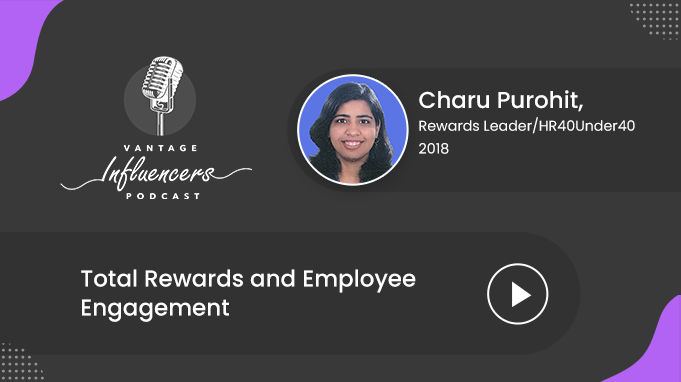
Charu Purohit, HR & Rewards Consultant
Charu has worked in the industry for over 13 years leading HR assignments, primarily focused on rewards and talent, in organizations like Aditya Birla Group, Abbott and Tata. She has worked across South Asia, the US and the Middle East leading multiple projects. Some of her key assignments include large scale mergers and acquisitions, business shutdowns and organization restructuring. She recently stepped back from her corporate roles to follow her passion of mentoring and advising start-ups on HR.
Connect with Charu on LinkedIn
Host
Susmita Sarma, Vantage Influencers Podcast Host
What You Will Learn
- What a total rewards philosophy actually includes beyond salary
- Why non-monetary factors drive more engagement than pay
- How to figure out what different generations of employees actually want
- Why personalization matters in rewards and recognition programs
- How to reward top performers effectively
- Which KPIs to track to measure whether a rewards program is working
- Global benchmarks for rewards and recognition spend per employee
Key Topics & Timestamps
| Timestamp | Topic |
|---|---|
| 00:34 | Introduction: today's topic and guest |
| 01:17 | Charu's 13-year journey in HR and rewards leadership |
| 02:00 | What a Total Rewards System is and why it matters |
| 03:55 | How total rewards connects to employee engagement |
| 05:15 | Understanding what different generations of workers value |
| 09:10 | Communicating total rewards so employees feel heard |
| 11:51 | The most effective way to reward top performers |
| 12:40 | Additional benefits beyond pay to build a better workplace |
| 15:35 | Measuring whether a rewards program is actually working |
| 16:34 | Rewards and recognition investment trends in India and abroad |
| 18:17 | Charu's closing advice for HR professionals |
Full Transcript
Click to read the full episode transcript
Welcome to the Vantage HR Influencers Podcast. This podcast is sponsored by Vantage Circle, the leading employee benefits and engagement platform.
When we think about workplace experience, workers want experiences that strive to energize them, not only by satisfying their basic needs, but by providing opportunities for career advancement and expansion to look forward to. That is where the concept of total rewards comes in, and it includes all that an employee wants today, rather than concentrating exclusively on compensation. Let's know more in today's episode.
Susmita Sarma: Welcome back to the Vantage HR Influencers Podcast. Today we will be talking about total rewards and employee engagement, and for the same we have with us guest speaker Charu Purohit. Charu has worked in the industry for over 13 years leading HR assignments in organizations like Aditya Birla Group, Abbott and Tata. She has worked across South Asia, the US and the Middle East leading multiple projects. Some of her key assignments include large scale mergers and acquisitions, business shutdowns and organization restructuring. She recently stepped back from her corporate roles to follow her passion of mentoring and advising startups on HR. Welcome to our show, Charu.
Charu Purohit: Hi, Susmita. Thank you for having me.
Susmita Sarma: Welcome. So, first before we start with the topic, please let us know a brief about your journey in the corporate world.
Charu Purohit: So, as you might be aware, I have spent about 13 years in HR, primarily focused on rewards and talent. I was very fortunate to work with organizations such as Tata Group, Abbott and Aditya Birla. This has been a fantastic journey for me because it allowed me to work across geographies, including Southeast Asia, the Middle East and the US. And I've worked on some fairly challenging projects, including setting up greenfield sites, restructuring initiatives and business shutdowns. So it has been a pretty interesting journey so far.
Susmita Sarma: So Charu, going by our topic today, for our listeners, could you please explain what total rewards is, what the total rewards approach is, and why it's so important for organizations today?
Charu Purohit: So, let me break it down and address the first question. Before going into the details, if you simply think about it, total rewards is just about the big picture. As an employer, I start looking at what it is that my employees value most about working at my organization. Now, when you drill into it, this would be a combination of pay, benefits, learning opportunities, growth opportunities, wellness programs, and of course recognition. So as an employer, I have to find an optimal mix of these levers and deliver a value proposition.
Why do I need to do that? It helps me look at it holistically and optimize my return on talent. So from my perspective as an employer, when I start talking to probable employees or existing employees, I don't just talk about pay packages. I start talking about growth and opportunities, flexibility and other schemes for development and continued education. This matters for talent attraction and retention, but most importantly, going back to the cultural aspect, I'm also building a culture of fairness, transparency and clarity. It signals to my employees that there is a genuine intent on my part to build a relationship with them, and hence I find it very important.
Susmita Sarma: We also talk a lot about employee engagement. So how are total rewards connected to employee engagement? What are your views on it?
Charu Purohit: Let's look at it a little differently. As I mentioned, total rewards is about the big picture, a sum total of the financial and non-financial value proposition I have to offer to employees. As a consultant, I love research and usually use it as a starting point for my work and advice. If you go back to the research, whether from academic institutions like Harvard or from well known research and advisory firms in the HR space, they have found that the non-financial aspects of total rewards are very critical to employee engagement. The pay part is more of a hygiene factor. However, things like quality of work environment, career development, culture, work life balance, and probably the most important factor, recognition, all have a much greater impact on employee engagement.
Susmita Sarma: So how do we figure out what workers or employees, depending on generation, actually want, especially if we talk about millennials, who are almost 70% of the working population now?
Charu Purohit: It's a very important question to ask ourselves. Now, while I have great faith in research, research on subjects like millennials will probably tell you there are certain stereotypes, like they like challenging workplaces, they like flexibility to pursue personal passions or be better parents, and they are more socially and environmentally conscious. I like to focus on the positives, so I talk about that. But what I'm trying to say is, while these generalizations are good to start with, they end up being ageist. So first, let's be humble and start by saying we really do not know what our employees want. Once we start with that, then we try to find out. And the simplest way is to ask them.
One important thing that has changed for this generation is that we are really used to personalization in our lives. For example, at home, my husband, my daughter and I all watch different series on Netflix. We don't watch the same things. The same is the case with music, with Spotify. Again, when we go out to eat, one person wants vegan, another wants gluten free, and we are all willing to pay for these experiences. So your employee is not just an employee, they are a person. And when they're used to personalization in their regular lives, how can they not expect it in their workplace? So when you ask them, see if there's scope for personalization.
Susmita Sarma: So it's basically about asking employees what they want, but that will also depend on each person's wants and desires. What one person wants, another on the same team may not. So is it possible to offer that kind of personalization at an organizational level?
Charu Purohit: Yes, you'll be surprised actually. You could look at our good friend marketing. Technology has enabled a lot of personalization. You may not be able to personalize everything, but you can find niches where you can do it. For example, recognition is one area where people value different things. One person may value a good program at an esteemed institution, another may value a coupon for dinner, and yet another may value something else entirely. We have to start thinking in those terms.
Susmita Sarma: So once we know what employees want, how do you communicate it in a way that makes sure employees understand that the company is responsive and able to fulfill their requirements?
Charu Purohit: It's important to remember that as a company, you will probably not be able to fulfill all their requirements. What you need to make sure is that your employees understand what the company is offering, and that you're making a constant effort to keep up with their requirements based on the resources you have. Going back to research, high performing organizations make employee communication a priority, as important as customer communication. There are a lot of frameworks you can draw from marketing or HR, but I like to keep it simple.
First, be clear and concise. Make sure your message is received the way it's intended, with no ambiguous or secondary messages clumped together. Second, and probably most important, start at the top. Your CEO, CHRO and other senior leaders need to set the tone. Third, going back to our friends in marketing, make sure employees hear, see and experience the message multiple times, in multiple ways, to understand it completely. Get creative, have fun with it, but stay true and consistent to your messaging, it should reflect who your organization is. Fourth is discipline: have a calendar, be regular and systematic. And finally, as a rewards person, I believe in numbers, measure effectiveness. Check formally and informally, regularly, and be humble that you could have communicated differently. It's all right, we are all learning.
Susmita Sarma: So according to you, Charu, what's the most effective way of rewarding top performers?
Charu Purohit: Top performers are a topic as old as time, and rewarding them remains a hot topic simply because they are your most important people. But the principle stays the same: don't take a one-size-fits-all approach. Make sure recognition is exclusive, timely, public and genuine. And going back to our earlier discussion, personalize it wherever possible. We can really learn from marketing here, these are your top customers and we have to serve them well.
Susmita Sarma: When we talk about additional benefits, our listeners will know that we have our own products, Vantage Rewards, which is an easy to use and customizable cloud-based solution, and Vantage Fit, which has been revolutionizing employee wellness journeys around the globe. So according to you, what additional benefits can you give to build a better workplace apart from pay?
Charu Purohit: I'm aware that Vantage is doing some fantastic work in this space, and I've been reading up on it, that's why it's such a pleasure to talk to you today. So do feel free to go out and research what Vantage is all about.
I'll talk more in terms of the basics rather than products, because products are there in the market once you decide your approach. As I mentioned earlier, the research consistently shows that non-monetary rewards are more critical than ever. Let's talk about the ones that, in my opinion, are most important. One is learning and development opportunities, especially for millennials, who are young, in a hyper-competitive environment, and in a world that changes really fast, as we're all experiencing currently. These opportunities could include continued education programs, cross-geography assignments or deputations, fast-track programs, and more.
Second, what our current lifestyle has brought to the fore in personal life comes to the workplace as well: health and wellbeing. Here we're talking about not just physical fitness but also mental health, which has become a huge topic now. Flexible working, allowing people to take care of family time, and parental friendly policies also matter.
And finally, probably the most important, is recognition. I talk about this a lot because it's very critical and probably a low hanging fruit, easier to do than everything else. Have customized programs for recognition, recognize employees for their contribution, but make it meaningful and tailored to individual needs.
Susmita Sarma: So for any recognition or rewards program to be effective, it should meet several criteria. How can you say if your reward system is successful?
Charu Purohit: Like anything else, you can only know if something is successful by experiencing it. You can only know you made a good curry by eating it. So we have to measure it, there's no other way, and we have to measure it from the right sources. It has to show up in various KPIs and feedback forums. Some of my favorites are retention rate, engagement score, and eNPS, which is actually borrowed from sales and marketing when you're talking about employee promoter scores, whether employees advocate for your organization. And finally, the old ones: absenteeism and attrition.
Susmita Sarma: So if we talk about current trends, how much do companies invest in rewards and recognition in India and abroad?
Charu Purohit: That's a bit of a larger question, and it really depends on your purpose when it comes to rewards and recognition, it varies a lot. For example, if employee churn is a huge concern for you, then anything you spend on rewards and recognition that helps retain employees, as long as it's less than the cost of replacing an employee, which includes not just recruitment but also training and ramp-up time, is something you'll be willing to spend.
But if you look at rough figures from research, the best companies globally spend around $250 to $300 per employee. This value is a bit lower for smaller and medium sized organizations, where our estimate would be somewhere around $150 to $200. India historically was lower because our pay and employee practices were still evolving, but now we've reached a stage where we're very close to the global average.
Susmita Sarma: Great. So any suggestions for our listeners, Charu?
Charu Purohit: There are many things we've spoken about during this podcast, but if you were to take away one thing as a fellow HR professional, my advice is this: move away from best practice and start thinking in terms of best way. We benchmark way too much. Let's start reflecting on our own organization, seeking feedback from employees, looking at formal and informal signals and suggestions. Then start small, you don't have to commit to anything. Do a bit of piloting, sort of MVPs, see if they work, and then go for a full launch. Let's not be afraid to try and fail, and look at something unique to our organization if we really want a competitive advantage.
Second, borrowing again from marketing: just like marketing moved from product offering to customer centricity, let's start moving from HR offerings to relationships with our employees. Let's not think about what we're offering employees, but start thinking about what an employee values most. Then we'll develop much better proposals, programs and practices.
And finally, don't fall in love with your rewards or your HR programs. Employees don't. We're in an era where things are dynamic and changing fast, and we should stay agile. We might have a great policy today that within a year becomes a burden. Let's accept that and move forward from it. Remember when certain perks were reserved strictly for employees above a certain level, and every organization wanted a policy like that? Today it looks pretty meaningless, doesn't it?
Susmita Sarma: Really nicely explained, Charu. So how can our listeners reach out to you?
Charu Purohit: I'm there. As you're aware, I work a lot as an advisor to young startups, so I love hearing from fellow HR professionals. I'm on LinkedIn, very easy to reach. Just give me a shout out, reference this podcast, and I'm happy to respond.
Susmita Sarma: That was an awesome conversation with you, Charu. Thank you.
Charu Purohit: Thank you, Susmita, for the opportunity. I loved it.
FAQ
What is a total rewards strategy?
A total rewards strategy looks at the complete employee value proposition, not just pay. It combines compensation, benefits, learning and growth opportunities, wellness programs, and recognition to find the mix that matters most to employees at a given organization.
How does total rewards affect employee engagement?
Research consistently shows that non-financial elements, such as career development, culture, and recognition, have a much stronger effect on engagement than pay alone. Pay tends to function as a baseline expectation rather than a driver of engagement.
How can companies figure out what employees actually want?
The most reliable method is to ask directly rather than relying on generational stereotypes. Employees increasingly expect the same personalization at work that they experience in their personal lives, so building in room to tailor rewards and recognition matters.
How do you measure whether a rewards program is working?
Track it through concrete KPIs such as retention rate, engagement scores, eNPS, and absenteeism or attrition trends, and check in on the data both formally and informally on a regular basis.
Related Reading
Also listen on