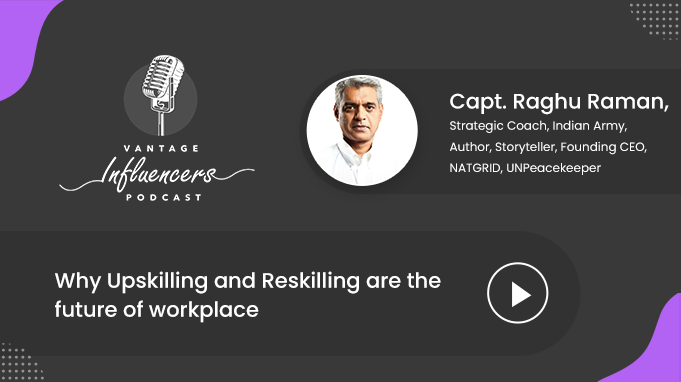
Why Upskilling and Reskilling are the future of workplace
Episode Overview
Capt. Raghu Raman opens this episode by rejecting a word most HR conversations take for granted: upskilling. His argument is blunt. Upskilling assumes you should add another layer to a foundation that may already be obsolete, the way a carpenter might get better at varnishing furniture in a world where flat-pack retailers have wiped out demand for custom carpentry altogether. What people actually need, he says, is diff-skilling: picking up ability in a genuinely different domain rather than getting incrementally better at a shrinking one. He makes the arithmetic concrete with a hypothetical software team facing cuts. If the market only needs 200 project managers instead of 500, certifying the other 300 as better project managers solves nothing, because the problem was never competence, it was demand. He backs this with a Stanford classroom exercise where students are handed twenty dollars and two hours to make as much money as possible. The sharpest students ignored the cash entirely and monetized something else instead, their five minutes on stage in front of an audience of potential buyers. The lesson he draws is that people fixate on the resource they assume is fixed, when the real opportunity usually sits somewhere they haven't thought to look.
The conversation then turns to what leaders owe the people they have to let go. Raghu frames it through a lifeboat: when a sinking ship has fifty people trying to fit into a boat built for twenty, a leader's first duty is to keep that boat afloat, not to insist everyone goes down together. He lays out downsizing as a sequence, starting with shared, sliding-scale pay cuts that ask senior staff to absorb more of the pain than juniors, and only escalating to layoffs once that isn't enough, because an organization that survives can eventually rehire the people it had to release. He also names three afflictions he has watched quietly kill organizations from the inside: a bureaucratic slowdown that leaves them unable to move as fast as leaner competitors, a hardening indifference to people dressed up as smart process, and a kind of institutional memory loss where companies forget the risk-taking instincts that built them in the first place. None of it, he insists, has much to do with the crisis of the moment. A crisis just removes the excuse to keep ignoring problems that were already there.
Episode Highlights
- Diff-skilling beats upskilling when the job itself is disappearing, not just the skill level within it.
- A Stanford exercise about turning $20 into more money in two hours reveals how people fixate on the wrong constraint.
- Leaders should treat their organization like a lifeboat: keep it afloat first, then bring people back.
- Downsizing should start with shared, sliding-scale pay cuts before any layoffs happen.
- Bureaucracy, indifference to employees, and forgetting past risk-taking are the three diseases quietly killing organizations.
- Remote leadership loses the sidebar conversations and body-language cues that used to carry half the workplace's real communication.
About the Guest
Capt. Raghu Raman, Former CEO of the National Intelligence Grid and former President of Reliance Industries
Capt. Raghu Raman began his career in the Indian Army, serving in operations in Punjab, on the frontline of the Siachen glacier, and as a UN peacekeeper in Angola. He left the Army in 1998 to join the Mahindra Group, where he built and led companies including First Choice and Mahindra Special Defense Services, before going on to found and head the National Intelligence Grid and later serve as President of Reliance Industries.
Host
Rohit, Vantage Influencers Podcast Host
What You Will Learn
- Why diff-skilling, not upskilling, is the right response when an entire job category is shrinking
- How to spot when you're solving the wrong constraint, using the Stanford $20 experiment as a mental model
- The three-stage sequence for handling downsizing without destroying trust
- Why a leader's first responsibility is to keep the organization afloat, not to protect every individual job
- The three "diseases" (bureaucracy, indifference, and lost institutional memory) that quietly kill growing organizations
- What changes about leadership communication when a team goes fully remote
Key Topics & Timestamps
| Timestamp | Topic |
|---|---|
| 00:00 | Capt. Raghu Raman's journey from the Indian Army to the corporate world |
| 07:48 | How people can use this time to upskill and build a longer career during downsizing |
| 15:12 | Guiding principles for leaders to stay positive while letting people go |
| 20:09 | The biggest risk organizations face when it comes to risk and security |
| 29:58 | How to lead effectively in a remote work structure |
| 43:42 | Raghu's favorite business book |
| 45:24 | Role models Raghu has learned from |
| 48:00 | Advice for young HR leaders |
Full Transcript
Click to read the full episode transcript
Welcome to the Vantage HR Influencers Podcast. This podcast is sponsored by Vantage Circle, the leading employee benefits and engagement platform.
Rohit: Hi, this is Rohit from Vantage HR Influencers Podcast. And today I'm excited to have Captain Raghu Raman, who's the former CEO of National Intelligence Grid and former President of Reliance Industries. Raghu began his career in the Indian Army and was in operations in Punjab, then in the frontline of the Siachen glacier, and as a UN peacekeeper in Angola. In 1998, Raghu left the Indian Army and joined the Mahindra Group, and has been the CEO of First Choice and Mahindra Special Defense Services, among other companies. A big thank you to Shadlul for helping me organize this episode. Welcome to the show, sir.
Capt. Raghu Raman: Thanks, Rohit. Glad to be here.
Rohit: Awesome. So you've had a journey where you worked in government, the corporate world, and the army. How do you go about reinventing your career, especially in these kinds of crises, when people are looking to either change their career or look at new opportunities?
Capt. Raghu Raman: So that's a good question. I've asked myself that question several times. In hindsight, it becomes much easier to give agency to many things that happen. And I think many times when we fail, we blame it on bad luck, but when we succeed, we always pretend that it is all hard work and intelligent strategy. So I would say luck had a major role to play, there's no doubt about that.
I left the army and my first stint in the private sector was in the Mahindra Group, as you mentioned. I began in an organization called Mahindra United World College, a new college that was being set up at the time. When I joined, there was an army officer from my unit who had already left the army and joined that organization, so he became a mentor who helped me transition from the leadership style of the armed forces into the private sector. Within a year, I was very fortunate to have someone like Anand Mahindra, who has played a huge role in shaping me, and not just me, hundreds of other people too.
When I began my stint at First Choice, my chairman at that point was Mr. Deepak Kari. Having people like that as a standard to live up to was a huge break for me. So I wouldn't take away the aspect of luck, it definitely had a role to play.
The second part is my philosophy that if you're a learner who learns a lot of different things, rather than focusing in depth on one area, opportunities present themselves much more. When I moved from First Choice to a company called Mahindra Consulting, I started a practice there on information security. This was around 2000 to 2001, when information security wasn't yet a buzzword. I was always passionate about coding and hacking, and that passion grew into a company. It started as a practice, with our only client essentially being the Mahindra Group itself, but it eventually grew into a company in its own right. So I had the good fortune of learning the job of a CEO, or the job of a leader with P&L responsibility, literally from scratch.
Looking back at my career, I've either been in startups or in turnarounds throughout. In a startup, you're drawing the road map yourself. When I speak to entrepreneurs venturing into startups, I tell them this is the closest you come to writing your own destiny, because you're the one writing it.
That was my second stint. Then, of course, I became CEO of a joint venture with the Mahindra Group in the defense space, which was familiar territory since defense was already familiar to me. By this time it was 2008, about ten years since I'd left the army, and I had learned the ropes of running a P&L, managing markets, and managing investor expectations. I realized that a CEO's job is equally about managing the board and the expectations of many stakeholders, not just running the business, and I got excellent grooming for that in the Mahindra Group.
Then a turning point came in my career with 26/11, which happened completely unexpectedly, and I moved back into government to found and set up the National Intelligence Grid. That was one of the most challenging assignments I've ever taken on, because we had to build an organization where the private sector and the government worked together, which is always difficult since you have two distinct worlds with different motivators and different drivers. We were building it from a blank sheet of paper, from the ground up.
So I'd say mentors played a very big role in shaping me and teaching me things I didn't know, both after I left the army and even during my time in it. I also picked up an attitude early on of not specializing in just one area, but instead cross-pollinating ideas from different fields into a unified product or service. I was only partially successful at implementing that, I think. It also comes down to curiosity. When I started leading marketing for my organization, I had to learn the basics of marketing and advertising from scratch, so I'd sit with friends in the advertising industry and ask them to explain how things worked, and they'd guide me on what books to read and what to watch. I think that's what enables a well-rounded education. Education isn't just one domain, it's knowing how that domain interacts with several others. So that's possibly one of the reasons I was able to make that transition.
Rohit: Interesting. And downsizing is a reality everywhere, not only in India. How can people use this time to upskill and gather more skill sets to have a longer career?
Capt. Raghu Raman: So yes, you're right, downsizing is going to be a reality. I think we're going to see a downturn worse than what we saw in 2008, when downsizing in some companies came up to 30 to 50 percent. So it's a very possible reality, nobody's really debating whether it will happen, just how long it will last.
I wish there was a different word than upskill. I wish there was a word called diff-skill, meaning different skills. Upskill almost assumes you need to learn something above your current competency level, and I don't think that's the right way to look at it. The right way is what I call diff-skilling, learning a different skill altogether.
A lot of us, when we think about upskilling, take the foundation of what we already know. Say you're in the software industry and you believe downsizing is coming. If you've been a programmer or a project manager, and you think, let me get a few more certificates in project management, I don't think that's the right way to look at it, because the world doesn't need that many project managers, that's why you're being laid off in the first place. If there were 500 project managers needed before the downsizing and only 200 after, it doesn't matter that the other 300 become better project managers, that's not a good strategy. The strategy should be to ask what different skills you can learn, rather than upskilling within the same track, and that could be completely away from your current domain.
There's an interesting anecdote I read recently about a professor at Stanford who teaches lateral thinking. She would tell her students she's going to give them $20 and two hours, and they have to figure out a way to make maximum money with that $20 in that time, then present the business plan to the entire class. A lot of people think about the $20 as the resource, so they'll say they'll buy lemons and make lemonade, or something similar. I've run this experiment myself with students in business schools where I teach, and I get similar answers, some will do a car wash or something like that, and in two hours there's only so much you can do that way.
But a few of the more lateral thinkers realize the $20 is a red herring, something that focuses you because you assume it's your constraint. If instead you say you have three resources, the $20, the two hours, and five minutes in front of the Stanford students, then in those two hours you could call up restaurants and make reservations for the next week and sell those reservations. That's a completely different approach where the $20 plays almost no role. The truly innovative ones realize that five minutes in front of Stanford students is possibly worth several thousand dollars to companies looking to pitch to that audience, and they sold that five minutes.
The point of the story, and what that professor was getting at, is that when we think of the word upskill, we believe we're going to add another layer to our existing foundation, another tool to our repertoire. If I was a coder in one language, now I'll learn another language, I'll diversify my toolkit. But people forget that the job that used those tools may not exist anymore. It's a bit like a carpenter saying he'll also learn how to do varnishing in a world where flat-pack furniture has taken over, so there are no jobs for carpenters left. Even if you become a better carpenter, you'll still be a better out-of-work carpenter. So the mindset shift we need is different skills, not upskilling, and that's a very different mindset.
I think the time is right for it, because many of the changes we're seeing now, including the fact that we're having this conversation in a digital environment, were changes that were bound to come anyway, maybe next year or the year after. It's a bit like remembering floppy disks, then CDs, then USB drives, and now everything is on the internet. Anyone making CDs could see that change coming, it's not that they didn't see it coming. Similarly, I think this reinvention of the world was something that was always going to happen, but like a frog sitting in slowly heating water, people didn't notice it building. I'm not trivializing it, a lot of people will lose their jobs and many companies will go under, but any turn like this is actually a great opportunity for people to reboot themselves.
Sometimes when your computer becomes really slow or your phone becomes clunky, one of the best things to do is reformat it back to factory settings, reload the software you want, keep the data you need, and reinstall it, and it starts moving much faster again. I think despite its huge number of negatives, this pandemic affords us the chance to take that reboot step and make a genuinely major shift. Paradigm shifts are like six-foot ditches, you need to make a six-foot leap, you can't cross a six-foot ditch by making a three-foot leap twice, it doesn't work that way. So I think this pandemic has given people the opportunity to reconsider their core competencies, not their skills. A person isn't necessarily a coder, maybe they're very creative at problem solving, and maybe that problem-solving now has to happen in a completely different domain. So I'd urge people to stop looking at upskilling and instead look at diff-skilling themselves completely differently.
Rohit: Wonderful insights. And so you've had a long career in the army and worked at a lot of startups. How can a leader stay positive in these times when they have to lay off people they've worked with for a long time, and even cut salaries? What would you tell a leader about staying positive in times nobody has seen before?
Capt. Raghu Raman: There are two guiding principles that could help not just leaders, but everybody, though definitely leaders. The first guiding principle is that a leader's job, first and foremost, is to the mission, to the organization and the entity, making sure it stays afloat. Imagine a lifeboat that can only fit 20 people, and the ship is sinking, and 50 people have jumped into that lifeboat. At best it can take maybe 25, so 25 people have to be dropped, otherwise all 50 will sink. The first and foremost responsibility of a leader is towards the mission, which loosely translated means the company entity has to survive and thrive. If the entity thrives, there's always a possibility that even though the decision to let some people go was tough, those people could eventually be brought back.
In downsizing, there are three clear stages. The first is where everyone in the organization takes a cut, on a sliding scale where seniors take a bigger cut than juniors, so everyone shares the poverty depending on where they sit in the hierarchy. Some organizations may choose not to follow this, but those are the three stages generally. The next stage is when you realize that despite that, you'll have to let some people go, and it's the leader's responsibility to keep that lifeboat attitude, that if the lifeboat is floating, there's always a chance to come back for the people in the water and pull them out. But if the whole lifeboat sinks, nobody survives. So it's not the leader's job to say everyone goes down together, the leader's job is to ensure the safety of the entity.
And then there's the fact that after letting people go, and I saw this in the 2002 downturn which was mainly in the IT sector, it might sound harsh to say at the time, but everyone who was let go back then, within six months to a couple of years, completely reinvented themselves. Many of them, when I met them later, said it was actually a good thing that happened, because it shook them out of their comfort zone or pushed them to do something their comfort zone wasn't letting them do, so it gave them the opportunity for a reboot. It's like a mobile phone with a cracked screen, you'll keep using it because it still works, and a lot of our jobs and positions are like that. But if the phone dies completely, you'll do whatever it takes to fix it.
So if a leader understands these paradigms, that their first effort should be to try and share the poverty across everyone rather than concentrating it on a small group, and that if downsizing has to be done despite that, it should be done judiciously through leave, furlough, or letting people go so that the remaining unit has a fighting chance to survive and thrive, and that when rehiring starts, the first right of refusal goes to the people who had to be let go, that's possibly the right response. We must remember a leader also has a responsibility to shareholders, not just employees, and to the people who entrusted them with the ship and said, you have to sail it. If there's a disaster on that ship, the leader's first responsibility is to bring the ship to shore in whatever shape, even if it's limping in. That's the aspect we must keep in mind, a leader's responsibility isn't just towards employees, it's towards other stakeholders too.
Rohit: Very nicely put, that a leader has to save the company and make sure there's cash in the company's books. And you've been in government, corporate, and the army for 30 years. How would you rate the biggest risk facing organizations and enterprises, especially when it comes to security?
Capt. Raghu Raman: I have to tell you, I've been asked this question so many times, having been in the field of risk and security for three decades now, by small organizations and big ones alike. Usually they expect me to say something like it's going to be security related, a terror attack or a bomb going off at an airport, but I don't think those are the risks organizations need to worry about. After 9/11, most of the companies that were affected shook it off and started again, some even emerged stronger. The same thing happened after 26/11, none of the companies affected by it folded.
The biggest risk to organizations, and I've spoken about this at length, is that there are three diseases actually killing organizations. The first is like a human disease, and it's easy to understand because organizations, like human beings, are born, have a childhood, an adolescence, a youth, they mature, and then they grow old. Similarly, they start getting certain diseases, and the first is what I'd call arthritis, layer after layer of bureaucracy that takes far more time to get anything done, the bigger the organization, the more bureaucracy, it's the nature of the beast. When you're a 20-person team, you know each person by name and trust their capability individually. When you grow to 20,000, you have to manage people more like categories than individuals, the way a class of students is grouped by age rather than as a mixed group of friends. An organization that starts looking at its employees as categories and classes becomes slower in its decisions, and that arthritis is best symbolized by an old man who knows how to do something and has done it before, but now it takes so much time to do it that nimbler, faster competitors do it much faster instead. There are plenty of examples of this, and I don't need to repeat the stories of companies that failed to keep up with change because it's been told to death.
The second disease, to put it differently, is like coronary hardening. As organizations grow bigger, they start being managed entirely by platforms, everything becomes a platform. A person wanting reassurance that they're valued by the company can't be reassured by a website that tells them how many leaves they've got or how much bonus they're entitled to, it doesn't reassure them. So organizations need to be aware that while they're pursuing being smart, they shouldn't lose heart, and that's something that happens in organizations too.
The third is that organizations get something like Alzheimer's, they forget their past glory, the mojo they had at one point, the can-do attitude and the risks they used to take. One of my mentors, a fairly elderly gentleman, once told me a story about two brothers who decided at one point that they were going to make jeeps in this country, at a time when even a needle wasn't manufactured locally. They'd go abroad, figure out how to make a jeep, buy an assembly line, bring it back, and train workers to build it. That spirit of entrepreneurship created a company. As that company grew and made more jeeps, they needed managers, so they hired managers, and then accounting issues came up, so they brought in accountants, and sooner or later something goes wrong and lawyers get brought in too. Entrepreneurs operate with the hope of success, and lawyers operate with the fear of failure, so the moment fear of failure enters an organization, entrepreneurship starts to die. That's the third disease, an organization forgets the glory of the major risks it took in its early stages and instead falls into what I call a zero-error syndrome. There's a lot of talk about rewarding failure, but very few companies actually do it, a handful of the biggest ones, like Amazon and Google, genuinely encourage failure. In my experience consulting with several organizations and working with top leaders, about 95 percent of the time it's just lip service to encouraging failure, while what's actually being practiced is a zero-error syndrome.
So these are the three big risks, not a terror attack or a hacking attack. Show me one company that folded because their data was lost, even major banks and the Pentagon have been hacked and had data taken, and none of them folded, they went through a downturn, took a hit, saw a price drop, but they didn't fold. Companies fold not because of those issues but because they can see competitors moving faster right in front of them and still can't respond in time, like an athlete who sees a rival doing something faster but still isn't able to match it. Those are the risks strategic leaders need to worry about far more. And this turn will definitely accelerate that. Zoom's valuation today is more than the top seven airlines combined, and WeWork dropped from an $8 billion valuation to $2 billion in a matter of two months. In this environment, if a large organization thinks it can keep operating with the same speed and the same processes as before, that's a real problem, and you can see it happening in your own industry too.
Rohit: That's a great point on agility. The last two months you must have spoken to a lot of leaders trying to lead their companies. How can a leader lead a company effectively in a remote situation, when they're not physically able to see their teams, and in the coming months a lot of companies will see only 25 to 50 percent of the workforce coming back to offices? What are some ways leaders can lead more effectively even without meeting employees in person?
Capt. Raghu Raman: This is a question I've been asked so many times over the last three months, by leaders I've been working with, that I eventually decided to do a webinar on it, so I'll send you the link for the show notes. But there are some principles here, drawn largely from the experience of the armed forces, where this is actually an occupational reality, because when a battalion is deployed, a unit of 800 people can be stretched over 20 or 30 kilometers, and there are stretches where the commanding officer won't be able to see everyone for six to eight months at a time. So there are elements of leading remotely that are very different from normal leadership.
For instance, in a real physical meeting, which is typical in corporates, you'd arrive a few minutes early and have side conversations with a counterpart from finance about something stuck, or someone from another department would come up and talk to HR about a candidate. You had the opportunity to get a lot done on the sidelines. Secondly, even during the meeting itself, side conversations could happen while someone was speaking. Thirdly, if a VP was presenting an idea, the CEO could scan the room and read the reactions and body language of the team to sense whether they were buying into it. All of those tools of leadership have been taken away, so in many ways the entire protocol of leadership has to change.
In the real world, a meeting might run for two hours and stream into lunch. In the virtual world, you have to give a fixed time, usually about a third of what you'd have allowed in person, so it's truncated. And in the real world you also had the opportunity for everyone to voice input. In a virtual world, because it's truncated and because we're now communicating in what I call simplex communication, one person speaking while everyone else listens, rather than duplex where multiple people can speak or interject, the conversation typically goes into a totem pole, the most senior person speaks first, then the next, and towards the end the CEO usually asks if anyone else has anything to add. But a junior person is unlikely to voice their point of view at that stage, and if you don't create opportunities for juniors to voice their thoughts, you lose contact with the ground, because it's the junior people who are actually in contact with customers and seeing behavior change well before people higher up can.
So I increasingly encourage the CEOs I work with to set aside about 10 minutes and, at random, tell people in advance that they'll be asking one or two juniors to speak for about five minutes. That forces everyone to stay prepared and gives them an opportunity to voice something that might be an important but uncomfortable observation. I saw this in my own career, when we were building the National Intelligence Grid, privacy wasn't a big issue in our heads at the time, but it was the younger team members who pointed out that privacy was going to become a major issue down the line, and it was their voicing that concern that let us prepare for something that would have hit us six or nine months later. Had we not created an environment where people felt psychologically safe raising their views, it would have come out of the blue and surprised everyone.
So the second thing I advise CEOs on is that they must strive to create a psychologically safe environment, one where even the most junior person feels that speaking against the tide won't be penalized, it'll be rewarded. In my experience and from what I've read, it's sad but true that if you polled employees at most companies, 50 to 60 percent would say it's not safe to speak their mind, because if you don't toe the organizational line, it can hurt your career. Unless leaders create that psychologically safe environment, unless they listen to the voices closest to the ground, which by definition are the most junior people, and make it easy for people to offer contrarian views, it's going to be a big problem. A lot of leaders think they can just do what they did in the real world, put it in front of a camera, and it'll work the same way, but it doesn't. You can't film a play and call it a movie, if that worked we'd just record plays instead of making films, but it's a completely different medium, and leadership in a remote setting is a completely different paradigm too.
Rohit: And you've done one of the greatest talks on storytelling, we'll put that in the show notes. You've been a speaker and a great storyteller, any tips for youngsters and leaders who want to improve their storytelling and communication skills, and how are you building your own speaking career?
Capt. Raghu Raman: I think storytelling is an essential tool of a leader, one of the most essential tools in a leader's toolkit. People will follow a storyteller who promises to put a man on the moon, without having the material to build the rockets or the propellants, without having any of it in hand at that moment, but whose vision, told as a story, can galvanize thousands of people and an entire nation toward that goal. That will never happen with statistics, you can't show an Excel sheet and inspire people by saying you've changed the lives of 10,000 customers. But if you tell the story of one customer whose life genuinely changed because of your product or service, that's what sticks.
So storytelling, to my mind, might be the single biggest factor in whether a leader reaches a strategic level. If a leader doesn't know how to tell stories, they have very little chance of becoming an inspirational leader, they might become a leader by authority, because they've reached that position, but it will be very difficult to get people to actually follow them. Even when we talk about core values, I often run an experiment when I'm invited to speak to an organization's strategic leadership, I ask them to write down their core values on a sheet of paper, and invariably you'll get 30 or 40 different values, because each person writes their own version, some even carry over values from a previous company. Any organization that has to put its core values up on a board has lost the plot. In a family, the head of the household doesn't start every morning by asking everyone to recite the family's values, because the whole family already knows them, what's acceptable and what isn't. The moment an organization has to spell it out on screensavers and boards, it means the majority of the organization either doesn't know the values or doesn't genuinely subscribe to them. But if you communicate those same values through stories, they stick, they get into the DNA of the organization. That's the power of storytelling. So the most important point I'd make to leaders is that storytelling shouldn't be treated as an adjunct to leadership, it's central to it. Crafting stories should be a core leadership skill.
Rohit: That's a great takeaway. I want to do a quick round of three. What's your favorite business book?
Capt. Raghu Raman: I don't have one favorite book in any space, I think it's unfair to single one out, because with every book you learn something new. Whenever someone asks me for a few good books, I tell them all books are good, because millions of people have a story inside them, but maybe only a thousand get to publication and only a hundred of those actually make it to a bookstore. That distillation process means every book that's actually on a shelf has something to teach you. And from a 300 or 500 page book, if you take away just one idea and that idea makes a real difference, the book has earned its keep a hundred times over. So rather than naming three books people should read, I always encourage people to read as much as they can, but read books, not websites, Twitter, or articles, because books require you to get into the zone and build a narrative in your head, your synapses get built while reading. So long as people are reading, it doesn't really matter which business book they're reading, every one of them has an idea or a piece of knowledge worth taking.
Rohit: And do you follow any HR leader or CEO that listeners should also learn about?
Capt. Raghu Raman: Again, my philosophy is similar to how I think about books. I have many leaders who are role models in specific areas. If I think about someone I've worked with, I'd look to one prominent business leader I've worked with for his ability to dream big and think at massive scale. If I look at Anand Mahindra, whom I've also worked with, I'd look at his ability to spot talent, and once he's spotted it, to give people a free hand to run with it. Every leader has things you can learn from, and also bad leaders, and honestly I think you can learn more from bad leaders. If someone told you they admire a leader who wakes up at four every morning, does yoga, and studies scripture, you'd have to do all of that yourself to really emulate them. But if there's a leader you've come across who's abusive, or demands work by end of day and then doesn't respond to your email for four days, and when you ask what happened just says they haven't seen it yet, you learn what not to do, and very often knowing what not to do is an easier way to climb the leadership path than trying to copy exactly what to do. So in our ecosystem of learning from role models, we should build a good set of people we learn both what to do and what not to do from, rather than following one individual, which becomes more like a cult or fandom. I don't believe any human being can be right in every dimension, even Winston Churchill, who won the Second World War for Britain, was voted out of office within months of the war ending. He did great things, but he had his downsides too. So I don't think we should follow one individual, it should be a set of individuals, and the specific skills, mindsets, and philosophies we can learn from each of them.
Rohit: Do you have one piece of advice for young HR leaders who want to build their careers in HR?
Capt. Raghu Raman: I've often come across HR professionals who've forgotten that their customer is the employee, not the management. The only piece of advice I'd give HR leaders is, first, don't forget that your main customer is the frontline employee. And second, be courageous. The role of HR is to be the voice of the employees, not the voice of management, and I've come across a lot of HR professionals who've gotten that the other way around, believing they're the voice of management rather than the voice of employees. I don't think HR is the sole responsibility of HR professionals either, to my mind managing people is the responsibility of every leader, and most importantly of the CEO. I've always believed HR is a CEO responsibility, not just an HR professional's responsibility. But an HR professional still needs courage, the courage to tell the truth, and the courage to even put in their papers if what's being asked of them isn't right, even knowing that might affect their own career in the short term. In the long run, a person who fights from the viewpoint of the employee, representing their concerns, is doing the one thing that matters most in HR. Everything else falls into place after that.
Rohit: What's the best way for people to reach out to you and learn more about your work?
Capt. Raghu Raman: I have a website, captraghuraman.com, and my Twitter handle is also under Capt Raghu Raman. Those are the two channels I usually communicate through, otherwise I also have an email address which we can put in the show notes. But Twitter is probably the best way to reach me.
Rohit: We'll put that in the show notes. Thank you so much for your time, I had a great time with this conversation.
Capt. Raghu Raman: Same here, it was very interesting. All the best with the rest of your podcast series.
Rohit: Thank you. Thanks a ton.
FAQ
What is diff-skilling, and how is it different from upskilling?
Diff-skilling means learning a genuinely different skill or domain rather than adding another layer to what you already know. Capt. Raghu Raman argues that upskilling often means getting better at a job category the market no longer needs as much of, while diff-skilling means moving into a category where demand actually exists.
Why does Capt. Raghu Raman compare a leader's job to captaining a lifeboat?
He uses the lifeboat as a metaphor for triage during a crisis. If a lifeboat built for 20 has 50 people trying to board, the leader's first duty is to keep the boat afloat rather than let everyone sink together. Applied to business, that means protecting the organization's survival first, because a surviving company can eventually rehire the people it had to let go.
What are the three "diseases" that Raghu says kill organizations?
He describes bureaucratic slowdown (organizations moving too slowly as they scale), a hardening indifference to employees dressed up as smart processes, and institutional memory loss, where a company forgets the risk-taking instincts that built it in the first place. He argues these matter far more than external shocks like security incidents or data breaches.
How should leaders approach layoffs according to this episode?
Raghu recommends a staged approach: start with shared, sliding-scale pay cuts where senior employees absorb more of the reduction than juniors, and only move to layoffs if that isn't enough. When rehiring resumes, he suggests giving first right of refusal to the people who were let go.
Related Reading
Also listen on