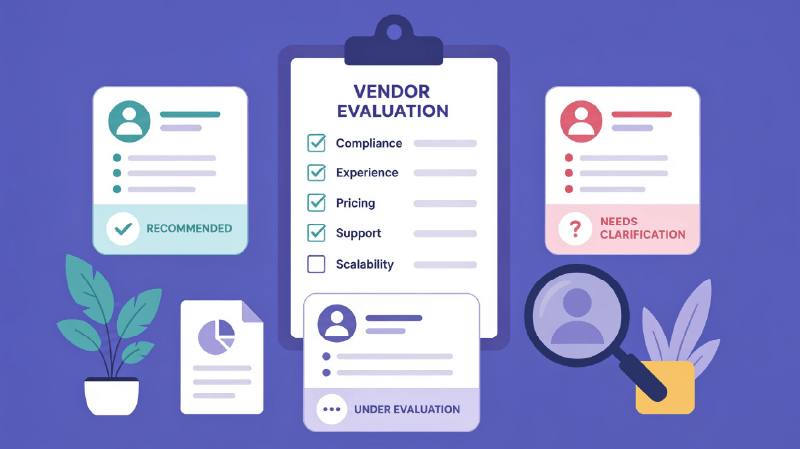
Every recognition platform looks impressive in the demo. The activity feed is lively, the rewards catalog runs deep, and the team giving the pitch has clearly run it a hundred times. The trouble tends to show up months later, and it rarely looks like a product problem. It looks like a renewal you cannot defend to Finance, an invoice that did not move after a restructuring, or a launch that lost steam the moment the rollout became your team's job.
That gap, the one between the platform that demos beautifully and the platform you live with for the next three years, is rarely about features. It is about the contract. A strong employee recognition program rises or falls on the commercial terms you negotiate before anyone logs in: how you are billed, what happens when your workforce changes, and whether the vendor stands behind the outcomes it promised. Most of those terms get settled during the demo, which is the exact moment you carry the most enthusiasm and the least leverage.
So this article hands you the seven questions that bring those terms into the open while you can still act on them. They work on any recognition and rewards (R&R) vendor on your shortlist, including the ones you already like, and including Vantage Circle.
Here are the seven questions, in the order they tend to matter:
- Do you price per seat, or per active user?
- What happens to my contract if my headcount drops?
- Is any part of your fee tied to the outcomes I define?
- How much of each reward dollar actually reaches my employees?
- What happens if adoption stalls?
- How will you help me prove ROI to Finance?
- What does year two, and renewal, actually look like?
So let's break down why each one matters, what a strong answer sounds like, and the red flag to listen for.
Why the Right Questions Matter More Than the Feature List
Most advice on choosing a recognition platform hands you a feature checklist. The trouble is that features are the easiest thing for two vendors to match, which is exactly why they so rarely decide anything. Two pieces of employee recognition software can look identical in a demo and then behave completely differently the first time your budget tightens or your headcount moves.
The same pattern shows up across software. CoreView's analysis of five million Microsoft 365 users found that 56% of licenses were inactive, oversized, or still assigned to people who had moved on. Simply reclaiming the unused ones cut software costs by about 14%. The fix was never a better feature list. It was a pricing model that tracked who actually used the tool.
What actually separates a good vendor from a bad one is commercial, not technical. It comes down to how they price, what they will commit to, and what they are willing to put in writing. That is also the ground Finance cares about, and measurement is exactly where it gets hard. Gartner finds that while 89% of CHROs are focused on building a high-performance culture, most organizations still struggle to measure progress beyond employee satisfaction. So a vague answer on how a platform proves its value does not just store up risk for later. It can stall your approval now.
This article covers that commercial layer. If you are still shaping the program itself, our guide to building a recognition program handles the strategy side, and you can treat this as the contract layer that sits underneath it.
One note before you start, because it makes every answer easier to judge. A strong answer is specific and written down. A weak answer is warm and verbal. The tell is usually a single phrase: "we can put that in the contract," rather than "we would sort that out at renewal."
1. Do You Price Per Seat, or Per Active User?
Why it matters: Per-seat pricing bills you for the headcount you had on the day you signed. It does not care whether those employees ever open the platform. You end up paying for empty seats and disengaged users at the same rate as your most active teams.
What a strong answer sounds like: The vendor ties billing to actual usage rather than the roster. Billing should follow monthly active users, so the invoice reflects who genuinely engages each month. A handful of vendors now build this in. Vantage Recognition, our employee recognition and rewards platform, prices on active users as part of its Adaptive Pricing model. Even if a vendor cannot match that, asking the question tells you how they think about the value you actually receive.
The red flag: Any answer that defends a fixed per-seat count as "industry standard." It is common, but common is not the same as fair, and it quietly transfers all the usage risk to you.
For a deeper look at how pricing maps to value, our breakdown of the employee recognition budget is a useful companion to this question.
Not Sure Which R&R Platform Is Right for You?
Our Buyer's Guide covers everything you need — evaluation criteria, must-ask vendor questions, and a side-by-side comparison framework.
Download the Buyer's Guide2. What Happens to My Contract if My Headcount Drops?
Why it matters: Workforces are no longer stable across a three-year term. The World Economic Forum projects labor-market churn equal to 22% of jobs by 2030, with roles created and displaced at the same time. If your contract is locked to a headcount you no longer have, you keep paying for people who left.
What a strong answer sounds like: The contract should recalibrate automatically when headcount falls, without a renegotiation call. Look for a written clause, not a verbal promise to "work with you." Some vendors build this in. Vantage Circle, for example, adjusts pricing automatically once headcount drops more than 15%, within 30 days. The exact number matters less than whether any such clause is in writing at all.
The red flag: "Headcount is locked for the term." That sentence means a restructuring becomes your financial problem, not the vendor's.
This is the question with the most money hiding behind it, so it is worth going deeper: our breakdown of what a per-seat recognition contract really costs when headcount drops walks through the math and the clauses to look for.
3. Is Any Part of Your Fee Tied to the Outcomes I Define?
Why it matters: Every vendor promises outcomes in the pitch. Very few accept any consequence for missing them, and the outcomes are far from guaranteed. BCG found that only 35% of companies actually meet their digital transformation goals. When the fee is fixed no matter what happens, the vendor has little reason to stay invested after go-live.
What a strong answer sounds like: A share of the fee should sit at risk against the KPIs you define, and go uninvoiced if those targets are missed. Some vendors will do exactly this. Vantage Circle, for example, places up to 40% of its annual fee at risk against the KPIs a client sets. Even when a vendor cannot match that, the question forces a useful conversation about what they will actually commit to.
To make the conversation concrete, bring a short KPI menu to the table:
| KPI | What it measures | How a vendor can be held to it |
|---|---|---|
| Voluntary turnover reduction | The share of employees who choose to leave | Tie a fee component to an agreed reduction target |
| Monthly active adoption | The share of the workforce using the platform each month | Set a contractual adoption threshold by a fixed date |
| Manager participation | The share of managers giving recognition each quarter | Report it on a shared dashboard and review it quarterly |
| Recognition coverage | The share of employees who received recognition in a period | Set a coverage floor and measure against it |
The red flag: Vague offers of "credits" or "service reviews" with no defined number. A credit you have to fight for is not accountability.
4. How Much of Each Reward Dollar Actually Reaches My Employees?
Why it matters: This is the cost that never shows up in the subscription line. Some platforms take a cut of every reward redeemed, a markup that quietly shrinks the budget you set aside for your people. Rewards also leak when they go unredeemed: Bankrate found that 43% of Americans hold at least one unused gift card, worth about $27 billion in total. Between markups and forgotten balances, a real share of your recognition budget can simply never reach an employee.
What a strong answer sounds like: The full value you load should reach the employee, with no markup on redemption. A clean way to ask it is direct: of every $100 we fund, how much actually lands with the employee? The best answer is all of it, with the vendor earning from the platform subscription rather than a cut of each reward. Whatever the number, a small percentage adds up fast across a whole workforce, so the math is worth doing before you sign.
The red flag: A vendor who cannot give you a straight percentage, or who buries the reward fees in a separate agreement you have to ask for.
5. What Happens if Adoption Stalls?
Why it matters: A platform nobody uses is the most expensive outcome of all. Prosci's research shows how wide the gap is: teams with excellent change management meet or exceed their objectives 88% of the time, compared with just 13% when change management is poor. In most rollouts that stall, that people-side risk is carried entirely by the HR team, while the vendor moves on after go-live.
What a strong answer sounds like: A serious vendor accepts part of the adoption risk and writes a commitment into the contract. Some vendors will. Vantage Circle, for example, commits to 70% active use by Month 6 and extends the contract at no cost if it misses that mark. The real question to put to every vendor is simple: what happens if adoption stalls, and is the answer in the contract or only in the pitch deck?
The red flag: A rollout plan that hands the entire change effort back to HR with no shared accountability and no defined target.
6. How Will You Help Me Prove ROI to Finance?
Why it matters: Finance approves what it can measure. Recognition has a long history of being felt but not counted, which is exactly why so many programs lose their budget in the first review cycle. The stakes are not small: Gallup puts the cost of low engagement at $8.8 trillion, about 9% of global GDP. If the vendor cannot help you show impact, you will be defending the line item alone.
What a strong answer sounds like: The vendor should provide reporting that links recognition activity to engagement and retention, not just a feed of thank-you counts. Ask what dashboards come standard, whether you can connect recognition data to sentiment or turnover, and who owns the analysis. The strongest vendors treat measurement as part of the product, not a custom report you pay extra for.
A practical first step is to model the numbers yourself before the vendor does. Our recognition ROI calculator gives you a baseline you can bring into the conversation.
The red flag: "You'll see the engagement lift." A lift you cannot put on a slide is a lift Finance will not accept.
7. What Does Year Two, and Renewal, Actually Look Like?
Why it matters: Most of the risk in a software relationship hides in year two. That is where surprise price increases, lock-in, and data-portability problems tend to surface, long after the people who negotiated the deal have moved on. The frustration is common: Gartner found that 60% of buyers involved in renewal and expansion decisions regret nearly every purchase they make.
What a strong answer sounds like: The vendor should be transparent about renewal pricing, data ownership, and what happens if you leave, all before you sign. Ask how the program is designed and measured from day one, because a clear baseline makes the year-two conversation far easier. A structured diagnostic set before commercial terms are agreed, such as an AIRe assessment, is one way to establish that baseline early.
The red flag: A renewal "we'll figure out closer to the date." Anything left undefined now becomes leverage for the vendor later.
How to Use These Seven Questions
Take all seven questions into every vendor conversation on your shortlist. Score each vendor on the answers, and weight the commercial questions at least as heavily as the feature ones, because the commercial terms are what survive a budget review or a restructuring.
To make that easier, score each vendor right here. Work through the seven questions, mark each answer Red, Amber, or Green, and your result updates as you go. Your scores save on your device, so you can come back to them after the next demo.
Prefer to take it into the room on paper? Download the one-page checklist and mark each vendor by hand during the meeting.
The goal is not to catch vendors out. It is to start the relationship with clear expectations on both sides, so the platform you choose still makes sense in year three.
Summing It Up
Go back to that renewal you could not defend for a moment. The reason it is so hard is almost never the feature set. It is the contract, where the pricing model, the accountability, and the renewal terms quietly decided, months earlier, whether the program would survive its first real budget review. The seven questions here pull those terms into the open while you still have leverage, which is before you sign.
So ask them of every vendor, and hold out for answers that are specific and written down rather than warm and verbal. If you would like to see how Vantage Circle answers all seven, you can book a walkthrough and review each clause in writing.
Frequently Asked Questions
What should I look for in employee recognition software?
Look past the feature list to the commercial terms. The factors that decide long-term value are the pricing model, whether any fee is tied to outcomes, the fees on rewards, how the vendor supports adoption, reporting that Finance accepts, and clear renewal terms. Features tend to look similar across vendors, so the contract is where the real differences show up.
How much does employee recognition software cost?
Pricing usually combines a platform subscription with a reward budget you fund. The subscription may be billed per seat or per active user, and some vendors add a markup on rewards at redemption. To compare costs fairly, ask each vendor for the total cost of ownership, including setup fees and any reward markup, not just the headline per-user price.
Is free employee recognition software worth it?
Free tools can work for very small teams, but the cost usually reappears elsewhere. Common trade-offs include markups on rewards, limited reporting, no adoption support, and weak security or integrations. For an organization that needs to prove impact to Finance, the lack of measurement is often the deciding limitation.
What is the difference between per-seat and active-user pricing?
Per-seat pricing bills you for every employee on the contract, whether or not they use the platform. Active-user pricing bills only for employees who engage in a given month. Active-user models matter most when your headcount changes, because the invoice tracks real usage instead of a fixed roster.
What should an employee recognition RFP include?
A strong RFP asks for the pricing model, any outcome-linked fee structure, reward markup percentages, adoption commitments, the standard reporting and analytics, security and compliance details, integration support, and full renewal terms. Framing each item as a contract question, rather than a feature checkbox, gives you answers you can actually hold a vendor to.

Nilotpal M Saharia is an Assistant Manager, Content Marketing at Vantage Circle and a recognition-and-rewards (R&R) strategist with 9 years of experience spanning Marketing, HR, and content strategy. He helps HR leaders turn employee recognition and leadership research into practical workplace programs.
Connect with Nilotpal on LinkedIn.