
In the summer of 2022, Zaid Khan, an engineer in New York, posted a 17-second TikTok about no longer going above and beyond at work. He was not leaving his job. He was simply going to do it. Within weeks, the internet had a name for the idea, and corporate America had a new anxiety.
Most viral workplace terms fade within a year. This one did not, and the name itself explains why. "Quiet quitting" describes an employee who shows up, meets expectations, and goes home. Anywhere else, that is called doing your job. That it needed a warning label says less about workers than about how much organizations had come to depend on effort they never asked for, never paid for, and rarely acknowledged.
Quiet quitting is what happens when employees stop offering that effort for free.
The scale is hard to dismiss. According to Gallup's U.S. employee engagement survey, only 31% of U.S. employees were engaged at work in 2025. As of May 2026, 17% were actively disengaged. The large group in between is where the quiet quitting conversation gets more complicated: not everyone in that middle is disengaged, but neither is everyone bringing discretionary effort to the job.
This guide is for the leaders managing that middle: what quiet quitting is, what drives it, how to spot it early, and why the fix starts with management rather than with the employee.
Key Takeaways
- Most U.S. employees are neither engaged nor actively disengaged, and that middle is where quiet quitting lives.
- There are 6 observable behavioral signs that appear before quiet quitting shows up in performance metrics.
- Quiet quitting, quiet firing, and quiet cracking describe three different behaviors, and knowing which you are dealing with changes how you respond.
- Many cases of quiet quitting trace back to addressable management gaps.
What Is Quiet Quitting?
Quiet quitting is the decision by an employee to limit their contribution to what their role formally requires, withdrawing discretionary effort they previously gave without being asked: mentoring peers, raising problems proactively, or volunteering for work outside their defined scope.
The behavior it describes is not new. What is new is the scale at which it has been normalized. Quiet quitters continue to perform their assigned responsibilities. They do not get fired for it. But they are no longer psychologically invested in the work, and that gap between minimum compliance and full employee engagement is where productivity, innovation, and culture quietly erode.
Why Does Quiet Quitting Happen?
Quiet quitting often starts the same way: someone stops getting anything back for the extra they put in, and eventually they stop putting in the extra. Three common drivers stand out.
Recognition gaps. Extra effort that goes unacknowledged long enough stops happening. According to The Recognition Effect, a 2025 Vantage Circle and Great Place To Work study of 5.7 million employees, teams with consistent recognition show 92% retention versus 76% where recognition is patchy or rare. Retention only tells part of the story. In low-recognition environments, employees do not always leave. Sometimes they stay and quietly stop trying.
Early burnout. Burnout and quiet quitting look similar from the outside but they are not the same thing. Burnout is what happens when someone hits the wall. Quiet quitting can precede it, with the employee cutting back before they get there, though the two do not always follow that sequence. Microsoft's 2025 Work Trend Index found that 68% of employees already struggle with the pace and volume of their work. Quiet quitting, in that context, is less about disengagement and more about self-preservation.
No visible path forward. When an employee cannot see what they are building toward inside the company (no promotion on the horizon, no new skills, no one investing in their development), the case for going above and beyond dissolves. Why stretch for a job you do not see a future in?
None of these are fixed states. Each has a management lever. That makes quiet quitting something leaders can address, not simply diagnose.
The scale of disengagement
Sources: Gallup U.S. employee engagement survey; Gallup State of the Global Workplace 2026; The Recognition Effect, 2025
Quiet Quitting vs. Quiet Firing vs. Quiet Cracking
These three terms are frequently used interchangeably, but they describe distinct behaviors by different parties.
| Term | Who Is Doing It | What It Looks Like | The Core Signal |
|---|---|---|---|
| Quiet quitting | The employee | Doing the minimum required; withdrawing discretionary effort | Disengagement from contribution |
| Quiet firing | The employer | Creating poor conditions to push an employee to resign without formal termination | Disengagement from management responsibility |
| Quiet cracking | High performers | Continuing to deliver results while privately burning out | Disengagement beneath the surface |
Quiet firing is the employer-side mirror of quiet quitting. It typically looks like stripping high-value projects from an employee without explanation, freezing development opportunities, or delivering feedback so vague it cannot be acted on. The intent is to make the role uncomfortable enough that the employee leaves voluntarily. For more on the employer-side of this pattern, see Quiet Cutting vs. Loud Recognition.
Quiet cracking is a newer term used to describe high performers who continue meeting or exceeding their targets while accumulating significant personal cost to do so. Unlike quiet quitters, quiet crackers are not disengaged from output; they are disengaged from sustainability. They deliver, but they are drawing down a reserve that is not being refilled. It tends to show up in high-accountability roles under sustained pressure, and it is harder to spot because the output looks fine right up until it does not.
How to Know If Someone Is Quiet Quitting
Quiet quitting is visible in behavioral patterns before it shows up in performance metrics.
| Sign | What It Looks Like in Practice |
|---|---|
| Withdrawal from discretionary activities | No longer volunteers for projects, cross-team initiatives, or non-mandatory meetings |
| Minimal communication | Responses become shorter, less proactive, limited to what is directly asked |
| Reduced effort on low-visibility work | Core deliverables stay acceptable, but anything optional or above the minimum drops in quality |
| Loss of flexibility | No give on urgent requests they would previously have absorbed |
| Disengagement in group settings | Less contribution in team meetings; less visible in collaborative channels |
| Decline in peer relationships | Stops mentoring junior colleagues, building cross-team relationships, or participating in team culture |
I have seen this play out firsthand. A manager noticed nothing unusual about a team member's performance until an internal transfer request came through. Her work had never slipped. What had changed was the work itself: it had become predictable, with the same processes, the same scope, and little left to stretch toward.
She never raised it. Instead, she began building relationships in another department, positioning herself for a different role, and exploring what came next. By the time her manager knew she was looking, she had already been accepted for the transfer.
The signal was never in her output. It was in what had disappeared from her current role: the initiative and the investment beyond what it required. No one had been looking there.
The challenge for managers is that none of these signs individually constitutes underperformance. A quiet quitter is doing their job. What has changed is the investment behind it, and that investment gap shows up in employee morale and engagement data before it appears in output reviews.
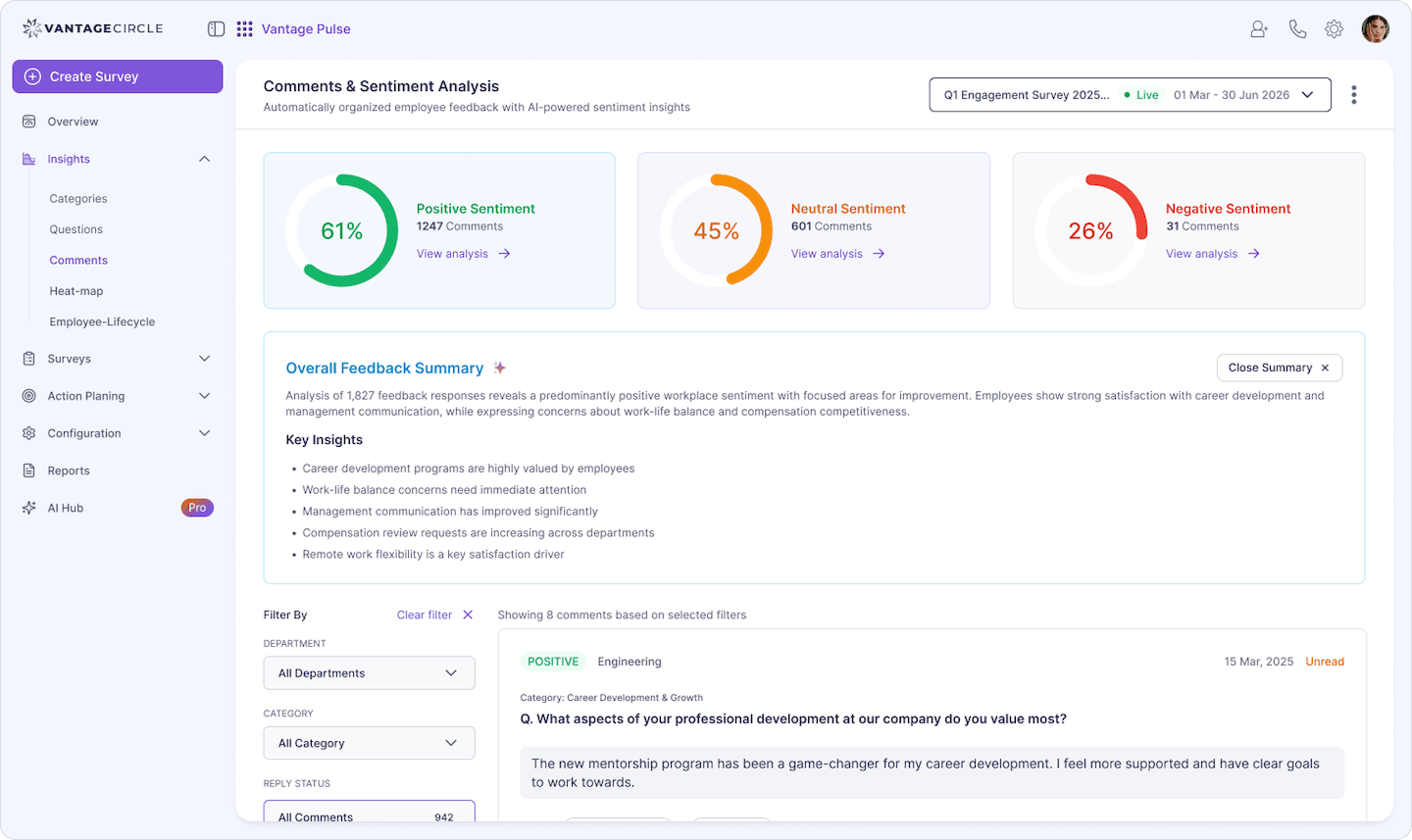
Vantage Pulse surfaces these signals through recurring eNPS surveys and sentiment analysis on open-text responses. Department-level engagement data shows whether the pattern is concentrated under a specific manager or team, which is where the response needs to happen.
How Managers Can Prevent and Respond to Quiet Quitting
According to Gallup's State of the American Manager (2015), managers account for at least 70% of the variance in employee engagement scores, a finding Gallup has reaffirmed in subsequent research. The response to quiet quitting has to start there, not with a performance warning.
Start with recognition, and make it specific. Vague praise like "great work this quarter" does not move the needle. Recognition that names the behavior, connects it to an outcome, and arrives while the work is still fresh does. Peer recognition matters here too. Employees who feel seen by their colleagues, not just their direct manager, are less likely to quietly withdraw when manager attention is inconsistent.
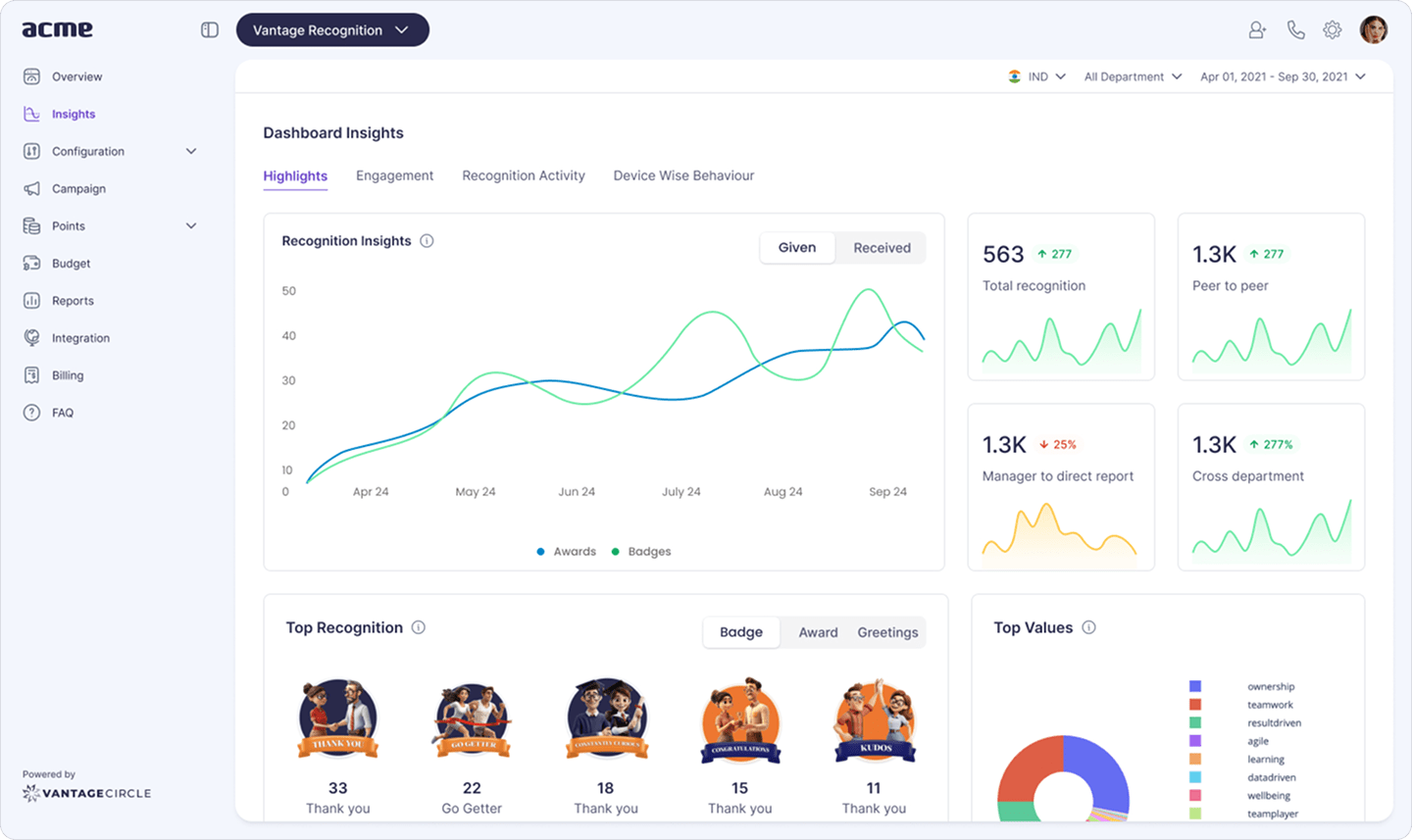
Vantage Rewards makes this easier to sustain at scale: each recognition is tagged to a core value and visible across teams, so HR can spot which managers or departments have gone quiet on recognition before it shows up as a disengagement problem.
Do not wait for someone to tell you they have checked out. Most employees are unlikely to announce that they have mentally disengaged. Anonymous pulse surveys, run on a regular cadence, surface what employees will not say directly: burnout, feeling passed over, unclear expectations, workload that never lets up. Vantage Pulse also shows where the disengagement is concentrated (one team, one manager, one function) rather than averaging it into a company-wide score that hides the problem.
Answer the "why bother" question in 1:1s, not town halls. The reason most "connect work to purpose" efforts fail is that they happen at the wrong scale. A town hall does not answer why this person's work matters right now. A regular 1:1 where the manager explicitly names what someone's contribution is moving does.
Know where each person is headed. If a manager cannot say, for each person on their team, what they are working toward and what the next concrete step looks like, that is the gap quiet quitting grows in. It does not require a formal development program. It requires the manager to have the conversation.
After any meaningful change, track whether it worked. Employee engagement surveys run 90 days post-intervention, segmented by team, show whether the disengagement is reversing or just quieter. For a broader look at what keeps people, see employee retention strategies.
Is Quiet Quitting Legal?
Quiet quitting is not, by itself, a legal category. Most U.S. employment is at will: either the employee or the employer can end the relationship at any time, for any lawful reason. An employee who meets their role's stated requirements is not violating any obligation by declining to do more. Whether that level of contribution is enough to keep the role is a separate question, and the performance process answers it differently than the law does.
Standard performance management frameworks are designed around whether an employee is meeting their defined job expectations, not whether they are exceeding them. Quiet quitting typically does not trigger a performance improvement plan because the employee is technically compliant.
The appropriate response is diagnostic, not disciplinary. Find out why the employee stopped investing, address the root cause, and measure whether engagement recovers. In cases where the behavior has become a sustained pattern across a team, the diagnostic question shifts from the individual to the management environment that produced it.
Frequently Asked Questions
What is the difference between quiet quitting and burnout?
Burnout is chronic depletion caused by sustained overwork. Quiet quitting can be an early response to mounting pressure: the employee sets a ceiling on their contribution before they hit the wall. A burned-out employee is still trying and failing; a quiet quitter has, often without fully realizing it, stopped trying to exceed the minimum. Pulse survey data is one of the more reliable places to catch the early signals before burnout sets in.
What is the difference between quiet quitting and setting healthy boundaries?
An employee who leaves at 5 p.m. because their job ends at 5 p.m. is not quiet quitting. Quiet quitting is withdrawing investment from the role itself, including effort that falls within scheduled hours. The distinction matters: treating work-life balance as a management problem creates pressure to overextend, which is itself a driver of quiet quitting.
How do managers detect quiet quitting before it spreads?
The early signals are in engagement data, not output metrics. A decline in eNPS scores, a rise in negative sentiment in open-text survey responses, and a drop in peer recognition frequency tend to appear before visible behavioral changes do. Anonymous pulse surveys run on a regular cadence catch the pattern while there is still time to act.
What Comes After Quiet Quitting
Quiet quitting is not a fixed end state. It can resolve in one of three broad ways, depending on whether the underlying issue gets addressed.
The employee re-engages. A manager notices the withdrawal, has the right conversation, and removes the barrier, whether that is recognition, a growth path, or clarity about where the role is heading. The person who was coasting starts contributing again. This is more achievable than most retrospective conversations suggest, but only if the issue is named rather than managed around.
The employee stays but becomes permanently transactional. They show up, meet expectations, and both sides accept the arrangement. The organization loses the discretionary effort; the employee loses investment in the work. Neither party is technically doing anything wrong, but the relationship has calcified in a way that is difficult to reverse.
The employee eventually leaves. Quiet quitting is often a bridge between staying and going. The internal distance grows until the gap between what someone is putting in and what they could put in elsewhere becomes too wide to ignore.
Which of these plays out often depends on what happens early, before the withdrawal is visible in output or has settled into a pattern. That is the window where the right tools and the right management conversations make the most difference. Vantage Pulse is built to find it. Vantage Rewards is built to close it.

Supriya is a Content Marketing Lead at Vantage Circle, where she writes on employee engagement, recognition, workplace communication, and culture. She spent the earlier part of her career in corporate communications at Burson, ESPN Star Sports, and CBRE, advising organizations on the messages employees actually hear.
Connect with Supriya on LinkedIn.