Gallup surveyed managers and employees on the same question in 2024. Nearly 60% of managers say they do a good job recognizing their team's hard work. Only 35% of individual contributors (employees without direct reports) agree.
Managers remember the thank-yous they gave. Employees remember the stretches when nobody said anything. Both are accurate, and they don't match. That changes how you should use a recognition platform, because managers who already believe they recognize people enough have little reason to act on a reminder.
So how do recognition platforms shape manager habits? They shape them by making recognition easier, prompted, and visible. One-click recognition in the tools managers already use, automated milestone reminders, and dashboards showing who has and hasn't been recognized turn appreciation from an occasional event into a weekly routine, which Gallup (2024) links to substantially higher engagement.
What Does a Recognition Platform Actually Change About Manager Behavior?
A recognition platform changes three things: when a manager is prompted, how much effort recognition takes, and what the manager can see about their own habits. The badges, points, and catalog that fill most vendor demos sit on top of those three, so ask about them first when you evaluate a platform.
A platform can't change whether a manager believes recognition matters. It can remove the reasons they give for not doing it. For the wider case, here is why employee recognition matters across the organization.
Why Manager Recognition Habits Matter
Weekly recognition from a manager is tied to a 23-point gap in employee engagement (Gallup, October 2024). In that analysis, 61% of employees who receive both feedback and recognition from their manager at least once a week are engaged. Among employees who get weekly feedback but less frequent recognition, it is 38%.
Look at who the second group is. Their managers talk to them every week, and the only thing missing is recognition. Gallup also found that employees recognized weekly are 2.9 times as likely to strongly agree that they receive valuable feedback.
So design for frequency. A recognition that takes 20 seconds and goes out every week does more than a polished one that gets drafted twice and dropped. Make the fast path fast, and build specificity in with a short structure and values tags, so that even a 20-second note names the behavior.
The 4 Manager Habits Recognition Platforms Build
Recognition platforms build four manager habits: recognizing more often, more specifically, more fairly, and more visibly.
Recognizing More Often
Platforms raise frequency by prompting managers at the right moment and removing the effort of sending. Most missed recognition is not a decision. The manager meant to thank someone, got pulled into something else, and never went back.
Milestone reminders for birthdays, work anniversaries, and service awards are the usual starting point, and they make an easy first repetition because nobody has to decide whether an anniversary is deserved. But they are not performance recognition. A manager who only recognizes on the calendar gives the person who had a great March the same note as everyone else with the same start date. Treat milestones as the on-ramp, then shift the prompt to a different question: who did something this week worth naming? That is where a spot award fits.
Effort matters just as much. If recognizing someone means opening a separate app, finding the person, picking a category, and writing from scratch, most managers skip it in a busy week. When it takes one click inside Microsoft Teams or Slack, which they already have open, more of them send it. When you evaluate any platform, including Vantage Recognition, time how long it takes to send a recognition from the tool your managers use all day.
Recognizing More Specifically
Values tags and a simple three-part structure turn generic praise into recognition an employee can repeat. Most recognition messages fail because they could be sent to anyone. "Great job on the launch, thanks for all your hard work!" says the manager noticed something, but not what.
Here is an illustrative version of a better one:
Priya, when the vendor pushed the go-live back two days, you rebuilt the rollout schedule over the weekend and called each store manager yourself. Nobody had to chase you for an update, and the launch went out on time. That is what we mean by accountability.
It names what she did, what happened because of it, and which company value it showed. Any manager can learn that structure, and choosing a values tag makes them think about the behavior before they write.
Tags stop working when the field is a dropdown and managers pick whatever is listed first. Check the feed after 90 days. If one value accounts for most recognitions, the tags tell you nothing. The fix is two or three behavioral examples of each value, written where managers can see them.
Recognizing More Fairly
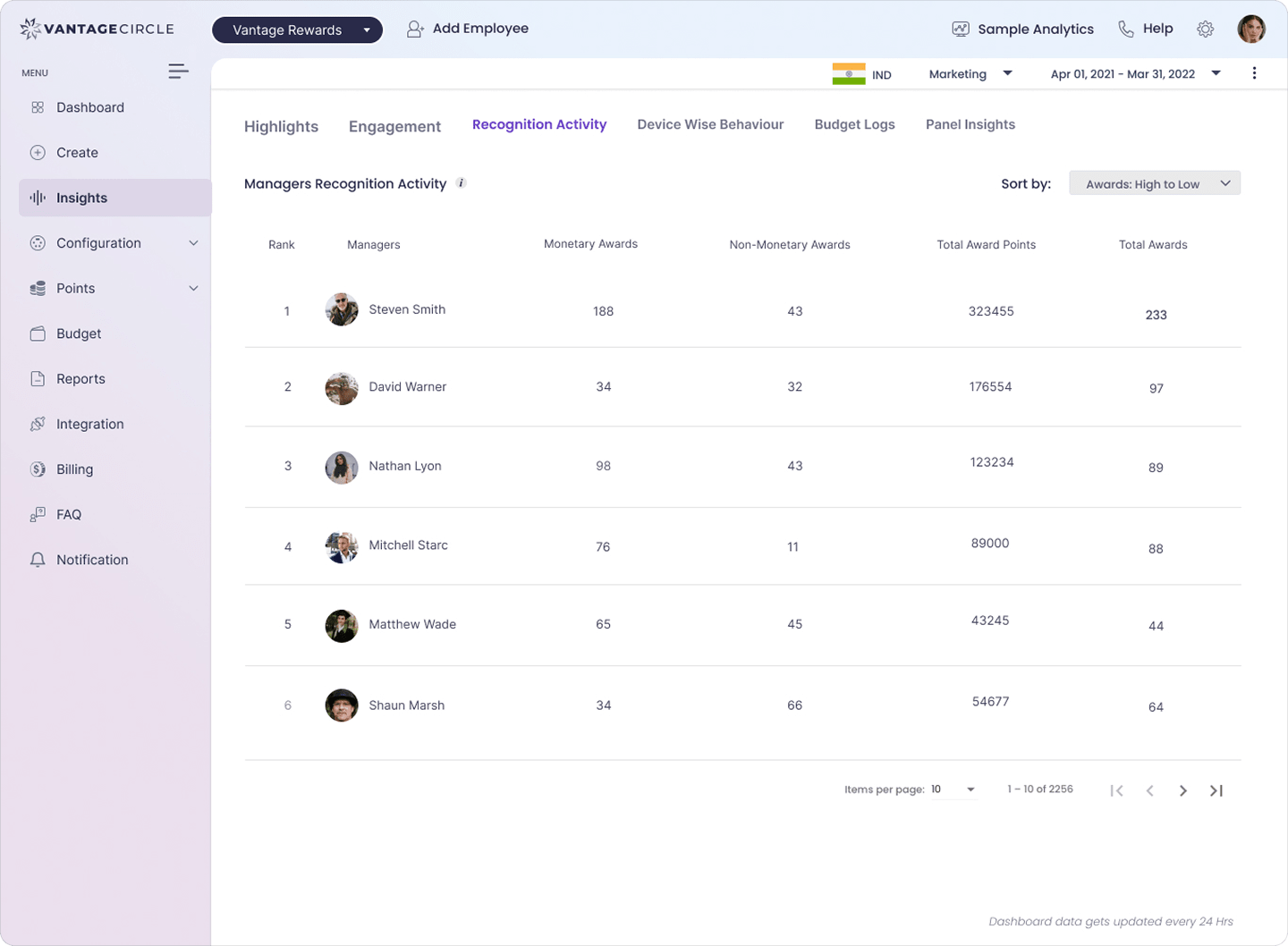
Manager dashboards show who on a team has been missed, which is how platforms spread recognition beyond the most visible people. Start with the mistake that can undo a dashboard: if the same view goes on a leadership slide before the manager has seen it, it becomes a scorecard. Some managers then send a quick "thanks!" to everyone on the list just to clear it. Show managers their own data privately first.
Done that way, the dashboard gives a manager something they usually don't have, a specific list of names. Managers tend to recognize the people they interact with most, meaning the ones who present, speak up in meetings, or message them often. People who do steady, quiet work get less. Nobody plans it that way, and the dashboard shows it early enough to fix before review season.
Picture a manager with nine reports who pulls up her quarterly numbers and sees she recognized four people, two of them twice. Five people got nothing. She'll probably check whether the report is wrong. It won't be.
Recognizing More Visibly
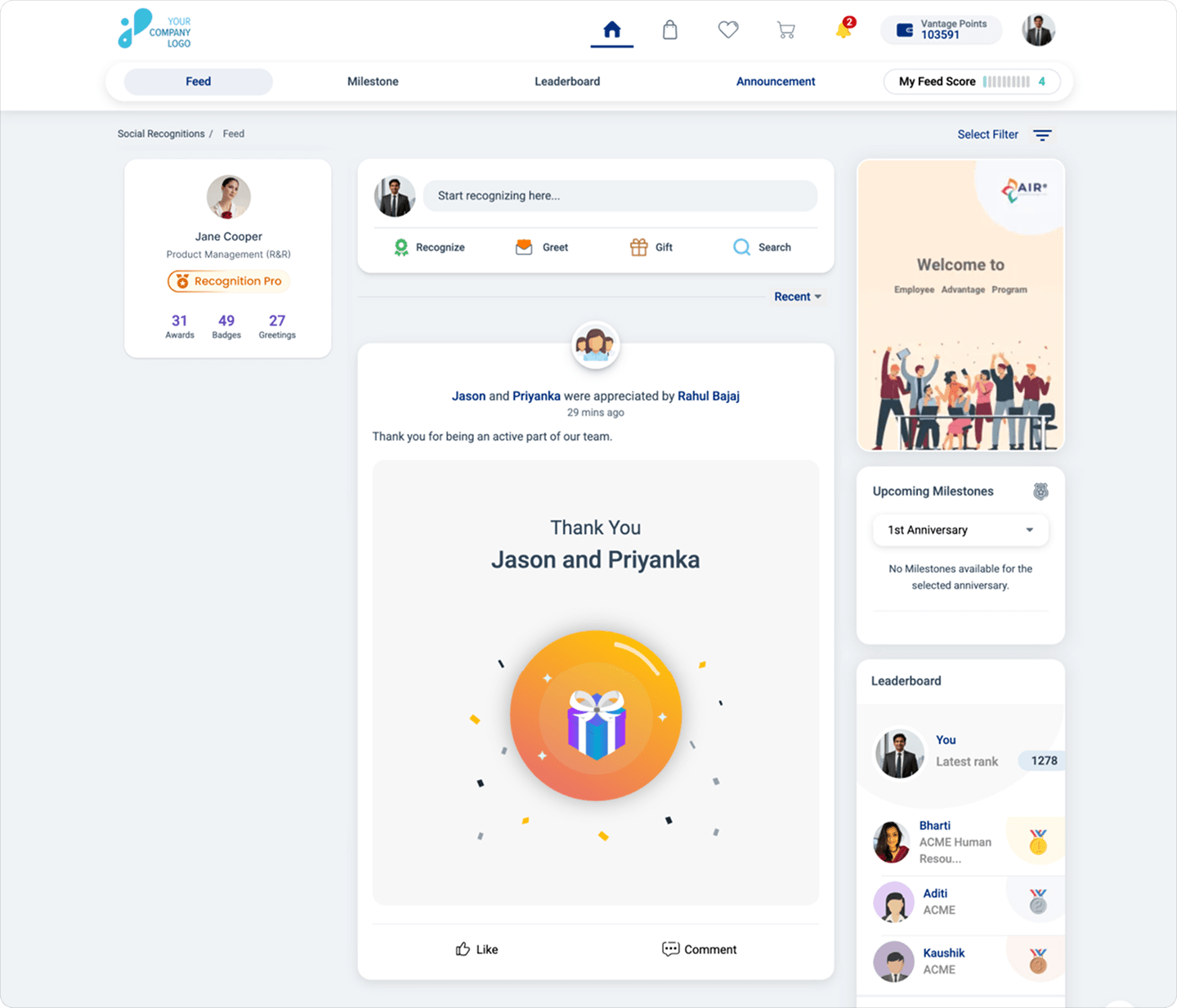
A shared recognition feed shows the whole team which behaviors get noticed, and shows managers how their own team compares. If other teams are being recognized every week and yours isn't, you can see that without anyone saying a word.
The catch is that feeds reward people who write well. Someone who fixes the same difficult problem every month and never posts about it gets less attention than someone who narrates a small win. Watch for that, because it's the same quiet-worker pattern the dashboard is meant to catch.
Here are the four habits side by side:
| Habit | Without a platform | With a platform | Platform mechanism |
|---|---|---|---|
| More often | Recognition happens when a manager remembers | Managers are prompted at the right moment | Milestone reminders, one-click recognition in Teams or Slack |
| More specifically | Generic notes that could go to anyone | Notes name the behavior and the value | Values tagging on every recognition |
| More fairly | Recognition goes to the most visible people | Managers see who has been missed | Manager dashboards, department-wise insights |
| More visibly | Appreciation stays between two people | The team sees which behaviors are valued | Shared recognition feed |
Why Platforms Turn Recognition Into a Habit: The Behavior Model
A behavior happens when motivation, ability, and a prompt come together, according to the Fogg Behavior Model (BJ Fogg, Tiny Habits, 2019). Each of the three maps to a platform feature:
- Prompt: milestone and anniversary reminders, and nudges that name a specific person.
- Ability: one-click recognition inside Microsoft Teams and Slack.
- Motivation: the visible response on the feed, such as reactions, comments, and a thank-you from the employee.
Launches often put their effort into motivation: the announcement email, the executive video, the kickoff call. The parts a platform changes most are the prompt and the effort. Keep reminders few, because a prompt that names one person and one reason is easier to act on than a general nudge to recognize the team.
What Vantage Circle Platform Data Shows
A global digital infrastructure company grew managerial monetary recognition by 26% and the number of people giving monetary awards by 58% over five years on Vantage Circle, from FY2020-21 to FY2024-25.
The company has more than 10,000 employees across 190+ countries. Before the platform, recognition leaned on manager-led, top-down appreciation that was hard to scale across regions. The program that replaced it relied on two things:
- Managers were trained to recognize employees right away when they saw a desired behavior.
- Leaders modeled recognition from the start, with regular reviews focused on clear outcomes.
Here is what changed, as reported in the published case study:
| Metric | Change, FY2020-21 to FY2024-25 |
|---|---|
| Managerial monetary recognition | Up 26% |
| People giving monetary awards | Up 58% |
| Peer-to-peer non-monetary recognition | Up 185% |
| Active platform users | Up 134% |
By FY2024-25, the company recorded one recognition every two minutes.
This has limits. It covers five years at one organization, and it does not show how often individual managers recognize their teams week to week. What it does show is that managerial recognition grew while more people began giving monetary awards, and that leaders modeled the behavior first. That last part is the piece other programs can copy.
Other published client stories point the same way. Several describe the same starting problem: recognition depended on managers remembering to act, and managers had no view of whom they had missed. The fix they describe is a dashboard or reminder that shows exactly that, alongside leaders who model the behavior.
Where Recognition Platforms Fall Short
A platform makes recognition easier, not meaningful.
Badge fatigue and generic praise set in when recognition turns into a routine click. Recognition can also pile up on the same few people, and some managers never log in at all. Their reasons tend to be time, confidence, accountability, or tooling friction, and each needs a different response. Our guide to why managers don't participate in recognition programs covers how to tell them apart. If leadership never bought in, start with manager buy-in.
A platform message also doesn't replace a real one-on-one. The best outcome is that the small recognitions get handled quickly, so managers have more time for the conversations that need attention.
Recognition and Rewards Have to Match
Managers who can attach a reward to recognition need clear guidelines, or the reward becomes the weakest link. When recognition is left to individual managers, it tends to gravitate toward people who are already visible, senior, and well-regarded, and employees notice quickly.
Agree on a few things before launch. Decide which recognition is a no-cost thank-you, such as a badge, which earns points from a manager's budget, and which needs an approval step because the reward is larger. Write the criteria in plain language, and keep the top tier for results and behaviors, with service awards handled separately for tenure. Then review distribution every quarter by team, department, and manager, including how many people gave and received recognition. If one group receives most of the rewards, the program has a fairness problem that no dashboard will fix on its own.
How HR Can Use a Platform to Build Manager Recognition Habits
Start with a baseline, coach the managers furthest behind, then turn on prompts. Doing everything in week one overwhelms managers, so this order works better.
- Set a baseline. Find out who recognizes weekly, who never does, and who thanks the same three people. Use whatever you have before launch, such as a manager survey or HR records, and set a proper baseline from platform data in the first weeks. Count distinct recipients per manager, not total volume. Volume is easy to inflate and tells you very little.
- Coach the managers furthest behind first. Celebrating the top recognizers is pleasant and changes little. Book 15 minutes with each manager who rarely recognizes anyone, share their own numbers privately, and ask what gets in the way. That is where behavior moves.
- Turn on milestone prompts. They give managers an easy, expected moment to act, which builds the first repetition.
- Enable recognition inside Teams or Slack. Get the effort as close to one click as you can.
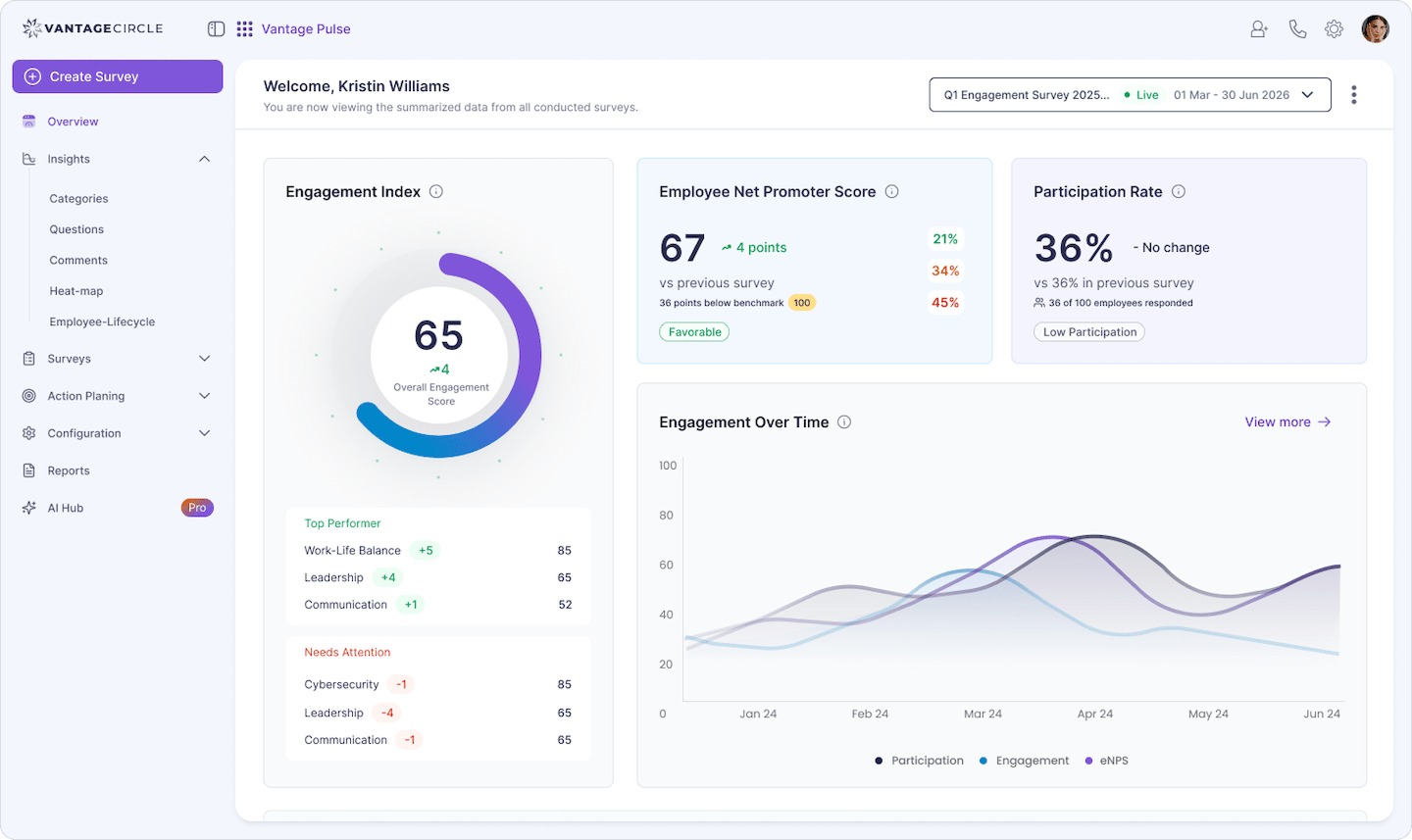
- Tie it to eNPS and review quarterly. Recognition activity only matters if employees feel it. Pair your dashboards with regular pulse surveys and check, team by team, whether more recognition is moving engagement.
If you are still choosing a tool, our guide on selecting and rolling out recognition software covers what to look for. And if you are on the other side of the relationship, here is a piece on recognizing your own manager, which is a different problem with its own etiquette.
FAQ
1. Do recognition platforms improve manager behavior?
They do when they remove the barriers to a habit. Prompts, one-click recognition in Teams or Slack, and manager dashboards make it easier to recognize people often, specifically, and fairly. A platform can't create care where none exists, so results depend heavily on how managers are coached to use it.
2. How often should managers recognize employees?
Gallup's 2024 analysis points to weekly. It found the strongest engagement among employees who receive recognition from their manager at least once a week. Frequency matters, but one specific recognition that names a behavior and a value does more than several generic ones.
3. Can a recognition platform replace manager feedback?
No. A platform helps a manager recognize people more consistently, but it can't replace the one-on-one conversations where a manager coaches, gives direction, and listens. The two work best together, since recognition makes feedback easier to hear.
4. What is the difference between manager recognition and peer recognition?
Manager recognition comes from the person who directs someone's work. Peer recognition comes from colleagues and fills the gaps between manager touchpoints. Healthy programs use both, and our guide to peer-to-peer recognition covers setting up the second half.
5. What is the biggest risk of using a platform to drive manager habits?
Treating activity as the goal. A manager can send plenty of recognitions and still miss the point if the messages are generic or land on the same few people. Watch distribution and specificity, and treat total volume as a secondary number.
Summing It Up
Managers usually care about recognizing their people, and they usually overestimate how often they do it. A platform helps by prompting at the right time, making recognition quick, and showing managers their own numbers.
Try one thing this week: pull the number of distinct people each of your managers recognized last quarter. The names missing from that list tell you where to start. If you want to see what a manager dashboard looks like on real data, book a demo.

Susmita Sarma is a Digital Marketer at Vantage Circle, making employee recognition less of a checkbox and more meaningful - helping organizations say we value our people and truly mean it.
Connect with Susmita on LinkedIn.