
Let's be clear: two companies investing in similar employee recognition and rewards platforms can end up with very distinct results.
In one company, recognition is woven into everyday work. Managers regularly acknowledge good work, peers celebrate each other, company values are displayed in real examples, and employees understand which behaviors matter.
The other company shows how recognition activity peaks around launch and gradually fades. Recognition is sporadic; the same people keep receiving it, and employees start seeing the platform as another mere HR tool instead of part of their work experience.
The difference has little to do with the rewards catalog alone.
Employee recognition and rewards platforms shape company culture when recognition is frequent, meaningful, personal, fair, and aligned with how the organization wants people to work. Gallup describes these qualities through five pillars of strategic recognition: fulfilling, authentic, personalized, equitable, and embedded in organizational culture.
A platform gives recognition scale, visibility, data, and structure. But what ultimately shapes culture is how leaders, managers, and employees use those capabilities.
Do Recognition Platforms Actually Change Company Culture?
A recognition platform can influence company culture. However, installing technology alone doesn’t create a recognition culture.
Culture is reinforced through repeated signals about what an organization values. Recognition is one of those signals.
When employees repeatedly see colleagues getting appreciated for collaboration, customer focus, innovation, integrity, or another company value, those values become easier to understand through practical exposure. A statement such as "we value collaboration" becomes more concrete when employees see the behaviors that earned recognition in the first place.
Technology plays a pivotal role in making these moments visible beyond private conversations between a manager and an employee. Peer-to-peer recognition, social recognition feeds, value tagging, manager awards, and recognition analytics help turn those individual moments of appreciation into insights that the wider organization can see and learn from.
The quality of those moments matters too.
A Gallup study found the following:
Well-recognized employees are 45% less likely to change organizations after two years.
Employees who receive high-quality recognition that meets at least four of Gallup’s five pillars of strategic recognition are 65% less likely to be actively looking for another job opportunity than those who receive lower-quality recognition.
That distinction is crucial here. The research doesn’t simply show that employees who receive more rewards stay longer. It focuses on the quality of the recognition experience.
For HR leaders, this changes the question from:
"How many recognition transactions did we generate?"
to:
"Is the recognition that employees receive actually reinforcing the culture we are trying to build?"
That is also why evaluating the business case for employee recognition requires more than looking at platform adoption.
The 5 Pillars That Decide Whether a Recognition Platform Succeeds
Gallup identifies five pillars of strategic recognition: fulfilling, authentic, personalized, equitable, and embedded in organizational culture.
These pillars offer a useful way to assess a recognition program’s effectiveness by shifting attention from features to the employee experience those features create.
| Pillar | Platform succeeds when | Common failure pattern | What HR should examine |
|---|---|---|---|
| Fulfilling | Employees receive recognition consistently enough for it to feel meaningful | Recognition happens mainly during annual events, birthdays, or major milestones | Frequency, recognition coverage, teams with long recognition gaps |
| Authentic | Messages explain what the employee did and why it mattered | Generic or automated messages become the norm | Message quality, employee sentiment, survey comments |
| Personalized | Employees can receive recognition and rewards in ways that suit them | Everyone gets the same recognition experience regardless of preference | Recognition preferences, reward choice, public vs private recognition |
| Equitable | Recognition reaches people across teams, locations, roles, and working arrangements | Recognition becomes concentrated among highly visible employees or teams | Recognition distribution by team, manager, location, role, and employee group |
| Embedded in culture | Leaders and employees connect recognition with company values and daily work | The platform becomes an HR initiative employees visit occasionally | Manager participation, peer recognition, values tagging, integration into work tools |
Fulfilling: Is recognition frequent enough to matter?
Recognition is fulfilling only when employees experience it frequently enough to know their contributions are noticed.
A recognition platform can make frequent appreciation easier, especially across large or distributed organizations. Employees no longer have to wait for a formal award cycle to have their work acknowledged.
However, frequency alone is not enough. A bunch of generic recognition messages will always have less impact than thoughtful and meaningful acknowledgment.
HR teams should consider both cadence and coverage. Which employees are receiving recognition? How long are the gaps? Are some departments consistently active while others barely participate?
Integrations can help remove friction here. For example, letting employees and managers recognize people within Microsoft Teams or Slack means appreciation can happen closer to the work itself instead of requiring a separate platform visit.
Authentic: Does recognition feel genuine?
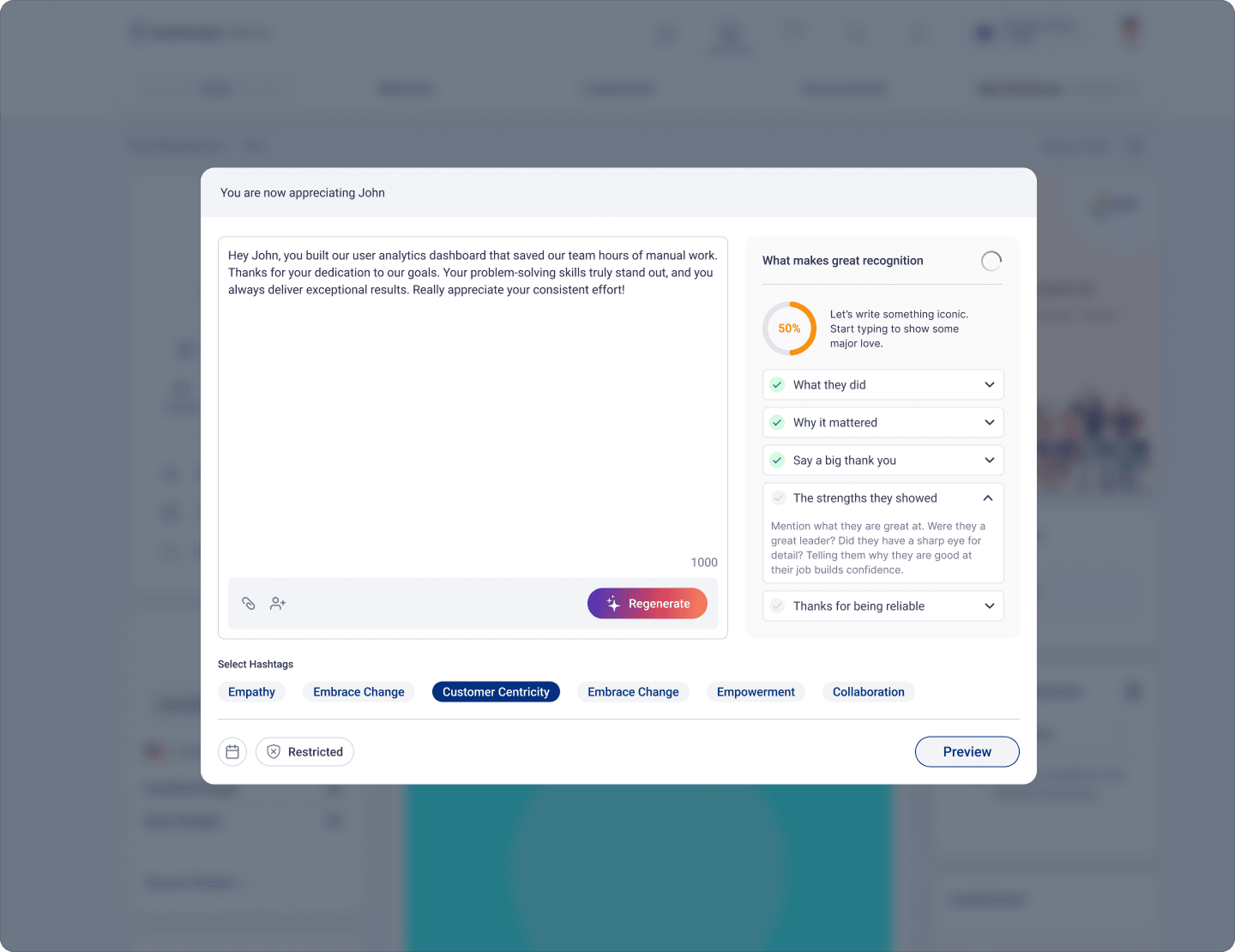
Authentic recognition gives employees a clear picture of exactly what was valued about their contribution.
No wonder a "Great job!" is positive, but it gives the employee very little information.
Compare that with recognition detailing how someone handled a difficult customer situation, supported a colleague during a deadline, or found a better way to complete a process. The second type of recognition reinforces behavior and gives employees a reason to believe the appreciation is genuine.
Source: Vantage Recognition
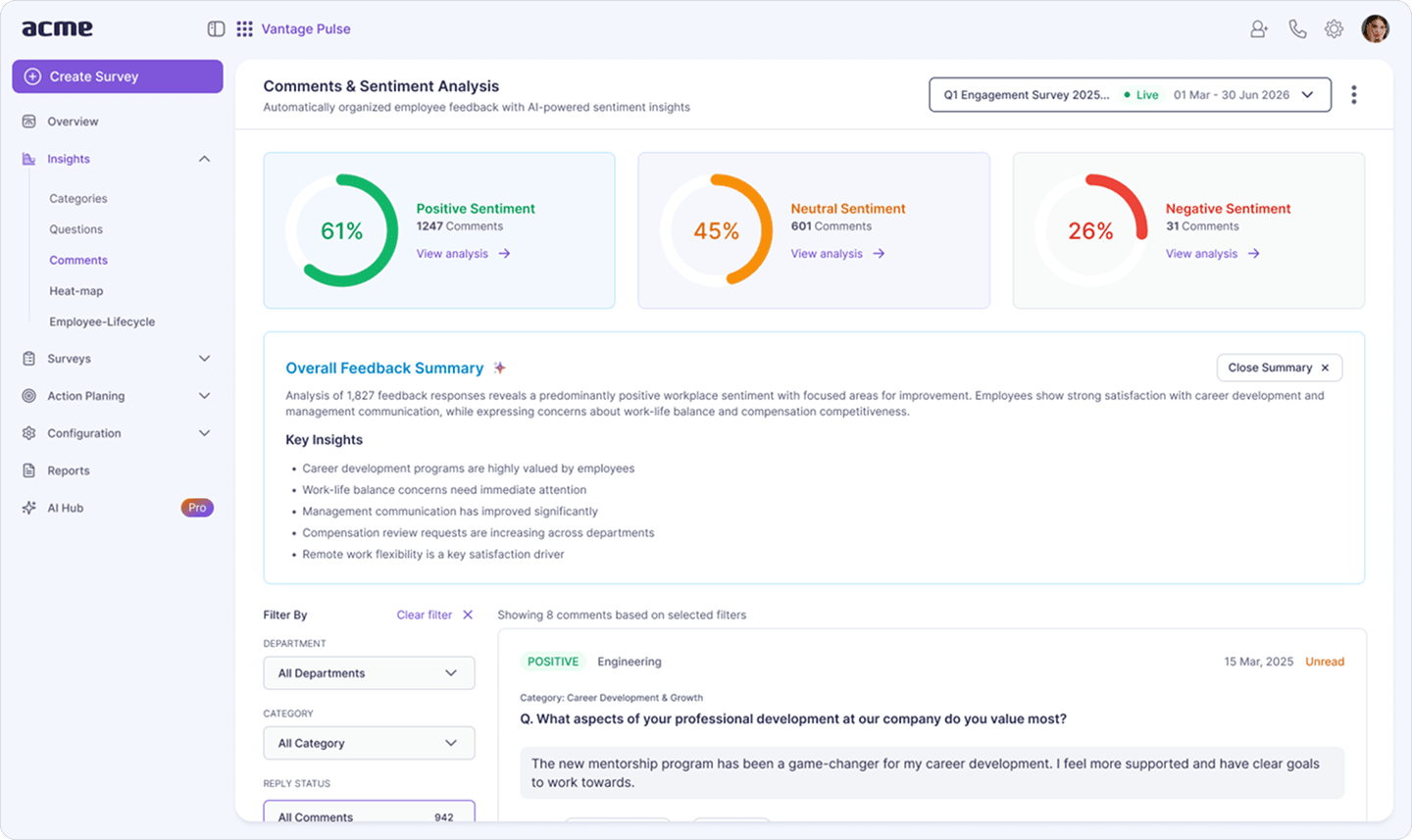
That is why the number of recognition moments alone does not always reflect their quality. A dashboard may record hundreds of recognitions, but employee feedback suggests many feel automatic or routine. HR teams, therefore, need qualitative feedback alongside recognition counts.
Pulse surveys and open-text feedback can help answer a question that transaction data cannot:
Do employees actually feel recognized?
Source: Vantage Pulse
Personalized: Are people recognized in ways that work for them?
When individual preferences are taken into account, recognition is bound to add more meaning for employees.
One employee may enjoy public appreciation in front of a large team, while another may value a thoughtful private message from their manager. Employees may also place very different value on different rewards.
Yet personalization is often limited in practice.
Gallup's research on managers found that only 12% of employees reported being asked how they like to be recognized.
Employee recognition and rewards platforms like Vantage Recognition can support personalization through a choice of rewards, multiple recognition formats, flexible award types, and a mix of monetary and non-monetary appreciation.
Personalization requires managers to understand their people. Software can offer options, but they become useful only when managers know employees’ preferences.
Equitable: Does recognition reach everyone?
Let’s face it! Recognition cannot strengthen a shared culture if meaningful appreciation is concentrated in only a small part of the workforce.
Recognition naturally carries visibility bias. Employees who work closely with senior leaders, speak frequently in meetings, or hold highly visible roles are easier to notice. On the other hand, remote employees, frontline teams, support functions, and people working across locations are easier to miss.
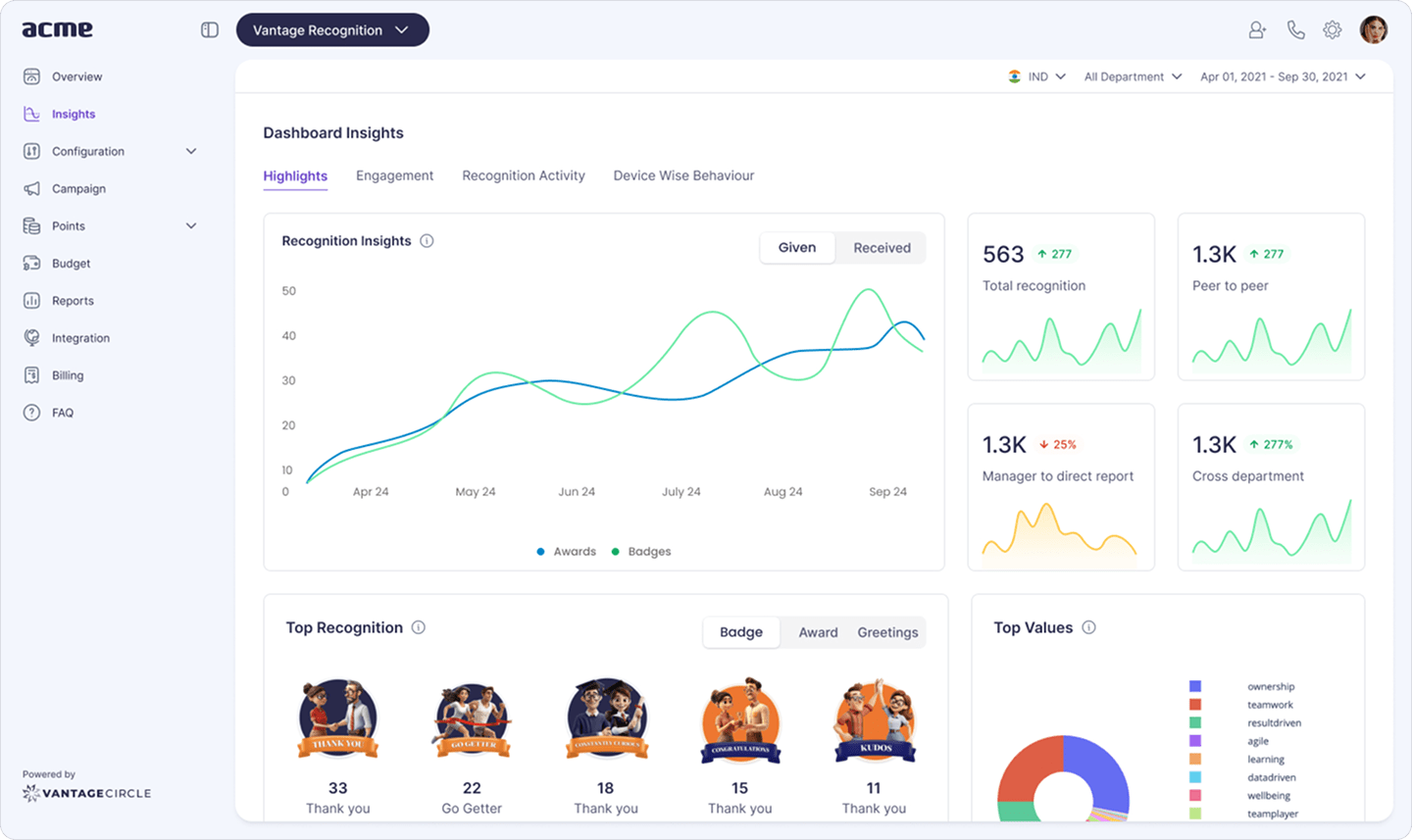
At enterprise scale, recognition analytics becomes important.
It allows HR leaders to see how recognition is distributed across departments, locations, job levels, managers, and other relevant groups. The aim is not to make every team generate the same number of awards, but to uncover patterns that require closer attention.
Source: Vantage Recognition
For example, a recognition program may appear successful because a large number of recognitions are being given across the company. But a closer look may show that some departments are receiving very little recognition.
This is why overall recognition numbers alone may not tell the full story.
Embedded in culture: Is recognition connected with how the company works?
Recognition strongly impacts company culture when it reinforces the organization's values and appears naturally in everyday work.
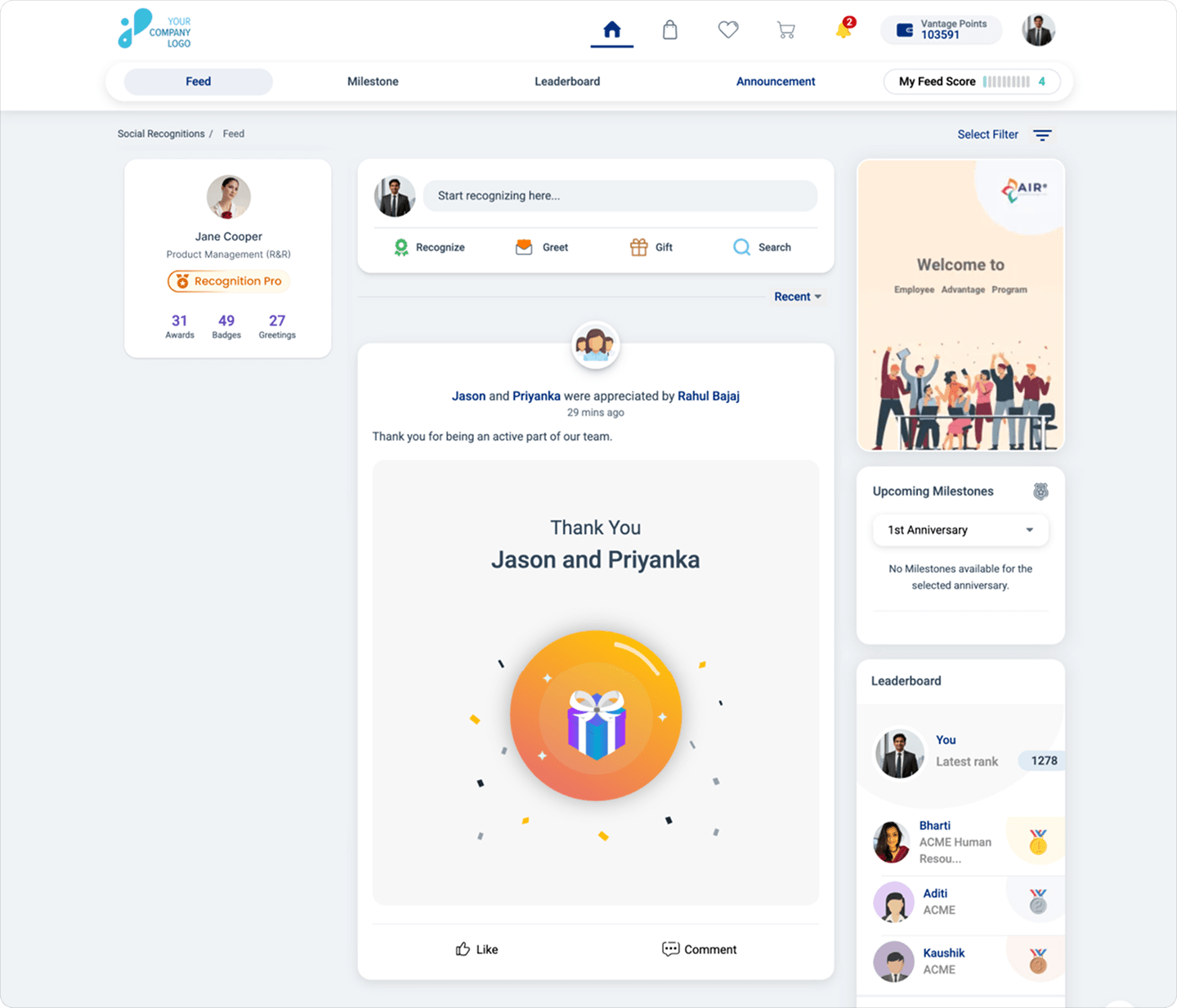
Value tagging is pivotal here because it connects an abstract value to a real behavior.
A value like "customer first" is easier to understand when employees regularly see examples of colleagues getting recognized for solving customer problems. Over time, the recognition feed can become a record of what the organization rewards socially.
Source: Vantage Recognition
Peer recognition also plays a vital role here. A culture should not depend entirely on a manager to notice every contribution. Peer-to-peer recognition allows employees to acknowledge one another and bring valuable contributions to wider attention.
Why Manager Behavior Is the Deciding Factor
Employees often follow their managers’ approach to recognition. That is why managers’ behavior plays a crucial role in making recognition part of everyday work.
There is also a noticeable perception gap.
Gallup reported that early 60% of managers feel they are doing a good job recognizing their team’s hard work and contributions, but only about a third of individual contributors (35%) share the same sentiment.
That gap suggests that having good intentions around recognition is different from employees consistently experiencing it.
A recognition platform can help managers close this gap by simplifying the recognition process, showing recent activity, highlighting participation gaps, and embedding recognition within tools managers already use.
However, HR should avoid measuring manager success solely based on the number of recognitions sent. A manager who sends twenty vague messages isn’t necessarily building a stronger recognition culture than the one who sends fewer but specific, timely acknowledgments.
Manager behavior deserves deeper attention because it sits between program design and employee experience.
How Recognition Platforms Can Support Employee Performance
Recognition can support employee performance by strengthening factors such as motivation, engagement, connection, and clarity around the behaviors an organization values. However, recognition should not be seen as a direct guarantee of higher productivity.
Vantage Circle’s research below shows how effective recognition is linked to stronger employee motivation, engagement, and productivity-related outcomes.
Vantage Circle, in association with Great Place to Work, found that employees in high-recognition cultures report stronger workplace experiences. In these organizations, 91% of employees feel motivated and 94% believe their organization is a great place to work. In emerging recognition cultures, those figures fall to 73% and 78%, respectively.
These findings suggest that recognition can influence important parts of the employee experience that support sustained performance. Employees who feel appreciated and connected to their workplace may be more motivated to contribute. At the same time, productivity also depends on other factors such as workload, leadership, skills, processes, technology, and staffing.
Vantage Circle’s State of Recognition & Rewards 2025 adds another perspective. The report found that organizations with highly effective recognition programs showed nearly 2x higher design maturity and were 2 to 3 times more likely to reward specific behaviors, not just outcomes.
Behavior-based recognition gives employees a clearer understanding of what good performance looks like. When someone is recognized for collaboration, customer focus, innovation, or another specific behavior, the recognition not only acknowledges the result but also reinforces the actions the organization wants to encourage.
The same research also found that 84% of high-effectiveness programs spend under $100 per employee per year. This suggests that recognition program effectiveness is not simply determined by how much an organization spends. Program design, consistency, fairness, reach, and recognition quality also play an important role.
The research further found that among organizations that rate their recognition programs as highly effective at driving engagement and behavior, 86% also report high effectiveness in driving productivity. This suggests that recognition programs that are effective at shaping employee engagement and behavior are also more likely to be associated with stronger productivity outcomes. It reinforces the idea that productivity is connected to the wider employee experience created by the recognition program, rather than recognition operating as a standalone driver.
Taken together, these findings point to a more useful way of understanding the relationship between recognition and performance:
Meaningful recognition → stronger motivation and connection → better conditions for sustained performance.
For HR leaders, the focus should therefore go beyond the number of awards given or the amount spent on rewards. A more important question is whether the recognition experience is helping employees feel valued, reinforcing the right behaviors, and supporting the culture the organization wants to build.
Activity Metrics vs Culture Outcomes: How to Tell If Your Platform Is Working
Metrics such as logins, recognition counts, and reward redemptions show HR how actively employees are using the platform. But these numbers alone don’t reveal whether recognition is improving employee experience.
Usage data is still important. Low activity can signal issues such as poor communication, complex processes, limited manager participation, or difficulty accessing the platform.
However, HR leaders also need to look beyond usage. They need measures that show whether recognition reaches more employees, is distributed fairly, feels meaningful, and reflects the company’s values.
| Activity metric | Culture-outcome metric to examine alongside it |
|---|---|
| Number of logins | Percentage of employees regularly giving or receiving meaningful recognition |
| Total recognition moments | Recognition distribution across teams, locations, roles, and managers |
| Rewards redeemed | Whether employees feel the recognition and reward experience is personally meaningful |
| Number of managers using the platform | Consistency and quality of manager recognition across teams |
| Number of value-tagged recognitions | Which values and behaviors are being reinforced across the organization |
| Total program participation | Employee sentiment about feeling appreciated, seen, and fairly recognized |
Consider two organizations with an 80% login rate.
In the first, recognition reaches employees across departments, managers participate regularly, peers recognize each other, and company values appear throughout the recognition feed.
In the second, most activity comes from a handful of departments and the same group of employees receive repeated recognition.
The adoption number looks similar, but the cultural experience massively differs.
These warning signs deserve your closer attention:
Recognition activity getting heavily concentrated in certain teams,
Managers participating only around campaigns,
Recognition messages becoming generic,
Employees reporting that appreciation feels unfair, or
Platform activity keeps rising while employee sentiment about recognition remains flat.
At that point, the next step involves diagnosis. The 10-question recognition program audit can help identify whether the issue comes from program design, execution, manager participation, or the platform itself.
What to Do If Your Platform Isn't Changing Culture
Before changing technology or redesigning the whole program, identify where the recognition experience is breaking down.
Look at the five pillars (as discussed above) individually.
Perhaps recognition is frequent but feels generic. Maybe employees appreciate the rewards, while recognition remains uneven across departments. Manager participation may be strong in one location and almost absent in another. Your company values may be attached to awards, but employees may not understand why particular behaviors connect to those values.
The diagnosis tells you what needs dire attention.
A framework for the diagnosis: Vantage Circle's AIRe Framework breaks a recognition program into four parts you can check one at a time:
- Appreciation: Does recognition reach enough employees, often enough?
- Incentivization: Do employees understand how recognition is earned, and do the awards feel worth having?
- Reinforcement: Does recognition point to specific behaviors and company values, not just results?
- eMotional Connect: Is recognition personal and shared in ways people remember?
In the State of Recognition & Rewards 2025, highly effective programs averaged an AIRe score of 64 out of 100, compared with 34 for others.
Conclusion
Employee recognition and rewards platforms can make the appreciation process easier, more visible, more measurable, and more accessible across an organization. Those capabilities create the infrastructure for a recognition culture, but the platform does not create that culture by itself.
The stronger signal is what happens after implementation.
Are managers participating consistently? Are peers recognizing each other? Is appreciation specific and meaningful? Does recognition reach employees across the organization? Can people see the connection between recognized behavior and company values?
When those answers show up in both platform data and employee experience, then you can safely claim that recognition has moved beyond an HR program. It has become part of how the organization communicates what matters.
FAQs
What are the five pillars of recognition?
Gallup and Workhuman identify five pillars of strategic workplace recognition: fulfilling, authentic, personalized, equitable, and embedded in organizational culture. These describe the quality of the recognition experience, including whether appreciation is meaningful, genuine, suited to the employee, fairly distributed, and connected with everyday company culture.
Why do employee recognition programs fail?
Recognition programs commonly struggle when participation fades, managers use them inconsistently, recognition feels generic, appreciation is concentrated among a small group of employees, or recognition is disconnected from company values and everyday work. Platform usage can also remain high while these deeper problems continue, which is why HR needs to track cultural outcomes alongside activity metrics.
Can a recognition platform improve employee productivity?
Recognition can support productivity through employee engagement, although a platform itself does not guarantee productivity gains. Gallup and Workhuman found higher engagement among employees who receive frequent recognition alongside feedback. Gallup's broader engagement research also shows a relationship between highly engaged teams and higher productivity.
How do you measure recognition program effectiveness?
Measure both activity and employee outcomes. Activity measures include adoption, recognition frequency, manager participation, and reward redemption. Outcome measures can include recognition coverage, distribution across teams, values alignment, employee sentiment about recognition, engagement, and retention-related indicators.
The strongest picture emerges when you examine these measures together rather than treating platform usage as proof of cultural impact.
What are some examples of employee rewards and recognition programs?
Programs can include peer-to-peer recognition, manager recognition, value-based awards, service awards, spot recognition, performance awards, team celebrations, social recognition, non-monetary appreciation, and points-based rewards that allow employees to choose from a reward catalog.
The right mix depends on the workforce, culture, and behaviors the organization wants to encourage. For more options, explore these recognition program examples.

Riha Jaishi is a Content Marketing Specialist at Vantage Circle and host of the HR Vantage Influencers podcast, sharing insights that help organizations build recognition-rich, people-first cultures!!
Connect with Riha on LinkedIn.