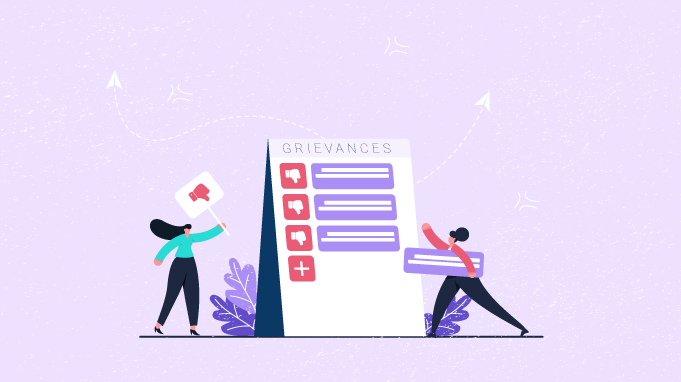
An employee grievance is a complaint an employee raises about their job, manager, pay, or working conditions because they feel something is unfair. The best way to handle one is a clear, documented process, from setting up the system to fixing the root cause.
Left unresolved, grievances lower employee morale, increase absenteeism, and drag down productivity at work.
Aim to settle grievances informally first. If the issue is serious, or an informal talk does not fix it, the employee can raise a formal grievance. Every company should have a written policy that says who to approach and sets a time limit for each stage. Here are the 8 steps to follow.
8 Steps to Handle Employee Grievances
1. Create the system
Start by setting up a grievance system that lets employees raise complaints and lets you resolve them. Make sure it covers the following:
- Handbook: Add the grievance procedure to the employee handbook so everyone can find it easily.
- Owner: Assign someone to receive grievances, usually a person in HR, and assure employees their complaints stay confidential.
- Access: Keep the place for submitting complaints central and easy to reach for everyone. If you use a grievance box, put it in a common area.
- Confidentiality: Grievances often involve personal matters, so involve as few people as possible. That keeps the issue from spreading.
- Follow-up: Follow up on every complaint on a set schedule, so no issue sits on hold for long.
2. Acknowledge the grievance
Listen more than you talk. When an employee comes to you with an issue, give them your full attention.
You do not have to resolve it on the spot. The goal is to let them know their complaint has been received and that you will act on it. Confirm in writing within a day or two, say what happens next and when they will hear back, and hold off on judging the complaint or promising an outcome.
3. Investigate
Not every issue needs a hearing, so first check whether the grievance is valid. Ask about the incident, gather the relevant facts, and collect any evidence. If other staff are involved, tell them and give them a chance to explain themselves and share their own evidence.
Once the investigation is over, arrange a formal meeting.
4. Hold the formal meeting
Invite the employee and all relevant parties to the formal hearing. The employee can present evidence that backs up the complaint and explain how they would like the problem to be resolved. Afterward, circulate the minutes of the meeting. Formal hearings can turn into difficult conversations, so prepare in advance.
5. Make a decision and act on it
Once you have gathered the information and examined the situation closely, make your decision.
You can uphold the grievance in whole or in part, or reject it. Tell the employee in writing what action you will take. You can also advise them on how to handle similar situations in the future. Explain the reasons behind your decision, not just the outcome. Even if you reject the grievance, name the points you weighed so the employee can see how you got there.
6. Offer an appeal
An employee who does not accept your decision has the right to an appeal. Your grievance policy should set out the terms of the appeal process.
The appeal should start with a letter from the employee explaining why they want the decision reconsidered. To keep it impartial, have another manager or supervisor who was not part of the first meeting hear the appeal. A hearing that considers any new evidence should follow, and the outcome should be shared with the employee in writing. If the employee is still not satisfied, the case can go to mediation. They may also take it outside the company, for example to a labor agency or a court.
7. Review the outcome
Take an objective look back at your decision. Check in with the employee about 30 days after the case closes. Ask whether the fix is holding, whether anything has changed in how they are treated, and whether they would feel comfortable raising a concern again. Then look back through the case file for anything in your process that was slow or unclear.
8. Fix the root cause
Aim for a lasting solution, so employees do not come back again and again with the same issue. Identify the root cause of the problem, fix it completely, and adjust policies or practices where needed. Ask what allowed the problem to happen, such as a missing policy, an untrained manager, or an unclear rule, then change that and check whether other teams have the same gap.
Example: A Grievance From Complaint to Fix
Here is how the 8 steps play out in a typical case. The scenario is made up for illustration.
Maya, a customer support agent, emails HR to say her team lead keeps giving the best shifts and projects to the same two colleagues.
Steps 1 and 2: The company already has a grievance process in its handbook, so Maya knows where to go. HR replies the next day:
Thank you for raising this, Maya. I have your complaint and I take it seriously. I will look into it, keep what you shared confidential, and update you by Friday on next steps.
Step 3: An HR partner who does not report to the team lead runs the investigation. They speak to Maya, the team lead, and two other agents, and they pull three months of shift schedules. The schedules show the same two agents did get most of the preferred shifts.
Step 4: At the formal meeting, Maya shares her examples and says what she wants: a fair way to assign shifts. The team lead explains that she had been giving shifts to whoever asked first, with no written rule.
Step 5: HR partly upholds the complaint. The team lead meant no favoritism, but handing out shifts first come, first served had the same result. HR writes to Maya with the outcome: shifts will rotate monthly under posted criteria, and her team lead will get coaching on fair allocation.
Step 6: Maya accepts the decision. If she had not, a manager outside the first meeting would have heard her appeal.
Step 7: Thirty days later, HR checks the new schedules and asks Maya how it is going. She says it is working.
Step 8: HR notes that the real cause was the missing shift policy, not one team lead. It adds a shift-allocation rule for every team, so the same complaint does not come back somewhere else.
Common Mistakes When Handling Employee Grievances
These are the slips that most often undo an otherwise sound process.
Brushing off informal complaints. A comment in a one-on-one or a message to a manager is often the first sign of a grievance. If nobody acts on it, the issue returns later as a formal complaint, usually angrier.
Promising confidentiality you cannot keep. An investigation means some people must be told. Say up front who will need to know and why, and keep everything else to that circle.
Letting an involved person investigate. If the complaint is about a manager, that manager should not run the inquiry or sit in on the decision. Use an HR partner or a leader from another team.
Going quiet during the investigation. Employees who hear nothing assume nothing is happening. A short update on the date you promised, even when there is no news, keeps trust intact.
Skipping the written decision. A verbal answer leaves room for misunderstanding and leaves you with no record if the case is reopened. Put the outcome and the reasons in writing.
Treating the employee differently afterward. Taking someone off projects, changing their shifts, or cooling toward them after a complaint can look like retaliation, whatever your intent. Watch for it, and check in with the employee after the case closes.
Fixing the case but not the cause. If you resolve one complaint but leave the policy or practice behind it unchanged, the same issue will likely return. That is what step 8 is for.
Informal vs. Formal Grievances
Move to the formal route when the issue is serious, involves several people, or stays unresolved after an informal attempt.
Informal grievance
- How it is raised: A conversation with the employee's manager or an HR partner, often verbally.
- Best for: Small, early-stage issues such as a scheduling conflict, a communication gap, or a misunderstanding about a policy.
- Record: A short note of what was agreed.
- Typical outcome: A quick fix or clarification, usually within a few days.
Formal grievance
- How it is raised: A written complaint submitted under the company's grievance policy.
- Best for: Serious or repeated issues, complaints about a manager, harassment, discrimination, pay disputes, or any issue an informal talk did not settle.
- Record: A full file with the complaint, evidence, meeting notes, the written decision, and any appeal.
- Typical outcome: A documented decision, with the right to appeal.
Grievance Resolution Timeline
A timeline keeps every case moving and shows employees they will get an answer. The ranges below are a practical starting point. Adjust them to your policy, your size, and the employment rules where you operate.
- Acknowledge the complaint: within 1 to 2 business days.
- Investigate: 5 to 10 business days, depending on how many people are involved.
- Hold the formal meeting: within 5 business days of finishing the investigation.
- Share the written decision: within 3 to 5 business days after the meeting.
- Appeal window: 5 business days for the employee to appeal, with the appeal heard within another 5 business days.
- Follow-up review: 30 days after closing the case, to check the fix held.
Put these dates in your grievance policy and tell the employee at each stage when to expect the next update. If a case will run late, say so and give a new date.
What Your Grievance Policy Should Cover
The steps above already describe the investigation, hearing, decision, and appeal, so your policy mainly needs to name who handles each one. Beyond that, make sure it includes:
- Who the policy covers and which issues it applies to.
- How to raise a concern, both the informal route and the written one, and who receives each.
- How confidentiality is handled, and a clear statement that retaliation against anyone who raises a grievance is not tolerated.
- The time limit for each stage, from acknowledgment to appeal.
- What is documented, where it is stored, and how long it is kept.
- How often the policy is reviewed, and how grievance trends reach leadership.
Sample Grievance Form
Give employees a simple form so every complaint arrives with the details you need. Download the template or use the form below, and adapt it to your policy.
Why Grievances Happen and How to Spot Them
Grievances usually come from one of these areas:
- Pay and conditions: improper wage adjustments, poor physical working conditions, or inadequate safety, health, and welfare amenities.
- Policies and changes: changes made without notice, or policies on promotion, demotion, transfer, discharge, leaves, or overtime that employees see as unfair.
- Relationships and fairness: poor employee relations, favoritism and nepotism, labor-management hostility, or a lack of organizational discipline.
- Compliance: violations of laws or workplace rules.
Not every unhappy employee will file a complaint, so watch for early signs:
- Changed behavior: withdrawal, short tempers, or a drop in output. One-on-ones and team meetings are the best moments to notice it.
- Open channels: an open door policy is one of the best employee empowerment techniques. Together with suggestion boxes, it gives employees a safe way to speak up and supports open communication and transparency.
- Surveys: periodic and anonymous surveys show where workplace satisfaction is slipping.
- Exit interviews: honest exit interviews show how your company culture affects people.
Frequently Asked Questions
1. What is an employee grievance?
An employee grievance is a complaint an employee raises about their job, manager, pay, or working conditions because they believe something is unfair. It can be about a single incident or a pattern, and it can be raised informally or in writing.
2. What is the difference between a grievance and a complaint?
The two terms are often used interchangeably. A grievance usually refers to a complaint raised through the company's formal process, with a written record, set timelines, and a documented decision. A complaint can be a quick concern that is settled in a conversation.
3. Can an employee appeal a grievance decision?
Employees should be able to appeal. Your policy should let them do so, with the appeal heard by someone who was not involved in the first decision.
Conclusion
A grievance process only helps if employees know it exists and believe it will be used. If you do one thing after reading this, write down who receives a complaint and how long each stage takes, then walk every manager through it. The first person an employee talks to is usually their manager, and that conversation sets how the rest goes.

Susmita Sarma is a Digital Marketer at Vantage Circle, making employee recognition less of a checkbox and more meaningful - helping organizations say we value our people and truly mean it.
Connect with Susmita on LinkedIn.