
 With Expert Inputs From
Saurabh Deshpande, People Culture Expert
With Expert Inputs From
Saurabh Deshpande, People Culture Expert
Leadership accountability in recognition means naming who is answerable for recognition happening, to whom, and against what measure. It runs across three levels. Leaders are accountable for modeling and resourcing it, HR for the system that enables it, and employees for sustaining peer recognition. Without a named owner at each level, recognition stays optional.
Few recognition programs answer that question explicitly. Most are defined by a budget, a platform, and a launch date, with ownership left implicit across the organization. The consequence emerges slowly, as participation declines over two or three quarters and no one is formally answerable for the decline.
The difficulty is rarely that leaders disagree about accountability. It is that accountability in recognition is seldom written down in a form anyone can be measured against.
Key Takeaways
- What leadership accountability in recognition actually means
- The recognition accountability matrix: who owns what, answerable to whom
- What leaders, HR, and employees are each accountable for
- Five metrics that prove recognition accountability is real
- Concrete examples of accountability in practice
What is Leadership Accountability in Recognition Practices?
Leadership accountability in recognition is the practice of assigning a named owner to each part of a recognition program and holding that owner to a measure. It is distinct from responsibility. Responsibility is doing the task. Accountability is being answerable for whether it happened.
That distinction is where most programs come apart. A manager may be entirely responsible for recognizing their team and still face no consequence after a quarter of silence, which leaves the expectation resting on individual conscientiousness rather than on any organizational mechanism.
Accountability in any form answers three questions:
- Who is answerable for the outcome
- To whom they are answerable
- Against what measure that answerability is assessed
Where any one of the three is missing, what remains is an intention rather than an accountability.
Recognition is unusual in that organizations routinely name the first question and almost never name the third. The owner is understood. The measure is not.
Accountability in recognition also runs in two directions. Leaders hold managers and HR to account, and employees in turn hold leaders to account when recognition is unfair or absent. Programs that operate only downward tend to produce compliance, and compliance reliably produces the minimum that avoids criticism.
A useful diagnostic is to ask who would face a question if recognition stopped across the organization for a full quarter. Where the honest answer is the HR program owner, accountability rests with a single function that controls very little of the behavior producing recognition. That mismatch explains why capable program owners often work hard and watch participation decline regardless.
None of this displaces the underlying case for employee recognition. It determines whether that case survives a demanding year.
Who is Accountable for What: The Recognition Accountability Matrix
Four groups carry distinct accountabilities in a recognition program. The matrix below names what each owns, who they answer to, and the metric that proves it.
| Level | Accountable for | Answerable to | Metric that proves it |
|---|---|---|---|
| Executive leaders | Modeling recognition visibly, funding it, and naming the behaviors it should reinforce | The board and the workforce | Executive recognition frequency, and whether recognition appears in the leadership scorecard at all |
| People managers | Delivering timely, specific recognition to every direct report | Their leader, through the performance review | Percentage of direct reports recognized per quarter |
| HR and Total Rewards | The system: platform, criteria, equity audits, and program refresh | The executive sponsor | Program coverage, distribution skew, and measured ROI |
| Employees | Sustaining peer recognition, and flagging unfairness upward | Their team, and themselves | Peer recognition volume and giver coverage |
The fourth column is the one worth reading first. Where a level carries no metric, it carries no accountability either, whatever the program documentation asserts.
The final row is the one most often left blank. Employees are seldom given a formal route to hold leadership to account for recognition, which allows an inequitable program to continue for years without anyone raising it through a channel that obliges a response.
The matrix is most valuable as a conversation rather than as a document. Working through the four rows with an executive sponsor, and completing the metric column before anything else, tends to surface the gaps quickly. Any row where the group cannot name a measure is a row where accountability does not currently exist, regardless of what the program charter states.
What Leaders are Accountable For
Executive leaders are accountable for three things that cannot be delegated:
- Modeling recognition in public, so that the behavior is visibly sanctioned
- Resourcing it, through budget, time, and platform access
- Defining which behaviors it reinforces, so recognition advances something specific
Each of these sits with leadership because each requires authority that managers and HR do not hold.
Modeling Recognition Visibly
Recognition delivered privately creates a single moment for one person. Recognition delivered publicly establishes a template that others in the organization observe and reproduce.
This is the accountability most often assumed rather than formally assigned. Where recognition never appears in a town hall or a leadership update, employees reasonably conclude that it is optional, and managers draw the same conclusion.
Consistency carries considerably more weight than eloquence in this context. A single specific acknowledgment each week from a senior leader carries more weight than a polished annual address, because the weekly version establishes a pattern employees can anticipate. Leadership's role in shaping recognition compounds because it is repeated and visible, not because any individual instance was memorable.
Resourcing It
Budget, time, and platform access are leadership decisions rather than managerial ones. A manager instructed to recognize more frequently, without a budget and without a tool that makes the act genuinely quick, has been handed a responsibility without the means to discharge it.
Reinforcing the Right Behaviors
Recognition shapes conduct only where it is tied to something specific enough to be repeated. Leaders own the decision about which behaviors are reinforced, and that decision is what distinguishes recognition as a morale exercise from recognition as a mechanism for advancing company values and objectives.
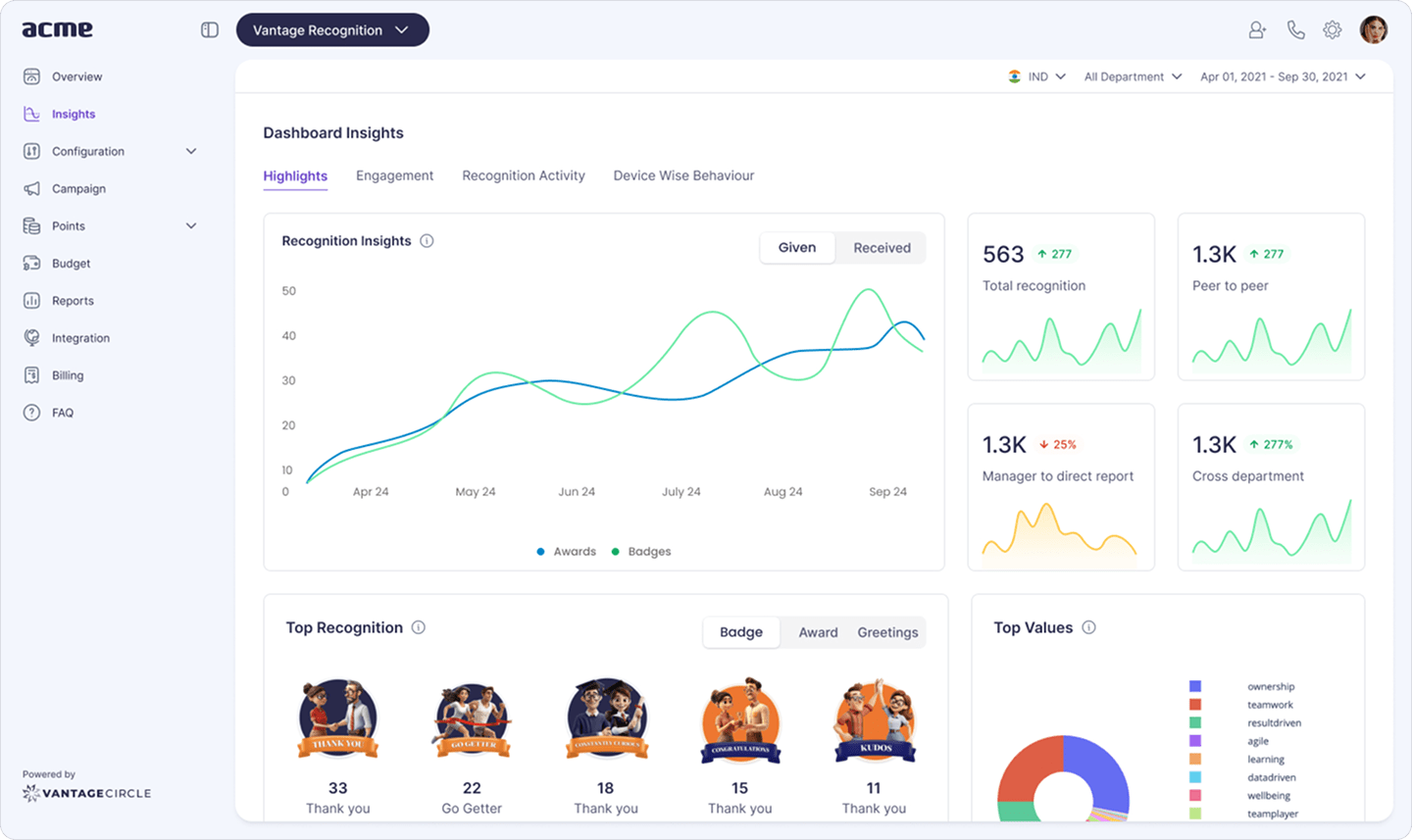
By showcasing where individuals stand in terms of Recognition and Rewards in relation to these overarching goals, we foster a sense of alignment and accountability throughout the organization.

What HR is Accountable For
HR owns the system that makes recognition possible: the platform, the criteria, the equity checks, and the refresh cycle. HR does not own whether managers actually use it. That distinction carries more consequence than it initially appears to, for reasons the final part of this section sets out.
The Platform and the Criteria
The platform should make recognizing someone faster than deciding not to. Criteria need to be documented and published, since criteria that remain unpublished are, from an employee's vantage point, indistinguishable from favoritism.
Recognition Equity Audits
Someone has to establish who is being recognized and who remains invisible. Distribution skew is the clearest early symptom of a program drifting, and it becomes apparent only when the data is segmented by team, tenure, and role.
This is where the recognition gap typically hides. Aggregate participation can appear entirely healthy while whole functions receive almost nothing.
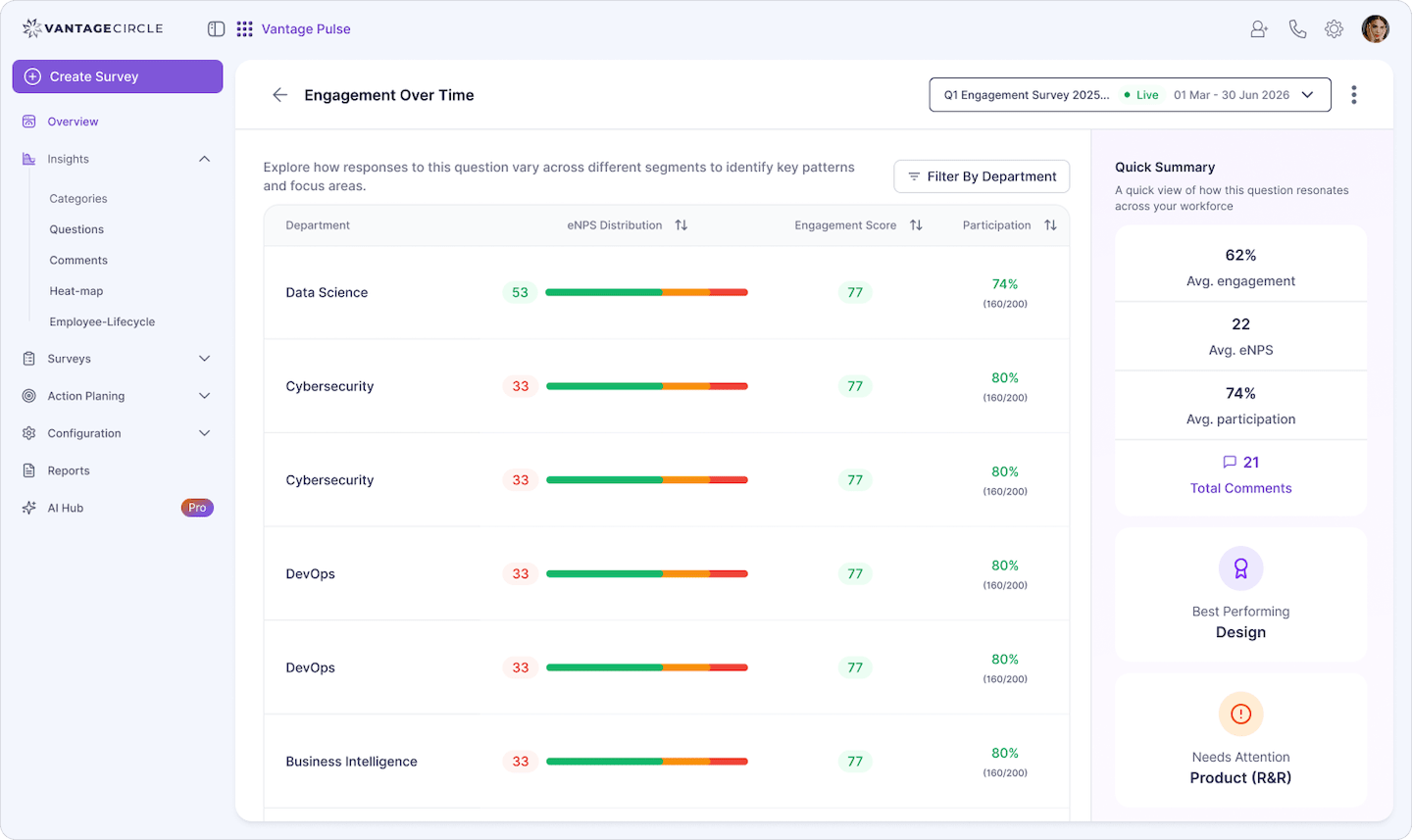
Vantage Pulse, Vantage Circle's employee engagement and pulse survey tool, breaks sentiment down by department, which is what makes a recognition equity gap visible rather than theoretical.
Reviewing and Refreshing the Program
Programs lose relevance over time. HR is accountable for gathering feedback, acting on what it shows, and retiring awards that have quietly become a rotation rather than a distinction.
What HR is Not Accountable For
HR is not accountable for whether managers recognize their teams. That accountability belongs in the manager row, and relocating it to HR undermines the model more thoroughly than any other misassignment.
Where manager behavior is treated as an HR deliverable, HR responds with the only instruments available to it: reminder emails, campaigns, and nudges. None of these alter what a manager is measured on, which is why none of them hold. The leaders who could change the measure, meanwhile, have no stake in the outcome. Accountability functions only where it sits alongside the authority to act on it.
What Employees are Accountable For
Employees are accountable for two things: sustaining peer recognition, and raising it when recognition is unfair or absent.
Sustaining Peer Recognition
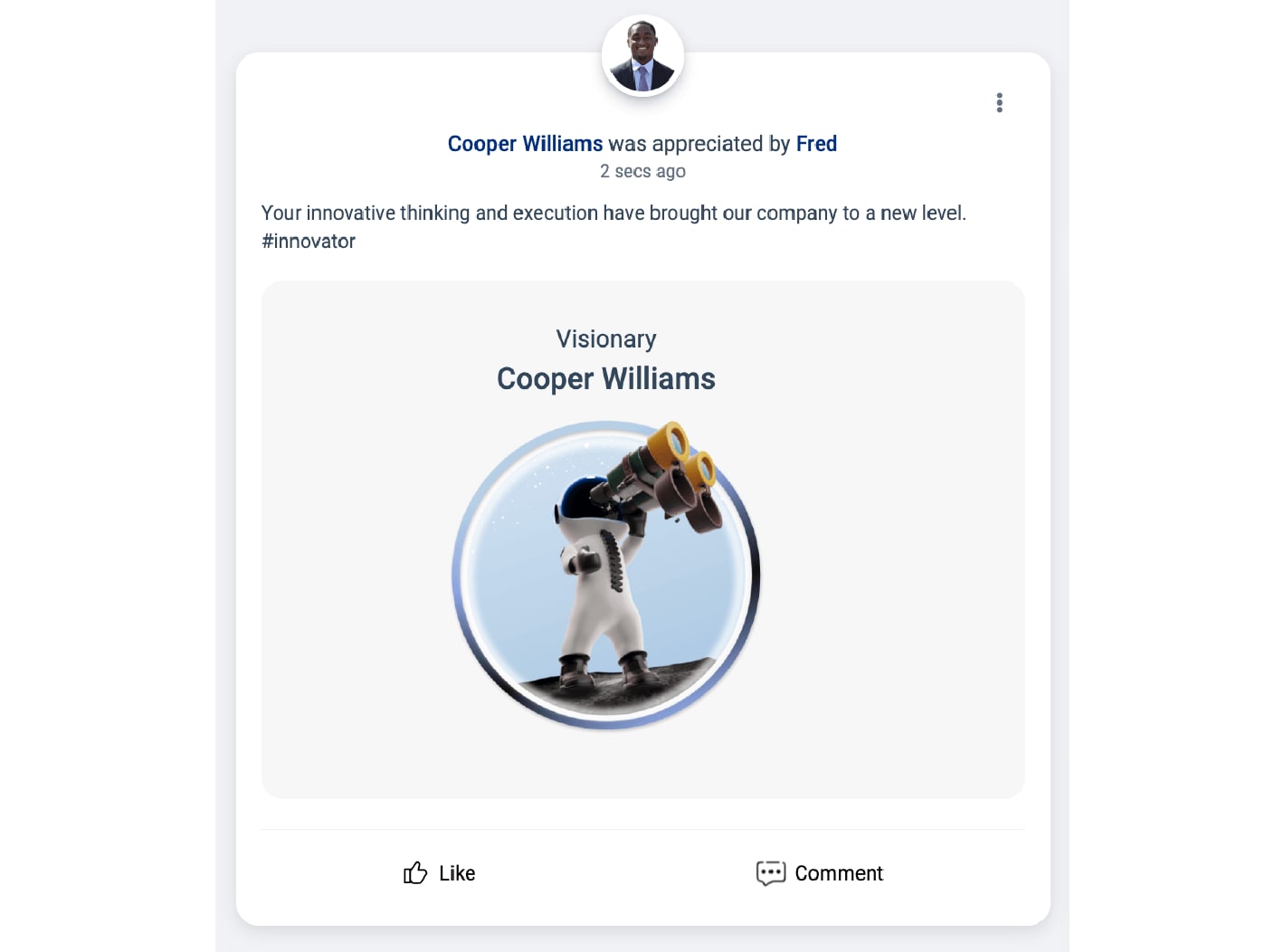
Peer-to-peer recognition captures the contribution that leaders rarely have visibility into. It is also the layer that declines first when leaders stop modeling the behavior, because colleagues take their cue from what leadership is visibly seen to do.
Holding Leaders Accountable Upward
Accountability that runs only downward is supervision rather than accountability.
Employees need a route through which to observe that recognition is consistently reaching the same individuals, or that their function has been overlooked for two consecutive quarters. In practice that route is an anonymous channel, since attributed criticism of a leader's fairness asks a great deal of the person raising it.
The mechanism depends on leadership actively inviting the feedback. Few employees will submit an observation of this kind into a culture where it is evidently unwelcome.
How to Measure Recognition Accountability
Recognition accountability is measured with five metrics: manager activity rate, coverage, giver coverage, distribution skew, and time to recognition. Of these, coverage is the measure that most reliably reflects the actual state of the program.
| Metric | What it reveals | Healthy benchmark |
|---|---|---|
| Manager activity rate | Share of managers giving recognition in a 30-day window | 50 to 70% active every 30 days |
| Recognition coverage | Share of employees who received recognition in the quarter | 60 to 80% per quarter |
| Recognitions per active manager | Depth of the habit, not just its presence | 2 to 4 per month |
| Distribution skew | Whether a minority of managers carries the program | Top 20% should send well under 70% of the total |
| Time to recognition | Gap between the work and the acknowledgment | Days, not quarters |
Coverage matters more than volume, because volume conceals the problem rather than revealing it. A program in which 20% of managers send 80% of all recognitions will appear entirely healthy on a raw count, while the majority of employees remain effectively invisible to leadership. The manager participation benchmarks behind these figures make that asymmetry straightforward to identify.
Measurement is also what separates the programs that work from the ones that merely exist. In Vantage Circle's State of Recognition and Rewards 2025, covering 352 recognition programs across North America, the UAE, and India, high-effectiveness programs showed a markedly stronger commitment to accountability. Nearly all of them measured ROI or strategic impact, and two in three used an online recognition platform to do it.
Can you say what percentage of your employees received recognition last quarter? If the answer needs a week of work, no one is currently accountable for it.
Organizations adopting this for the first time are better served by one metric than by five. Coverage is the appropriate starting point, since it is the hardest of the five to manipulate and the easiest to explain to an executive who does not follow recognition closely. It should be reported by function rather than as a company average, because the average is precisely what obscures the problem. Broader employee recognition statistics are useful for building the initial case, though it is an organization's own coverage number that tends to prompt action.
Where it is unclear which level of the matrix is weakest, an AIRe assessment scores a program across Appreciation, Incentivization, Reinforcement, and eMotional Connect, which locates the gap before remediation begins.
Examples of Leadership Accountability in Recognition
Accountability becomes real at the point where it changes something on a calendar, a scorecard, or a budget line. Four examples illustrate what that looks like in practice.
Recognition as a line in the manager review. The percentage of direct reports recognized each quarter appears in the performance conversation alongside delivery metrics. It ceases to be discretionary at the point where it is formally rated.
Published award criteria. The criteria for every award are documented and visible across the organization, so that nominators understand the threshold and unsuccessful candidates can see the basis for the decision.
A quarterly equity audit. HR reports recognition distribution by team, tenure, and role directly to the executive sponsor, so that any function falling below an agreed coverage floor is named rather than absorbed into an average.
A standing upward channel. A recurring pulse question asks whether recognition within the employee's team is perceived as fair, and the results are routed to the leader of that function rather than to HR alone.
What these four have in common is that each places a number in front of someone with the authority to change it, which is the whole of the mechanism. Recognition accountability is not a values statement or a training module. It is the decision to measure something and to show that measure to a person who can reasonably be asked about it.
The most productive first step is usually to take the weakest row in the matrix and give it a single metric this quarter. One measured accountability achieves more than four documented ones.
Summing It Up
Recognition programs rarely fail because people dislike being appreciated. They fail because no one within the organization is answerable for whether recognition actually happens.
The remedy is unglamorous but tractable. Name the owner at each level, give every owner a metric, and make that measure visible to someone with standing to ask about it. Leaders model the behavior and fund it. HR builds and audits the system. Employees sustain the peer layer and raise the matter when distribution becomes inequitable.
Documenting who owns what is worth doing before any further investment. A program with three named accountabilities and one dashboard will consistently outperform a better-funded one in which accountability is merely assumed.
FAQ
What are the 5 C's of leadership accountability?
The five C's are commonly listed as clarity, commitment, consequences, communication, and consistency. Applied to recognition, they mean: clear criteria for what gets recognized, visible commitment from leaders, real consequences when recognition is skipped, communication of who owns what, and consistency so recognition does not arrive in bursts.
What are the five pillars of recognition?
Most frameworks converge on timeliness, specificity, sincerity, equity, and visibility. Recognition that arrives late, stays vague, feels obligatory, favors the same people, or happens privately will fail on at least one pillar regardless of budget.
What are some examples of leadership accountability?
Adding a recognition metric to the manager performance review, publishing award criteria, running a quarterly recognition equity audit, reporting distribution data to an executive sponsor, and opening an upward feedback channel where employees can flag unfair recognition.
What are the 7 pillars of accountability?
The seven pillars are usually given as clarity of expectations, capability, measurement, feedback, ownership, consequences, and trust. Recognition programs most often break on measurement and consequences, because those two are the ones that require someone senior to act on a number.
Who is responsible for employee recognition, HR or managers?
Both, but for different things. HR is accountable for the system: platform, criteria, equity audits, and program refresh. Managers are accountable for the behavior of recognizing their direct reports. Holding HR accountable for manager behavior is the most common misassignment, and it is why program owners burn out.
How do you hold managers accountable for recognition?
The behavior needs a metric attached to it and placed somewhere visible. In practice that means a recognition KPI in the performance review, measured as the percentage of direct reports recognized per quarter, supported by a department-level dashboard their own leader can see. Reminder campaigns without a measure do not change behavior.

Nilotpal M Saharia is an Assistant Manager, Content Marketing at Vantage Circle and a recognition-and-rewards (R&R) strategist with 9 years of experience spanning Marketing, HR, and content strategy. He helps HR leaders turn employee recognition and leadership research into practical workplace programs.
Connect with Nilotpal on LinkedIn.