Redefining Internal Communications In 2022
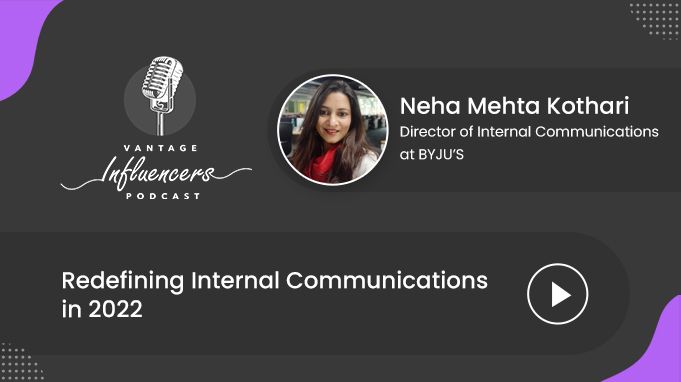
Episode Overview
Neha Kothari opens this episode with a simple but pointed observation: internal communication has stopped being a "nice to have" function and become a boardroom priority. She traces how the uncertainty of the pandemic pushed organizations to abandon stiff, one-way updates in favor of a more human and empathetic style of engagement, and explains why employees started trusting internal updates over social media chatter only once that communication became consistent, transparent, and genuinely two-way.
She then digs into the operational side of the job: building an intranet that lets employees talk back instead of just receive, holding leaders accountable for humanizing themselves through video and informal check-ins, and handling sensitive information without shutting down transparency. Neha also shares how she gathers honest feedback by staying close to informal, on-the-ground conversations rather than leaning only on surveys, before closing with her predictions for where internal communication is headed next.
Episode Highlights
- Internal communication earned a permanent seat at leadership tables once the pandemic proved how much clarity and reassurance employees actually needed.
- A single email channel isn't enough anymore; a strong intranet has to be a two-way street where employees can respond, not just receive updates.
- Employee engagement works best when it goes beyond career growth to cover mental wellness, physical health, and even family life.
- Company secrets leak less often when a communications team builds genuine ownership among employees and communicates proactively instead of only reacting to news.
- Honest feedback comes from staying close to informal, on-the-ground conversations, not from surveys alone.
- Internal comms is moving toward mobile-first, bite-sized, personalized content that stays consistent whether employees are at home or in the office.
About the Guest
Neha Kothari, Director of Internal Communications at BYJU'S
Neha spent close to seven years heading the internal communications team at Infosys before moving to BYJU'S, and started her career as a television correspondent with Times Now. Across news, media, PR, IT, and ed-tech, she has built a career around internal communications strategy, thought leadership, employee engagement, campaign management, and employer branding. Outside of work, she describes herself as a sports enthusiast, a Bollywood buff, a hopeless dreamer, a compulsive organizer, and a self-proclaimed DIY artist.
Host
Susmita Sarma, Vantage Influencers Podcast Host
What You Will Learn
- Why internal communication became a board-level priority during the pandemic
- How to design a multi-channel, two-way intranet that gives employees a voice
- What a genuinely holistic employee engagement strategy looks like beyond career growth
- How to handle sensitive company information without losing employee trust
- Practical ways to gather honest, on-the-ground employee feedback
- The internal communication trends shaping mobile-first, personalized employee messaging
Key Topics & Timestamps
| Timestamp | Topic |
|---|---|
| 01:13 | Neha's journey into internal communications |
| 02:58 | Common internal communication pitfalls and loopholes |
| 07:26 | Building a holistic employee engagement strategy |
| 12:06 | Internal communication in small vs. large organizations |
| 14:28 | Handling company secrets successfully |
| 18:14 | Getting honest employee feedback |
| 20:42 | Key internal communication trends for 2022 |
Full Transcript
Click to read the full episode transcript
Welcome to the Vantage HR Influencers Podcast. This podcast is sponsored by Vantage Circle, the simple and AI-powered rewards and recognition platform for employee engagement.
It's hard to believe that there are still some companies that undervalue or ignore internal communications. However, they do exist, and we can see their businesses suffer. The fact is, solving internal communications offers a sense of peace to the office and makes it more efficient and enjoyable. An effective internal communication plan enables organizations to shift from chaos to calm, especially in these critical times of COVID-19.
Susmita Sarma: Hi everyone, I'm Susmita, and welcome to another episode of the Vantage HR Influencers Podcast. This time we're back to talk about redefining internal communications in 2022, and I can't wait to introduce our guest today, Neha Kothari, the Director of Internal Communications at BYJU'S. Welcome to the show, Neha.
Neha Kothari: Thank you so much, Susmita.
Susmita Sarma: Okay, so before we start with the topic today, Neha, about internal communications and how to redefine internal communications in 2022, it would be great if you can brief us about your journey in the corporate world. How did you come into internal communications?
Neha Kothari: Absolutely, thank you so much for having me. I started off as a journalist, I started my career with Times Now. I was a TV correspondent and I loved everything about news. I loved that we could bring out people's stories, we could tell them what the world is all about. From there on, I also got into a bit of an entrepreneurial stretch. I was in Calcutta for about four years and had my own venture out there. After that, I knew that my calling still was in communications, so I moved to Bangalore. I was trying to interview for radio, actually, and then one of my friends who worked at Infosys told me there was a test happening there, so why not just take it up. I told her I didn't know how I'd fit into the corporate world, but she told me to just take it up and we'd see. So Infosys happened out of sheer serendipity, because I think I was meant to be in the corporate world. Everything I did as a journalist, I took those learnings back into the corporate world, and especially in an organization like Infosys, there was everything a journalist could ask for. There was a radio channel, a TV channel, communication of every kind. I was in the heart of communications there. After about seven years at Infosys, I finally decided to do something different. The startup bug bit me, so I thought, why not join a company that's growing, that isn't technically a startup anymore, it's almost like an MNC now. I completely believed in the passion behind what they were building, which is about making millions learn, and that's what struck the right chord with me. So here I am, at BYJU'S, after close to eight years of dabbling in various other things. I decided to take this up as a challenge as well.
Susmita Sarma: Just like in any other relationship, a lack of communication can cause a lot of problems for an organization. It can be hard to recognize signs of poor communication, but it has to be pointed out before the damage is done. So what are the most common, deep-rooted internal communication loopholes, or common pitfalls, that corporations make in their communication strategy?
Neha Kothari: Pre-COVID, internal communications was looked at more as a good-to-have function. COVID changed that for all of us, with dread and stress all around. We had an unknown enemy that we were fighting, a common enemy across the globe that plagued our lives. It was a completely new, challenging scenario that got companies to understand the power of relevant communication. We had to think on our feet, we didn't have any playbook or manual. It was very critical that we share the information we had and reassure our employees. In fact, we saw a point where our employees started relying on the information we were sharing with them rather than what was coming to them on social media or in the news, because of the level of confidence we were able to bring about. I think that changed the game for us. Unfortunately, and proudly, I can say that internal communications now has a seat at the table. We are at the right place at the right time.
You asked about the loopholes or the deficits. The time we're living in right now still has a lot of uncertainty. One day we're working from home, one day we're working from office, and then we go back to working from home again, because the brief is changing every minute for all of us. When you're facing a scenario like this, which is heading toward becoming an endemic, we don't know if there's ever going to be an end point. So we have to adapt into a mode where we have the agility to handle uncertainty. When we send out something today from the internal comms desk, there's a chance we'll revoke it tomorrow. To counter this, companies need architectural agility built in, they need to be flexible in thought and action.
In this continuously changing landscape, it's imperative that a communication team listens to its employees. The most critical aspect of devising any engagement strategy is to have your employees involved, because at the end of the day, this communication is for them. That could mean crowdsourcing, talking to your employees, listening to what they're saying and what they're giving you as input. Beyond that, you also need buy-in from leadership, because they're the ones who need to walk the talk. If they don't believe in what you're devising as a strategy, it isn't going to work. So you have to convince your leadership and your employees, only then will any plan, engagement activity, or campaign you design actually work, because at the end of the day, everyone in the organization needs to cascade that message, they need to live and breathe it.
So while I wouldn't say there are multiple problems in the field of communication right now, the most important thing is ensuring our communication is clear, crisp, relevant, and, most importantly, consistent. That's what all of us should have.
Susmita Sarma: So for all this efficiency in internal communications, Neha, do you use any tools in your organization?
Neha Kothari: Absolutely, we do. It's very critical that we have multiple tools. We're not living in an era where only email will work anymore, we have to look at a multi-channel approach. There will be times when you need to put something out on the intranet, so your intranet has to be really strong. I believe an intranet should never be one-sided, it should support an employee voice as well. When companies are deciding which intranet platform to go with, whether they're building it internally or going with a third-party vendor, they need a platform that gives employees a channel to come back and voice their opinion too. It has to be a two-way channel of communication, because emails, WhatsApp messages, even podcasts, they can all become one-sided, where the company is just saying what it wants to say. Are we giving employees a platform? That's most critical, because the moment you start doing that, you know your message actually has an impact, that it's being heard, that there's some relevance to the employee you're devising it for. So channels have to be devised smartly, and like I said, it has to be a multi-channel approach. One channel won't do the trick for us anymore.
Susmita Sarma: So how do you look at employee engagement in your organization? That has to be a critical part right now, isn't it?
Neha Kothari: Absolutely. I think most importantly, you have to listen to your employees. The reason I keep repeating that is, we can come up with multiple strategies, but the only strategy that will actually work is empathy. That's the strategy we need. The moment you start listening to and acknowledging your employees, you'll be able to hit the nail on the head. To be honest, communications is not rocket science, it's a human science. You need to be able to read people, and only then will people read what you write. As a communicator, your main goal is for people to read what you're writing, to absorb it, to consume the content the way you want them to, and there has to be a call to action too.
The other part of engagement, for a communications team, is thinking of an overall, holistic view. For an employee, it's not just about career growth. There are different personas in your organization, some might want career growth, some might want compensation, some might just be looking at overall holistic growth, which could be about health and wellness.
Susmita Sarma: Depending on their values.
Neha Kothari: Absolutely. Today we live in a world where mental wellness is just as critical as physical wellness. It's so uncertain that you don't know what's going to happen, and uncertainty always gives way to anxiety. So our engagement strategies and employee engagement campaigns should have a holistic picture. We can't rely on only talking about career to our employees, or only telling them their growth is fantastic in the company. We also have to show them that their mental health and physical wellness matter to us. Based on all of these pillars, we come up with engagement strategies.
Another important pillar, especially in today's world, is that our homes, our living rooms, our dining tables have become our workspaces, so families should also be involved. We've actually invaded the family space, not the other way around. We keep asking our families to stay quiet during calls, but can we involve them in a meeting instead? If there's a recognition happening for an employee, can we involve the family? Can we get family members to teach a skill to others, because sometimes you don't know the kind of talent family members come with? It's critical that all of these aspects are looked at, because one strategy or one way of thinking blindsides us.
We also have to ensure our engagement strategy has business goals attached to it. When I say business, I mean that if retention and productivity are critical for my business, if that's something my leadership is looking at, it's important for a communication team to align itself with that issue too. For example, we've all heard about the Great Resignation, we've read enough articles about it. As a communication team, it's critical we look at how this is also becoming an era of great opportunity, because if somebody is leaving from somewhere, they're joining somewhere else. So if you're offering something really good, you can bring in the best of the best employees, and how do you showcase that to your own employees and to potential hires? Because today, the employees already in your organization are your brand ambassadors, they carry the tag of your company outside, so it's a reflection of what you're doing internally.
It's extremely critical that a communication team aligns itself with people first, and then with business, what are the business goals and strategies, and how do we showcase what the company has in store for someone who wants to join or wants to stay? Because the opportunities outside are numerous, given the kind of talent and demand out there. Retention in these times is very critical, and remotely, it's tough, but with the right strategy and the right mindset, I think it's not too far that we'll be able to retain our people, keep them happy, and bring in good talent from the market too.
Susmita Sarma: So Neha, do you think internal communication efforts differ in small-sized organizations versus the big ones?
Neha Kothari: I don't think it differs much. I've been part of a very large organization previously, with around two lakh fifty thousand employees across the globe, and now I'm part of a company that isn't a startup anymore but still has similar issues and problem statements. What I think companies have started acknowledging, whether big or small, is that employee engagement and communication in this remote setup is of utmost priority. If your employees are engaged, productivity goes up, and if the business does well, you can put that back into the system and benefit employees again. It's a loop. So fortunately, big and small organizations by and large now know the power of good communication, and the issues that can crop up if there's a lack of it. There can be multiple approaches, centralizing or decentralizing communication in small and large organizations respectively, but everyone is working toward one single goal. So I wouldn't say there's too much of a difference, maybe just in team size. Otherwise, companies now know it's very critical to have a strong communication strategy if they want to stay in the game.
Susmita Sarma: So would you say it's a myth that weak internal communications can lead to failure specifically in small organizations, especially when working from home?
Neha Kothari: Absolutely. Whether you're bigger or smaller, if you don't have a strong communication strategy, if you're not able to go back and tell your employees what you're doing, you're eventually going to fail anyway. Because, like the situation we're in today with the pandemic, nobody knew anything about it, and that's what creates anxiety. It's a similar situation in organizations. If people don't know what you're doing for them, if they don't know whether you care about their growth as an organization, they'll obviously look for that elsewhere and move there. The days of someone working at a company for twenty five or thirty years, like our parents' generation, are gone. Today, if someone completes a year or a five-year milestone, companies think it's a big deal, because you've been able to retain that person given the demand and supply loop.
Susmita Sarma: Again, Neha, how do you handle company secrets successfully? We talk about transparency at the workplace all the time, but don't you think there are always a few things that are confidential to management only?
Neha Kothari: I wish we all had a recipe for this, so we all knew exactly how to go about it. But honestly, as a communications team, you're privy to a lot of information from management, and sometimes that information can have a huge impact, even change the game for the company. Especially if you're a listed company, there are repercussions if something gets leaked. As a leader heading the communication team, you have to educate your team, and by educate I mean empower them. You have to tell your team the kind of impact the news can have, so they know the difference they're making as part of the communication team, because everything we write internally, everything we say, affects so many stakeholders, internal or external. As they say, with great power comes great responsibility, so it's important your team knows the impact they're going to generate.
The second aspect is that leadership also has to be on the same page. When media reports that a highly placed source in the company said something, without naming a person, most of the time we know it's someone from within who shared that information outside. So how do you get your leaders to take ownership too? When you have a stake in something, you'll always want to safeguard it. When I know I actually own this, that this is my company, only then will people know there's something they should or shouldn't share. There will be leaks, there will be information that slips out. One way to counter it is to enable your employees beforehand. If there's news you want to share with the external world, can you also share it with your employees at the same time? Because most of the time, employees find out only through social media.
You should look at proactive communication, because most of the time companies do reactive communication, we look at something only after it's already out there and everyone in the organization is talking about it. So proactively, can you have a set of employees you share information with in advance, give them that sense that you have this information or need their input, or if it's something that's going to change a lot of things, can you ensure you share that internally at the same time so they know they got this from the company and shouldn't believe hearsay or media speculation? There are multiple approaches to this, but despite that, there will be leaks, because when you have information at hand, you feel you have power, and some people like to flaunt it. This is something most comms teams and internal communication teams are working toward, and hopefully, since the era we live in is all about social media and who gets their hands on the news first, we'll be able to have better answers to this over time. At the end of the day, it's about the feeling of ownership an employee has, and then they won't want to be the person who leaks company secrets to the outside world. When you have your own business, you do everything to safeguard it, and that's the feeling you should try to build, making employees feel like entrepreneurs within the company.
Susmita Sarma: As a leader in your organization, you need to know if you're supporting and challenging your staff in the right ways, or if, despite your good intentions, you're holding them back. So how do you manage to get honest employee feedback in your organization?
Neha Kothari: Fortunately for me, I was a journalist, it's a tag I'll always carry close to my heart. Thinking like a journalist means having an unbiased view, that's what journalists are supposed to do. You collect information, you gather everything you have, and then you analyze it rather than jumping to conclusions. Another part is that you have to listen to water cooler conversations, those are very critical conversations that happen near the coffee machine, that's where people are actually talking about what's going on in the company, so you have to keep your ears open for it. You should also truly show that you care, because if your approach isn't honest when you talk to people, it won't make a difference.
What I try to do, a practice I follow no matter which company or region I've worked in, is make an effort to connect with people on the ground, and in general conversations, talk to them about how things are going. They become like citizen journalists for me. If there's some burning issue, they immediately tell me, this is escalating, this is something I've heard. You need people around you who know that what you're doing is for the betterment of the company, and that you'll be able to help them too. If you can make a difference in even one or two scenarios, people will automatically start coming back to you. That's why I say think like a journalist, because if you have your sources in the right place, you'll have a pulse on what's happening on the ground. As a communications professional, it's critical to take that information back to leadership and say, here are the situations I'm seeing on the ground, here's the positive feedback, here's the negative feedback, and here's the neutral, but you never know when neutral can switch and become negative. When you can highlight situations in advance, you're helping both management and employees, because no matter how many surveys or pulse checks you run, what actually helps at the end of the day are these honest, one-to-one conversations. The internal communications team really needs to have its feet on the ground, talk to people, and work like reporters.
Susmita Sarma: Neha, we're already moving toward the end of this podcast, so would you like to share some key trends in internal communication that you see coming up in the following months of 2022?
Neha Kothari: Absolutely, there are multiple trends. At the start of every year, I think about how I'm going to speak to my team, what I need to talk to them about, so there are some things I already have in mind.
One big trend is this multi-channel approach, you can't rely on email communication alone anymore. You have to have a robust intranet in place, one that gives employees information, helps with engagement, and gives them a platform to say what they want to say. Alongside emails, you'll also have podcasts from leadership, you need to get your leaders to do some of these podcasts, because you have to humanize your leaders. We often meet our leaders once a quarter, or in some cases once every six months or once a year, so we don't actually know the real side of the leader. It's difficult to believe them if they only send a random email at the start of a new year, so leaders need to be humanized, and video helps a lot with that.
The other trend is that communication has to be mobile-enabled, because being on the go is the need of the hour. How many of us actually sit at a laptop all day, when most of the content we consume is on our phones? So communication has to work on mobile too. Next, whatever you send out has to be flexible and scalable. If you see that some information you're sending isn't working with people, and we measure that by how many people see it, like it, or share it, you have to be flexible enough to course correct, get feedback from the ground, because only then can you give people the things they actually want to see.
A one-size-fits-all approach also won't work, you have to tailor your content, and that's what will click with your employee base. Your target audience will be very different across organizations, and even within one organization. For example, if my target audience is in the twenty two to twenty four year age bracket, how do I ensure the content I give them is something they'll actually consume? How do I keep it bite-sized, make it look like an Instagram post, keep it as simple as possible, because that's what they consume daily in their personal lives? How do you put yourself in their shoes and ask, if I got this message, would I consume it, would I click on it? Because a clickbait subject line will only take you so far, so you have to empathize and put yourself in the shoes of the person reading the content, that's what makes the difference.
The last big trend, in a world that's sometimes office, sometimes hybrid, sometimes home, is that there has to be a consistent message. When employees come into the office, are you showing them the same thing digitally too? When they log into the intranet, do they see the company's values, stories, or the same messaging they'd see in an out-of-home ad or in the office? Is there a pop-up about company values, is there a campaign happening there too? You have to blend the physical and digital worlds and show people a consistent message, because that consistency creates stickiness in people's minds, this is what I saw when I came into the office, why should the digital environment feel different? If you're doing something physical, like office parties or get-togethers, why not do the same in the digital world? It could be as simple as a pizza party with your team, we actually encourage a lot of our leaders to do that, we ask them to do a casual catch-up on a Friday, no talk about work, maybe even a theme party where people dress up for a virtual meeting. That's how you bridge the gap, because one thing every organization is talking about right now is that employees are disengaged because of digital fatigue, so you have to reduce that fatigue by bringing a human touch to it.
Employee engagement and empathy are going to stay in the trends for 2022 and for all the years coming after, because they're the core of what we do. If we remove engagement and empathy from the equation, we're just like robots giving people information that's of no value.
Susmita Sarma: Thank you so much for sharing this, Neha. One must-read book for any internal communicator, or a podcast you'd want to suggest our listeners listen to?
Neha Kothari: Definitely your podcast, the Vantage HR Influencers Podcast, is something everyone should listen to, got to promote this one too. But like I said, I used to be a journalist, and nonfiction was my go-to, I used to be into crime and politics, that's what interested me. So I'd tell everyone listening to read anything and everything, listen to anything and everything, because it broadens your perspective. Whether you like it or not, you'll know you have a perspective even if you don't like it. Be open to unlearning and to learning something new each day. If you don't know something, it's okay, you can reach out to so many people, and thanks to the multitude of social media platforms we have today, you need to keep learning constantly, because what worked yesterday worked yesterday, what matters is what new thing you can do today, that's what sets you apart.
Susmita Sarma: Absolutely, getting very dynamic day by day.
Neha Kothari: Absolutely, you can't just rely on one book. I know a lot of people have that one favorite book, but I've learned from so many places, a small snippet from one author, something from another. There are so many things to pick from so many places, but you need to understand there are times you have to unlearn things, times when what worked yesterday won't work today. How do you keep yourself relevant to the times we're in? That's what makes a difference, and you do that by opening yourself up to many things. Fortunately, today we have access to so much information, and companies also push you toward learning and development, giving you access to courses. I'm coming from a company that believes in educating millions of people, and we do a lot for the learning and development of our own people too, and that's what's here to stay.
Susmita Sarma: Brilliant. Now, what would be your end note, or your suggestions to our listeners?
Neha Kothari: I'd just say, enjoy what you do, and everything will be a cakewalk. Communications is a profession for passionate people, you don't need a specific degree to be a good communicator. I say this from experience, because I have so many people on my team who don't come from a communications background, but it's their passion that drives them, because your only real tool is empathy. And there are no right or wrong answers in communication, it's all about what works for you, and it's a bit about trial and error too. Be open to ideas, be open to listening, be more flexible, be a little more than what you were yesterday. If we can do all of this, we're going to have a fantastic year no matter what variant comes into our lives. If we can manage these things and stay resilient, stay the course, nothing's going to be impossible.
Susmita Sarma: Finally, Neha, how can listeners reach out to you?
Neha Kothari: They can reach me by email, I'm very active there, or find me on Instagram or LinkedIn by searching for Neha Kothari. We can chat about anything under the sun, because I'm always open to learning and always open to sharing a bit of what I know in life.
Susmita Sarma: That's great. It was a pleasure talking to you, Neha, thanks for all your insights, and thanks for being a part of the Vantage HR Influencers Podcast.
Neha Kothari: Thank you so much, Susmita. It was wonderful being here, sharing what I know, and I always look forward to learning more from the people around me, because I think there are so many nuggets out there to pick from, and if you can just pick one each day, imagine three hundred and sixty five knowledge nuggets a year. So all the best, and thank you so much for having me.
Susmita Sarma: Thank you, thank you so much.
FAQ
What is the biggest shift in internal communication since the pandemic?
The pandemic pushed internal communication from a "good to have" function to a boardroom priority. Companies that shared information consistently and reassured employees during a period of uncertainty saw employees trust internal updates over social media or the news, which is what earned communication teams a permanent seat at the table.
How can companies build a two-way internal communication channel?
Rather than relying on email alone, companies need a multi-channel approach, especially a strong intranet that lets employees respond, comment, and voice opinions rather than only receive updates. A channel only works if employees feel heard, not just informed.
How should employee engagement strategies address wellbeing, not just career growth?
Engagement strategies should take a holistic view that covers mental wellness, physical health, and even family life, not just career growth or compensation. Since work now happens inside the home, involving family in recognition moments and communication efforts has also become part of a genuinely holistic approach.
What is the best way to gather honest employee feedback?
The most reliable feedback comes from staying close to informal, on-the-ground conversations, sometimes called "water cooler" conversations, rather than relying only on surveys or pulse checks. Building trust with people across the organization means they will flag issues honestly and early.
Related Reading
Also listen on