The Power Of Word Of Mouth In Employer Branding
Episode Overview
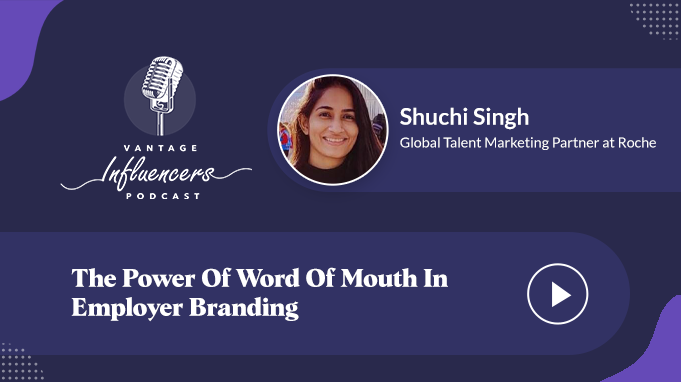
Shuchi Singh joins this episode to make a case that most employer branding playbooks miss: the loudest campaigns rarely move the needle, but a single unprompted comment from a current employee often does. She walks through how job seekers now run their own background checks before signing offer letters, turning candidate evaluation into a two way street. In her view, this shift means employer branding can no longer live inside the recruitment function alone; it has to reach onboarding, day to day management, and even how a company handles someone's exit.
She also unpacks the credibility gap between paid campaigns and organic word of mouth, arguing that a handful of curated brand ambassador posts cannot substitute for genuine sentiment shared across an entire workforce. Susmita and Shuchi discuss why negative reviews carry more weight than positive ones, how narrow storytelling fails a genuinely diverse workforce, and what employer branding teams often overlook when chasing visibility instead of trust.
Episode Highlights
- Word of mouth marketing carries far more credibility than paid campaigns or curated employee spotlight posts, because it comes from a source independent of company control.
- Job seekers now run a reverse evaluation on employers, researching a company's reputation during the interview process itself, not just before applying.
- Relying on a handful of highly visible employees as brand ambassadors can create resentment among the rest of the workforce who feel overlooked.
- Negative word of mouth outweighs positive word of mouth by a wide margin, so a few bad experiences can undo dozens of good ones.
- Real employer branding has to extend past recruitment marketing into onboarding, day to day engagement, and how a company handles employee exits.
- Emerging themes like mental health, generational shifts toward freelance work, and open conversations about compensation are reshaping what employer branding needs to address next.
About the Guest
Shuchi Singh, Global Talent Marketing Partner
Shuchi Singh is an engineer with an MBA in Human Resources & Industrial Relations from XLRI Jamshedpur. She has worked across industries including chemicals, automobiles, oil & energy, and healthcare, with experience spanning talent acquisition, performance management, and industrial relations. She currently leads employer branding and talent acquisition initiatives for a global healthcare organization, working across teams in the Americas, Europe, and Asia Pacific.
Connect with Shuchi on LinkedIn
Host
Susmita Sarma, Vantage Influencers Podcast Host
What You Will Learn
- Why word of mouth marketing is more credible than paid employer branding campaigns
- How the candidate evaluation process now includes a reverse phase where applicants vet employers too
- The risk of relying on a small group of employees as brand ambassadors
- Common misconceptions that limit the effectiveness of employer branding strategies
- The obstacles most employer branding teams face, from information overload to lack of innovation
- Emerging trends set to shape the next phase of employer branding
Key Topics & Timestamps
| Timestamp | Topic |
|---|---|
| 00:00 | Introduction to the episode and guest |
| 00:44 | Shuchi's journey into HR and talent acquisition |
| 02:12 | Her current role and focus areas in strategic talent acquisition |
| 05:16 | What employer branding really means and its link to employee engagement |
| 09:03 | Turning employees into brand ambassadors through word of mouth |
| 12:04 | Common misconceptions about employer branding |
| 15:44 | Major obstacles employer branding teams face today |
| 17:44 | Emerging trends shaping the future of employer branding |
| 22:18 | Shuchi's closing advice for building a strong employer brand |
Full Transcript
Click to read the full episode transcript
Welcome to the Vantage HR Influencers Podcast. This podcast is sponsored by Vantage Circle, the simple and AI-powered rewards and recognition platform for employee engagement. Hi everyone, this is Susmita, your host from the Vantage HR Influencers Podcast by Vantage Circle. In this episode, we take a look at employer branding, in special connection with the power of word of mouth and employee engagement. For the same, please help me welcome Shuchi Singh, Global Talent Marketing Partner.
Susmita Sarma: Hi Shuchi, welcome to the show, and we couldn't be happier to have you on board today.
Shuchi Singh: Hello, thank you so much for inviting me today.
Susmita Sarma: Shuchi, tell us a bit about your background, your professional experience, and what keeps you motivated these days.
Shuchi Singh: Sure, ironically I think my introduction will sound a little contradictory, because I'm an extremely private person personally. That said, I've always had a habit of trying random things and finding patterns along the way. Before I became an HR professional, I had other pursuits that still shape who I am today, and I did my MBA in HR and Industrial Relations. I've been fortunate to work across different companies and industries. I worked with Reliance Industries in a leadership program, and I owe a lot of my HR foundation to the mentors I had there and the courses I took during my MBA, which were broadly in performance management, awards and recognition, and industrial relations. With my current organization, it has been almost six years now, starting with leading talent acquisition for the India market and working on organizational redesign and new ways of working, before moving into a global role across the Americas, Europe, and Asia Pacific. Most recently, I've been working on employer branding frameworks for an organization that is more than 125 years old.
Susmita Sarma: So tell us more about your current role, and what keeps you interested and motivated in strategic talent acquisition and management.
Shuchi Singh: Sure. My organization is a healthcare innovator brand, so there isn't a lot we need to convince people of, since we've been around for more than 125 years and there's a legacy that comes with that. We put patients first in everything we do, and our innovation is driven by the basic need to create a positive impact on patients' lives. That's what we build our brand around. But as much as there's a larger purpose that speaks to a candidate about the company, we still have to recognize individual purposes and motivations, because that's what it actually takes to acquire and manage the right talent.
Honestly, I never planned to end up in strategic talent acquisition and management. It was the last thing on my list of HR functions I wanted to do. I'm an extremely private person and don't particularly enjoy talking to people, so it felt like the wrong fit for me at first. I hope you're comfortable on this podcast with me today.
Susmita Sarma: No, no, definitely, it's a topic quite close to my heart too.
Shuchi Singh: And that's where my passion actually lies. Having done talent acquisition for more than two years now, I've realized the impact it can have on business growth. We tend to talk about talent acquisition as a very transactional thing, but I've come to realize the impact it can have on organizational culture as well, because you're bringing the right people into the organization through strategic talent acquisition. It's genuinely a privilege to find the right talent in the market right now. But I'd emphasize the strategic part of it, because the bigger challenge is making sure that talent not only joins the organization but stays and remains premium talent. People shouldn't feel like they've joined an organization and lost their individuality in the process. That's where my focus lies, both in my current role and going forward, making sure people don't have to give up their individual characteristics just to fit into a new culture.
Susmita Sarma: You're also responsible for employer branding strategy at your organization, isn't it?
Shuchi Singh: Yes. For our function specifically, and broadly speaking, we try to globalize most of our frameworks and initiatives since we're a global brand. That said, there are specific regional needs and perspectives we have to cater to, so everything we do still has to be grounded in our global values.
Susmita Sarma: Today we're talking about employer branding on this podcast, Shuchi. So how would you describe employer branding, and how does it live and breathe in the minds and hearts of your past, present, and future employees?
Shuchi Singh: Sure. It's actually quite a complicated topic for me, because whenever we talk about employer branding, we tend to talk about the conventional ways we've always approached it, and at the end of the day we just talk about it feeding into the recruitment funnel to attract the right talent. It ends up becoming a purely recruitment-focused topic.
But one thing I'd like to highlight is that the recruitment funnel itself has been changing quietly, and it isn't really being discussed within the HR community. We always talk about consideration as a phase before a candidate applies to a job. But there's an additional step now. It's becoming harder to attract the right talent, and then comes a secondary consideration, or a reverse evaluation phase. Once a candidate is interviewing with you, they're doing their own research too, so it's no longer just about getting a candidate to apply for a job. That's what we call the war for talent, and that's where employer branding stops being just recruitment marketing. It has to extend into every other aspect of HR, like employee engagement and onboarding, and how well the rest of HR is functioning, because all of it eventually feeds into how the brand is perceived, right through to the exit interview.
Susmita Sarma: Exactly. And in fact, I have an example on that, if you have time.
Shuchi Singh: Yes, sure. From my own experience, let's look at a hypothetical candidate, let's call him Maddie. In today's environment, where fewer people are resigning and job security matters more, let's say Maddie is twenty four years old and in his second job after graduation. The main reason he'd change jobs, like most people, is a compensation change or correction. He has a student loan to pay off, so we can't really judge him for that. Right now, he's looking for something in his current role that he can't find, so he applies to a set of target companies, along with a wider batch of companies as a safety net.
What we try to define in employer branding is that we should run paid marketing campaigns to make sure Maddie applies to our job in the first place. That's the first consideration phase. He might apply because of the usual employer branding mechanisms, a paid campaign, a video, or a job posting he comes across.
When Maddie is actually deciding which company to join while going through the interview process, that's the second consideration phase, or the reverse evaluation phase. It isn't just the organization evaluating Maddie anymore, Maddie is also evaluating the organization he's about to join. That's where word of mouth marketing comes into the picture, because whatever blog posts or videos we run through paid campaigns don't carry the same credibility that word of mouth does. That's why employee engagement levels and engagement metrics end up being directly correlated with employer branding.
Susmita Sarma: So beyond job advertising and managing social media accounts, is there a smart and scalable way to get started with word of mouth promotion, something that empowers current employees to talk about the workplace?
Shuchi Singh: Yes, exactly. One thing we should recognize is that word of mouth marketing is, by definition, independent of the company. It isn't something companies can fully drive themselves. Different types of social media posts get made by employees at different companies, but the real word of mouth marketing we're talking about is different from what organizations often do, which is picking a few employees with existing visibility and asking them to post positive things about the company.
Cherry picking a small group of already visible employees to drive the narrative on different platforms can actually have a negative impact on how recognition is perceived within the organization. Are we favoring a few people over everyone else? What about the other ninety percent of employees who aren't seen as ambassadors? The real question is how we make sure all our employees, not just a select few, are using the right language and talking about the organization from a place of genuine understanding. If you take the example of Maddie again, he might not have the same priorities as someone already working at the company he wants to join. But do our employees actually know all the benefits, values, and cultural aspects of our organization well enough to share them with someone like Maddie, so he can pick what resonates with him and decide to join? It shouldn't come down to me only knowing about four benefits, telling Maddie about those, and him making his decision based on that alone. It comes down to whether our employees genuinely know everything we're doing for them, because that's what actually drives word of mouth marketing, not just social media posts from a handful of individuals labeled brand ambassadors.
Susmita Sarma: Honestly, I also believe it isn't an easy task to work on employer branding. As you mentioned, it's difficult to make sure all employees have the tools they need to strengthen the employer brand, or even take an interest in word of mouth marketing, because a lot of them don't realize how important it is to the brand. So moving forward, Shuchi, before we get into other things related to word of mouth marketing, could you walk us through some of the most common employer branding misconceptions?
Shuchi Singh: Yes, sure. That's actually a topic we often skip over before applying any employer branding frameworks. For example, we assume that all talent fits the same mold in the market, so we run similar campaigns for everyone, or use a similar employer branding strategy across different skill sets. What we don't realize is that the market has changed. If there's high demand for a particular skill set in the local labor market, we're not the only ones trying to hire that talent, they have multiple options, and that's where independent word of mouth information becomes critical for them in evaluating potential employers. That's a fairly significant misconception we tend to overlook.
Another one is that we don't really look at the marketing mix the way we should. When we talk about a product, we naturally think about the marketing mix, but when it comes to word of mouth marketing, there's a misconception that all word of mouth is the same, when in fact we fail to recognize the credibility factor. Not every individual on social media carries the same credibility. There's research in recruitment marketing showing that word of mouth information from a friend is perceived as far more credible than information from someone you barely know.
Susmita Sarma: It has a direct effect on reputation too. I actually have a stat that says sixty four percent of consumers have stopped purchasing from a brand after hearing news about that company's poor treatment of employees. So it clearly affects reputation as well.
Shuchi Singh: Exactly, and like you rightly mentioned, having just a few brand ambassadors on social media can't really offset that. If we have fifty positive word of mouth mentions versus three negative ones, believe me, those three negatives outweigh the fifty positives.
Susmita Sarma: For sure. It's the same with restaurant reviews, the negative ones tend to impact us more than the positive ones, most of the time.
Shuchi Singh: Exactly, and different things matter to different people in different ways. For me, a bad ambiance might be the deciding factor, for you it could be bad coffee. So within the negative perceptions about a company, are we also making sure the narrative itself is diverse enough that different people can find something in it that speaks to them?
Susmita Sarma: So employees really do hold a lot of power here, because they provide visibility into how things actually work inside the organization, to clients, prospects, and potential hires alike.
Shuchi Singh: Exactly.
Susmita Sarma: So moving forward, Shuchi, would you like to tell us about some of the obstacles you've faced in your employer branding work?
Shuchi Singh: Yes, sure. It's a much bigger topic of discussion these days because of the war for talent, everyone assumes that once marketing and branding solutions are in place, the job is done. But there are a few real challenges. The first is information overload. There's so much information out there about different companies and cultures that it becomes a question of credibility, the information overload is real, but how credible is that information? The second challenge is personalizing the benefits narrative. We talk about our organization in broad strokes, but different narratives speak to different people across diverse personalities, genders, and backgrounds. We tend to bucket our branding into five or six themes, compensation, benefits, team building, and so on, but newer priorities like mental health have to be folded in too, and it isn't always obvious how to talk about them well. The third challenge, one I've personally felt, is a lack of innovation in the recruitment marketing mix. We keep reusing the same videos, blog posts, and social media formats, without much innovation happening lately.
Susmita Sarma: When you talk about the next trends in employer branding, mental health comes up as the top one in most of the podcasts I've hosted. What's next after that, in your view?
Shuchi Singh: Oh, definitely, and there are honestly multiple new trends coming into employer branding, which also reflects how the market itself is changing. Mental health is one, but the real question is how we reiterate our commitment to it beyond just talking about it, and how we approach psychological safety, which is the basic foundation of mental health, since it's a term that's easy to misuse. Another trend is the generational shift, talent is moving into less conventional paths like freelancing, gig work, and consulting, so how do we build a common narrative in employer branding that reaches all these different types of talent pools? A more unique one is around social issues. There's so much happening in the world right now, unstable economies, wealth inequities, discrimination, and people want to see where a company stands on these things before they join. Are we doing anything about it, and how do we help people feel good about what's happening around them? Another trend, closer to core HR, is open conversations around compensation and benefits. I don't think there's room for secrecy around compensation anymore, the market isn't that closed off. So how do we turn open conversations about compensation and benefits into an advantage for employer branding? And the last one, which might sound a bit vague, is building what I'd call an ecosystem of care, something I've tried to build in my own organization and want to keep building going forward. Do we care for our employees beyond their employment contracts? Do we celebrate the people who leave, and the contributions they made while they were here? Can they become some of our biggest advocates in the market?
Susmita Sarma: That's really interesting to hear. So what do you do to make your employees feel cared for beyond the employment agreement itself?
Shuchi Singh: Sure, and again, I don't think employer branding or even employee engagement exists in isolation. It's a defined journey, we have to take care of onboarding, ongoing performance management, and even the exit, when a person is leaving the organization. Retaining someone doesn't just mean offering them money or a retention bonus, it's about understanding their career journey and their decision, and supporting them through the exit process. A lot of the time, the exit process is the most neglected part of that journey, but if you show care at that point too, that's when people really remember how they were treated, the same way they remember how they were treated when they joined.
Susmita Sarma: Very well said, Shuchi. So would you like to leave us with some concluding advice on employer branding?
Shuchi Singh: Sure, and I think I'd go back to the basics of HR itself as an employer branding professional. To have the right narrative out there in the market, there's one question worth asking yourself on a regular basis: are you doing enough that an employee goes home with a calm mind and a genuine understanding of their job? If the answer is no, it's time to revisit your engagement metrics, which will in turn redefine your employer branding metrics too. It's always worth relooking at these goals regularly, it doesn't make sense to set a plan once and stick to it forever, because human psychology is complicated, and we keep building frameworks that never change.
Susmita Sarma: It was lovely talking to you, Shuchi, and I'm sure there's a lot more to learn when it comes to employer branding. Our audience wouldn't want to miss the chance to connect with you, so please tell us how people can reach out.
Shuchi Singh: Sure, they can definitely reach out to me on my LinkedIn profile, which I'll be sharing. I'd love to have a chat.
Susmita Sarma: Thanks so much again, Shuchi. I genuinely appreciate you taking the time to join me, and thank you for sharing your knowledge with our audience today. I look forward to speaking with you again.
Shuchi Singh: Thank you so much, thank you for having me.
FAQ
What is employer branding, according to Shuchi Singh?
Employer branding is often reduced to recruitment marketing, but Shuchi argues it actually spans the entire employee lifecycle, from how a candidate first hears about a company to how that person is treated on their way out. It shows up wherever employees talk about their workplace, not just in campaigns a company runs.
Why does word of mouth marketing matter more than paid employer branding campaigns?
Word of mouth carries more credibility because it comes from a source outside the company's control. Candidates increasingly research a company's reputation as part of a reverse evaluation during the hiring process, and information from a friend or acquaintance is trusted far more than a curated social media post.
What are the biggest misconceptions about employer branding?
Two of the most common ones are assuming every candidate wants the same message, and assuming all word of mouth carries equal weight. In reality, talent has multiple options in high-demand skill areas, and the credibility of who is talking about a company matters just as much as what they are saying.
What obstacles do employer branding teams commonly face?
Shuchi points to information overload as companies flood the market with content, the challenge of personalizing benefits narratives for a genuinely diverse workforce, and a lack of innovation in recruitment marketing that keeps reusing the same formats.
Related Reading
Also listen on