Employee advocacy rarely starts as a program. It usually starts with one or two employees already posting about work on their own, and a marketing team that notices and tries to scale it.
Most playbooks skip that origin and go straight to the tool: pick a platform, write guidelines, ask people to post. The habit rarely survives past the launch email. What follows is usually a spike, then a slow drop in shares until the quarter ends and nobody mentions it again.
The employees who talk about their company without being asked twice are, almost without exception, the ones who already feel seen at work. Advocacy follows recognition. It rarely leads it. Get that order backward, and no tool fixes it.
Here's what the term actually means, what the data says about it, and how to build a program that works with that mechanism instead of against it.
Key Takeaways
- Advocacy follows recognition, not the other way around. Build the recognition culture first, or no platform, incentive, or launch event will produce lasting advocacy.
- Employee advocacy has three main types: social media advocacy, referrals and recommendations, and internal advocacy. Each needs different support from HR and marketing.
- A program only works in sequence: leadership buy-in, clear goals and KPIs, early advocates, a repeatable content supply, and ongoing measurement. Skip a step and the program stalls by week six.
- Software can make sharing effortless, but it can't manufacture willingness. That has to already exist, and it comes from employees who feel genuinely recognized.
What Is Employee Advocacy?
Employee advocacy is any voluntary act by an employee that promotes their employer's brand, culture, products, or people, usually outside the channels the company controls directly. Nothing more complicated than that.
That covers more ground than most guides admit. Sharing a company blog post on LinkedIn counts. So does referring a friend for an open role, wearing a company hoodie to the gym on a Saturday, or telling a stranger at a conference bar that the job is, genuinely, good. None of it needs a formal program behind it. Programs just make the behavior more consistent and easier to measure. Making it happen in the first place is a different job entirely.
What makes advocacy different from traditional marketing or employer branding comes down to one thing. The source. A candidate weighs a current employee's unprompted opinion differently than a curated careers page. Perceptyx's 2024 Benchmark Database, drawn from more than 20 million employee responses, tracks Advocacy as one of four core dimensions of engagement itself, alongside Pride, Commitment, and Motivation. Not a marketing side effect. An engagement outcome, filed as one, by a research firm with no reason to make that call.
That distinction, advocacy as an output of engagement rather than an input to marketing, is the center of this guide.
"An organization will obviously talk good about themselves, but nothing can be better than having your employees as your brand ambassadors. That's something which is more trustworthy, more relatable." Sulbha Kaushal Rai, Chief People Officer, RenewBuy, on the Vantage HR Influencers Podcast
Worth drawing the boundary too. A mandated LinkedIn post, written by marketing, copy-pasted by an employee who never reads it before hitting share: that's not advocacy in any meaningful sense. It can still move a reach number. It won't move trust, which is the entire reason advocacy works better than a paid ad in the first place.
The Key Benefits of Employee Advocacy
The clearest business case for employee advocacy isn't reach. It's retention, and reach is what most guides lead with anyway.
That's worth pausing on. Chasing impressions before fixing the recognition gap underneath them tends to produce a program that looks busy and runs hollow.
Four benefits show up consistently across recent research. They don't operate independently either, whatever most benefit lists imply. Credibility feeds recruitment. Recruitment and retention share a root cause. Reach only compounds once the first three are already working.
| Benefit | Why It Matters |
|---|---|
| Stronger brand credibility | Content shared by an employee reads as unprompted opinion, not marketing. Buyers and candidates weigh it differently than a company's owned channels. |
| Lower-cost recruitment | Referrals and organic employee posts substitute for paid sourcing, particularly for roles where culture fit is hard to describe in a job listing. |
| Higher retention | Organizations with high-recognition cultures, the same cultures that produce advocates, show a +21 point advantage in employees' intent to stay compared to low-recognition cultures. |
| Wider reach at near-zero marginal cost | Employees collectively hold far larger combined networks than a company's own branded channels, and activating that reach doesn't require ad spend. |
Information Gain: what Vantage Circle's own research shows The Recognition Effect, a 2025 study of 5.7 million employees across 2,000+ organizations run jointly with Great Place To Work India, found that only 55% of employees feel fully recognized, meaning they experience all four emotional signals the report tracks: appreciated, accepted, validated, and accomplished. Among that group, an average of 55% become what the report calls "Advocates," employees who actively uplift others and speak positively about their workplace. Miss even one of the four signals, and workplace sentiment drops by more than half. Half. That's the clearest data available connecting recognition directly to advocacy behavior, and it's the reason this guide treats advocacy as downstream of recognition rather than a parallel initiative.
I'd push back slightly on reading that 55% "Advocates" figure as a ceiling. It's a snapshot of current recognition practices, most of which under-invest in the emotional side of recognition. Read as a floor, it's a more useful number.
Some of the most shareable moments in a company happen inside a recognition feed long before anyone thinks to post about them externally. Making those moments visible internally is often the first step toward employees sharing them outside the company too.
Where advocacy actually starts
Vantage Rewards makes recognition moments visible with a social feed employees can react to and share, the exact kind of moment that turns into a LinkedIn post.
Explore Vantage RewardsTypes of Employee Advocacy
Most employee advocacy content narrows to "post about us on LinkedIn." That undersells it. Three types drive most of the value. Each needs different support from HR and marketing.
Social Media Advocacy
This is the type everyone pictures: employees sharing company content, wins, or opinions on their personal profiles. DSMN8's 2025 Employee Advocacy Benchmark Report, based on 252 program leaders surveyed between May and August 2024, found 61% of organizations now rate advocacy as extremely or very important to their marketing strategy.
DSMN8's analysis of 500,000 LinkedIn posts made in 2025 found that posts written by employees in their own words outperformed pre-written, company-supplied posts by more than 9x in reach.
That gap matters for program design. Templates make sharing easy. They also flatten the authenticity that makes advocacy work in the first place. The stronger move for most programs: give employees the facts and a rough angle. Let them write the actual sentence themselves.
Referrals and Recommendations
An employee referring a candidate, or recommending a product to a peer, is advocacy without a social media component at all. It's usually the highest-trust version too, since it happens in a direct conversation rather than a broadcast.
It's also the version most companies already reward, and reward badly. A flat referral bonus paid only on hire treats every referral as equally valuable, when the real value is upstream: an employee vouching for the culture to a friend shapes that friend's decision to even apply, long before a bonus is on the table. Programs that only pay out at the finish line miss the part of the behavior worth reinforcing.
Organizations with high-recognition cultures, the same cultures that produce confident referrers and advocates, show a +21 point advantage in employees' intent to stay compared to low-recognition cultures. A referral is, among other things, an employee betting their own credibility on staying put.
Internal Advocacy
Advocacy doesn't have to leave the building. An employee who defends a decision to a skeptical teammate is doing it. So is the one who shares a win in the team channel, unprompted. Same trust. It just hasn't left the room yet.
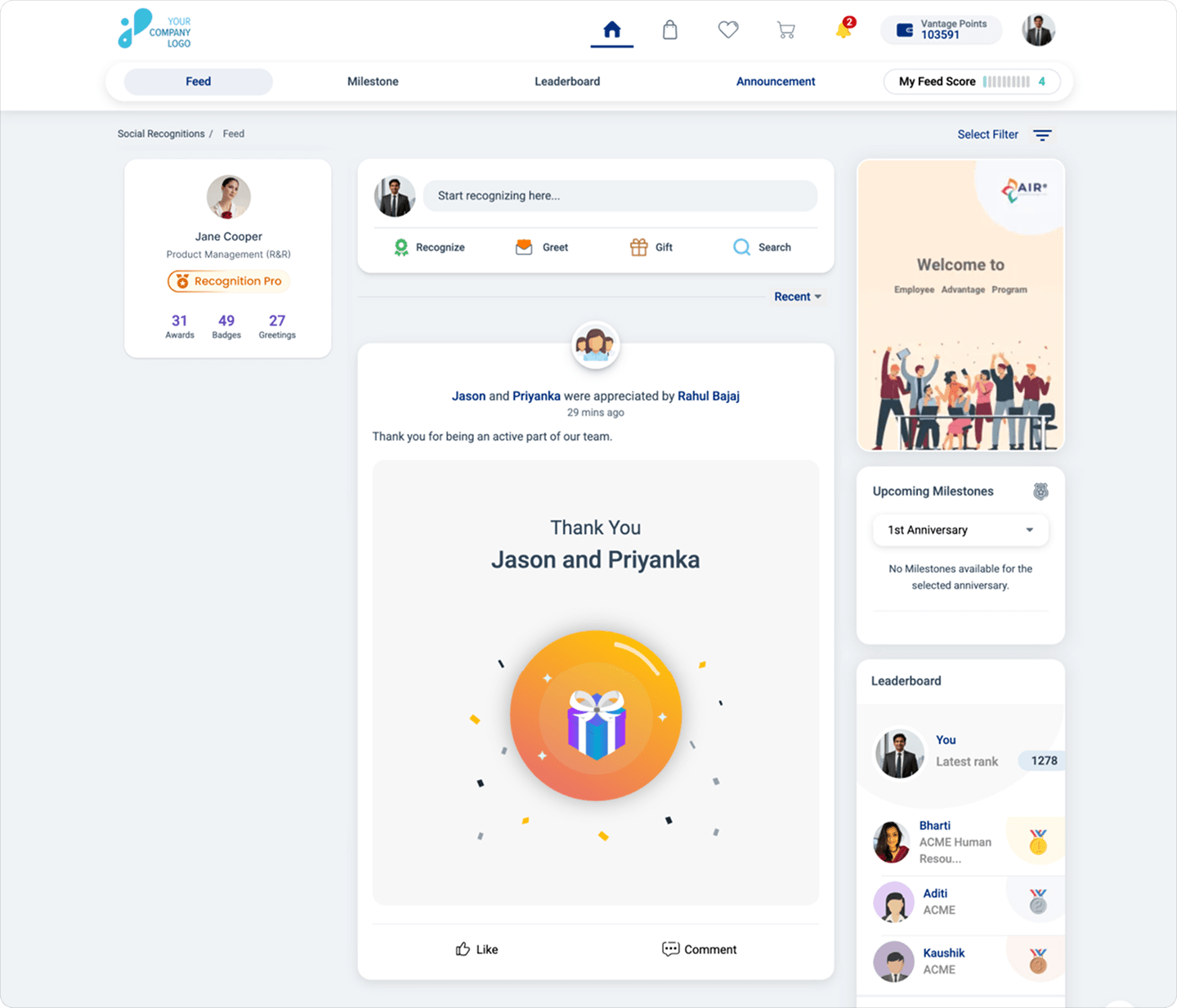
Screenshot: Vantage Rewards, Social Recognition Feed
Peer recognition is where this mostly starts. It's one of the few mechanisms that reliably produces specific, unprompted praise between colleagues, which is the exact currency internal advocacy runs on. Platforms like Vantage Circle's peer-to-peer recognition feature are built around exactly that: giving employees an easy, unprompted way to call out a colleague's work in public.
Internal advocacy is also the type most programs skip entirely, which is a mistake. It's the leading indicator. Employees rarely advocate externally for a culture they don't already vouch for privately. If internal sentiment is flat, an external advocacy campaign is just asking people to perform an opinion they don't hold.
See also: employee recognition, the mechanism behind most of what makes any of these three types sustainable rather than a one-time push.
How to Build an Employee Advocacy Program
A program built without sequence fails in a predictable way. Leadership announces it, a few naturally social employees participate, and six months later nobody remembers it exists.
| Step | What It Involves |
|---|---|
| Get leadership buy-in | Visible participation from senior leaders, not just written approval, since employees calibrate what's safe to share by watching what leadership actually does |
| Set goals and KPIs | Specific targets tied to participation, reach, or hiring outcomes, decided before launch rather than backfilled after |
| Identify and recruit advocates | A small group of naturally engaged employees who set the tone, supported by clear sharing guidelines and enough training that people aren't guessing what's appropriate |
| Build a repeatable content supply | A steady stream of shareable material (recognition moments, milestones, wins) so advocacy doesn't rely on employees generating content from scratch |
| Listen, measure, and optimize | Ongoing feedback loops and analytics review; a program built once and never revisited degrades within two quarters |
Get Leadership Buy-In
Employees read leadership behavior first. The handbook comes second. A CEO who never shares company content is telling the organization, implicitly, that this isn't actually a priority, whatever the launch email said.
This is also where programs quietly fail before they even launch. Leadership signs off on the budget, hands the rollout to HR or marketing, and stops there. Employees notice. They always notice. And they calibrate their own participation to match.
Set Goals and KPIs
Vague goals don't survive a budget review. "Increase visibility" is not a goal. It's a placeholder for one. Tie the program to something specific: a target number of active participants, a reach benchmark, or a measurable reduction in recruiting cost, and revisit it quarterly.
Participation rate is usually the more honest early metric, more honest than reach. A program with 200 employees and 8% active participation has a design problem no reach number will paper over, even if the 8% who do post generate strong engagement individually.
Identify and Recruit Advocates
Every organization already has a handful of employees posting informally. Find them first.
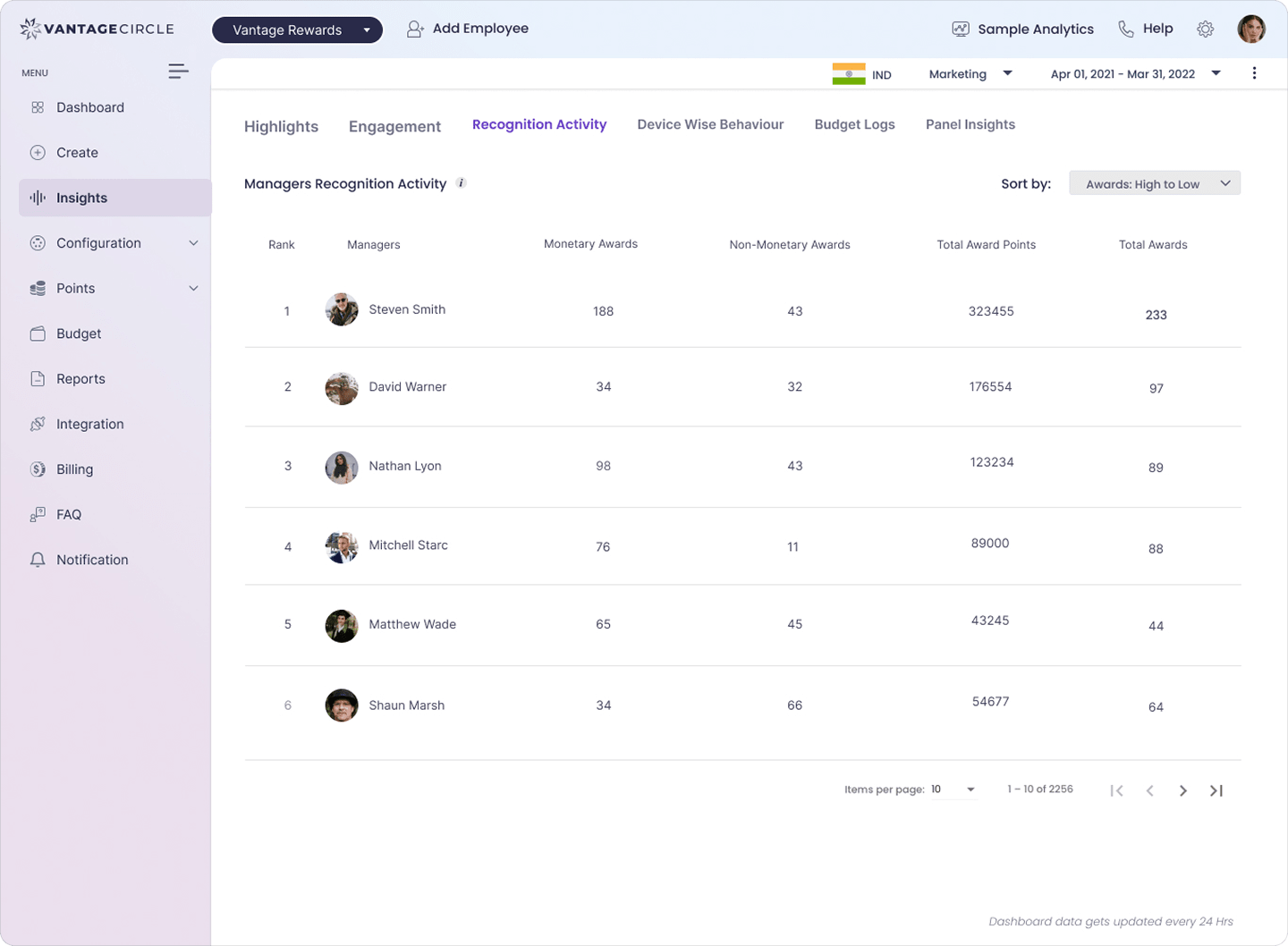
Screenshot: Vantage Rewards, Manager Recognition Report
Leadership buy-in for an advocacy program is easier to get when managers are already in the habit of recognizing good work. Manager recognition builds the muscle a leadership-endorsed advocacy program later depends on.
Managers who recognize consistently, easier advocacy buy-in later
Vantage Rewards gives managers budget visibility and AI nudges so recognition happens consistently, not just when HR sends a reminder. That habit is what an advocacy program builds on top of.
Explore Vantage RewardsGuidelines matter here too. Not to restrict what people say. To remove the ambiguity that makes cautious employees opt out entirely instead. What's proprietary, how to handle a negative comment, what tone fits the brand: settle it before launch, not during the first PR incident.
I've gone back and forth on how much guideline detail is too much. Too little, and cautious employees say nothing. Too much, and the program reads like a legal document nobody wants to consult before posting. There's no clean formula. Just a bias toward fewer, clearer rules over a long list of edge cases.
Training closes what's left. Most employees already know how to use LinkedIn, so skip the masterclass. A short session on what good sharing actually looks like, a specific detail beats a generic "proud to work here" caption, does more for quality than guidelines alone ever will.
Build a Repeatable Content Supply
Week one of a launch is easy. Everyone has something new to say. Week six is where programs actually die, not from lost interest, but from nobody handing advocates anything new to react to.
The fix isn't a content calendar full of pre-written posts, that reintroduces the authenticity problem from the section above. It's a steady supply of source material, recognition moments, product updates, wins, and milestones, that employees can respond to in their own words rather than manufacture from scratch. Incentives, kept narrow, still have a place here too. Recognize the ones who show up consistently. Publicly, specifically. That alone outlasts a one-time launch bonus.
Listen, Measure, and Optimize
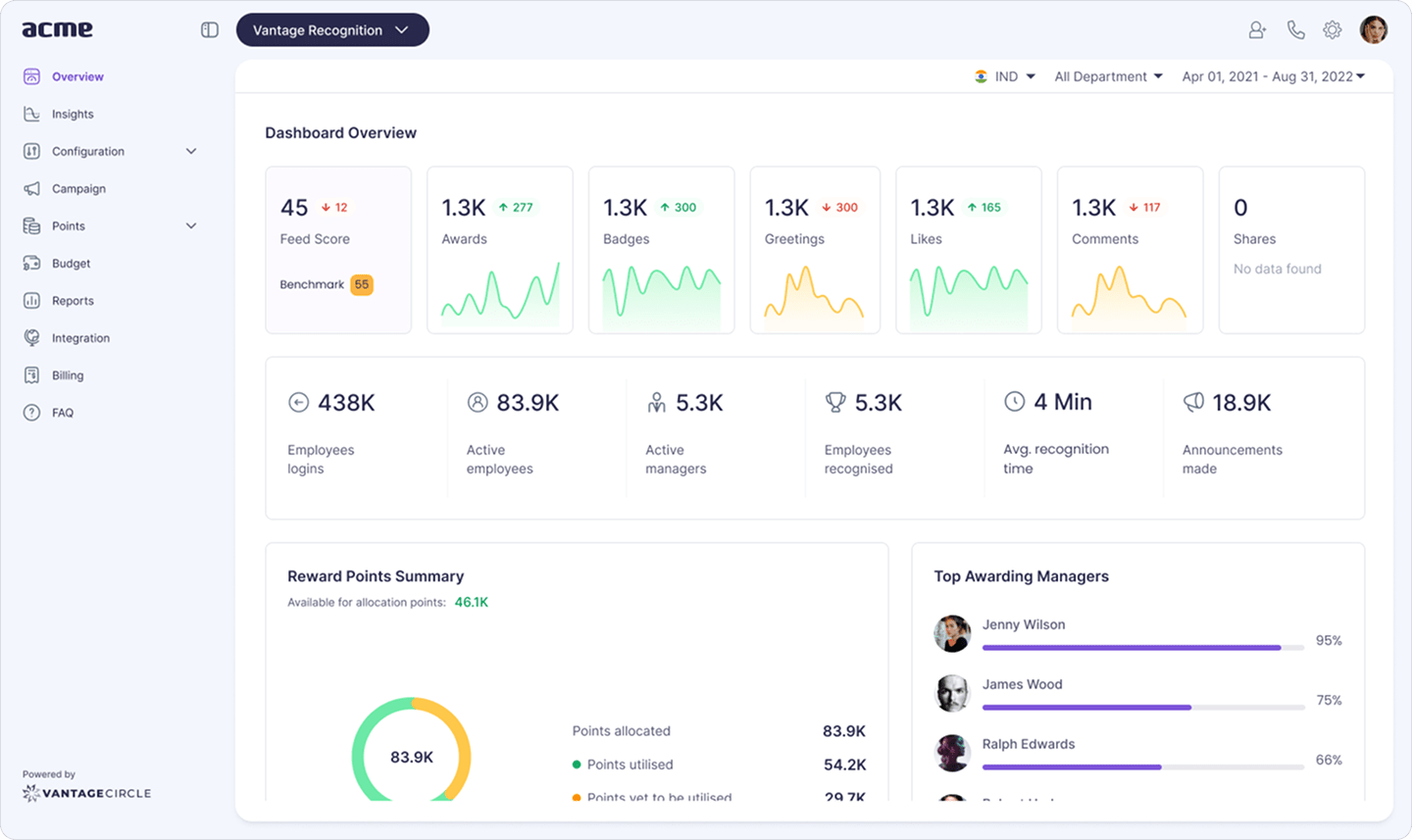
Screenshot: Vantage Rewards, Dashboard Overview
Aon Consulting's executive summary of Vantage Circle's Annual Recognition and Rewards Report (India) 2024-25 found that fewer than 20% of companies conduct a detailed ROI evaluation of their recognition and rewards programmes, but the ones that do see 2-3x higher impact against their stated objectives. Advocacy programs follow the same pattern. Measurement isn't a layer added afterward. It's most of what separates a program that compounds from one that quietly stalls.
Optimizing, in practice, means something narrower than the word suggests. Notice which advocates and which content actually move a number. Do more of exactly that. Everyone else gets the same broadcast ask they always got, which is fine. Not every employee needs to become an advocate for the program to work.
The 3 C's and 5 Steps of Advocacy, Applied to the Workplace
Two advocacy frameworks show up constantly outside the HR world, borrowed from public health campaigns, nonprofit fundraising, political organizing. Neither one was written with a workplace in mind. Both translate cleanly anyway, which says something about how generic the underlying mechanics of advocacy actually are.
The 3 C's, Translated for the Workplace
Applied here, the 3 C's aren't really a test of employees. They're a test of whether the company gave employees something real to commit to.
- Commitment: Advocacy performed under social pressure reads as performed. Employees can tell, and so can the people they're supposedly advocating to.
- Communication: People need something worth saying and a way to say it that doesn't require three rounds of approval first.
- Consistency: The one companies get wrong most often. One enthusiastic post from one engaged employee isn't a program. It's a screenshot someone in marketing got excited about.
The 5 Steps, Translated for the Workplace
The original sequence, identify the issue, define the goal, build support, plan the action, act, was built for campaigns trying to move public opinion, not employees deciding whether to hit share on a Tuesday afternoon. Adapted for the workplace:
- Figure out what's actually worth advocating for (specific wins and values, not "everything").
- Decide what success looks like before launch rather than after.
- Find the early advocates who build momentum without being told to.
- Hand them content and clear guidelines.
- Launch, and keep going past the first month.
Neither framework started in HR. Doesn't matter. What they're actually useful for is narrower than the names suggest, a check on whether a program's structural pieces are in place before launch. Not a substitute for the enthusiasm that has to already exist underneath it.
Is HR Supposed to Advocate for Employees?
Yes, and it's worth being direct about this, since the two directions of advocacy get conflated constantly in this exact search query.
Employee advocacy, the subject of this guide, is employees promoting the company. HR advocating for employees runs the other direction entirely: representing employee interests back to leadership. Pay equity. Workload. Career growth. The stuff that never makes it into a recognition feed.
Both matter, and they're not really separate initiatives. An HR function that visibly advocates for employees, pushing back on unreasonable workloads, closing pay gaps, taking feedback seriously, builds exactly the kind of trust that makes employees willing to advocate for the company in return. Skip the first, and the second dries up. Employees don't publicly vouch for an employer they feel unheard by, however good the swag is.
This shows up operationally in a specific way worth naming. Employee resource groups, engagement surveys, and pulse check-ins that visibly change something are themselves a form of HR advocacy, and they tend to produce the same employees who later show up as willing advocates externally. Surveys that go nowhere do the opposite. They teach employees that speaking up doesn't change anything, which is a hard lesson to unlearn once a company then asks those same employees to speak up publicly on its behalf.
Real Employee Advocacy Program Examples
Case studies age well as concepts, poorly as timelines. A few hold up regardless of when they launched.
| Company | What They Did | Why It Worked |
|---|---|---|
| Starbucks | Built "Partners," its name for any employee who promotes the company, into official language rather than a marketing campaign bolted on top. | Specific guidelines rather than vague encouragement, which is closer to what actually sustains a program: specificity over enthusiasm alone. |
| Electronic Arts | Launched EA Insiders in 2014 to connect its dispersed global workforce with the player community it serves. Over 1,000 employees joined, reaching a collective audience above a million. | Recognition was tied directly to participation, rewarding the posts that performed best. That pairing, an advocacy channel plus visible recognition, is the mechanism this guide keeps returning to. |
| Reebok | Took a narrower, culture-specific angle: employees posting fitness content under a branded hashtag, #FitAssCompany. | It asked for something employees were already doing, training, tracking workouts, rather than inventing a new behavior from scratch. |
Worth being honest about the limits of these three: all of them are large, consumer-recognizable brands with marketing budgets most companies don't have. A 200-person B2B software company isn't going to replicate EA's reach, and shouldn't try to. The transferable part isn't the scale. It's the design choice underneath each one: specific guidelines over vague encouragement, participation tied to recognition, and asking employees for something close to a behavior they already had rather than inventing one from nothing.
Career-milestone posts are among the things employees most commonly share on LinkedIn without any prompting, and a tenure-recognition program (Vantage Circle's Long Service Awards module is one example) gives a company a steady, authentic supply of them.
Choosing the Right Employee Advocacy Software, Platform, and Tools
The tools in this category solve a narrower problem than most buyers expect: making it easy for an already-willing employee to share pre-approved content in one click. They don't manufacture willingness. That has to already exist, which is the entire argument of this guide.
Before shopping for an advocacy platform, audit your recognition culture first. Check giver and receiver coverage, how often recognition happens, and whether it reaches past the leadership layer. A platform bought to fix low willingness will just make low willingness easier to not act on.
Software, platform, tool: this space uses the words almost interchangeably. The practical differences are still worth knowing before a purchase.
| Category | What It Does | Best For |
|---|---|---|
| Content curation & scheduling tools | Centralizes company content in one place employees can browse and post from, often with pre-written captions | Organizations early in their program, still building a sharing habit |
| Dedicated advocacy platforms | Adds gamification, leaderboards, and analytics on top of curation, purpose-built for advocacy specifically | Mid-to-large programs that need to prove ROI and sustain participation past the launch phase |
| Social media management suites | Broader tools built primarily for brand-account scheduling, with advocacy folded in as a secondary feature | Marketing teams that want advocacy inside an existing social workflow rather than a standalone tool |
Ease of use decides adoption more than feature count does. A platform that needs three logins and a training session loses the employees who'd otherwise share in thirty seconds from their phone. One-click sharing isn't a nice-to-have on the feature list. It's close to the whole point.
Integration matters less by breadth than by fit. LinkedIn, mostly, for B2B. Instagram and Facebook if the audience is consumer-facing. A platform boasting a dozen integrations and doing none of them particularly well loses every time to one that nails the two that actually matter.
Analytics separate the tools that prove value from the ones that just generate enthusiasm. At minimum, look for participation rate, content shares, and reach by employee. This keyword category runs some of the highest cost-per-click rates in HR tech, itself a signal of how competitive and commercially serious the buying decision has become. The vendors worth that spend tend to differentiate on the analytics layer, not the sharing mechanic, which is largely commoditized across the market at this point.
The real filter A platform can make sharing effortless. It cannot make an employee want to share. That willingness comes from somewhere else entirely, and it's the reason this whole guide starts with recognition, not software.
Pricing model is worth checking early, since it varies more in this category than the marketing copy suggests. Some platforms price per active user regardless of how often that person posts, which penalizes exactly the kind of low-frequency, high-trust sharing that referrals and internal advocacy depend on. Others price by content volume or by seat tier, a better fit for a marketing-led program than an HR-led one. Neither approach is wrong. They're built for different starting points, and matching the pricing model to how the program is actually meant to run avoids paying for capacity nobody uses.
Security and compliance matter more here than the category's social-media framing suggests, too. Any tool that lets employees post on a company's behalf needs clear controls: what content requires approval before it's available to share, how quickly a piece of content can be pulled if something changes, and who can see participation data at the individual level. Regulated industries tend to underestimate this until procurement asks about it directly.
One more decision precedes the vendor comparison entirely: whether participation is opt-in or effectively mandated. Programs framed as expected behavior, even informally, generate resentment and low-effort compliance rather than genuine advocacy. No platform feature fixes that. It has to be decided before the RFP goes out, not solved after the contract is signed.
None of the dedicated advocacy platforms, and there are several credible ones, solve the upstream problem this guide keeps coming back to. They can't manufacture an employee's willingness to advocate if the recognition and engagement underneath it isn't there. That's a genuinely separate software category. Worth evaluating both, not choosing one instead of the other. Worth naming plainly, since this guide is published by a recognition and rewards company: that doesn't change the recommendation. The two categories solve different problems, and a company evaluating one usually needs to be evaluating the other too, not instead.
How Vantage Circle Turns Recognition Into Organic Advocacy
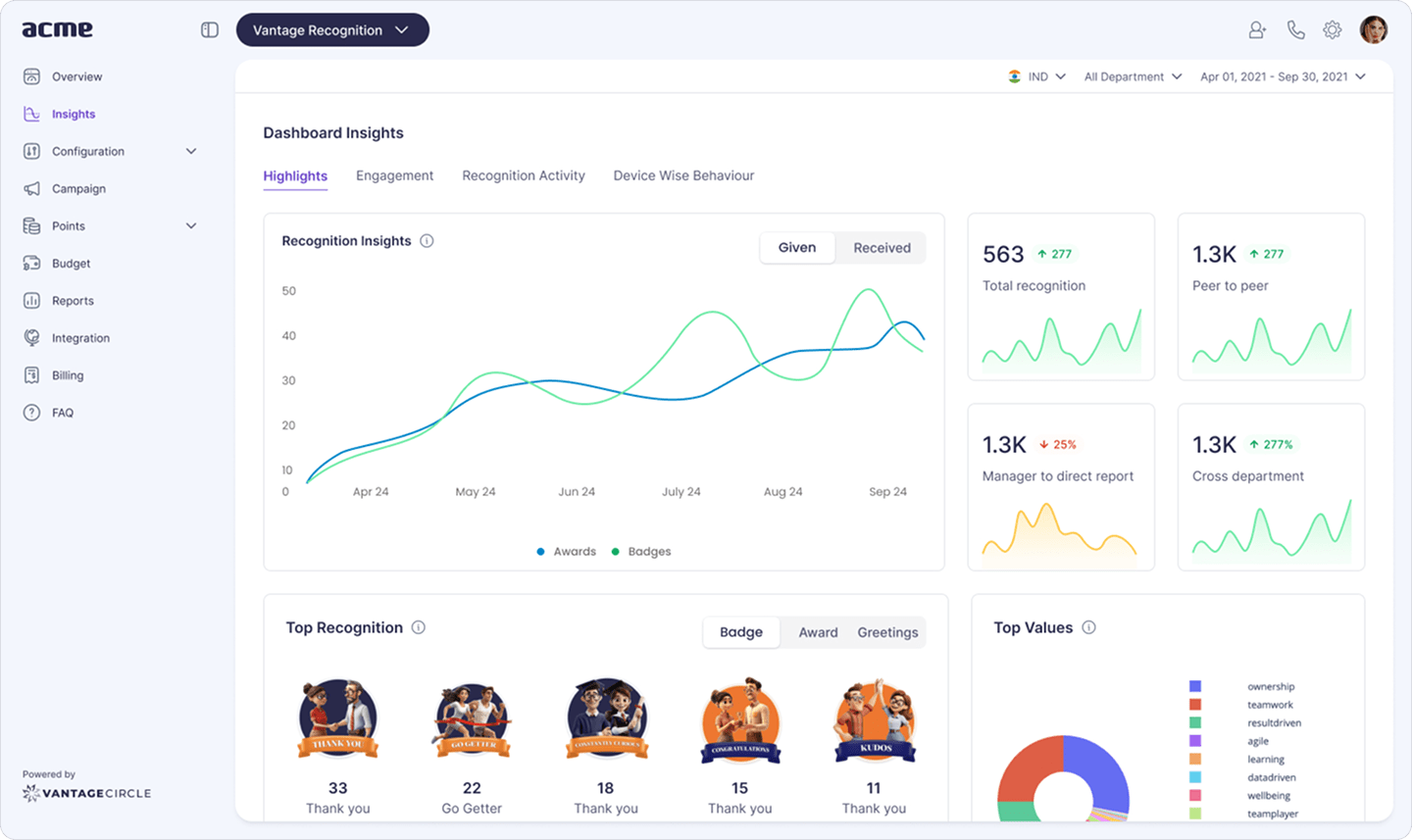
Screenshot: Vantage Rewards, Recognition Highlights
Recognition and advocacy aren't two initiatives that happen to correlate. In Vantage Circle's recognition and engagement data, the second consistently follows the first as a downstream behavior, not a program running in parallel.
| Vantage Circle Feature | How It Drives Advocacy |
|---|---|
| Social Recognition Feed | Makes recognition moments visible internally first, usually the step before an employee decides a moment is worth sharing externally too |
| Peer-to-Peer Recognition | Produces specific, unprompted praise between colleagues, the same currency that makes external advocacy credible rather than performative |
| Core Values Alignment | Gives employees a concrete, shareable story tied to a specific behavior, instead of generic praise that doesn't translate into a post worth writing |
| Vantage Pulse (eNPS surveys) | Surfaces disengagement early, before it shows up as public silence instead of advocacy |
| Engagement Analytics | Lets HR leaders correlate engagement scores with advocacy-adjacent behavior at the team level |
(eNPS: employee Net Promoter Score, a survey metric that measures how likely employees are to recommend their workplace to others.)
The Recognition Effect data also shows recognition rising with rank: 78% of senior leaders report feeling recognized versus 66% of non-supervisory employees. That gap is worth sitting with. It means the employees a company most needs advocating for it, the ones closest to customers, candidates, and day-to-day culture, are statistically the least likely to feel fully recognized in the first place. Fixing that isn't a marketing fix. It's a recognition design fix, which is the actual product category this guide has been arguing for the whole way through.
It's worth circling back to where this guide started. Perceptyx tracks Advocacy as one of four core engagement dimensions, not a marketing metric bolted on afterward. Vantage Circle's own data says roughly the same thing from the recognition side. Two different research organizations, measuring two different things, arriving at the same structural claim, is a stronger signal than either data set on its own.
Build the recognition culture advocacy depends on
Vantage Rewards turns everyday recognition into visible, shareable moments. Vantage Pulse surfaces disengagement before it turns into public silence. Together, they're the upstream fix this guide keeps pointing back to.
Explore Vantage RewardsConclusion
Most employee advocacy advice starts with the tool. Wrong starting point.
The employees who talk about their company without being asked are the ones who already feel recognized. That feeling has to exist before any platform, incentive, or launch event can activate it. Build the recognition first, consistent, specific, reaching past the leadership layer and down to the people actually doing the work customers see. Advocacy tends to follow on its own.
That doesn't mean skip the program. Guidelines, content, and the right tool still matter, they just aren't the starting point. Get the sequence backward, and a company ends up with a launch event, a short-lived spike, then silence. Get it right, and advocacy stops being a campaign. It starts being what the culture already sounds like from the outside.
FAQs About Employee Advocacy
Q1. What is employee advocacy?
A: Any voluntary action by an employee that promotes their employer's brand, culture, or work. That covers sharing content on social media, referring candidates, and speaking positively about the company in conversation.
Q2. What are the 3 C's of advocacy?
A: Commitment, Communication, and Consistency. In the workplace, that means advocacy has to be genuinely felt, not performed. Employees need something worth saying and an easy way to say it. One enthusiastic post doesn't substitute for a steady baseline of participation.
Q3. Is HR supposed to advocate for employees?
A: Yes. HR advocating for employees on pay, workload, and working conditions is the reverse direction of the same trust relationship that makes employees willing to advocate for the company externally.
Q4. Can you give an example of an employee advocacy program?
A: Electronic Arts' EA Insiders is one. Launched in 2014, it connected over 1,000 employees with the broader player community and paired participation with recognition for high-performing posts.
Q5. Can you give some examples of advocacy?
A: Sharing a company blog post on LinkedIn. Referring a candidate for an open role. Defending a decision to a skeptical colleague. Speaking positively about the company at an industry event. All of it counts as employee advocacy.
Q6. Can you give three examples of advocacy?
A: Social media sharing, employee referrals, and internal advocacy (vouching for the company to coworkers). These are the three most common types, covered in more detail earlier in this guide.
Q7. What are the 5 steps of advocacy?
A: Adapted for the workplace: identify what's genuinely worth advocating for, define what success looks like, recruit early advocates, equip them with content and clear guidelines, then launch and sustain participation with ongoing measurement.

He has worked in the human resources environment and has elevated recognition and rewards through his insightful and detailed writing. He aims to enhance the practice of Recognition in the workplace with new ideas and innovation that will help shape the work culture. For any related queries, contact editor@vantagecircle.com