
Ask anyone about the best manager they've ever had, and they'll probably tell you a story instead of listing leadership qualities.
And yet 76% of employees have never formally rated their manager's performance, according to Gallup, even though that person shapes their pay, promotions, and day-to-day experience at work.
Not because they don't want to but because speaking upward feels different. A thoughtful compliment can feel like flattery. Honest gratitude can be mistaken for trying to impress the boss. So, people say nothing at all. And that's a shame.
Managers spend much of their careers helping other people grow, but they rarely hear which of their everyday actions actually changed someone's work or confidence. The most meaningful feedback isn't about calling someone an exceptional leader. It's about naming the moment they made a difference.
Below, you'll find 35 positive feedback examples built for exactly that, organized by the situation you're actually in. That's what this blog is here to help you do.
What is Upward Feedback?
Upward feedback is a form of employee feedback, specifically the kind employees share with the person who manages them.
Unlike most workplace feedback, upward feedback travels against the direction of authority. The person receiving it often influences your performance review, compensation, career opportunities, and day-to-day experience at work.
Some organizations collect upward feedback through structured processes such as 360-degree reviews or performance cycles. Those have an important role. But the feedback that shapes trust most often happens between formal reviews, in one-on-ones, after difficult projects, or in everyday conversations.
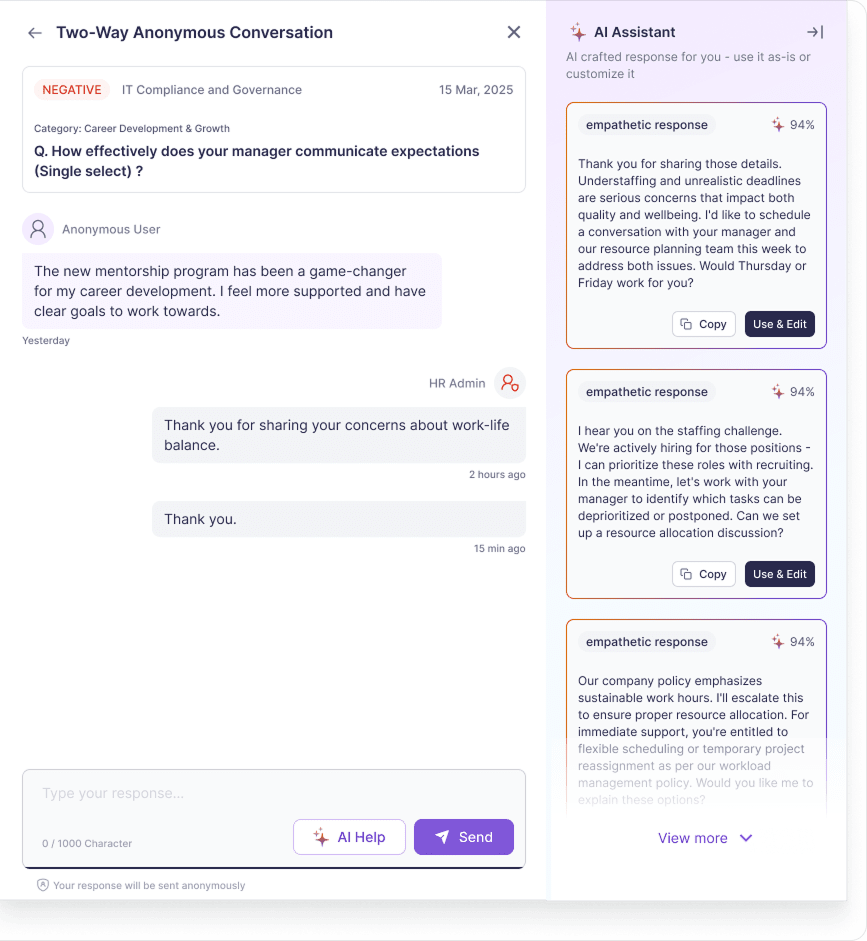
When employees don't feel safe attaching their name to honest feedback, anonymous channels become essential. They help employees share candid upward feedback without fear of repercussions, giving managers a clearer picture of what's working and what needs to change.
How to Praise Your Manager Without Sounding Like Flattery
The best feedback doesn't tell managers who they are. It tells them what they did and why it mattered. A simple way to think about it is this:
Describe the Behavior
Point to a specific action instead of a trait. Instead of saying "you're a great leader," name what they actually did. Maybe they simplified a complex project, advocated for the team, or gave you the confidence to own an important decision. Specific behaviors are observable. That's what makes feedback credible.
Explain the Impact
Name what changed because of the behavior. The behavior is only half the story. Did it help you make a better decision? Reduce stress? Build confidence? Deliver better work? The impact is what transforms a compliment into meaningful feedback.
Choose the Right Moment
Match the message to the setting. Some appreciation is best shared privately in a one-on-one. Other moments deserve to be recognized publicly, reinforcing the behaviors your team wants to see more often. Matching the message to the moment makes the feedback feel thoughtful rather than performative.
One final check keeps your feedback honest. If you could copy and paste your compliment to almost any manager, it's probably too generic. Feedback should describe a moment that only one person could recognize, because only they created it.

VANTAGE INFLUENCERS PODCAST
On this episode, Paul Glover explains why the most difficult thing a leader can do is confront their own blind spots, and how honest self-awareness is what breaks the cycle of disengagement on a team.
Paul Glover, C-Suite Performance Coach and Author of "WorkQuake"
Listen to the Episode35 Positive Feedback Examples for Managers by Occasion
The best positive feedback sounds less like a performance review and more like remembering a moment that mattered.
You don't need impressive words to appreciate a manager. Most of the time, the simplest observations are the most meaningful because they're rooted in something that actually happened.
Think of these examples as starting points. Borrow the structure, but replace the details with your own experience. That's what makes upward feedback feel genuine.
In a One-on-One Meeting
One-on-ones often become status updates. But they're also one of the few moments where you can tell your manager what's genuinely helping you grow.
Instead of complimenting their leadership in general, talk about something they consistently do that improves your work.
"In our 1:1 last week, you asked what was actually blocking me instead of reviewing my task list. I left with a real plan instead of a status update."
"You remembered the deadline I was stressed about last month and followed up today without me bringing it up. You're tracking what matters to me, not just the roadmap."
"When I said I felt behind, you asked what was going on before jumping to solutions. That made it easier to tell you the real problem."
"You gave me your full attention through our whole 1:1 today, no phone, no notifications pulling you away. It's rare, and I noticed."
"You asked where I wanted to be in a year and actually wrote it down. Nobody here has asked me that before."
"You told me directly you didn't have an answer yet instead of making one up. I trust the answers you do give me more because of it."
"You pushed back on my self-assessment and said I was underselling the Meridian project. That honest read is more useful than a compliment I don't believe."
During a Performance Review
Performance reviews and 360-degree feedback cycles tend to focus on employees, but they're also an opportunity to recognize the leadership that helped you succeed.
The strongest comments don't evaluate your manager. They acknowledge the behaviors that made your own performance possible.
"In this 360, I want to flag something specific: you rewrote my growth plan around what I actually said I wanted, not a template. That's why I'm still here a year later."
"You gave me direct feedback on the Denholm pitch within a day, not at the next scheduled review. Fast feedback is rare, and it's why I improved before the next one."
"On my last review, you separated what I control from what the market did. That distinction made the feedback feel fair instead of like blame for a bad quarter."
"You asked me to rate you honestly this cycle and didn't get defensive about the answer. That's what made me answer honestly instead of playing it safe."
"You connected my goals this review period to the team's actual roadmap instead of generic competencies. I finally understood why my work matters beyond my own scorecard."
"In my calibration meeting, you advocated for my promotion with specific examples instead of a general recommendation. I found out later how much work that took."
"You followed up two weeks after my review to check whether the plan we set was realistic. Most managers set the plan and never revisit it."
In Public or a Team Channel
Public appreciation serves a different purpose. It doesn't just recognize your manager. It shows the rest of the team that good leadership deserves recognition too.
Keep it concise, but make it specific.
"You called out in standup that the fix I shipped Friday was why the outage didn't repeat. Nobody would have known that was me if you hadn't said it."
"In the all-hands, you thanked the support team by name instead of a general 'great job, everyone.' People noticed the difference."
"You posted in the team channel that my doc saved new hires two weeks of ramp time. People actually read what I write now."
"You gave Priya credit for the idea in front of the client, not just internally afterward. That's the kind of thing people remember."
"You tagged our whole pod in the launch recap and named what each of us did. It read like you'd paid attention the entire sprint."
"You replied publicly to my update instead of reacting with an emoji. It made the update feel like it mattered."
After a Difficult Project or Crunch Period
People remember managers most during the hardest weeks—not because everything went right, but because someone made a difficult situation easier. That's worth acknowledging.
"After the Meridian crunch, you told leadership the timeline was unrealistic before we missed it, not after. That protected the whole team."
"You checked in with me the week after launch, once the adrenaline wore off, not just during the fire. That's when I actually needed it."
"When the migration went sideways, you stayed on the call at 11 p.m. instead of delegating it and going to bed. I won't forget that."
"You took the blame for the missed date in front of the client, even though half of it was a vendor problem. That kept the team's morale intact."
"After the release, you gave the team two days off instead of moving straight to the next sprint. It told us the crunch wasn't the new normal."
"You asked what almost broke during the crunch before asking what we shipped. That question is why we fixed the real problem instead of just celebrating the deadline."
For a Team Leader You Don't Report To
Leadership isn't limited to reporting lines.
Most of us have worked with someone who wasn't our manager but still made our work easier. Maybe they shared their expertise without being asked. Maybe they stepped in to unblock a project. Maybe they simply created an environment where collaboration felt easy.
Those moments deserve recognition too.
"You're not my manager, but you made time to walk me through the API before my first client call. I wouldn't have been ready without it."
"You gave me feedback on my proposal even though I'm not on your team, and you did it before the deadline, not after."
"In the cross-functional review, you backed my team's estimate instead of siding with your own. That's rare between departments."
"You included me in the planning conversation even though I don't report to you and didn't have to be there."
"You noticed I was new to this process and slowed down to explain it, without making it feel like extra work for you."
Short Appreciation Messages for a Manager
Sometimes you don't need a paragraph. A few thoughtful sentences are enough, especially after a meeting, a project milestone, or a difficult week. The key is to keep them personal without becoming overly emotional.
"Thank you for actually listening in today's 1:1. It made a difference."
"You made a hard week easier. I noticed, and I appreciate it."
"Thanks for backing my call on the Denholm account. It mattered."
"You've made this team a place I want to stay. Thank you."
5 Flattery Comments, Rewritten as Real Feedback
| Flattery Version | Why It Fails | Behavior-Plus-Impact Rewrite |
|---|---|---|
| "You're the best manager I've ever had." | It compares people instead of describing behavior. | "You consistently explain the reasoning behind important decisions, which helps the team adapt instead of feeling surprised." |
| "You're an amazing leader." | It's a compliment without evidence. | "You stayed calm during a difficult client escalation, and that helped the rest of the team stay focused too." |
| "You're always supportive." | Supportive can mean almost anything. | "When I was struggling with the project, you helped me prioritize instead of simply asking me to work longer hours." |
| "You're easy to work with." | It describes a personality, not an action. | "You encourage different opinions during meetings before making a decision. That makes people comfortable sharing honest ideas." |
| "Thank you for everything you do." | It's thoughtful but too broad to be useful. | "You make a point of recognizing the team's work in front of senior leadership. That motivates people to keep giving their best." |
Making Upward Appreciation a Habit, Not an Annual Event
Most managers spend their careers recognizing others. Far fewer are recognized themselves.
It's not because employees don't appreciate good managers. It's because most recognition systems were designed to flow in one direction—from manager to employee. Upward appreciation is often left to annual engagement surveys, performance reviews, or the occasional thank-you after a major milestone.
That creates a blind spot.
Managers rarely know which of their everyday behaviors build trust, reduce stress, or help people do their best work. Yet those small moments are often what employees remember most.
The healthiest recognition cultures don't treat appreciation as something that happens once a year. They make it part of everyday work. When employees can recognize managers as naturally as managers recognize their teams, feedback becomes more balanced, trust grows, and great leadership is reinforced in real time.
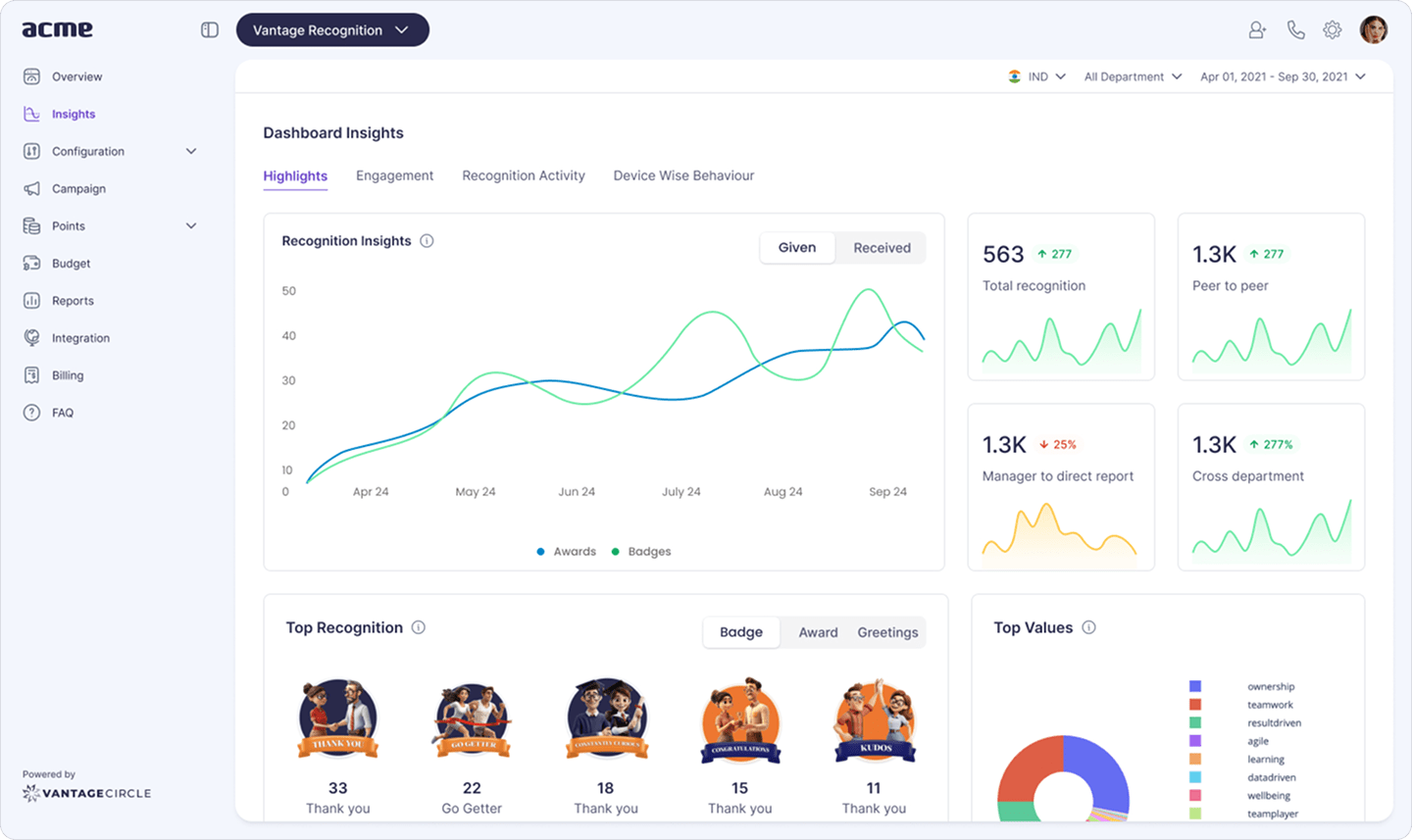
That's where a platform like Vantage Recognition makes a difference. By enabling recognition in an open social feed, employees can publicly appreciate anyone—including their managers—for specific behaviors that reflect company values.
Over time, HR leaders gain visibility into recognition patterns across the organization, making it easier to see not only who gives recognition, but whether the people leading teams are receiving meaningful appreciation as well.
Conclusion
Good managers rarely hear what actually made a difference. Not because people don't notice, but because upward feedback feels riskier than it should, and most workplaces have no natural moment built in for it.
The fix isn't a bigger compliment. It's a smaller, more specific one: naming the behavior, the moment, and the effect it had, whether that's in a 1:1, a review, a team channel, or a quick note after a hard week. Use the examples above as a starting point, swap in your own detail, and send it. Do that consistently, and appreciation stops depending on the annual survey to surface it.
FAQs
1. What are Some Examples of Positive Feedback for Managers?
Good feedback highlights a specific behavior and its impact. For example: "Thank you for giving me the autonomy to lead the project. Your trust helped me build confidence and deliver better results."
2. What are the 7 Qualities of a Good Manager?
Great managers communicate clearly, build trust, recognize good work, provide constructive feedback, empower their teams, make fair decisions, and support employee growth. These qualities create stronger engagement, collaboration, and performance over time.
3. Why Is It Important to Give Positive Feedback to Managers?
Positive feedback helps managers understand which behaviors build trust, improve team performance, and support employee growth. It also reinforces effective leadership and encourages managers to continue the practices that make a meaningful difference.

Shikha Gogoi is a Content Marketing Specialist focused on SEO-driven content around employee engagement, recognition, and workplace culture, helping build people-first workplaces.
Connect with Shikha on LinkedIn.