
A recognition program does not fail because someone made a bad decision when building it. It fails because it was built for a workforce that no longer exists. Hybrid work, peer-driven culture, multi-region teams, and the integration demands of modern HRIS platforms have shifted the goalposts entirely. The program your organization launched five years ago was probably the right answer to a different question. This guide gives HR leaders a binary decision framework: patch the existing employee recognition program, or redesign it from the ground up. Five redesign triggers, a 10-question diagnostic audit, the AIRe Framework (Appreciation, Incentivization, Reinforcement, eMotional Connect), and a 4-phase migration playbook, so you stop spending budget on incremental fixes that will not move engagement.
Redesign your employee recognition program when:
- Recognition coverage falls below 50% over a 90-day rolling window
- Manager-driven recognition exceeds 80% (peer-to-peer is absent)
- eNPS has not moved across two consecutive measurement cycles
- Your platform predates 2020 or lacks SSO/HRIS integration
- Program owners cannot name their coverage or frequency benchmark targets
If three or more of these triggers sound familiar, a patch will not move the needle. See how Vantage Recognition is built for peer-to-peer coverage, values-tagged recognition, and HRIS-ready scale.
Explore Vantage Recognition →Patch vs Redesign: Two Different Problems, Two Different Solutions
Patching and redesigning are not on a continuum. They address structurally different failure modes, and conflating them is how organizations spend 18 months on incremental fixes before arriving at the same broken program.
The scale of the problem is worth sitting with. In the largest recognition study ever run in India, a joint study by Great Place to Work® and Vantage Circle drawing on 5.7 million employees across 2,000 organizations, only 55% of employees said they feel truly recognized. That means nearly half, including top performers, may be quietly disengaged. As the study put it bluntly: this isn't a perception issue, it's a design issue. That is exactly why the patch-or-redesign distinction matters.
Patching works when the program architecture is sound but something operational is underperforming: managers are not using it, the reward catalog is stale, or the program has never been properly promoted. These are fixable without touching the foundation.
Redesign is required when the architecture itself is the constraint. When the program's structural design prevents it from doing what recognition is supposed to do: create visibility, reinforce values, extend reach beyond a single layer of management.
| Problem | Symptom | Fix Type |
|---|---|---|
| Managers not using the platform | Low nomination volume from specific teams | Patch: manager training + nudge cadence |
| Reward catalog disengagement | Redemption rates below 40% | Patch: catalog refresh + point rebalance |
| Recognition invisible to the broader team | No social feed or public acknowledgment | Redesign: add social recognition layer |
| Coverage structurally capped at manager bandwidth | Coverage plateau at 30–40% regardless of training | Redesign: add peer-to-peer as core mechanic |
| Program detached from company values | Recognition cites personal traits, not behaviors | Redesign: rebuild values-tag taxonomy |
| Platform predating modern identity standards | No SSO, no HRIS sync, manual employee uploads | Redesign: platform migration required |
The diagnostic question is not "what is wrong?" It is "what kind of wrong is this?" The audit below answers that.
The 10-Question Diagnostic Audit: Is Your Employee Recognition Program Actually Broken?
Run this 10-question audit. Tap Yes or No on each statement and your score and verdict update instantly below. Score one point for each "yes." A score of 7 or more points indicates redesign. A score of 4 to 6 indicates targeted patches are the right response. A score of 3 or below means the program is architecturally sound but needs better promotion, not structural change.
Is Your Recognition Program Actually Broken?
Answer all 10. Your score and verdict appear instantly, no scrolling required.
1. Over the past 90 days, fewer than 50% of employees have received any form of recognition.
2. Recognition is concentrated in 20% or fewer of your managers, meaning most recognition flows through a small group.
3. Entire departments or regions go unrecognized for 60+ day stretches with no structural explanation.
4. The average employee receives fewer than 2 recognition moments per month across all channels.
5. There is no automated cadence. Birthdays, work anniversaries, and milestone triggers require manual action.
6. Recognition rarely references a specific company value or desired behavior. It is generic praise.
7. Your eNPS score has not improved by 5 or more points across the past two measurement cycles despite active recognition activity.
8. Your current platform was implemented before 2020, or it lacks single sign-on (SSO) and HRIS synchronization.
9. Employees cannot give or receive recognition from a mobile device without friction.
10. You cannot pull a coverage report by department, manager, or region without manual data extraction.
0 of 10 answered
Scored 7 or higher? That is a redesign signal, not a patch. See what a modern recognition architecture looks like in practice, with peer-to-peer, social recognition, and built-in coverage analytics.
See Vantage Recognition in action →The 5 Triggers That Justify a Full Redesign (Not Just a Patch)
Trigger 1: Recognition Coverage Below 50%
When fewer than half of employees have received recognition in a 90-day window, the architecture is the problem, not the promotion.
I have seen organizations run recognition campaigns for six straight months and still not break through a 40% coverage ceiling. The campaigns were well-designed. The messaging was clear. What they were missing was a structural mechanism to reach employees whose managers were either disengaged or simply too stretched to nominate consistently.
A coverage ceiling is almost always a manager-bandwidth problem wearing a participation-rate costume. Managers have finite attention. You cannot train your way past a structural constraint. What breaks the ceiling is peer-to-peer recognition: horizontal capacity that does not depend on managerial headspace. The Great Place to Work × Vantage Circle data backs this up. Recognition still rises with rank, but the greatest need sits at the base of the pyramid. Frontline, non-managerial, Gen Z, and women employees are the least likely to feel seen. A manager-only model structurally underserves exactly the people who need recognition most.
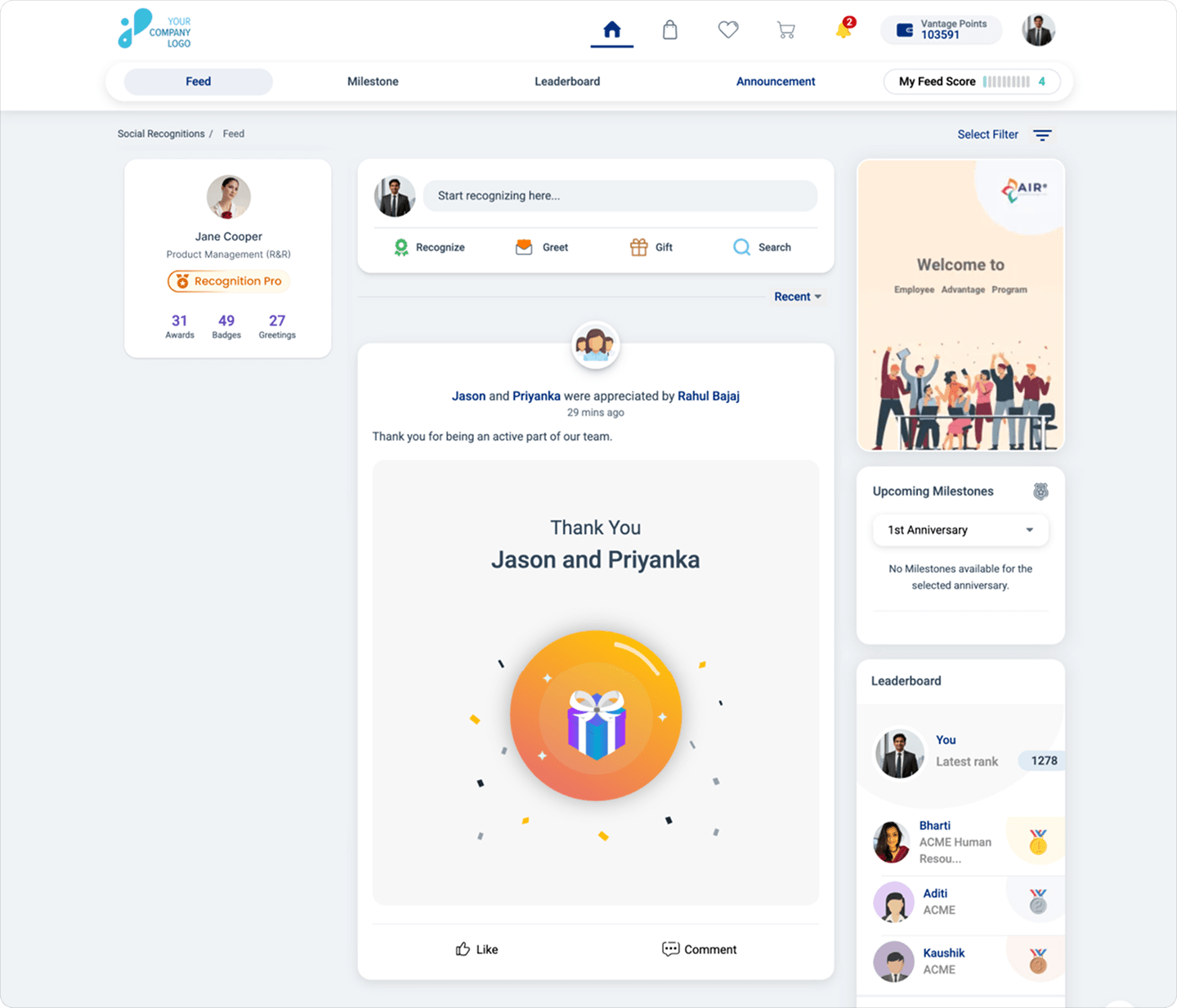
A redesign at this threshold must include peer-to-peer as a core mechanic, not an optional add-on. It also needs a social recognition feed (Vantage Rewards) that makes recognition visible to the full team, not just the recipient and their immediate manager. Visibility is what pulls peer participation. Without it, peer-to-peer modules sit unused.
 (Source: Vantage Recognition Platform)
Benchmark target for post-redesign: 70% coverage within 90 days of relaunch. Anything below 60% at the 90-day mark warrants a coverage-mechanics review. See recognition program benchmarks for full industry coverage data.
Trigger 2: Manager-Driven Recognition Above 80%
Programs where managers drive 80% or more of all recognitions have hit a structural ceiling that no amount of manager training will break.
This is not a criticism of managers. It is a statement about architecture. Manager bandwidth is finite, and recognition competes with every other management task. When peer-to-peer does not exist, the entire recognition load sits on a layer of the organization that is already overextended.
The redesign fix here is not adding more manager-facing features. It is unlocking the lateral layer. Peer-to-peer recognition is the only recognition mechanic that scales without depending on a single reporting relationship. Vantage Circle's *State of Recognition & Rewards 2025* study found that the highest-effectiveness programs use up to 2x more recognition than their peers, and they get there precisely by recognizing more people, more often, across more directions than the manager-to-report line.
One thing worth flagging: the goal after redesign is not zero manager-driven recognition. Manager recognition still carries the highest perceived weight for most employees. The target is a healthy split: roughly 60% peer-driven, 40% manager-driven. A program where 100% of recognition flows from peers signals a different problem: managers have fully disengaged. The distribution matters as much as the total volume.
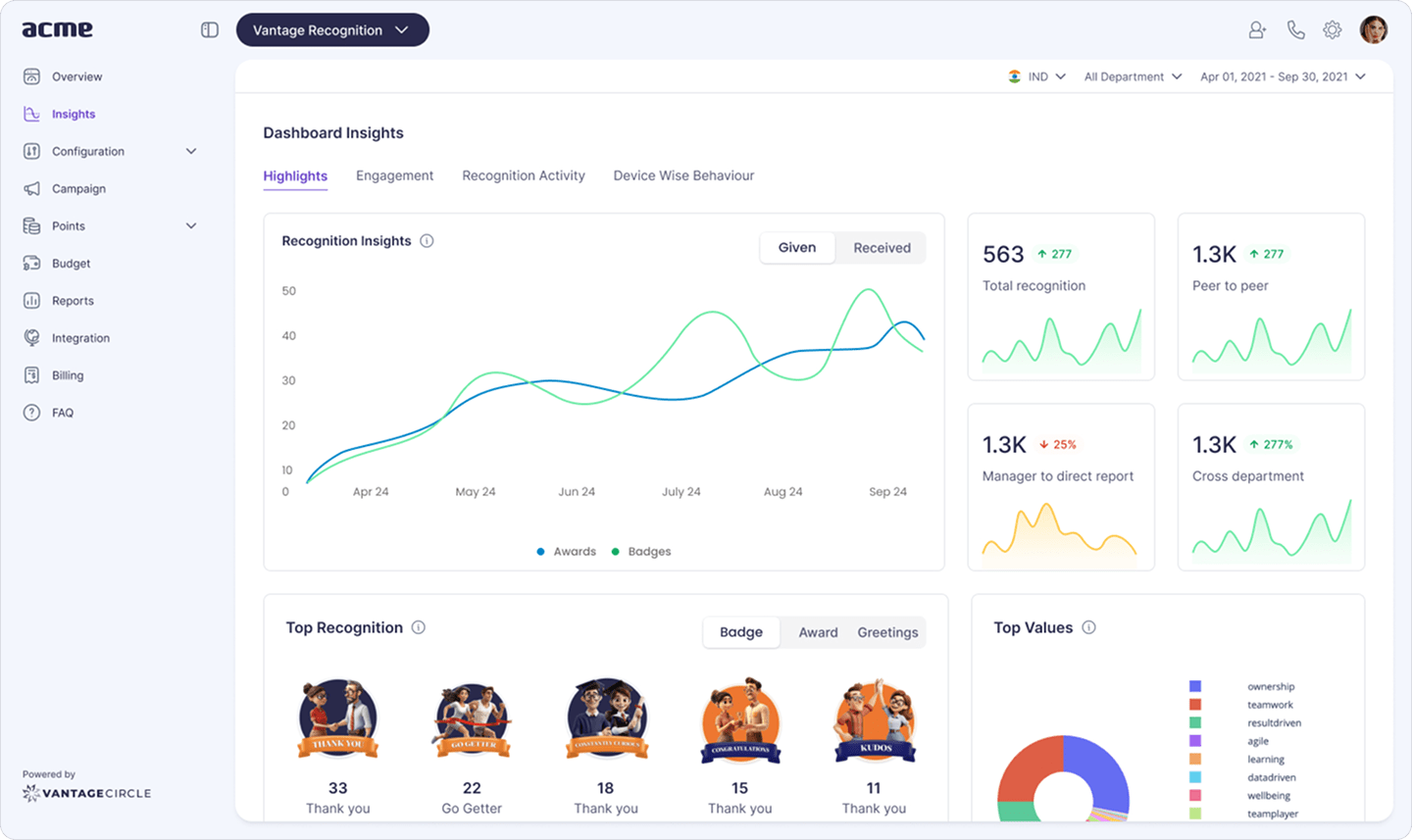
Vantage Rewards combines manager and peer flows in a unified social recognition feed, and surfaces the split in its insights dashboard, so you can see peer-to-peer, manager-to-report, and cross-department recognition as distinct streams rather than one undifferentiated total.
 (Source: Vantage Recognition Platform)
Trigger 3: eNPS Flat Across 2 Consecutive Cycles
Recognition activity without eNPS movement is the most misread signal in the field.
HR leaders see the recognition numbers going up (nominations submitted, rewards redeemed, platform logins increasing) and conclude the program is working. Then the engagement survey comes back flat, and nobody can explain it.
The diagnosis is almost always "thanks theater." Recognition is happening, but it is detached from anything the employee actually values. Praise for showing up on time. Birthday shoutouts. Generic "great job this quarter." These create noise, not signal. The Great Place to Work × Vantage Circle study quantified just how fragile the emotional payoff is. When employees feel all four recognition outcomes (appreciated, accepted, validated, and accomplished), 98% report strong workplace sentiment and 97% intend to stay. But with even one of those signals missing, the impact drops by more than half. Recognition that lands emotionally moves engagement; recognition that doesn't is activity without outcome.
The fix is values alignment. When every recognition moment is tagged to a specific company value or a named behavior the organization is trying to reinforce, the program becomes a behavioral signal, not just an appreciation mechanism. Employees start to understand what "good" looks like here. That understanding is what moves engagement scores.
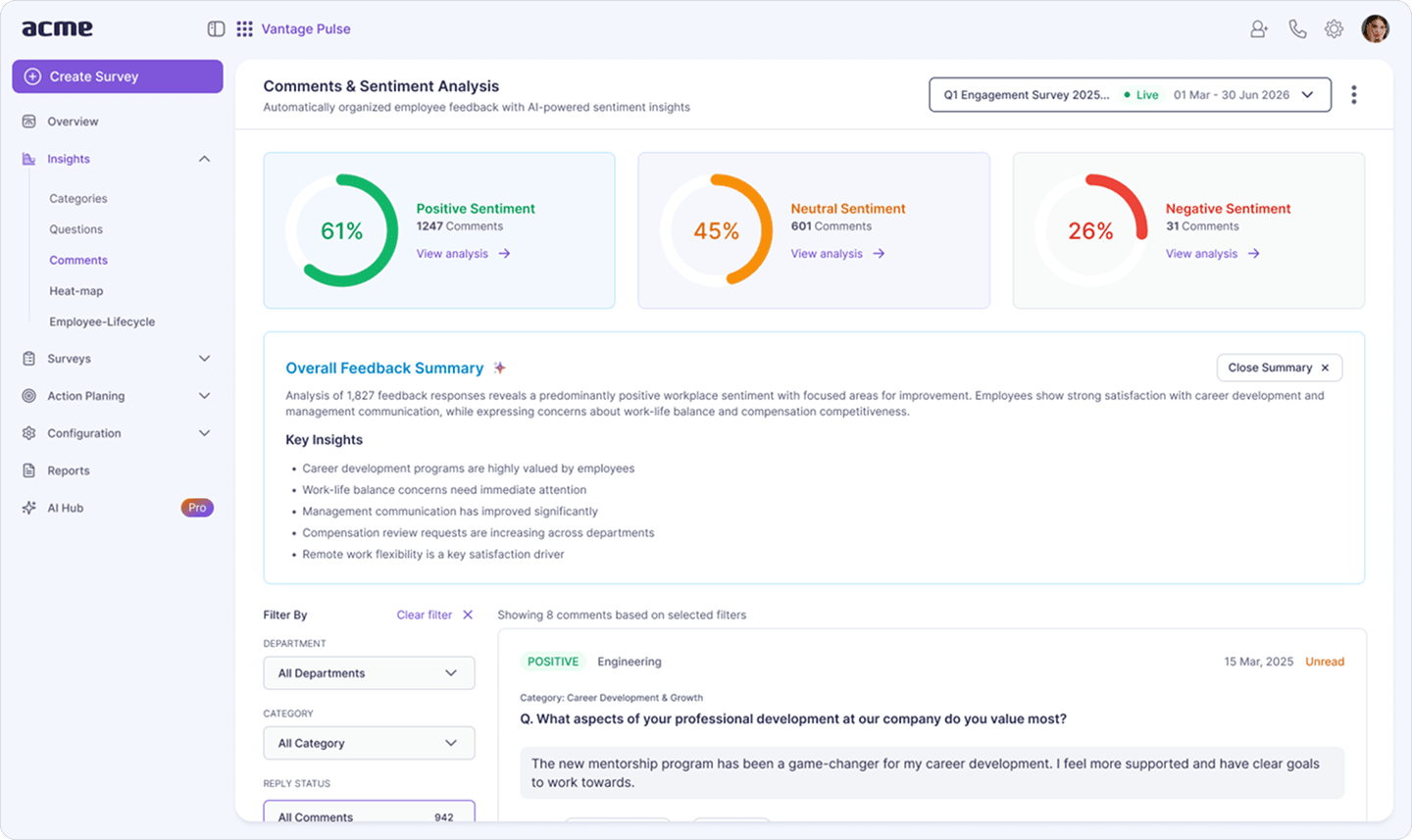
This is also where sentiment analysis earns its place. Cross-referencing recognition data with Vantage Pulse sentiment scores surfaces the gap: teams where recognition is high but sentiment is low point directly to misaligned recognition patterns. The fix is architectural. Learn more about Vantage Pulse for recognition-engagement cross-referencing.
 (Source: Vantage Pulse)
Trigger 4: Platform Predates 2020 or Lacks SSO/HRIS Integration
Pre-2020 recognition platforms predate modern identity standards, mobile-first UX expectations, and AI-assisted nudging. They were built for a workforce that was primarily office-based, managed through desktop tools, and operating in a single region.
The operational signs are diagnostic in themselves: manual employee uploads when someone joins or leaves, no Slack or Teams integration, no single sign-on, a single-currency reward structure that breaks across geographies, and no API access to pipe recognition data into your HRIS.
A platform limitation at this level is not a feature gap. It is a structural rate-limiter. You cannot build a peer-to-peer mechanic on top of a system that cannot authenticate users automatically. You cannot run values-tagged recognition if the platform has no values taxonomy. You cannot measure coverage if the platform has no reporting layer. And for distributed and frontline teams, a desktop-only tool quietly excludes the very employees who already feel least seen. Recognition that requires a desktop login is recognition that will not happen in the field.
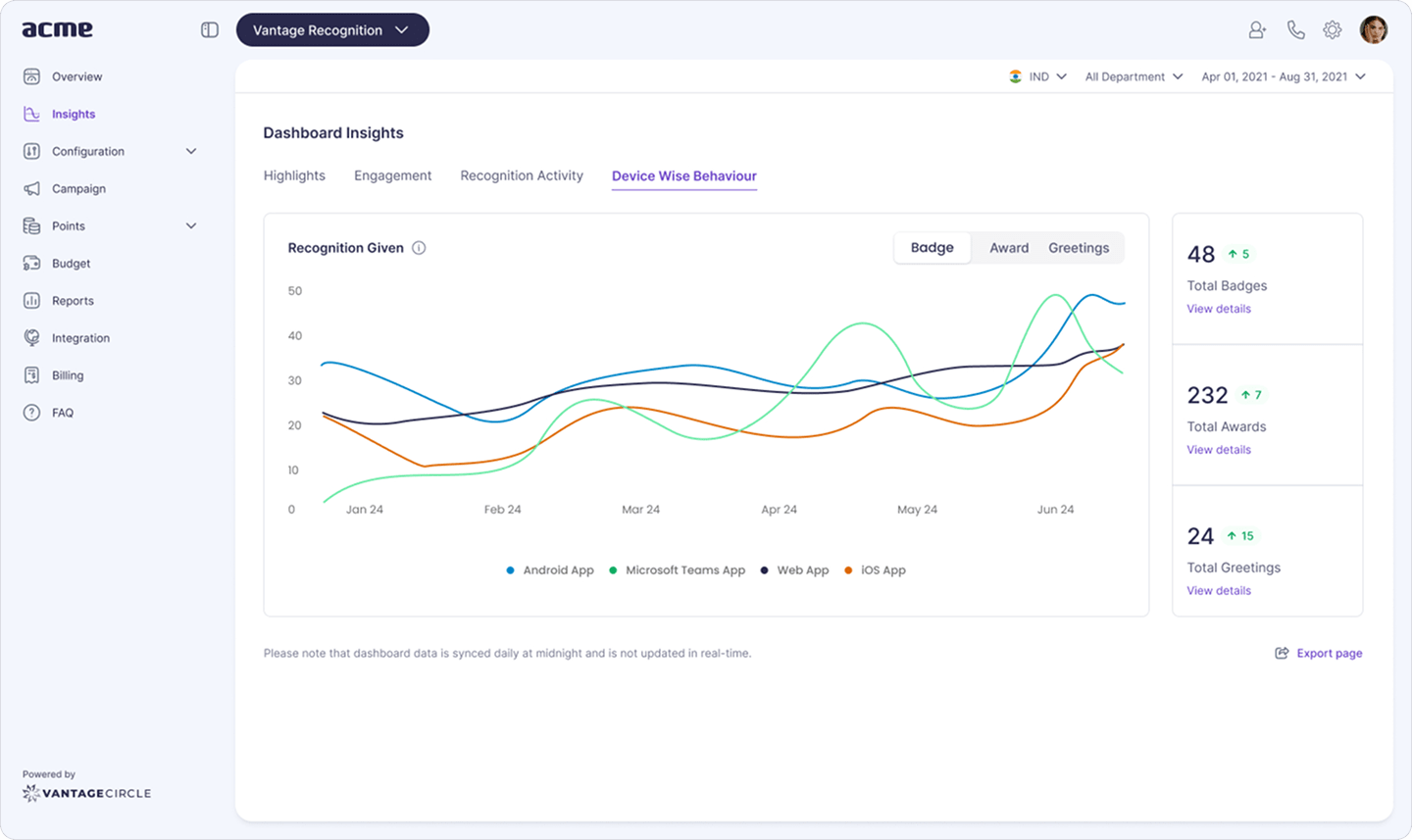
Vantage Rewards integrates with Workday, SAP, and Oracle HCM, supports SSO via SAML 2.0, and is mobile-first by default, with recognition flowing across Android, iOS, web, and Microsoft Teams. For a 2026 redesign, those are baseline requirements, not differentiators.
 (Source: Vantage Recognition Platform)
Trigger 5: Program Owners Cannot Name Their Benchmark Targets
This one is uncomfortable to say out loud, but it is the clearest redesign signal there is.
If the person responsible for the recognition program cannot answer "what is our coverage percentage target?" or "what frequency of recognition are we aiming for per employee per month?" without checking a spreadsheet they have not opened in three months, the program is running without a measurement spine.
A patch does not fix this. You cannot bolt a measurement framework onto a program that was not designed with measurement in mind. The targets, the benchmarks, and the feedback loops have to be built into the redesign architecture from the start. Vantage Circle's State of Recognition & Rewards 2025 study found that the highest-effectiveness programs are 2 to 3 times more likely to codify their recognition criteria and communicate them clearly than lower-performing programs. Measurement discipline is not a nice-to-have; it is the dividing line between programs that work and programs that don't.
What good looks like: the program owner can state, without prompting, that their 90-day coverage target is 70%, their frequency target is 2 recognition moments per employee per month, and their manager-to-peer ratio target is 40/60. Those numbers are tracked weekly. Deviations trigger a review. Reference recognition program benchmarks for the full benchmark set.
The AIRe Framework: A Redesign Lens for Employee Recognition
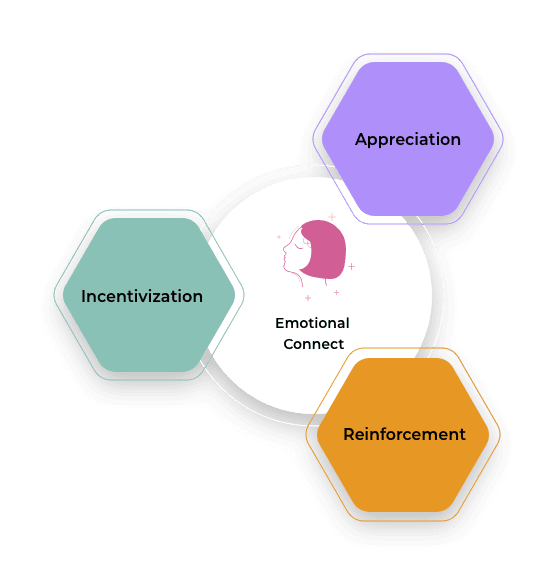
The AIRe Framework (Appreciation, Incentivization, Reinforcement, eMotional Connect) is Vantage Circle's proprietary model for evaluating a recognition program. It scores a program on four themes, and each theme has two dimensions, so you can see exactly where the program is strong and where it falls short. Use it as the specification for the redesigned program, not as an overlay on the old one.
Most legacy programs lean heavily on Appreciation and neglect the other three themes. In Vantage Circle's research, Incentivization is the most under-leveraged of the four, with more than half of programs scoring low on it. They make people feel good but never give them a clear reason to repeat the behavior.
Appreciation — the soul of recognition
Appreciation is the feeling of being valued. It is about acknowledging a person's contribution, not just rewarding a result. It has two dimensions: Coverage (does recognition reach every employee, not only top performers?) and Frequency (does it happen often enough to matter?). The redesign question is simple: does recognition reach everyone, often enough to register?
Incentivization — the muscle of recognition
Incentivization is what makes recognition worth earning. Its two dimensions are Clarity (do employees know exactly what behavior or achievement earns recognition?) and Impetus (is the recognition valued enough that people want to earn it?). Unlike a once-a-year bonus, recognition can happen often and carries social value on top of any reward. This is the theme most legacy programs miss.
Reinforcement — the brain of recognition
Reinforcement ties recognition to the behaviors that matter. Its two dimensions are Specificity (is there a clear set of behaviors and results the program recognizes?) and Alignment (are those the behaviors that actually move the business forward?). When this theme is weak, the program hands out praise without direction.
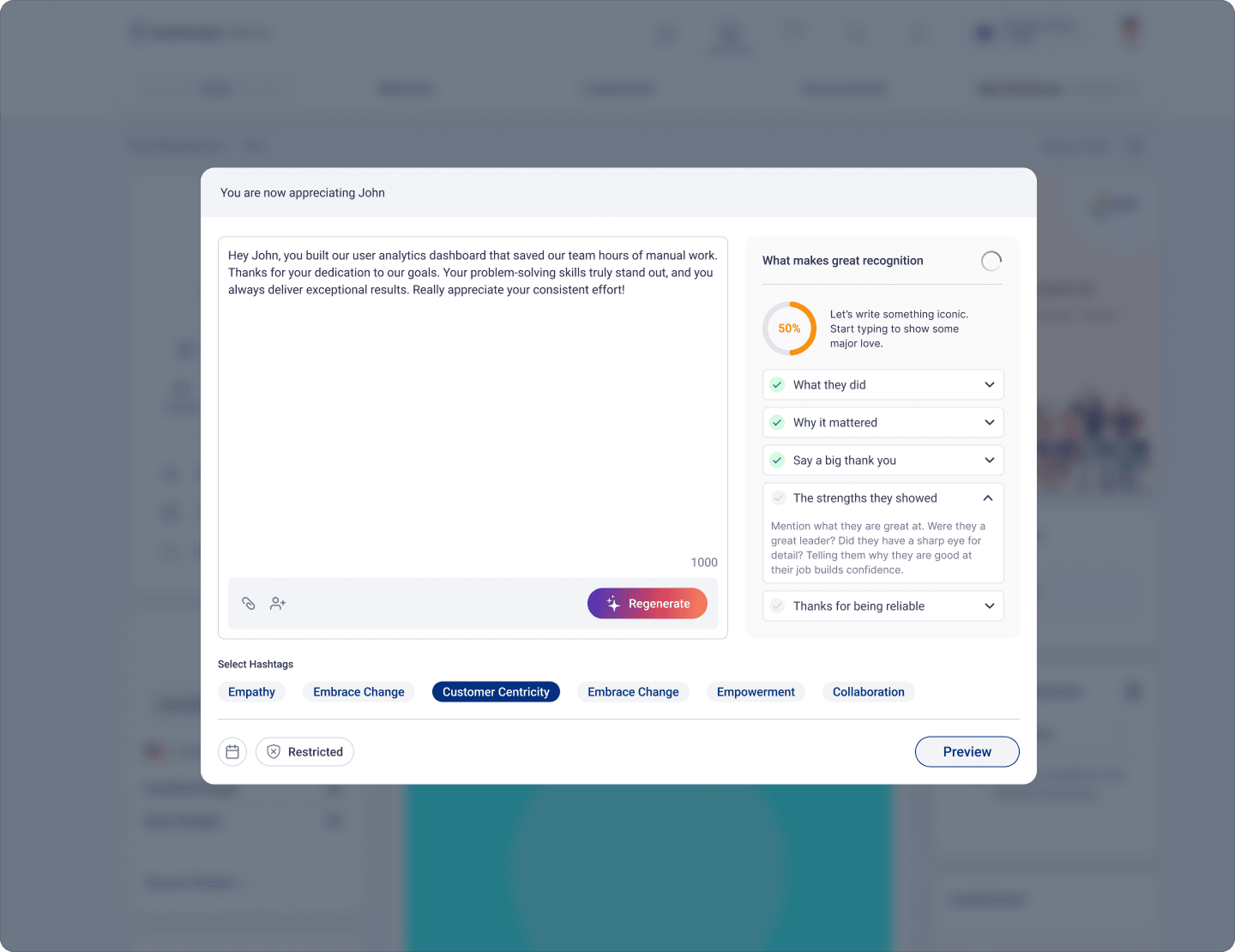
The data is unusually consistent on this point. In Vantage Circle's Aon Consulting-authored executive summary of the *Annual Rewards & Recognition Report (India)*, 67% of organizations that targeted behavioral reinforcement through their R&R programs reported high to very high effectiveness, versus fewer than 50% of those that targeted loyalty and retention directly. Yet only 38% of organizations currently target the behaviors their business leaders actually prioritize, leaving a wide gap between program design and strategic intent. Harvard Business Review's research on motivation (Amabile and Kramer's work on the "power of small wins") points the same way: recognition that names a specific behavior or progress milestone is what sustains motivation, while generic praise fades. Values-tagged recognition in Vantage Rewards puts the Reinforcement theme into practice at scale. The recognition composer prompts the giver to attach a company value and to be specific rather than vague.
 (Source: Vantage Recognition Platform)
eMotional Connect — the heart of recognition
The "e" in AIRe is written as a superscript, like an exponent, because eMotional Connect multiplies the impact of the other three themes rather than just adding to them. It is about how recognition is given, not just what is given. Its two dimensions are Personalisation (do the message and the reward fit the individual?) and Delivery (is recognition given at the right moment, in the right way, with genuine warmth?). Here the "how" matters more than the "what." A program that routes everything through one manager, with no peer recognition and no choice of reward, is weakest on this theme, and that is exactly what a redesign should fix.
 (Source: Vantage Circle AIRe Framework)
The AIRe assessment maps your current program against all four themes and surfaces where the design gaps sit. Take the AIRe assessment to score your program before redesigning.
The 4-Phase Recognition Program Redesign Playbook
A recognition redesign that skips the migration planning tends to produce two programs running in parallel for 12 months, confusion about which one is "real," and eventual abandonment of the new one because the legacy program's advocates never let go.
The 4-phase playbook below runs 24 weeks. It is not a sprint. Organizations that try to compress it consistently report the same failure: the program goes live before manager adoption is in place, early recognition volume is low, and the narrative becomes "the new system is worse."
Phase 1: Diagnose (Weeks 1–3)
Run the 10-question audit. Score the AIRe gap by mapping your current program against all four framework dimensions. Define redesign scope: are you replacing the platform, the framework, the values taxonomy, or all three? Document what stays. Long service awards (R&R) and tenure milestones are often the one element worth carrying over; they have institutional memory attached to them that a new program cannot replicate quickly.
Assign a redesign owner with decision authority and a named executive sponsor. A redesign without executive visibility does not survive the migration phase.
Phase 2: Design (Weeks 4–8)
Rebuild the recognition framework first, before touching the platform. Define: what behaviors the program will reinforce, how values will be tagged, what the peer-to-peer participation model looks like, and what the manager-to-peer target ratio will be.
Then select the platform. The platform should serve the framework, not dictate it. Evaluate vendors against the 8-criterion rubric see best employee engagement software for the full rubric with coverage architecture and HRIS integration as non-negotiable requirements.
Write the values-tag taxonomy. This is the step most redesigns skip, and it is the one that determines whether recognition becomes behavioral signal or generic noise.
Phase 3: Migrate (Weeks 9–16)
Run the old and new programs on a dual-track for 30 days. This is not indecision; it is risk management. The dual-track period lets early adopters build momentum on the new platform while legacy program advocates see it working before the old system is fully sunsetted.
Migrate employee identities and HRIS data before running any recognition on the new platform. SSO and HRIS integration (Vantage Rewards supports Workday, SAP, Oracle HCM) should be the first integration confirmed, not the last. Data migration failures in this phase are the most common cause of redesign delays.
Phase 4: Relaunch (Weeks 17–24)
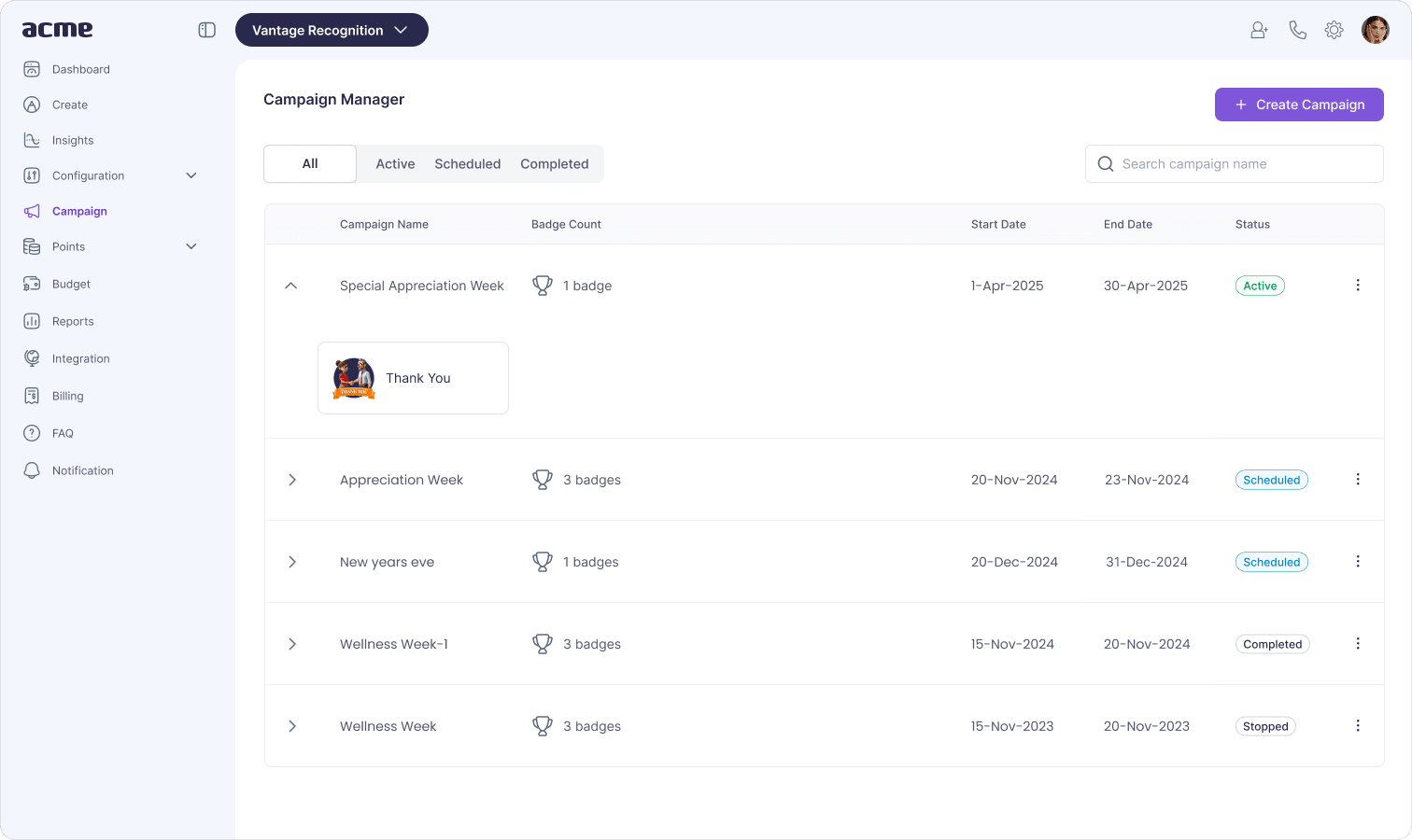
The relaunch is not a platform go-live announcement. It is a behavior change campaign. Time-bound campaigns using Campaign Management in Vantage Rewards are the most effective relaunch mechanism: a 30-day values-tagged recognition sprint, with visible participation metrics shared weekly, drives the behavioral pattern that sustains the program past the novelty phase.
 (Source: Vantage Recognition Platform)
Executive sponsorship during relaunch is not optional. The CEO or CHRO being the first person to give a public recognition moment on the new platform sends a signal that no internal communications deck can replicate.
Planning a relaunch? Vantage Recognition gives you Campaign Management, a unified social recognition feed, and weekly participation analytics in one platform, so the behavior change sticks past the novelty phase.
Book a Vantage Recognition walkthrough →The Cost of Not Redesigning (When Patching Keeps Failing)
The budget argument for redesign is usually made wrong. Leaders frame it as "the redesign costs X." The honest frame is "the patching cycle has already cost Y, and it will cost Y again next year."
Here is what the numbers look like in practice.
Unrecognized employees are 2x more likely to quit within 12 months (Gallup, 2024). And the effect runs the other way too: Bersin by Deloitte found that organizations with a recognition-rich culture have a 31% lower voluntary turnover rate than those without one. At an average US replacement cost of $15,000 to $25,000 per non-executive hire (SHRM, 2024), the math is not abstract.
Take a 500-employee organization where recognition coverage sits at 40%, meaning 300 employees are effectively unrecognized. Even at a conservative 5% annual churn differential between recognized and unrecognized employees, that is 15 additional departures per year attributable to recognition failure. At $20,000 average replacement cost, that is $300,000 in avoidable annual churn cost.
The patch budget for the same program: manager training, a catalog refresh, a new campaign, maybe a consultant engagement. Call it $40,000 to $60,000 per year. Run that for three years and you have spent $120,000 to $180,000 on patches while absorbing $900,000 in avoidable churn cost.
The redesign is not the expensive option. It is the delayed option that organizations keep choosing over the more expensive status quo.
I would push back slightly on the precision of the replacement cost figures. The $15K to $25K per hire range has become the standard citation, but the actual number varies significantly by role seniority and industry. The directional argument holds regardless: the churn cost of a failing recognition program almost always exceeds the redesign cost within 18 months. See employee recognition statistics for the full data breakdown.
Vendor Switch as Part of the Redesign: When to Change Platforms
Roughly 60% of recognition redesigns involve a platform switch because the legacy platform was the rate-limiter on what the program could do. The platform was not the only problem, but it made every other problem harder to fix.
Five signals that the platform switch is necessary, not optional:
- No peer-to-peer architecture. If the platform was built around manager-to-employee flows and cannot support true peer-to-peer recognition at scale, there is no path to breaking the coverage ceiling without replacing it.
- Single-region currency or catalog. Multi-region organizations running recognition through a platform that cannot handle multi-currency rewards or region-specific catalogs are creating a recognition equity gap between geographies.
- No analytics layer. If you cannot pull coverage by department, frequency by manager, or redemption by reward type without a data export, the program is flying blind. A redesign built on an unanalyzable platform will have no feedback loop.
- No HRIS or SSO integration. Manual employee provisioning is not a minor inconvenience. It creates a lag between someone joining the organization and being able to receive recognition, and it guarantees data drift as employees move roles or leave.
- No mobile-first UX. For distributed, hybrid, and frontline workforces, recognition that requires a desktop login is recognition that will not happen in the field.
When evaluating replacement platforms, use an 8-criterion rubric weighted toward integration architecture and peer-to-peer capability. See best employee engagement software for the full vendor evaluation framework.
How to Measure a Redesigned Recognition Program: 90-Day, 6-Month, and 12-Month Gates
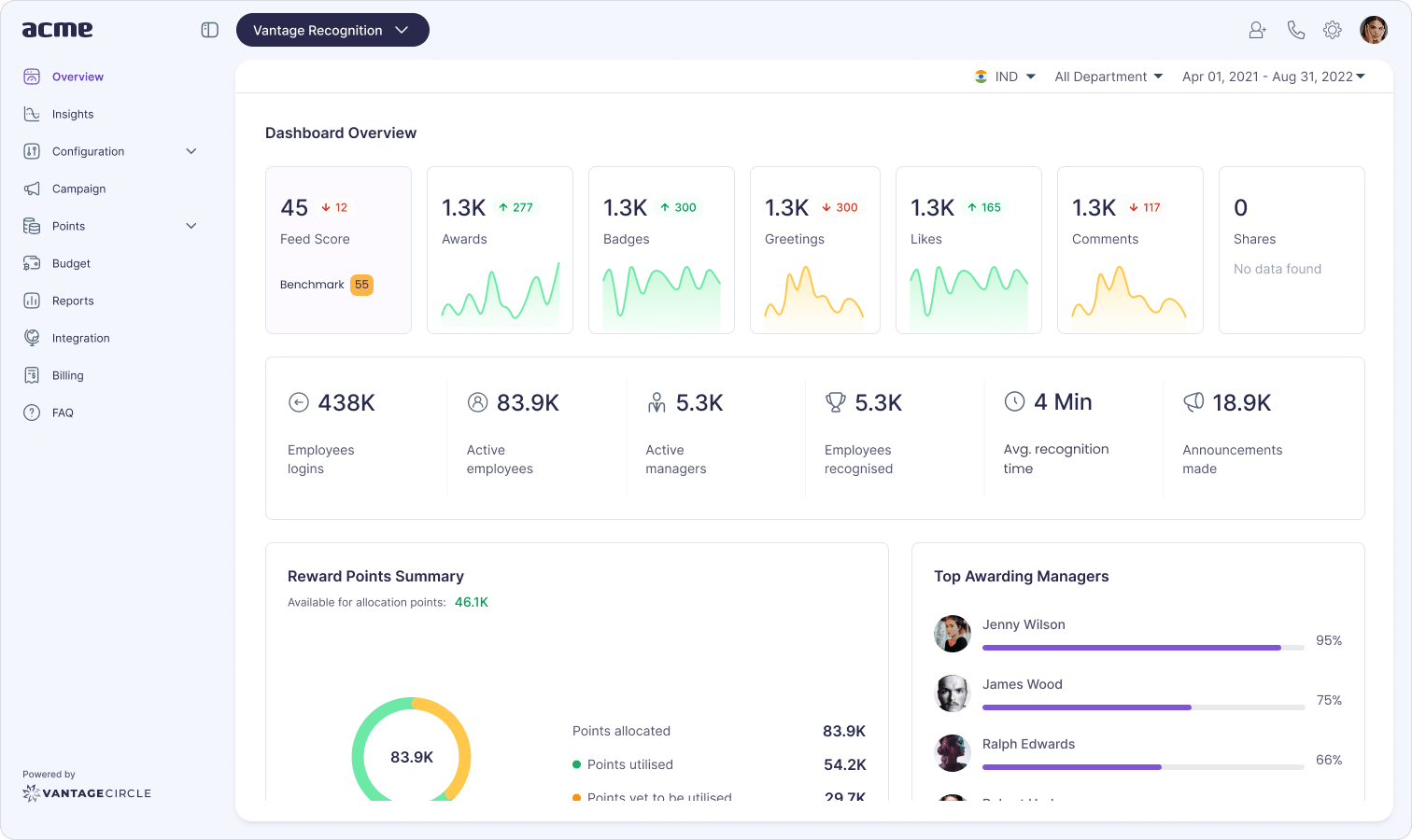
Measurement for a redesigned program needs phase-specific gates, not a single annual engagement survey. The 90-day gate tells you whether the relaunch mechanics worked. The 6-month gate tells you whether the behavior change is sticking. The 12-month gate tells you whether the program is producing engagement outcomes.
90-Day Gate:
- Coverage percentage up 20 percentage points from pre-redesign baseline
- Recognition frequency at 2 or more moments per employee per month across all channels
- Peer-to-peer recognition accounting for at least 30% of total volume (from a standing start)
6-Month Gate:
- eNPS lift of 5 or more points compared to the pre-redesign baseline measurement
- Manager-driven recognition concentration below 60% (peer-to-peer share above 40%)
- Values-tagged recognition at 70% or more of all recognition moments
12-Month Gate:
- Correlation coefficient of 0.4 or higher between coverage percentage and eNPS score, measured by department
- Recognition program cited in exit interview data as a retention factor (qualitative, but trackable)
- Program owner can state all benchmark targets without reference to a report
 (Source: Vantage Recognition Platform)
At the 90-day gate, the program is still in its behavioral formation period. Do not make redesign decisions at 90 days unless coverage has not moved at all. At 6 months, you have enough signal to distinguish "this needs adjustment" from "this needs another overhaul." At 12 months, the program should be producing measurable correlation between recognition activity and engagement outcomes. If it is not, the values-tag taxonomy and peer-to-peer architecture are where to look first. See recognition program benchmarks for industry-standard targets at each gate.
The Audit Decides: Redesign When the Architecture Is Broken, Patch When the Promotion Is
The budget cycle is the wrong frame for this decision. So is the annual engagement survey. The 10-question audit is the right frame because it answers the actual question: is this program underperforming because of how it was promoted, or because of how it was built?
Most programs that are struggling are struggling for architectural reasons. They were built before peer-to-peer recognition was a standard mechanic, before HRIS integration was a baseline expectation, before values alignment was understood as the mechanism that converts recognition activity into engagement outcomes.
Patching them is not a failure of effort. It is a failure of diagnosis. The organizations that redesign when the audit says redesign, and patch when the audit says patch, spend less money, move their engagement numbers faster, and stop losing people for a reason that is entirely preventable.
The AIRe Framework gives you the redesign specification. The 4-phase playbook gives you the migration structure. The 10-question audit tells you which one to run.
Take the AIRe assessment to score your current program · Book a Vantage Rewards redesign consultation
Frequently Asked Questions
When should you redesign an employee recognition program?
Redesign when coverage falls below 50% over 90 days, manager-driven recognition exceeds 80%, eNPS has not moved across two consecutive cycles, the platform predates 2020, or program owners cannot name their benchmark targets. If three or more triggers are present simultaneously, a patch will not fix it.
How do you know if your recognition program is failing?
Coverage stagnation below 50%, flat eNPS despite active recognition activity, and recognition concentrated in a small group of managers are the clearest signals. Run the 10-question diagnostic audit above. A score of 7 or more yes answers confirms a structural failure.
What is the difference between fixing and redesigning a recognition program?
Patching addresses operational problems: a stale catalog, low manager participation, poor promotion. Redesigning addresses architectural problems: no peer-to-peer mechanic, no HRIS integration, no values-alignment layer. Patching a structural problem produces temporary improvement followed by regression.
How long does a recognition program redesign take?
A full redesign takes 24 weeks across 4 phases: 3 weeks to diagnose, 5 weeks to design the framework and select the platform, 8 weeks to migrate, and 8 weeks to relaunch and stabilize behavior. Compressing this timeline is the most common cause of failed relaunches.
What is the AIRe Framework?
The AIRe Framework (Appreciation, Incentivization, Reinforcement, eMotional Connect) is Vantage Circle's proprietary model for evaluating recognition programs across four themes, each scored on two dimensions. Legacy programs typically score well on Appreciation and poorly on Incentivization and eMotional Connect. Take the AIRe assessment to score your current program.
How do you measure the success of a redesigned recognition program?
At 90 days: coverage up 20 percentage points, frequency at 2 or more moments per employee per month. At 6 months: eNPS lift of 5 or more points, peer-to-peer above 40% of total volume. At 12 months: a correlation of 0.4 or higher between coverage and eNPS by department.
What is an example of a redesigned recognition program?
A professional services firm at 38% coverage redesigned to add peer-to-peer recognition and values-tagged recognition using the AIRe Framework. At 90 days, coverage reached 64%. At 6 months, eNPS moved 8 points. The architectural shift, not the new platform, drove the result.
How much does a recognition program redesign cost?
Platform migrations for mid-market organizations typically run $30,000 to $80,000 in combined platform, implementation, and internal costs over 24 weeks. Framework-only redesigns without a platform switch cost significantly less. In both cases, the investment is typically recovered within 12 to 18 months through reduced churn cost.

He has worked in the human resources environment and has elevated recognition and rewards through his insightful and detailed writing. He aims to enhance the practice of Recognition in the workplace with new ideas and innovation that will help shape the work culture. For any related queries, contact editor@vantagecircle.com