
Trust in the workplace is the confidence employees have that their leaders and coworkers will act honestly, do what they say, and treat people fairly. Where it exists, people share ideas, admit mistakes early, and work together without second-guessing. Where it is missing, they hold back and teams slow down.
This guide covers what trust looks like at work, why it matters, 10 practical ways to build it, and why trust breaks down.
What does trust in the workplace look like?
Trust rests on the assumption that people will behave in a dependable, honest, and competent way and keep their promises. It is the cornerstone of positive relationships and effective teamwork, where team members feel safe, respected, and supported.
Trust between managers and employees
Employees judge a manager by small, repeated signals: whether they keep promises, share context, and give credit. Managers, in turn, extend trust by delegating real decisions and not micromanaging the results.
Trust among peers
Peer trust grows through reliability. Colleagues who deliver what they commit to, share information freely, and speak up when something goes wrong become people others want to work with.
When are you trustworthy in your workplace?
Trust depends on how others see your actions, words, and consistency, whatever your intentions are. Saying you are trustworthy counts for little until reliability and honesty show up in what you do.
For example, suppose you, as a leader, frequently promise things to your team but fail to deliver on those promises. In that case, you will not be considered trustworthy. On the other hand, a leader who regularly exhibits honesty, openness, and reliability and maintains their commitments will be seen as reliable by their followers.
Why is trust in the workplace important?

Trust pays off in engagement. Gallup reports that just 20% of U.S. employees strongly agree they trust the leadership of their organization, and those who do are 3.7 times as likely to be engaged at work.
- Collaborative environment: When team members trust each other, communication flows freely. This openness fosters idea-sharing and problem-solving, creating a dynamic environment where creativity and innovation thrive.
- Leadership effectiveness: Trusted leaders can delegate tasks confidently, knowing their team will perform well. This trust allows leaders to focus on strategic goals and long-term planning.
Read our ultimate guide on: Leadership: Fundamentals, Evolution, Challenges & Future
- Employee morale and engagement: Trust and morale feed each other, much like the chicken-or-egg dilemma. Trust sets the foundation for solid engagement, while high morale can enhance trust.
- Employee satisfaction and retention: Employees who feel trusted report higher job satisfaction and are less likely to leave, which reduces turnover and protects productivity.
- Enhances innovation: Trust promotes an innovation culture where employees are comfortable sharing ideas and taking risks because they do not fear being judged.
Signs of low trust in the workplace
Low trust usually shows up in everyday behavior, and the signs are easy to explain away as personality or workload. Watch for these patterns:
- Information gets hoarded: People keep knowledge to themselves, or share it only after being asked twice, because they worry about losing influence or being blamed.
- Meetings go quiet: Few people speak up, disagreements play out in side chats afterward, and the most senior voice decides.
- Work gets checked and redone: Managers review every detail, and employees ask for approval on decisions that sit squarely within their role.
- Gossip fills the gaps: When decisions are not explained, rumors move faster than official updates.
- Mistakes get hidden: Employees cover errors instead of reporting them, so problems surface late and cost more to fix.
- Good people leave: Strong performers have options, and they use them when they stop believing leadership will keep its word.
If you recognize two or three of these in your team, the tips below are a good place to start.
10 tips to build trust in the workplace
1. Build a culture of transparency
Open communication is vital for building trust. It ensures everyone is aligned on goals and expectations, reducing misunderstandings and conflicts. Employees who feel heard and valued become more engaged and committed to their work.
Strategies for promoting transparency:
- Regular Updates: Keep employees informed about company goals, changes, and decisions. Regular updates build trust by reducing uncertainty and keeping everyone on the same page.
- Open Door Policy: Encourage an open-door policy where employees feel comfortable approaching leaders with questions, concerns, or feedback. This fosters a sense of accessibility and openness.
- Feedback Mechanisms: Implement regular feedback systems where employees can voice their opinions and suggestions. Act on this feedback to show their input is valued and taken seriously.
- Clear Communication Channels: Use clear and consistent communication channels. Ensure information is easily accessible and avoid mixed messages.
- Honest Reporting: Be transparent about challenges, boundaries and setbacks, not just successes. Honesty builds credibility and strengthens trust.
For example, when a team misses a quarterly target, a short note from leadership explaining what happened and what changes next builds more trust than silence.
Fostering an environment of openness and clear communication lays the groundwork for a more trustworthy and collaborative workplace.
2. Encourage mutual respect
Trust and mutual respect go hand in hand. When employees respect each other, they are more likely to trust one another. Respect creates a positive environment where trust can flourish, leading to better teamwork and collaboration. However, developing mutual respect in bigger teams can quickly become challenging if not managed well. Below are some strategies you can effectively use to build connection and respect.
Strategies for fostering a culture of respect:
- Lead by Example: Demonstrate respectful behavior as a leader to set the standard for others.
- Encourage Respectful Dialogue: Invite honest, respectful conversation among employees to build understanding and trust.
- Value Diverse Perspectives: Respect and include different viewpoints and backgrounds, showing that everyone’s opinion matters.
- Address Disrespect Quickly: Tackle any instances of disrespect promptly and fairly to maintain a respectful environment.
- Provide Respect Training: Offer workshops or training sessions on communication and respect to build awareness and skills.
For example, if a manager regularly interrupts a colleague in meetings, addressing it privately and quickly shows everyone that respect applies to leaders too.
By fostering mutual respect, you create a supportive atmosphere where trust can grow, enhancing overall teamwork and productivity.
3. Promote accountability and responsibility
Holding employees accountable builds trust by showing fairness and consistency. When employees know what is expected and see that performance matters, they trust the process and leadership.
Encourage responsibility by setting clear expectations and empowering employees to make decisions. Provide support and recognize their achievements. This approach fosters a sense of ownership and commitment, strengthening trust within the team.
For example, a manager who gives a team member ownership of a client project, agrees on what success looks like, and then steps back is showing trust in practice. If something goes wrong, they ask what can be learned instead of who to blame.
4. Recognize and reward trustworthiness
Recognizing and rewarding trustworthiness reinforces the value of integrity and reliability. It motivates employees to uphold these qualities and demonstrates that the company values and expects trust.
Ways to recognize and incentivize trustworthiness:
- Public Recognition: Highlight trustworthy behavior in meetings or company communications to show appreciation and set a positive example.
- Performance Reviews: Include trustworthiness as a key criterion in performance evaluations and discuss it openly.
- Rewards and Incentives: Offer tangible rewards, such as bonuses or extra time off, for employees who consistently demonstrate trustworthiness.
- Career Advancement: Provide growth opportunities or promotions to employees who exhibit strong integrity and reliability.
- Personal Praise: Give direct, sincere praise to employees who act with honesty and dependability.
For example, instead of a generic "good job," say "You flagged the delay to the client before they asked, which kept the project on track."
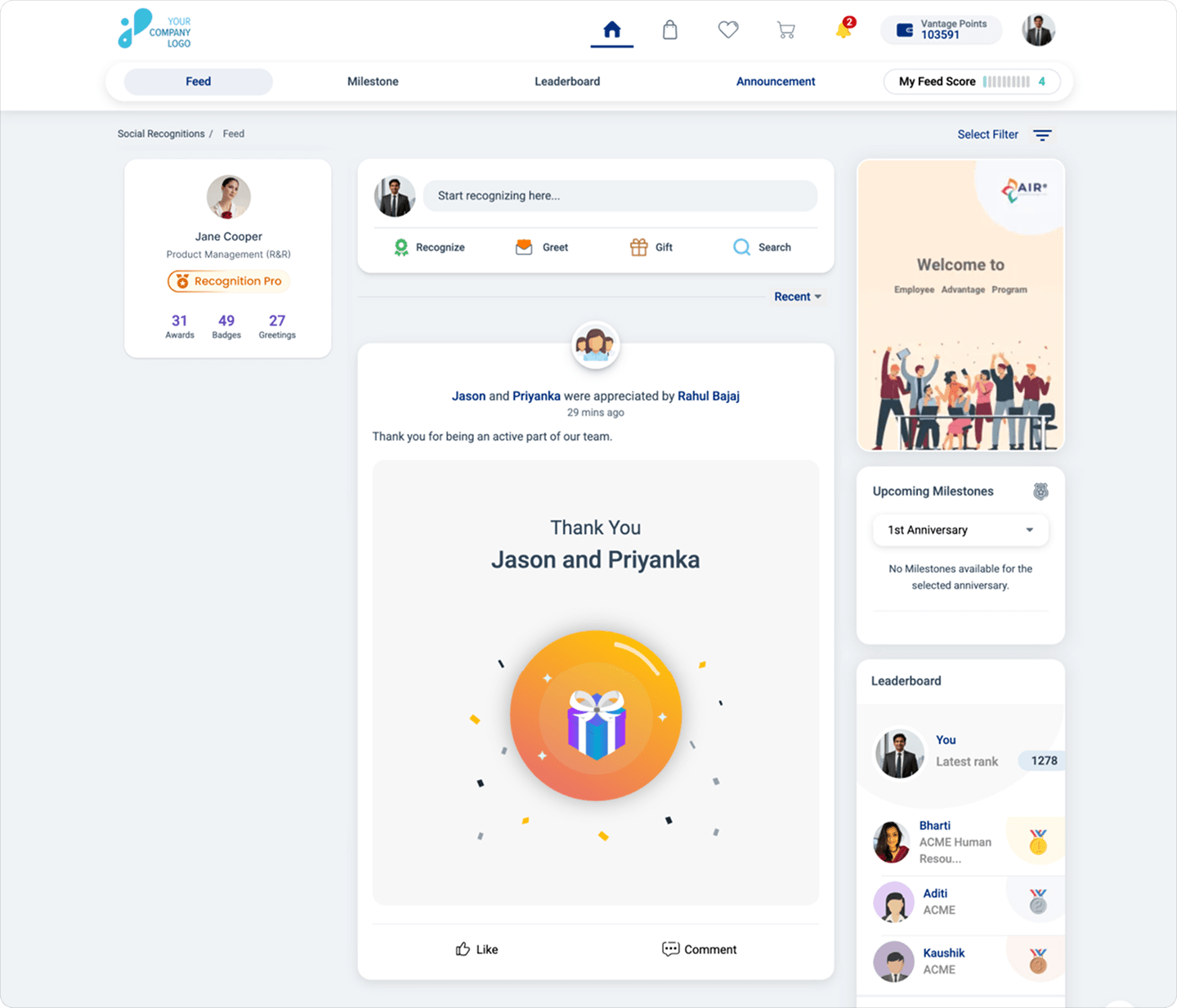
Where that praise happens matters too. A thank-you in a private message helps one person. The same note on a shared feed lets the whole team see what trustworthy behavior looks like, and colleagues can add their own comments and reactions. Over time, people start naming reliability in each other, and trust becomes something the whole team practices.
Vantage Recognition is built for exactly this. Appreciation posts, badges, comments and milestone highlights sit together on one social feed, so a teammate who owned up to a mistake early or kept a promise under pressure gets recognized in front of everyone who benefited from it.
Source: Vantage Recognition
5. Display your commitment to fair play in rewards and recognition
Fair play is the key element in a trusting relationship. An employee may perceive whether the rewards and recognition package is fair in terms of the following:
- The amount of effort they put forward.
- The influence and quality of their performance.
- Their education, experience, and training.
- Their present role's scope and complexity.
They will also compare fairness to others like:
- Colleagues playing similar job roles in the organization.
- Supervisors and subordinates.
- Peers in other organizations.
Your rewards and recognition program should focus on fairness from both internal and external aspects.
Internally, ensure that the R&R program provides equal opportunities and benefits for all employees, regardless of their location, job title, or background. Externally, consider the cultural and economic differences of your team and tailor your R&R program to meet their specific needs and expectations.
Fairness also plays a role when it comes to handling inevitable mistakes. Rewarding people for their good faith mistakes can help them understand what not to do and how to use their mistakes as motivators. This builds trust across the team.
One practical way to build fairness into recognition is to involve more than one decision-maker. In a panel-based award, several reviewers score each nomination against shared criteria. This reduces bias and keeps personal relationships and favoritism from deciding who gets recognized.
6. Set privacy policies

Establishing specific privacy policies is critical in any organization. It is mostly to maintain personal and professional boundaries within the organization. Some information, such as pay disclosure, may result in mistrust in an organization, complicating matters.
It is also true in the case of engagement surveys or feedback programs, where anonymity is quite important. There is also an anonymity threshold, implying that the survey results will not be displayed unless a certain number of people reply.
For example, suppose you set a minimum of 5 respondents and only get 4 responses. In that case, the survey results cannot be filtered since it is too easy to correlate answers to respondents.
Ensure your survey platform offers this threshold, especially if you are a small organization with small departments. Communicating this procedure to your employees will foster trust and, as a result, honest responses.
Vantage Pulse keeps responses anonymous and includes templates for pulse, employee satisfaction, and culture surveys, so you can run the trust check described later in this post.
Schedule a free demo to see how!
7. Offer training and development opportunities
Offering training and development opportunities signals that you’re invested in your employees’ futures. When employees see that the company is committed to their growth, they feel valued and supported. This investment builds trust and boosts their motivation and loyalty, leading to a more engaged and dedicated workforce.
In practice, this means turning good intentions into a plan. Sit down with each employee, ask where they want to grow, and agree on one or two skills to build over the next quarter. Then protect the time. A development plan that gets pushed aside the first time a deadline appears tells employees the promise was never real.
- Individual development plans: Write down goals and review them in regular one-on-ones.
- Stretch assignments: Give people responsibility slightly beyond their current role, with support available.
- Protected learning time: Set aside a few hours each month for courses, mentoring, or shadowing.
8. Communicate your employee engagement initiatives
Employees are naturally curious about the motivation behind employee engagement activities. They want to understand its purpose, goals, and benefits. As an employer, it is essential to communicate clearly with employees about the reasons for engagement activities.
This can be achieved through various communication channels, such as company-wide announcements, team meetings, newsletters, or one-on-one conversations.
Clear communication helps employees understand the significance of their participation. It encourages them to take an active role in these initiatives.
Say a company launches a monthly recognition program. The announcement should explain why it exists, what behavior it aims to encourage, how it works, and when employees will see results. A few weeks in, share early numbers and what you plan to adjust based on feedback. When employees see their input change the program, they treat it as a shared effort and take part more honestly.
9. Show consistency
Showing consistency is an important factor in establishing trust in the workplace. Leaders should strive for consistency in their actions and decisions, so employees know what to expect.
For example, if a leader promises yearly bonuses, it's important to follow through on that promise year after year. Such consistency builds a sense of trust and dependability that can improve morale and productivity across the organization.
Consistency matters most when it is inconvenient. Imagine a manager who gives one employee extra time on a missed deadline but holds another to the original date. Even if each decision has a reason, the team sees an uneven standard. Apply deadlines, feedback, and rules the same way for everyone, and when an exception is truly needed, explain it openly.
10. Embrace diversity

Employees from different backgrounds bring different viewpoints, experiences, and skills. When people feel included and respected for those differences, they speak up more and trust their teammates and leaders more. The reverse also holds: when some employees feel overlooked, trust drops quickly.
To make inclusion visible, recognize the behaviors that support it, such as mentoring a new hire from a different background or speaking up against a biased remark. Share the results of inclusion surveys with employees along with the actions you will take, so people see that their feedback leads somewhere.
How to measure trust in your workplace
Trust is easier to measure than most leaders expect. A short pulse survey, run every quarter, is enough to see where trust stands and which teams need attention.
Ask employees to rate each statement from 1 (strongly disagree) to 5 (strongly agree):
- I believe my manager will do what they say they will do.
- I can disagree with a decision without worrying about consequences.
- Leadership explains the reasons behind major decisions.
- I can admit a mistake without fear of being blamed unfairly.
- Rewards and recognition here are given fairly.
- I trust my teammates to follow through on their commitments.
How to read the results:
- Look at the gaps, not just the average: A team that scores far below the rest usually points to a manager or process issue rather than a company-wide one.
- Compare over time: A single score means little. Track the same statements each quarter to see whether your actions are working.
- Protect anonymity: Only show results for groups above a minimum size, as covered in tip 6, so people answer honestly.
- Share what you learned and what you will change: Asking and then staying silent damages trust. Tell employees the results within a few weeks and name one or two actions.
Trust in remote and hybrid teams
When people work apart, trust cannot rest on being seen at a desk. It has to rest on clear expectations and results.
- Define outcomes, not hours: Agree on what good work looks like and by when, then judge the work itself. Tracking online status or logged hours tells you little about performance and signals suspicion.
- Explain decisions in writing: Remote employees miss hallway context. Record decisions and the reasons behind them in a shared place so nobody learns about changes second-hand.
- Keep one-on-ones consistent: A regular check-in that rarely gets canceled shows reliability better than any policy. Use it for support and feedback, not just status updates.
- Be careful with monitoring: Software that tracks keystrokes or screen time often reads as distrust, even when the intent is good. If you must monitor anything for security or compliance, tell employees what is tracked and why.
- Make room for connection: Short virtual coffee chats, in-person team days, and peer recognition help colleagues who rarely meet build the rapport that trust grows from.
Why trust breaks down at work

Leaders and employees often see trust differently. In PwC’s 2024 Trust Survey, 86% of executives said they highly trust their employees, but only 60% of employees said they feel highly trusted.
Gallup’s 2023 analysis found that when employees strongly agree their leaders communicate clearly, inspire confidence in the future, and lead and support change, 95% fully trust them.
Common reasons trust breaks down include:
- With the rise of remote work, employees feel disconnected, leading to a loss of trust.
- Job insecurity and mistrust in leadership emerge from organizational changes such as mergers or downsizing.
- Because of high-profile incidents of corporate scandals and unethical behavior by CEOs, employees have lost trust in corporations.
- Lack of openness in communication, decision-making, or information sharing breeds rumors and suspicion.
- High levels of workplace stress and burnout can lead to a breakdown in trust.
- Employees who do not receive relevant feedback or recognition for their efforts may feel devalued and unfairly treated. It might result in a breakdown of trust between employees and their managers or employers.
Frequently Asked Questions About Trust In The Workplace
1. What are the characteristics of trust in the workplace?
Honesty, reliability, transparency, vulnerability, and consistency are characteristics of trust in the workplace. Employees are more likely to feel comfortable, supported, and engaged at work when they believe they can trust their leaders and coworkers. Over time, trust is developed via regular, real actions and communications.
2. What are good examples of trust in the workplace?
Effective collaboration and mutual support among coworkers, as well as companies that place a high priority on employee well-being and work-life balance, are all examples of organizations that foster trust in the workplace. You can also show trust by keeping your word, owning up to your mistakes, and giving supportive criticism.
3. What is the value of trust as a leader?
Trust is a key asset for a leader. Employees are more likely to feel inspired, engaged, and loyal when they trust their leaders. Building stronger teams, fostering an environment of openness and collaboration, and more effective task delegation are all made possible by trust. Trust-focused leaders are more likely to be regarded as credible, approachable, and efficient.
4. What is the core value of trust in the workplace?
The fundamental value of trust in the workplace is that it lays the groundwork for solid relationships and successful communication. Employees are more likely to collaborate efficiently, solve problems creatively, and openly share ideas when they have mutual trust. Furthermore, trust fosters psychological safety, empowering staff to take calculated risks and innovate without worrying about criticism or retaliation.
5. How do you rebuild trust at work?
Start by acknowledging what went wrong and taking responsibility without excuses. Then explain what you will change, make small commitments you can keep, and follow through every time. Rebuilding takes time because people judge by repeated behavior rather than a single apology. Check in regularly to ask whether things are improving.
6. What are the signs of low trust in the workplace?
Common signs include hoarded information, quiet meetings, managers rechecking routine work, gossip, hidden mistakes, and strong performers leaving. If several appear together, ask employees directly through an anonymous survey and act on what you learn.
7. How do you build trust in a remote team?
Judge outcomes instead of hours, explain decisions in writing, hold consistent one-on-ones, and be open about any monitoring. Regular, reliable communication matters more than constant availability.

Susmita Sarma is a Digital Marketer at Vantage Circle, making employee recognition less of a checkbox and more meaningful - helping organizations say we value our people and truly mean it.
Connect with Susmita on LinkedIn.