Most bad leaders don't believe they're bad leaders, and often neither do the people they report to. The manager who rewrites every deliverable calls it high standards, the director who announces a reorg by email calls it efficiency, and the one who takes credit upward and passes blame downward has usually been at it long enough to call it Tuesday. As long as their numbers look healthy, nobody above them questions the story, so the problem tends to reach you first.
It rarely arrives as a complaint, though. Instead, it surfaces in a pulse score that keeps slipping under the same name, a team losing people faster than the one next door, or an exit interview that finally says out loud what everyone had been working around. By then the damage to engagement, retention, and performance is well underway, and making the case against a manager with strong results falls to you.
This guide is built to help with that. It walks through the ten signs that give a bad leader away, the seven types they tend to fall into, where the pattern comes from, what it costs, and how to catch and correct it before your attrition numbers make the argument for you.
What Is Bad Leadership?
Bad leadership is a consistent pattern of behavior in which a person with authority fails to serve the team's goals or its people. It is not one bad meeting. It is a pattern that repeats across decisions and conversations until the team's trust, direction, or wellbeing erodes as a result.
It can come from someone genuinely incompetent, but just as often it comes from a capable person working with the wrong incentives, no training, or too much unmanaged pressure. The common thread is the effect on the team, not a label on the person: less honest feedback, and a team that stops raising problems because nothing changes when it does.
Good leadership qualities, clear communication, consistency, follow-through, are what a team is missing when bad leadership shows up, which is why the signs below map so closely to their absence.
Bad Leadership vs. a Bad Leader
Bad leadership is a pattern, not a verdict on a person. A capable, well-intentioned manager can still practice it if they were promoted without training, inherited a broken system, or are under pressure they are not equipped to manage. Treating it as a pattern rather than a fixed trait is also what makes it fixable: the intervention targets the behavior and the conditions producing it, not the person's character.
10 Signs of Bad Leadership
The most common signs of bad leadership are micromanagement, poor communication, taking credit while shifting blame, and leaving the team without direction. The leadership behaviors below are the ones that show up most often in engagement surveys and exit interviews, each with the data signal that reveals it early and the fix that addresses it.
1. Micromanages Instead of Trusting the Team
A leader who rewrites every deliverable, approves routine decisions, or tracks hour-by-hour progress is micromanaging, not managing, and a team that is constantly second-guessed stops bringing its own judgment to the job. Micromanagement shows up in Vantage Pulse leadership-driver scores as low autonomy and trust ratings months before anyone resigns, and the fix is structural: hand off a defined set of decisions permanently and measure outcomes instead of process.
2. Does Not Listen
A leader who interrupts, dismisses concerns, or never follows up on what a team raised is not practicing active listening, and the team notices. Employees stop writing detailed survey feedback once they conclude nothing happens with it, so response rates and comment length quietly decline. The fix is closing the loop visibly: every round of feedback gets a specific, public response, even when it's "not now, and here's why."
3. Takes Credit and Shifts Blame
A leader who presents the team's work as their own idea, then blames the team when it goes wrong, is practicing one of the clearest signs of bad leadership. It is hard to catch in a survey question, but a pattern where one person's name never appears in peer recognition despite leading high-output work is an easy tell. Building peer-to-peer recognition into how work gets acknowledged makes contribution visible, so credit is harder to quietly take.
Explore: Learn about Vantage Rewards
4. Never Recognizes Good Work
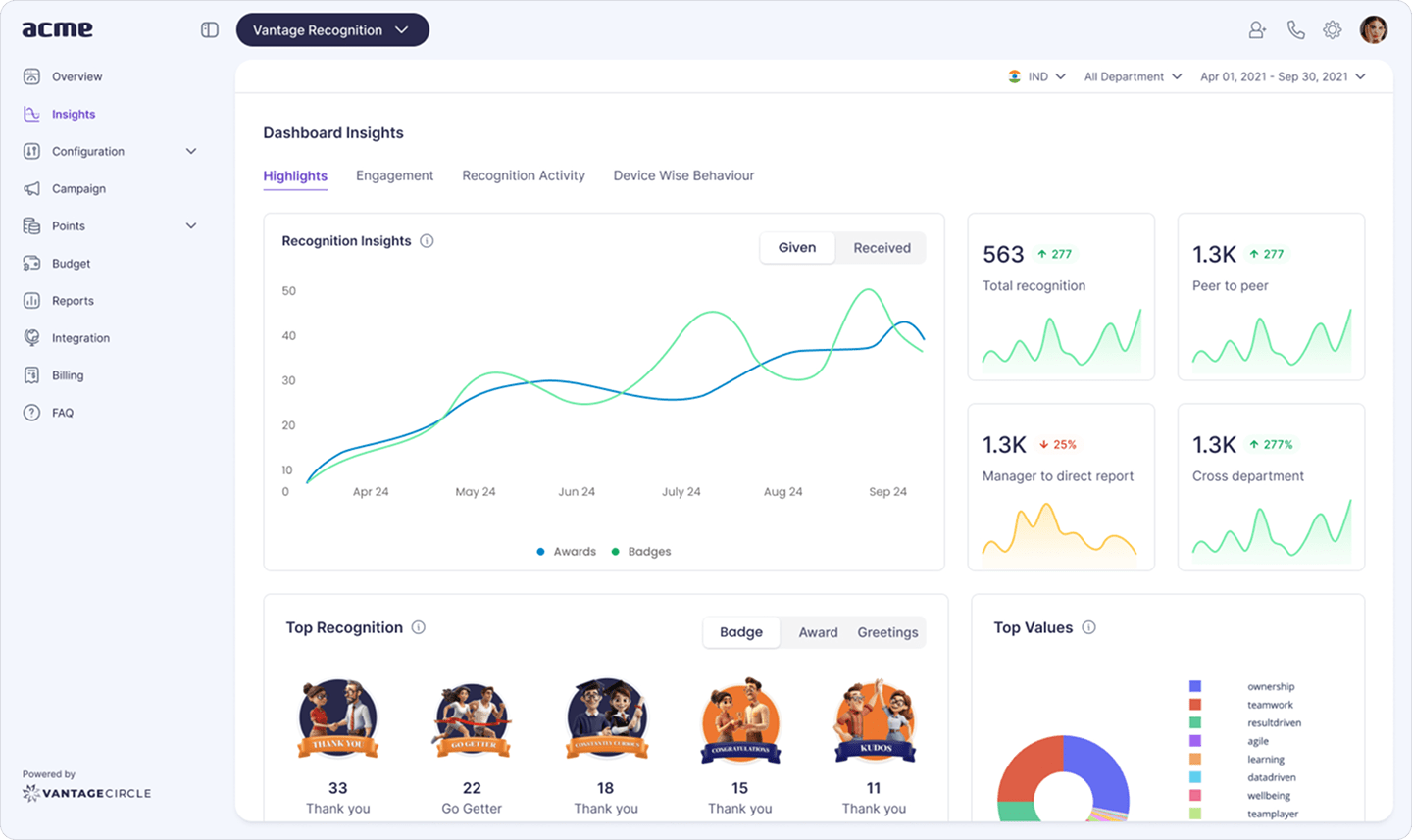
A leader who never says thank you or flags good work to their own boss is signaling that performance doesn't matter here, regardless of what they say in meetings. "My manager never recognizes anyone" is a common complaint, and it's one you can actually verify: recognition analytics shows which leaders give little or no recognition relative to their team's output, turning a vague complaint into a specific, coachable fact.
Explore: See recognition analytics
5. Communicates Unclearly or Hides Information
A leader who withholds the reasoning behind decisions or answers direct questions vaguely is failing at transparency in the workplace, and it costs the team more than it looks like it should. A reorganization employees hear about from another department first is a textbook example. This reliably shows up as declining trust scores in engagement data well before it shows up as attrition. The fix is sharing the reasoning behind a decision, not just the decision.
6. Gives No Clear Direction or Vision
A leader who cannot explain where the team is headed, or whose priorities reset every week, leaves people guessing instead of executing. Leadership drift like this shows up as missed deadlines and expensive, last-minute changes, and it erodes faith in the company's whole purpose, not just the leader's. The fix is a written priority list that holds for a defined period, reviewed on a schedule rather than reset on impulse.
7. Avoids Decisions and Accountability
A leader who delays decisions past the point they're useful, or is first to explain why a bad outcome "wasn't really" their call, is avoiding the accountability the role requires. This surfaces in engagement data as low confidence in leadership direction, since teams quickly learn not to expect timely calls. The fix is forcing a decision cadence: a deadline by which a call gets made with the information available.
8. Refuses to Adapt
A leader who rejects new ideas on reflex or treats flexibility as weakness is practicing rigid, not firm, leadership. A process kept in place well past the point it stopped working is a common tell. Rigid leadership shows up as a team that stops proposing changes altogether, because the cost of being ignored outweighs the effort of asking. The fix is treating process as a draft: review it on a schedule and make at least one visible change per cycle.
9. Does Not Develop or Empower People
A leader who makes every decision themselves or never delegates meaningful ownership is failing at employee empowerment. This shows up directly in attrition among the team's strongest performers, since capable people leave roles that stop developing them. The fix is deliberate: hand off one piece of real ownership at a time, and coach after mistakes instead of stepping in before them.
10. Ignores Team Well-Being and Burnout
A leader who treats exhaustion as a given, or responds to burnout symptoms with "push through," is ignoring the thing most likely to break the team entirely. Leadership burnout compounds this in both directions, since a burned-out leader is more likely to produce this same pattern in their own team. The fix starts with measurement: tracking workload and sentiment signals before they turn into resignations.
Signs, Signals, and Fixes at a Glance
Each sign of bad leadership leaves a measurable trace in engagement or recognition data before it shows up as a resignation.
- Micromanages: shows up as low autonomy and trust scores in pulse data. Fix: hand off decisions permanently and measure outcomes, not process.
- Does not listen: shows up as falling survey response rates and shorter comments. Fix: close the loop publicly on every round of feedback.
- Takes credit, shifts blame: shows up as the leader's name missing from peer recognition despite leading the work. Fix: build peer-to-peer recognition into how credit is tracked.
- Never recognizes good work: shows up as a recognition-given rate near zero for that leader. Fix: use recognition analytics to flag and coach the gap.
- Communicates unclearly: shows up as declining trust and transparency scores. Fix: share the reasoning behind decisions, not just the decision.
- No clear direction: shows up as missed deadlines and shifting priorities. Fix: set a written priority list that holds for a fixed period.
- Avoids decisions: shows up as low confidence-in-leadership scores. Fix: set a decision deadline and force a call with the information available.
- Refuses to adapt: shows up as fewer employee-submitted ideas over time. Fix: review process on a schedule and make one visible change per cycle.
- Does not empower: shows up as attrition concentrated among the team's strongest performers. Fix: hand off real ownership and coach after mistakes, not before.
- Ignores well-being: shows up as rising burnout and workload signals in pulse data. Fix: track workload and sentiment before resignations spike.
The 7 Types of Bad Leadership
Barbara Kellerman's research, published in Bad Leadership: What It Is, How It Happens, Why It Matters (Harvard Business School Press, 2004), identifies seven types: incompetent, rigid, intemperate, callous, corrupt, insular, and evil. Leadership styles describe how a leader operates day to day; Kellerman's types describe specifically how leadership fails. The first three describe leaders who are ineffective; the last four describe leaders who are unethical, and the two categories call for different responses.
- Incompetent: lacks the will or skill to sustain effective action, like a manager who cannot translate strategy into a workable plan for the team.
- Rigid: capable, but unyielding, refusing to adapt to new information, like a director who keeps a failing process in place because "it's always worked."
- Intemperate: lacks self-control and lets personal excess spill into work, like a leader whose mood swings make the team manage around them, not with them.
- Callous: disregards the needs or wellbeing of the people they lead, like a manager who schedules around their own convenience, ignoring team burnout.
- Corrupt: lies, cheats, or puts self-interest ahead of the organization, like a leader who inflates their own results while taking credit for the team's work.
- Insular: ignores the welfare of people outside their immediate circle, like a department head who protects their own team at another team's expense.
- Evil: inflicts severe psychological or physical harm on others. Extreme and rare, but the deliberate end of the same spectrum as the rest.
When Bad Leadership Turns Toxic
Bad leadership turns toxic when it moves from the first three types into the callous, corrupt, or evil end of Kellerman's framework, and the effect compounds across the whole team. A toxic work environment is usually the downstream result of exactly this shift, one leader's callous or corrupt behavior normalizing for everyone reporting to them, and the culture problem outlives the decisions that caused it.
This distinction matters for diagnosis, not just vocabulary. Rigid or incompetent leadership responds to training and clearer structure, while callous and corrupt leadership responds to accountability and, in persistent cases, removal. Treating both the same way is how organizations under-react to the second kind for years.
What Causes Bad Leadership?
Most bad leadership comes from promoting people without preparing them, from ego and self-interest, and from pressure leaders are not equipped to manage. None of these causes excuse the pattern, but understanding them changes the fix.
Promoting High Performers Without Leadership Training
Most new leaders are promoted for being excellent individual contributors, a skill set that has almost nothing to do with leading a team. Without leadership skills training, a newly promoted manager defaults to the only approach they know: doing the work themselves, which often shows up later as micromanagement.
Ego and Self-Interest
Some bad leadership is simpler than a training gap: a leader protects their own position, image, or advancement ahead of the team's. This is the root of credit-taking, blame-shifting, and insularity, and it responds to accountability measures more than coaching.
Unmanaged Pressure and Burnout
A leader under sustained pressure they aren't equipped to manage tends to pass that pressure downward, as shorter tempers and less attention to the team's wellbeing. Leadership burnout is both a cause and a consequence of bad leadership, since a burned-out leader produces the exact conditions that burn out their own team.
The Real Cost of Bad Leadership
Bad leadership costs organizations through the people who leave because of it, and the people who stay disengaged while deciding whether to.
of the variance in team engagement is explained by the manager alone. (Source: Gallup)
of employees have left a job specifically because of their manager. (Source: DDI)
DDI (Development Dimensions International)'s same study found that 32% of employees haven't quit yet because of their manager, but have seriously considered it, the group most likely to show up in next year's attrition numbers if nothing changes. Team-level eNPS (employee Net Promoter Score: whether a team would recommend working there) is the earliest version of this question, since a team that wouldn't recommend working there is often describing its leader rather than the company as a whole.
Beyond turnover, the same pattern shows up as burnout, stalled performance, and a toxic work environment for everyone who stays behind.
Bad Leadership Examples
Bad leadership usually looks ordinary: a manager who rewrites every deliverable, a director who announces changes by email, or a leader who praises upward and blames downward. The four scenarios below are composites drawn from patterns HR teams commonly report, not any single individual or organization.
- The Approval Bottleneck (micromanagement): A product manager required sign-off on every routine customer email the team sent. Cost: response times tripled, and two senior team members requested a transfer the same quarter.
- The Silent Reorg (unclear communication): A department head announced a restructuring by email, after most of the team had heard about it secondhand. Cost: trust scores dropped across the whole department on the next pulse survey, not just the roles affected.
- The Borrowed Win (credit-taking): A director presented a team's idea to leadership as their own, then blamed the team when execution slipped. Cost: the employee who originated the idea stopped proposing new ones and left within the year.
- The Invisible Ceiling (no empowerment): A manager kept personally approving every decision for a team that had outgrown that level of oversight. Cost: the team's strongest performer, repeatedly passed over for ownership, accepted an offer elsewhere.
How to Fix Bad Leadership in Your Organization
Organizations fix bad leadership by detecting it early in team data, giving leaders specific feedback, training before promoting, and holding leaders accountable for outcomes.
Detect It Early: Pulse Surveys, eNPS, and Recognition Data
The earliest warning for bad leadership is rarely a resignation letter. It's a drop in a team's leadership effectiveness scores, weeks or months before anyone leaves. Department-wise pulse data, broken down by team rather than averaged company-wide, shows exactly where the problem sits.
Give Leaders Specific, Upward Feedback
A leader rarely improves from a vague complaint, but responds to specific, structured feedback about what they do and its effect. 360-degree feedback, where input comes from peers and reports as well as managers, surfaces blind spots a single upward review misses.
Train Before You Promote
Leadership training works best before someone has a team to practice on, not after the damage is visible. Build leadership skills training into the promotion process itself, not into a remedial step after a complaint.
Make Recognition and Development Part of the Leader's Job
Rewarding the leadership behaviors an organization actually wants, clear feedback, developing people, giving credit, turns a vague expectation into a measurable standard. Manager recognition and core values alignment give leaders a concrete target instead of an abstract one.
Act When It Does Not Improve
When a leader doesn't change after specific feedback, training, and a clear runway, the organization's remaining responsibility is to the team, not the leader's position. That can mean reassignment, a change in scope, or removal, and delaying the decision rarely protects anyone it was meant to protect.
Conclusion
Bad leadership is rarely one dramatic failure. It compounds quietly, in missed recognition, withheld information, and decisions nobody owns, until it shows up as a resignation that looks sudden but wasn't. The fix isn't complicated: detect the pattern early, name it specifically, and hold leaders accountable to a standard the organization actually measures.
Frequently Asked Questions
Q1. What is the meaning of bad leadership?
A. Bad leadership is a consistent pattern of behavior in which a person with authority fails to serve their team's goals or wellbeing, through incompetence, rigidity, self-interest, or harm. It's defined by the pattern and its effect on the team, not by a single bad decision.
Q2. What are signs of bad leadership?
A. The most common signs are micromanagement, poor or unclear communication, taking credit while shifting blame, never recognizing good work, avoiding decisions, refusing to adapt, failing to empower people, and ignoring team wellbeing. See the full list of 10 signs above for how each one shows up and how to address it.
Q3. What are the 5 qualities of a bad leader?
A. Five qualities that show up most often are poor communication, a need to control every decision, an unwillingness to give credit, resistance to feedback, and indifference to the team's wellbeing. Most bad leaders show several of these together rather than just one.
Q4. What are 6 characteristics of a bad leader?
A. Six recurring characteristics are micromanagement, inconsistent or unclear communication, credit-taking, avoidance of accountability, rigidity in the face of new information, and a lack of interest in developing the people on the team.
Q5. What are 10 signs of bad leadership?
A. Micromanaging instead of trusting the team, not listening, taking credit and shifting blame, never recognizing good work, communicating unclearly or hiding information, giving no clear direction, avoiding decisions and accountability, refusing to adapt, not developing or empowering people, and ignoring team wellbeing and burnout.
Q6. What are the 7 types of bad leaders?
A. Researcher Barbara Kellerman identifies seven types: incompetent, rigid, intemperate, callous, corrupt, insular, and evil. The first three describe ineffective leadership; the last four describe unethical leadership.

Shaoni Gupta is a content marketing specialist at Vantage Circle, with expertise in scriptwriting and copywriting in the field of employee rewards and recognition.
Connect with Shaoni on LinkedIn.