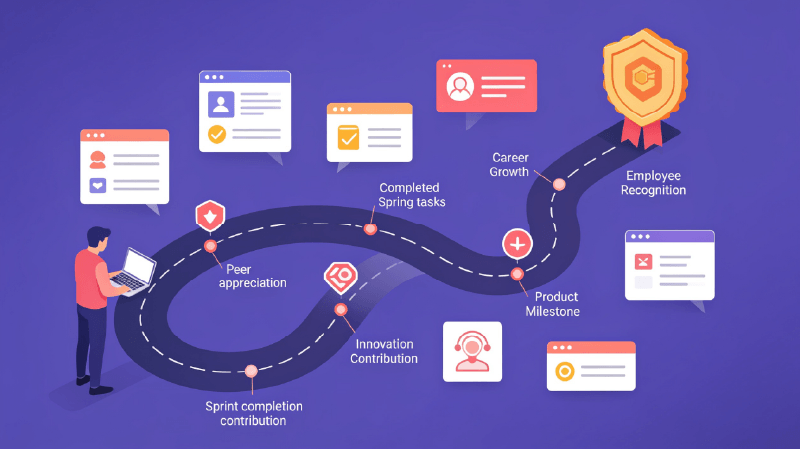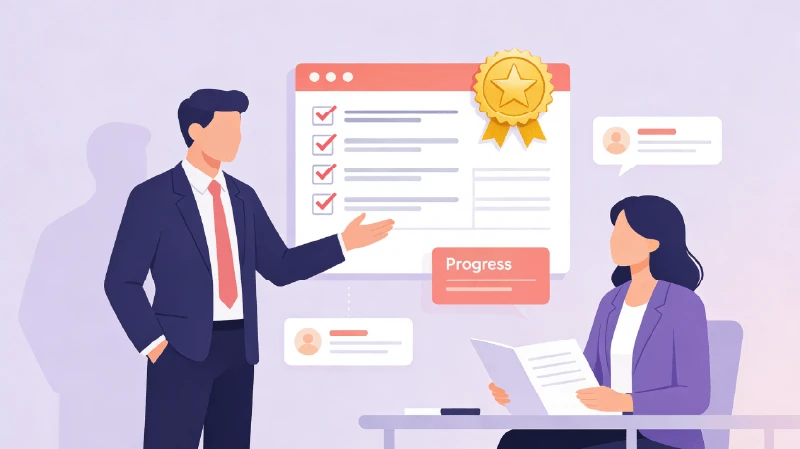
Employee management is the set of practices an organization uses to direct, develop and retain the people it employs. It spans hiring, goal-setting, performance monitoring, recognition and offboarding. It differs from workforce management, which schedules and forecasts labor, and from talent management, which focuses on identifying and growing high-potential employees.
That definition sounds settled. It is not.
Ask three HR software vendors what employee management covers and you will get three different answers. One says five categories. Another says six areas. A third says four pillars inside a lifecycle loop. None of them say where the model came from.
Meanwhile, economists have spent two decades scoring management practice across thousands of firms and publishing what correlates with performance. Almost no HR content references it. That gap is worth closing. When the goal is sustained employee engagement rather than a documented process, a framework you can trace back to measurement beats one assembled for a product page.
What Employee Management Actually Covers
Employee management covers six functions that run from the day someone is hired to the day they leave. Most organizations split ownership between HR, which builds the systems, and line managers, who apply them day to day.
The split matters. HR can design a performance review cycle, but a manager decides whether the conversation inside it is useful. Confusing the two is one way organizations end up with well-built programs that nobody runs properly.
| Function | What It Covers | Who Usually Owns It |
|---|---|---|
| Hiring and placement | Sourcing, selection, role fit, onboarding into a team | HR leads, manager decides |
| Goal-setting | Translating company objectives into individual targets | Manager leads, HR sets the cadence |
| Performance monitoring | Tracking output, reviewing progress, correcting course | Manager leads |
| Recognition and reward | Acknowledging contribution, linking it to pay and advancement | Shared |
| Development | Training, coaching, internal mobility, succession | HR leads, manager sponsors |
| Offboarding | Exits, knowledge transfer, alumni relationships | HR leads |
Those six functions map onto the stages of the employee lifecycle, which is the sequence employees move through rather than the practices applied to them. The lifecycle tells you when something happens. Employee management tells you what good looks like when it does.
Employee Management vs Workforce Management vs Talent Management
Employee management is the broadest of the three. Workforce management sits underneath it and handles scheduling, time and labor forecasting. Talent management sits alongside it and focuses on a subset of employees identified as high-potential.
Buyers conflate these constantly, and vendors have little reason to correct them. A workforce management platform sold as an employee management system is not lying exactly. It is just answering a narrower question than the one being asked.
| Discipline | Core Question | Time Horizon | Typical Owner |
|---|---|---|---|
| Employee management | How do we direct, develop and keep the people we have? | Continuous | HR and line managers |
| Workforce management | Do we have the right people working at the right times? | Daily to quarterly | Operations |
| Talent management | Who will lead this company in five years? | Multi-year | HR and executives |
The same confusion repeats at the tooling layer. Employee management software is the general category. An HRIS, or human resources information system, is the record-keeping core underneath it. Workforce management tools handle scheduling and time for shift-based teams. A platform can be excellent at one and thin at the others.
If a vendor cannot tell you in one sentence which of these three problems their product solves first, you are looking at a positioning deck rather than a product.
Where the Popular Employee Management Frameworks Come From
The frameworks most HR content uses to explain employee management are vendor-authored and unsourced. Their counts drift between four and six depending on who published them. There is a measured alternative, and it comes from economics rather than HR.
The frameworks in circulation
The frameworks in general circulation group employee management into somewhere between four and six categories, and they overlap heavily without agreeing on a count. One major HR software glossary uses five categories covering selection, monitoring, interaction, reward and discipline. A business-advice publisher runs six areas with near-identical labels. A European workforce platform offers four pillars wrapped in a six-stage lifecycle loop.
These are not wrong. They are reasonable groupings of real activities. But none of them cite an origin, and the count changes with the publisher, which tells you the grouping is editorial rather than empirical. Nothing anchors it.
What the research actually measures
There is a measured version, and it comes from economics rather than human resources. In 2007, Nicholas Bloom and John Van Reenen published Measuring and Explaining Management Practices Across Firms and Countries in the Quarterly Journal of Economics. They surveyed 732 medium-sized manufacturing firms across the United States, United Kingdom, France and Germany, scoring 18 specific management practices from one to five.
Their finding was that management practice scores are statistically associated with productivity, profitability and firm survival. The scores came from structured interviews against a fixed rubric, not from managers rating their own performance.
That survey became the World Management Survey. It now covers more than 13,000 firms across 35 countries, extending into retail, hospitals and schools.
One honest caveat. The grouping of those 18 practices has drifted. The original paper sorts them into four areas: operations, monitoring, targets and incentives. The project's own site often summarizes them to three. A 2021 retrospective from the same researchers uses lean operations, monitoring, target-setting and people management. The 18 practices and the scoring method stayed stable. The labels on the buckets did not.
So the vendor taxonomies are not inventing their categories from nothing. They are describing roughly the same territory without the measurement underneath.
| Research Practice Area | What It Measures | Closest Vendor Equivalent |
|---|---|---|
| Operations | Whether work processes are documented and improved rather than improvised | Usually absent from HR frameworks |
| Monitoring | Whether performance is tracked and the data is used to change something | "Monitoring" or "Measuring" |
| Targets | Whether goals are specific, visible, and acted on when missed | Folded into "Monitoring" |
| Incentives | Whether promotion and reward track performance, and whether good people are kept | "Reward" and "Discipline" |
Notice what falls out. Most HR frameworks have no equivalent for operations, and they split incentives into reward and discipline. That is a defensible editorial choice, and worth knowing as one.
What Makes Employee Management Effective
Effective employee management rests on three of the four practice areas the research scores: targets people can see, monitoring that tracks work rather than workers, and incentives that track contribution. The sections below take each in turn.
Set targets people can actually see
Targets work when employees can state their own without checking a document. The research tests whether goals are specific, whether progress is visible, and whether anything happens when they are missed.
Target-setting usually fails on the third test. Goals get set in January and reviewed in December, which makes them a reporting exercise rather than a management tool. A structured approach like management by objectives exists precisely to close that loop, though it only works if the review cadence is short enough to allow a correction.
Monitor performance without monitoring people
Good monitoring tracks work. Bad monitoring tracks workers. The distinction is whether the data collected could change a decision, or whether it exists to prove activity happened.
This is where micromanagement starts, and it is usually a symptom rather than a cause. Managers who cannot see outcomes resort to watching inputs. Fix the visibility of outcomes and the surveillance instinct tends to fade on its own.
Make recognition a practice, not a gesture
Recognition belongs in the incentives area of the research, and it is the function most often left to a manager's memory. The gap between intending to recognize good work and actually doing it is where most programs quietly fail.
Recognition frequency data shows how wide that gap runs.
Fewer than 20% of US employees are recognized every quarter, according to the AIRe Benchmarking Report USA 2023-24 (Vantage Circle).
That is not a motivation problem. It is a systems problem. When recognition depends on a manager remembering, it happens to the visible people and skips the rest.
Most US companies have already moved past rewarding output alone.
Almost 60% of US companies base recognition on both results and behaviors, while under 20% look at results alone, according to the same report.
Basing recognition on behaviors as well as results is what turns it into a signal. Employees learn which actions the company actually values, rather than guessing from who got praised last quarter.
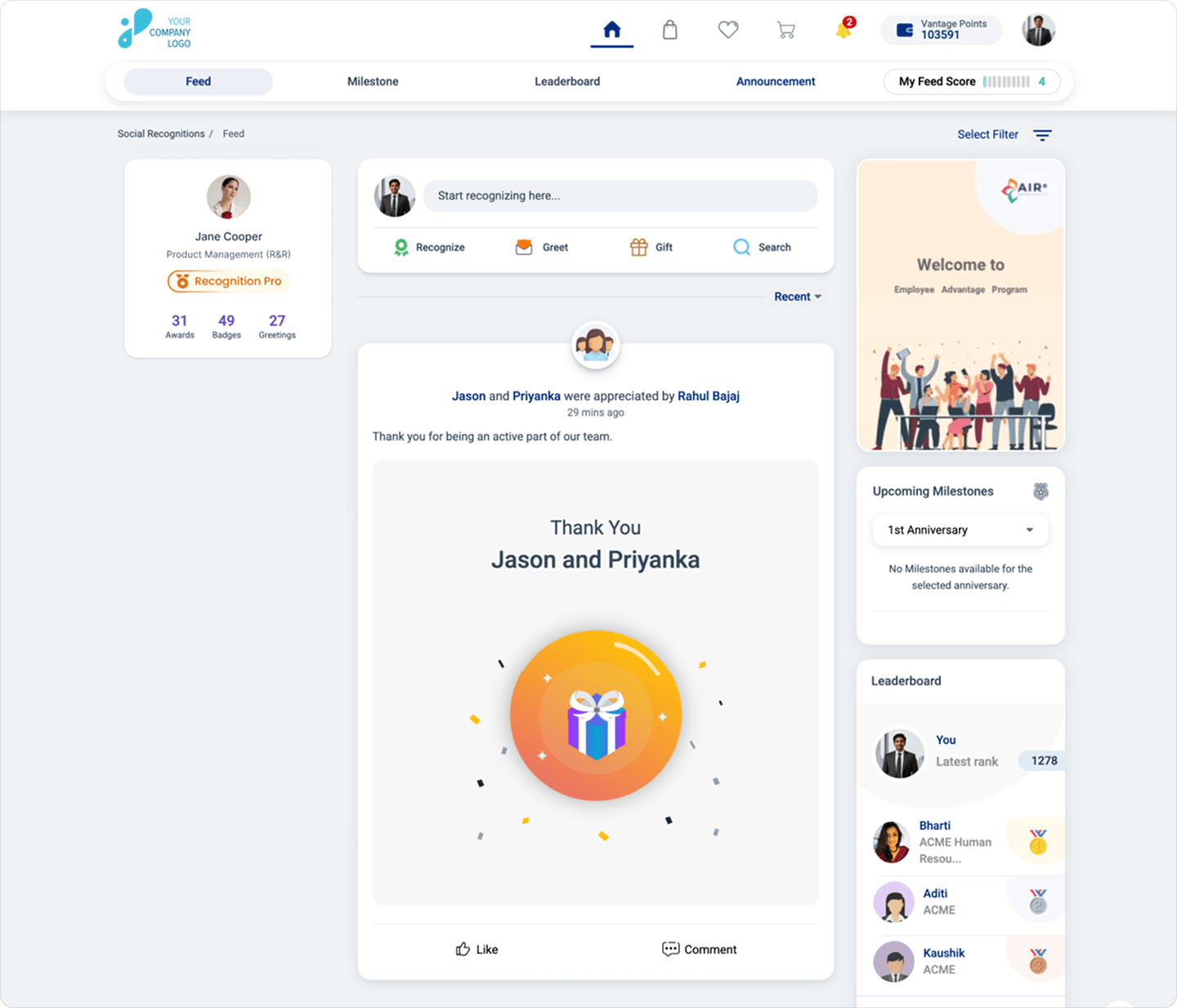
Vantage Recognition, Vantage Circle's employee recognition platform, exists for this part of the problem. Tying each award to a named company value makes the signal explicit, and the participation data answers a question most managers cannot: who on this team has gone unrecognized this quarter?
Handle the hard conversations early
Performance problems compound when nobody names them. The research on incentives covers how organizations deal with underperformance, not just how they reward strong work.
Most managers delay these conversations because the first one is uncomfortable and the fifth one is a formal process. Managing difficult employees gets substantially harder the longer the delay runs, and the same is true for employee relationship management more broadly. Early and small beats late and formal.
Employee Management Software: What to Look for
Employee management software centralizes the records, goals, performance data and recognition activity that would otherwise live in spreadsheets and inboxes. The category is broad, and most buyers overpay for breadth they rarely use.
What employee management software does
These platforms cluster around five capabilities, and almost no product is strong at all five.
- Records and reporting. The system of record for employee data, contracts and org structure. This is the HRIS core.
- Goals and performance. Objective tracking, review cycles, feedback history.
- Time and scheduling. Shift planning, attendance, leave. Critical for hourly teams, largely irrelevant for salaried ones.
- Recognition and rewards. Peer and manager appreciation, points, redemption.
- Surveys and sentiment. Engagement measurement, pulse checks, exit feedback.
Suites built on payroll tend to be strong on the first and third. Suites built on engagement tend to be strong on the fourth and fifth. Very few are strong on the second.
How to choose: five criteria
Most comparisons rank these platforms by feature count. That is the wrong test. A feature list tells you what the platform can do, not whether anyone in your company will open it. Here is a better set of tests.
- Adoption after rollout. Ask for participation data at month three and month twelve, not launch-week numbers. A tool nobody opens is a line item, not a system.
- Admin burden on the HR team. How many hours per month does running it cost? Some platforms transfer work from managers to HR and call it efficiency.
- Integration with your existing HRIS. If employee data has to be maintained twice, it will drift. Check whether the integration is real or a CSV export.
- Pricing transparency. Vendors who publish pricing are easier to budget for and easier to renew.
- Support for non-desk employees. This is where most tools quietly fail. If a third of your workforce has no company laptop, a web-only platform reaches two-thirds of your company.
We left review-site star ratings out of this. A star rating reflects how actively a vendor collects reviews, not just how the product performs, and it says nothing about whether the tool is still in use at month twelve.
Platform comparison
The platforms below cover the main approaches in the US market. Each solves a different first problem, which is the thing to match against before comparing feature lists.
| Platform | Best For | Core Strength | Pricing Model |
|---|---|---|---|
| BambooHR | Small to mid-size HR teams | Clean HRIS with onboarding and records | Per employee per month, tiered |
| Workday | Large enterprises | Full HCM suite spanning HR and finance | Quote-based, annual contract |
| ADP Workforce Now | Payroll-led operations | Payroll and compliance depth | Quote-based |
| Rippling | Teams combining HR and IT provisioning | Device and app management alongside HR | Per employee per month, modular |
| Gusto | Small businesses under 100 employees | Payroll and benefits administration | Base fee plus per employee |
| Zoho People | Budget-conscious teams | Low-cost HRIS with heavy customization | Per employee per month, low tiers |
| Connecteam | Deskless and shift-based teams | Mobile-first scheduling and communication | Flat tiers by user band |
| Vantage Circle | Adding recognition to an existing HRIS | Recognition, rewards and engagement layer | Per employee per month |
One point of disclosure, since this is our own publication. Vantage Circle is not an HRIS and does not try to be. It holds no payroll, no contracts and no org chart of record. If you are replacing a core system, the platforms above it in that table are the ones to look at. If you have a core system and recognition is the function failing, that is the problem Vantage Circle is built for.
For teams whose requirement is specifically recognition rather than general employee management, the dedicated comparison of employee recognition software covers that category in more depth.
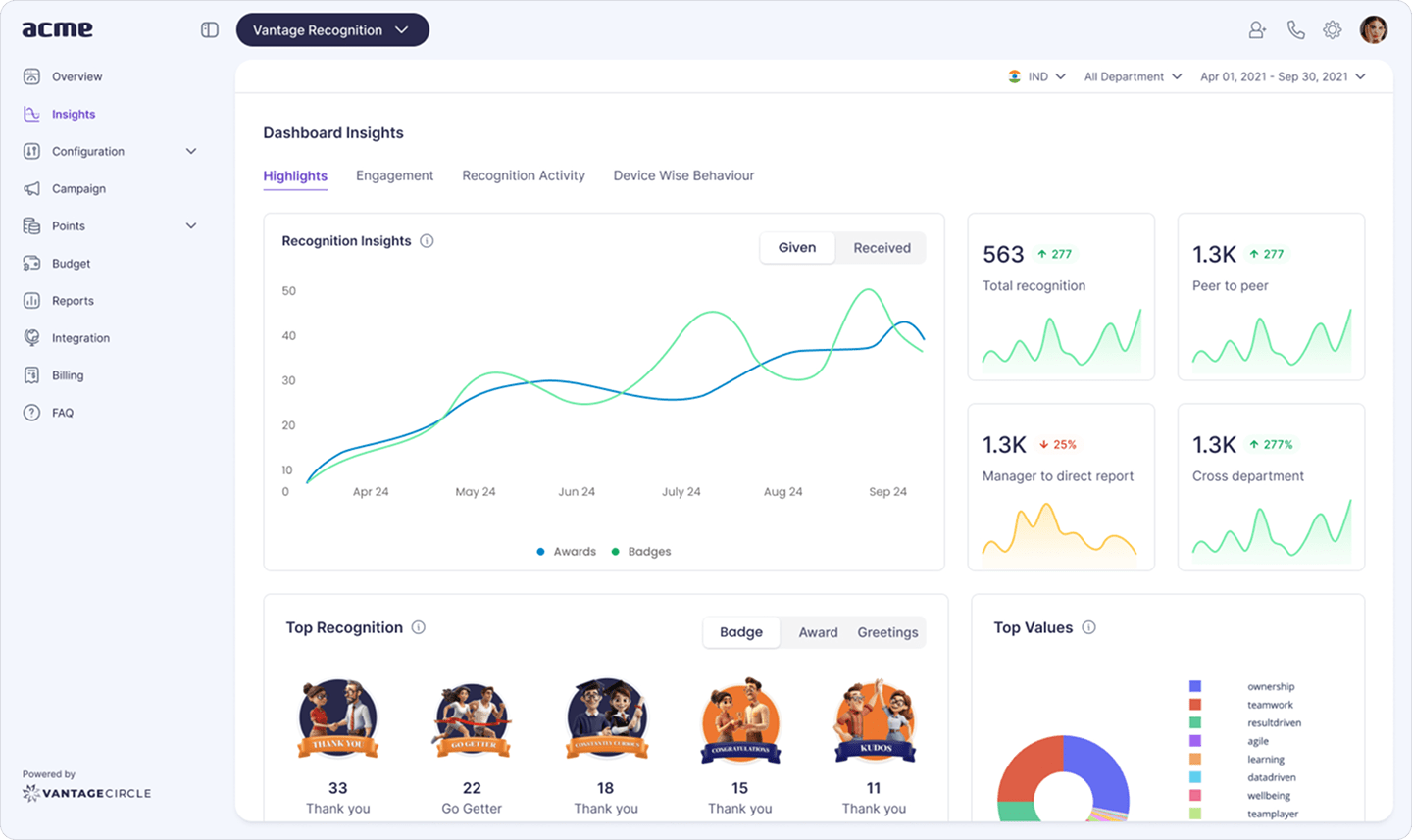
What it costs
Employee management software is priced in four recognizable shapes: per employee per month, a base fee plus a per-employee rate, quote-based enterprise contracts, or flat tiers by user band. Which one you face depends more on company size than on the feature set.
Per-employee pricing is the most common and easiest to forecast, though it punishes growth. A base fee plus a per-employee rate suits small teams. Quote-based pricing dominates the enterprise end and usually comes with implementation fees that are not in the first proposal. Flat tiers suit deskless teams with high headcount and low per-user value.
Budget for implementation separately from licensing. The gap between the two is where most first-year overruns come from, and headcount changes the math in ways the sticker price hides. We have broken down how pricing by headcount actually behaves across bands.
Common Employee Management Mistakes
Five mistakes show up repeatedly in the distance between a well-designed program and one that works. Each is a failure of execution rather than design.
- Measuring activity instead of outcomes. Login counts and submission volumes are easy to report and tell you almost nothing. Track whether behavior changed.
- Designing for the head office. Policies written for salaried desk employees reach a fraction of the company when a large share of the workforce is frontline or remote. Managing remote employees exposes this gap fastest.
- Treating recognition as an HR deliverable. When HR runs recognition, it becomes an event calendar. When managers run it with HR support, it becomes a practice.
- Confusing the system with the skill. A platform cannot give feedback. The people management skills sitting behind the tool determine whether it does anything.
- Setting objectives nobody revisits. Goals reviewed once a year are documentation.
Several of these trace back to the same root cause. Organizations buy a system to solve a problem that was not a tooling problem to begin with.
Engagement is the goal most of these programs set out to hit.
80% of US companies prioritize driving employee engagement as a primary objective in their recognition programs, according to the AIRe Benchmarking Report USA 2023-24 (Vantage Circle).
Stating the objective is the easy part. The programs that reach it are the ones where someone owns the practice, not just the platform.
So who actually owns the outcome? Ben Eubanks, who heads research at Lighthouse Research and Advisory, put numbers on that from the learning and development side on our podcast:
Vantage Influencers Podcast
"We're responsible for about 5% of someone's engagement. The other 95% has to do with their manager relationship, other talent practices, how well we reward them and recognize them for their efforts."
— Ben Eubanks, Chief Research Officer, Lighthouse Research and Advisory
Listen to the EpisodeVantage Pulse, Vantage Circle's employee engagement and pulse survey tool, is useful here for a narrow reason. It tells you whether a management practice is landing before the annual survey does, and its department-level view isolates which teams the problem actually sits in.
Summing It Up
Employee management covers six functions, splits ownership between HR and line managers, and succeeds or fails on the practices researchers have scored across more than 13,000 firms: targets, monitoring and incentives, with incentives covering both reward and dealing with underperformance.
The frameworks circulating in HR content are not wrong, but they are editorial. Knowing where the measured version comes from is what lets you tell a real practice from a repackaged list.
Software carries the records and the reporting. It does not carry the practice. Choose the platform that fixes your first problem, check adoption at month twelve rather than launch week, and keep the practice with the managers.
If recognition is the function breaking in your organization, book a demo and we will show you what the participation data looks like.
FAQs
What is employee management?
Employee management is the set of practices an organization uses to direct, develop and retain its employees. It covers hiring and placement, goal-setting, performance monitoring, recognition and reward, development, and offboarding. HR typically builds the systems while line managers apply them day to day.
What are the responsibilities of employee management?
The core responsibilities are placing people in the right roles, setting and tracking clear objectives, monitoring performance and correcting course, recognizing contribution, developing skills, and handling exits well. Ownership is shared, with HR designing the process and managers running it.
What is the difference between employee management and workforce management?
Employee management is the broader discipline covering how an organization directs, develops and retains people. Workforce management is narrower and operational, handling scheduling, time tracking, attendance and labor forecasting. Workforce management is effectively a component of employee management, most relevant for shift-based teams.
What makes employee management effective?
Three practices separate effective employee management from the rest: specific targets that are visible and acted on when missed, monitoring that tracks work rather than workers, and incentives that track contribution, including how underperformance is handled. Research across thousands of firms links these practices to productivity and profitability.
What is employee management software?
Employee management software centralizes employee records, goals, performance data, recognition and survey feedback in one platform. The category spans HRIS platforms, payroll-led suites, scheduling tools for deskless teams and recognition layers. Most products are strong in two or three of these areas rather than all of them.
How do you choose employee management software?
Match the platform to the problem failing first, then check five things: adoption rates at month twelve, the admin hours it costs your HR team, whether it genuinely integrates with your existing HRIS, pricing transparency, and whether it reaches employees without a company laptop.

Nilotpal M Saharia is an Assistant Manager, Content Marketing at Vantage Circle and a recognition-and-rewards (R&R) strategist with 9 years of experience spanning Marketing, HR, and content strategy. He helps HR leaders turn employee recognition and leadership research into practical workplace programs.
Connect with Nilotpal on LinkedIn.