Most "organizational development" initiatives aren't organizational development. They're a training calendar with a new name. An engagement survey nobody acts on. Sometimes just whatever the CEO wants fixed this quarter. None of that is wrong to run. It's just not OD. The real thing is a specific discipline with an actual process behind it. Diagnose what's broken. Run a targeted intervention. Check whether anything moved. Not a training day. Not a Q3 engagement push squeezed in before budget season. This guide covers where OD came from, the five-stage process every practitioner runs, the models that shape the diagnosis, the four categories of intervention, a worked example, and where OD stops and change management starts. Most of it comes down to people management in the end. Every intervention in this guide eventually lands on a manager's desk.
Key Takeaways
- Organizational development is a continuous cycle, not a one-off project: diagnose, intervene, evaluate, adjust, repeat.
- The OD process runs in five stages: entry and contracting, diagnosis, feedback, intervention, and evaluation.
- OD interventions fall into four categories: human process, technostructural, human resource management, and strategic.
- OD is broader than change management: change management moves one transition, OD decides which transitions are needed and whether they worked.
- The discipline is only as strong as its measurement. A baseline you never re-measure against is just a snapshot.
What Is Organizational Development?
Organizational development (OD): a planned, systematic, evidence-based effort to improve an organization's effectiveness and health by aligning its strategy, structure, people, and processes. Unlike a one-time project, OD runs as an ongoing cycle: diagnose, intervene, evaluate, and adjust. It draws on behavioral science and was formalized by Kurt Lewin and Richard Beckhard in the mid-20th century.
That distinction matters more than it sounds. Most workplace initiatives target one lever. A new review template. A revised onboarding flow. A survey nobody reads past the summary slide. OD treats those pieces as connected. Pull one out. Something else cracks somewhere you weren't watching.
Richard Beckhard gave the field its first widely cited definition. His 1969 book Organization Development: Strategies and Models described OD as planned, organization-wide, and managed from the top. The goal: increasing organizational effectiveness and health through interventions grounded in behavioral-science knowledge. Wendell French and Cecil Bell's 1973 textbook landed in similar territory, describing a long-range, planned effort focused on an organization's culture and its human and social processes, using applied behavioral science, action research chief among it.
Planned. Not reactive. Grounded in behavioral science. Not intuition, and definitely not whatever slide deck the last consultant left behind. That's the throughline in both definitions.
The word "health" in Beckhard's phrasing gets skimmed past constantly. It shouldn't. An organization can be functional in some ways and dysfunctional in others. Inert here. Overactive there. That's the whole reason the discipline won't touch an intervention before it diagnoses.
Origins and Author Definitions
Organizational development traces back to Kurt Lewin. He studied group dynamics and action research in the 1940s. The field wasn't named until two decades later. A strange thing to sit with: the method existed before anyone had a word for it.
Lewin, a social psychologist, argued you understand a system by trying to change it. Watch what happens. Don't just study it from a distance. Action research, he called it. Diagnose, act, observe, adjust, repeat. He died in 1947. OD had no name yet. No textbook. No consulting industry built around it. His three-stage model still made it into nearly every practitioner's toolkit anyway: unfreeze, change, refreeze.
Beckhard formalized the definition in 1969. French and Bell's Organization Development followed in 1973. It became the standard textbook for a generation. Thomas Cummings and Christopher Worley's *Organization Development and Change* came later, first published in the 1980s and still getting updated. It's the reference most practitioners reach for today.
Characteristics of Organizational Development
Six things separate OD from a one-off HR initiative.
- Planned. Not improvised in response to whatever complaint reached leadership last week.
- Organization-wide. Even an intervention aimed at one team treats the whole system as the unit of analysis.
- Systemic. Change the structure and culture shifts too. Change the culture and the numbers eventually catch up.
- Data-driven. It runs on collected evidence, not on whoever argued loudest in the room.
- Grounded in humanistic values. A legacy of the field's behavioral-science roots. Employee wellbeing counts as a real outcome.
- Long-term. Success is measured in quarters and years, not the two weeks after a workshop.
The Goals of Organizational Development
Ask why an organization actually runs OD. You get four honest answers. Better organizational effectiveness. More adaptability. Stronger culture and collaboration. The ability to manage change without performance cratering along the way.
Organizational effectiveness
The center of gravity. A company that performs better and keeps performing after the market shifts underneath it.
Adaptability
The capacity to change strategy when the current one stops working. Usually a question of decision rights and information flow.
Culture and collaboration
New behaviors that hold because people see them reinforced, not because a policy said so.
Change without losing performance
Getting through disruption with people still bought in, rather than quietly checking out.
Effectiveness sits at the center. Everything else exists in service of it: a company that performs better and keeps performing after the market shifts underneath it. Practitioners call that end state organizational effectiveness. OD work that can't trace back to it drifts into activity for its own sake. Workshops that feel productive. Nothing measurable changes.
Adaptability earns more attention every year as change cycles compress. An organization that can only execute its current strategy is fragile the moment that strategy stops working. Most interventions here target decision rights and information flow. I've sat through plenty of "resilience" workshops that never touched who actually gets to approve a decision, and those rarely move anything.
Culture and collaboration is where OD overlaps most with recognition and engagement work. Culture change rarely holds through policy alone. It holds when people see new behaviors reinforced, over and over, in ways that are hard to fake. Change the org chart and leave recognition untouched, and the whole thing reverts within a year. I've watched it happen more than once.
Last, managing change without losing performance. Leadership cares about this one most. Leadership measures it least. It shows up eventually in organizational commitment: whether people stay bought in through the disruption or start quietly checking out.
The Organizational Development Process (5 Stages)
The organizational development process runs in five stages: entry and contracting, diagnosis, feedback, intervention, and evaluation.
Each stage hands off to the next. The dashed arrow is the one most organizations skip: evaluation feeding back into the next diagnosis.
| Stage | What happens | What HR or the consultant produces |
|---|---|---|
| Entry & contracting | Scope the problem, agree on the engagement | A statement of work |
| Diagnosis | Collect data through surveys, interviews, and metrics; find the root cause | A diagnostic report |
| Feedback | Present findings to leaders, build shared understanding | A set of prioritized themes |
| Intervention | Run the change | An implemented change |
| Evaluation | Re-measure against baseline, institutionalize or adjust | An outcome review |
Older versions of this model call step four "solution." Wrong word. A solution implies the problem is fixed and everyone moves on. Intervention is more honest: you're disturbing a system on purpose, and you don't fully control what happens next.
Entry and contracting gets skipped more than any other stage because it looks like paperwork. It isn't. This is where the consultant, internal or external, agrees with leadership on the actual problem and what success looks like before anyone touches the org chart. An intervention that solves the wrong problem almost always traces back to a step like that one.
I sat in on a contracting conversation once. The CEO wanted "better collaboration." Three questions in, the real complaint surfaced: two VPs hadn't spoken directly in eight months.
Diagnosis is where organizations quietly underinvest. Surveys go out, response rates come back mediocre, and someone builds a deck from whatever data already existed. Real diagnosis combines structured data, engagement scores, turnover by team, performance ratings, with qualitative input from interviews and open-text responses. A root cause has to survive scrutiny. It can't just sound plausible in a meeting. Sentiment analysis tools that read open-text feedback for recurring themes earn their keep here. They turn a pile of comments nobody had time to read into a handful of patterns that hold up.
I've seen diagnosis produce eleven action items and zero real root causes. Nobody in the room wanted to say the actual problem out loud.
Feedback is the stage where OD lives or dies politically. The consultant hands leadership the diagnosis, and leadership either owns what it shows or starts defending against it.
A report that only tells people what they want to hear isn't OD. It's theater.
Intervention gets its own section below. Evaluation closes the loop. Re-measure the same indicators against the baseline. Institutionalize the change, or go back to diagnosis with what you learned. Most organizations run it once and call the project finished. That's a mistake.
Organizational Development Models
Five models keep showing up in OD work: Lewin's three-stage model, the Action Research model, McKinsey's 7-S framework, the Burke-Litwin model, and Kotter's eight-step model.
| Model | Core idea | Best used for | Main limitation |
|---|---|---|---|
| Lewin's 3-stage model | Unfreeze, change, refreeze | Simple, well-bounded changes | Assumes a stable end state; real organizations rarely stay frozen |
| Action Research | Iterative cycles of data collection, action, and reflection | Ongoing diagnosis where the problem is not yet clear | Slower than a prescriptive plan; needs sustained buy-in |
| McKinsey 7-S | Seven interdependent elements: strategy, structure, systems, shared values, skills, style, staff | Diagnosing misalignment across a whole organization | Descriptive, not prescriptive; shows what is misaligned, not how to fix it |
| Burke-Litwin | Twelve factors linking the external environment to individual and organizational performance | Large-scale, transformational change where cause and effect need tracing | Complex; requires real data across every level to use well |
| Kotter's 8-Step | Eight sequential steps, from urgency to anchoring the change | Leading one specific, high-visibility transformation | Linear; assumes a level of top-down control many flatter organizations don't have |
Lewin's model is the one most people learn first. It's the simplest.
Unfreeze. Disrupt the current state enough that people accept change is coming. Change. Run the intervention. Refreeze. Lock the new state in through structure, policy, and reinforcement. Fair criticism: it assumes organizations eventually settle into a stable state, and most don't anymore. That's basically why the Action Research model exists alongside it. Less a competing model, more a formalization of Lewin's actual method. Gather data. Feed it back. Act. Gather more data. Repeat.
I use McKinsey's 7-S framework constantly. Tom Peters and Robert Waterman published it in 1982, in their book In Search of Excellence. Seven interdependent elements: strategy, structure, systems, shared values, skills, style, staff. Change one without the others, and drag builds up fast. Fine. True, even. But it's a diagnostic tool wearing a change-model costume. It shows you where the misalignment sits. It says nothing about what to do once you've found it.
Burke-Litwin comes from W. Warner Burke and George Litwin in 1992. Twelve factors. The causal links between them matter more than the count. External environment shapes leadership and strategy. That shapes structure and systems. That shapes individual motivation and performance.
I used it once with a client convinced their attrition spike was a compensation problem. It wasn't. A leadership change eighteen months earlier was still working its way down through the org. Pay complaints were just the symptom people found easiest to name out loud.
Kotter published his eight steps in 1996, in Leading Change. Urgency. Coalition. Vision. Removing obstacles. Short-term wins. Consolidation. Anchoring the change in culture. Built for one visible transformation with a start date and an end date. Works well for exactly that. Works less well as a standing operating model. That's roughly where OD as a discipline parts ways with change management as a project. Change management models covers Lewin and Kotter in more depth.
Types of OD Interventions
Organizational development interventions fall into four categories: human process, technostructural, human resource management, and strategic.
The taxonomy comes from Thomas Cummings and Christopher Worley. Most real engagements end up combining more than one category.
Human process
Team building, coaching, conflict resolution, process consultation. The group diagnoses its own behavior.
Technostructural
Job redesign, restructuring, workflow redesign. Anything touching the structure or technology of the work itself.
Human resource management
Performance management, talent development, rewards, wellbeing. The category HR runs closest to, and most likely to run on autopilot.
Strategic
Culture change, mergers and acquisitions, transformation. Touches every other category at once.
Human process interventions
The oldest category. Interpersonal relations. Group dynamics. Organizational dynamics. Team building, coaching, conflict resolution, process consultation. A consultant helps a group diagnose its own behavior. Nobody hands the group a fix from outside.
Technostructural interventions
Job redesign. Restructuring. Workflow redesign. Anything touching the structure or technology of the work itself lands here. This is the category where OD and change management overlap most. A restructuring needs the systemic lens and a tactical rollout plan.
Human resource management interventions
Performance management. Talent development. Rewards. Wellbeing. HR teams already sit closest to this one. That's exactly why it's easiest to run on autopilot without checking whether diagnosis actually supports it. A performance review cycle rolled out because the old one felt stale isn't an OD intervention. The same rollout, triggered because diagnosis showed the old cycle was quietly wrecking manager-employee trust, is.
Strategic interventions
Biggest scope of the four. Culture change. Mergers and acquisitions. Organizational transformation. These touch every other category at once. That's why they take the longest and fail the most visibly when diagnosis got rushed.
Culture-change work deserves its own callout. It's the category most prone to good intentions and weak follow-through. Naming new values at a town hall doesn't change culture. It's a decorative gesture. Culture actually changes when values show up in what gets rewarded day to day. Recognition tied to specific, named elements of organizational culture does that. Vantage Circle's AIRe benchmarking found that when an organization recognizes work milestones and life events, employees are three times more likely to strongly agree they feel connected to the culture (Measure What Matters, Vantage Circle, 2022). A poster in the break room doesn't.
A Worked Example: One OD Intervention, End to End
Here's how a single OD cycle actually runs, diagnosis through re-measurement. This scenario is illustrative. It's built to show how the stages connect.
A 30-person operations unit inside a 400-person company. Engagement score, tracked across one full OD cycle:
Company-wide average: 7.2. The gain is real and it held, but the unit is still below average. Measured against a real baseline, you can say that with confidence.
A 400-person company runs a quarterly engagement pulse survey. Company-wide score: 7.2 out of 10. Respectable. Then the department-level breakdown shows something the aggregate hid. One 30-person operations unit sits at 5.1. It barely dents the aggregate because it's small. That's diagnosis working the way it should. A whole-org number that looks fine can hide a unit that's actually failing, and it takes department-level visibility to catch that before it shows up as attrition.
Interviews surface a specific pattern: the manager rarely acknowledges good work publicly, feedback flows one direction only, two senior team members have started quietly job-hunting. A human process problem. The intervention centers on manager coaching. Feedback habits. Recognition habits. The team resets how it surfaces and celebrates wins. Occasional manager praise gives way to a visible, peer-driven recognition habit.
Evaluation runs across two pulse cycles. A single post-intervention survey mostly measures the honeymoon effect of a manager's initial burst of effort. It doesn't measure whether the change held. Score moves from 5.1 to 6.4 after the first cycle, holds at 6.3 after the second. Evidence it stuck. The two job searches quietly stop, which nobody puts in a report but everyone on the team notices.
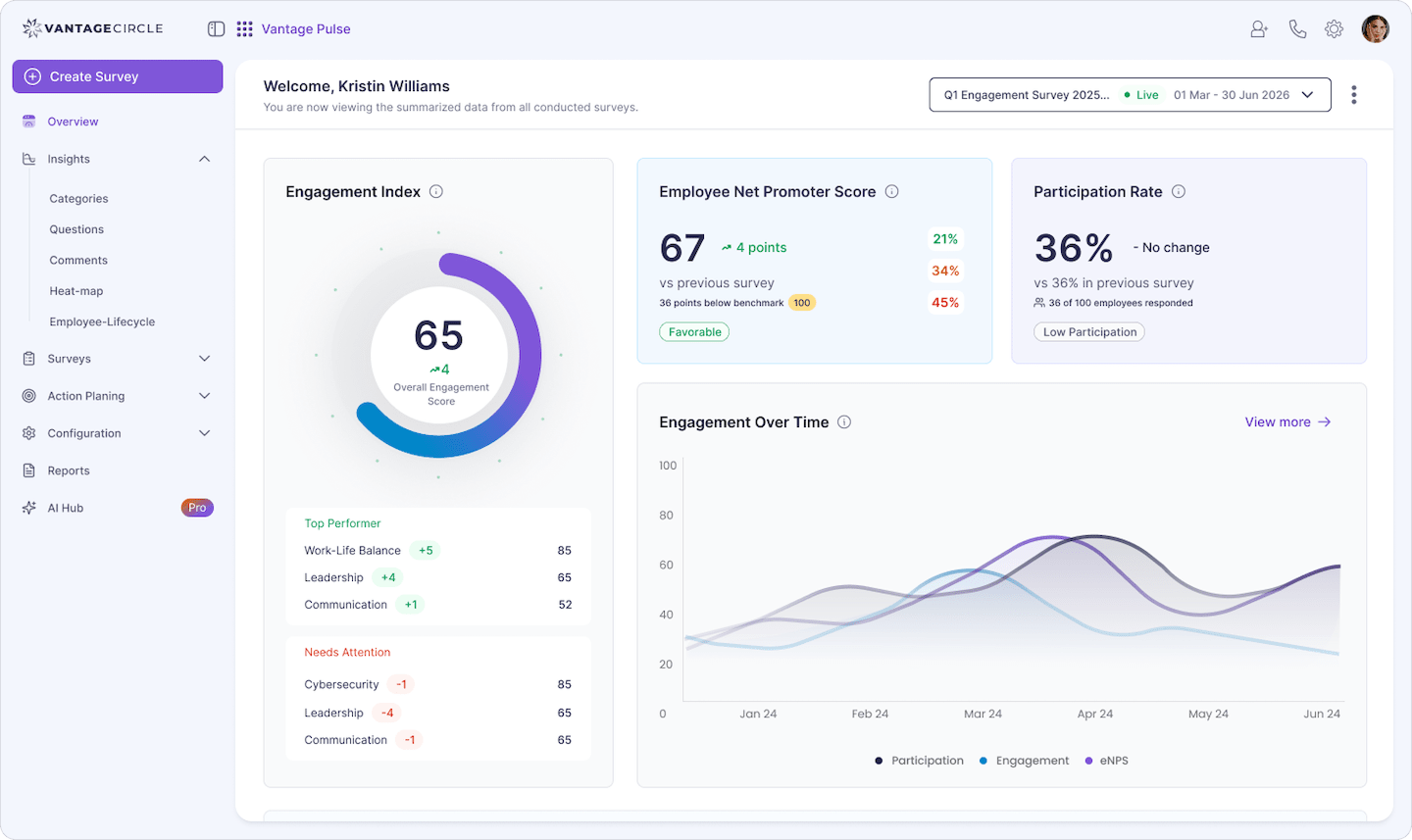
Tracking the same engagement index across pulse cycles is how the evaluation stage proves an intervention held, rather than just measuring the honeymoon effect. (Source: Vantage Pulse)
I wouldn't call that a full success. 6.3 is still below the company average. But it's real. It's held. It traces to a specific intervention. It's measured against a real baseline. You know it worked because you can point to the number.
Organizational Development vs Change Management vs Organizational Behavior
Three terms, three different jobs. OD is the broad, ongoing practice of improving an organization as a system. Change management guides people through one specific transition. Organizational behavior studies how people act inside organizations. It doesn't try to change anything.
| Organizational development | Change management | Organizational behavior | |
|---|---|---|---|
| Scope | Whole system: strategy, structure, people, processes | One specific transition or initiative | How individuals, groups, and structures behave within organizations |
| Timeframe | Ongoing, cyclical | Bounded, with a start and end date | Not applicable; it is a field of study, not a practice |
| Typical owner | HR, an internal OD function, or an external consultant | A project or program lead, often within the sponsoring function | Academic researchers; findings inform both OD and change management |
People conflate OD and change management constantly, and the confusion is fair. A change management plan is usually the intervention stage of a bigger OD cycle wearing a different name. The distinction that actually holds: change management gets one transition through to the other side. OD decides which transitions need to happen at all, and whether the last one worked once the dust settled.
Organizational behavior doesn't intervene anywhere. It studies why people behave the way they do: motivation, group dynamics, leadership effects. OD practitioners lean on that research constantly. They rarely run OB studies themselves. OB explains it. OD acts on it.
How HR Runs an Organizational Development Cycle
HR runs organizational development as a continuous loop. Establish a baseline. Diagnose. Intervene. Re-measure against that baseline. Repeat.
Where the function sits varies. Smaller companies fold it into whoever already owns engagement and people analytics. Bigger ones often carve it out as a separate function, sometimes reporting outside HR, sometimes handed to external consultants for one transformation and gone within a year. None of that changes the loop underneath it.
The measurement discipline is what actually changes the loop's effectiveness. Organizations that run OD well treat their diagnostic survey questions as a standing instrument. Same core questions, asked consistently, so a score movement actually means something.
A baseline set once and never revisited isn't a baseline. It's a snapshot with a fancier name.
Evaluation gets less attention than diagnosis almost everywhere I've looked. Makes sense, in a way: diagnosis produces something you can point to, a report, and evaluation just produces a number that moved or didn't. That number is the whole point. Put the baseline and the re-measurement side by side. Now you have an actual before and after, not a guess.
Benefits of Organizational Development
Run OD properly and four things move. Productivity. Engagement and retention. Change readiness. Leadership strength itself.
Productivity
Interventions that fix the real root cause, wasted approval loops and unclear decision rights, strip out drag the organization had stopped noticing.
Engagement and retention
Culture-change work that gets followed through on, instead of announced and abandoned, keeps people bought in.
Change readiness
An organization that has run the diagnose-intervene-evaluate loop before absorbs the next disruption without stalling.
Leadership strength
Running a real cycle forces leaders to sit with uncomfortable data. That habit compounds.
Leadership strength grows almost as a side effect. Companies with a genuine high-performance culture rarely got there through one initiative. They got there by running this loop enough times that it became how the place operates.
Here's what most leaders miss. The clearest case for OD comes from the cost of skipping it.
McKinsey's 2023 State of Organizations research pins much of that failure on leadership not fully backing the change, or employees resisting it outright. I'd push back a little on reading that as proof OD doesn't work. Read closely, it looks more like proof of what happens when organizations skip diagnosis and feedback and jump straight to intervention. The failures cluster right where the process gets shortened.
Conclusion
OD isn't a campaign with an end date. It's a cycle. Diagnose honestly. Intervene deliberately. Measure without flinching. Adjust. Run it again. Organizations that treat it that way build something closer to actual resilience. The ones that treat OD as a single project, a restructuring, a values rollout, a new performance system, get a temporary lift and a slow reversion to whatever the culture defaulted to before. Run it as a loop instead. The gains compound.
Frequently Asked Questions
What is meant by organizational development?
A planned, evidence-based effort to improve how an organization functions as a whole system: strategy, structure, people, processes. It runs as an ongoing cycle of diagnosis, intervention, and evaluation.
What are the 5 stages of OD?
Entry and contracting, diagnosis, feedback, intervention, evaluation, in that order. Each stage produces something specific. A statement of work at entry. An outcome review at evaluation. The cycle usually repeats.
What are examples of organizational development?
A restructuring guided by diagnosis. A culture-change effort tying recognition to newly defined values. Manager coaching triggered by survey data. A merger integration run through a formal diagnosis-feedback-intervention cycle. If none of that involved measurement, it probably wasn't OD.
What does OD mean in HR?
The function responsible for improving organizational effectiveness through planned, data-driven interventions. It's distinct from HR operations like payroll or compliance. Some companies house it directly inside HR. Others run it separately, or bring in outside consultants.
What is the difference between organizational development and change management?
OD is the broad, ongoing practice of improving an organization as a system. Change management is the narrower, bounded discipline of guiding people through one specific transition. A change management plan is often the intervention stage of a larger OD cycle.
What are the main types of OD interventions?
Four categories. Human process: team building, coaching, conflict resolution. Technostructural: job and structure redesign. Human resource management: performance management, rewards, wellbeing. Strategic: culture change, mergers, transformation.

He has worked in the human resources environment and has elevated recognition and rewards through his insightful and detailed writing. He aims to enhance the practice of Recognition in the workplace with new ideas and innovation that will help shape the work culture. For any related queries, contact editor@vantagecircle.com