Most HR leaders inherit their employee recognition platform while others never know how to leave one. When adoption stalls the end result is that the platform gathers digital dust. Managers disengage, budget stops showing returns, and switching feels risky. On top of that employees have unspent points and years of recognition history sit in the vendor's database. It all feels messy and risky.
However, that risk is manageable when the switch is run as a process instead of a sudden bombshell.
To switch employee recognition platforms, you move through 5 sequential phases:
- Audit the current program and contract.
- Build replacement criteria as an RFP (Request for Proposal)
- Plan data and points migration.
- Run a parallel pilot with change management.
- Relaunch and measure ROI.
A structured switch protects adoption, employee points, and historical recognition data.
This guide walks through each phase, the contract red flags to check first, and a 30-60-90 day plan you can put in front of leadership.
Why HR Leaders Switch Recognition Platforms (and Why It Feels Risky)
There is usually a slow build before the decision to switch. Nobody wakes up on a Monday and replaces their recognition vendor. It happens after a year of low participation numbers, a reorg that exposed the platform's integration gaps, or a finance review where the budget line stopped being defensible.
6 Common Triggers That Push HR to Replace a Recognition Vendor
| Trigger | What It Signals |
|---|---|
| Participation rate under 30% | The platform is not embedded in how people work day-to-day |
| Manager adoption near zero | Recognition is happening informally, outside the system, or not at all |
| Integration gaps with HRIS or Slack/Teams | Employees face friction every time they try to recognize someone |
| Budget reporting is manual or incomplete | Finance cannot verify ROI; the program is at risk in the next planning cycle |
| Global teams excluded from rewards | Reward catalog does not support local currencies or regional redemption options |
| Vendor support response times unacceptable | Contract disputes, migration questions, and platform bugs go unresolved for weeks |
Each trigger is a measurable signal, not a vague sense of dissatisfaction. Take the first one. Low participation has a clear opposite: a program employees actually use. After switching to Vantage Circle, Tata Motors reached 88% active engagement among registered employees, and ACG recognized 77% of its associates at least once in a single financial year. That is the benchmark a replacement platform should be measured against.
Why Replacing a Vendor Is Harder Than Buying Your First Platform
The first-time buy is clean. There is no legacy data, no accrued points balance, no employees asking what happens to their rewards history.
A replacement buy is messier. You are managing an exit and an implementation simultaneously. Employees notice the switch. Some will push back. A few will ask pointed questions in all-hands meetings about their points. Your current vendor may not cooperate on data exports, and your new vendor's implementation timeline may not align with the end of your current contract.
That is not a reason to stay on a broken platform. It is a reason to run the switch as a project, not an announcement.
Companies that run it that way see the payoff on the other side. Tata Realty replaced its previous recognition program and now reports 90% employee coverage across the organization. As Internal Communications Manager Nikita Kamtekar described it, "The Recognition and Rewards program we had before was very different from what Vantage Circle offers. After Vantage Circle, everything became a lot easier and structured."
Switching vs. Consolidating: Which Problem Are You Actually Solving?
These are two different problems. Treating them as the same one is where HR leaders waste six months.
Switching means replacing one underperforming recognition platform with a better one. You have a single vendor. It is not delivering. You leave.
Consolidating means you have accumulated three or four recognition tools across acquisitions, department initiatives, or vendor experiments. You are not replacing a vendor. You are rationalizing a stack. The politics are different. The data migration is different. The stakeholder management is different.
Get clear on which problem you have before you start an RFP.
Quick Test: Are You Switching or Consolidating?
Answer these three questions before you proceed:
- Do you have a single recognition platform that is underperforming, or multiple tools that overlap?
- Is the core problem with the vendor's product, or with how your organization adopted it?
- If you replaced your current platform with an excellent one tomorrow, would the problem go away?
If you answered "single platform" and "yes" to question 3, you are switching. Proceed with this guide. If your answers point to multiple tools or an adoption problem that a new platform alone will not fix, start with a consolidation audit before selecting a vendor.
The Hidden Cost of Staying on the Wrong Platform
Staying feels safe. It is not.
Adoption decay compounds. A recognition platform that sits at 25% participation in year one rarely improves on its own. The managers who were skeptical at launch do not become believers over time. They become confirmation that the tool does not work.
There is a budget problem, too. According to Gallup, employees who are not engaged cost their company the equivalent of 18% of their annual salary. Recognition platforms that fail to drive genuine engagement are not neutral investments. They are a budget line with negative carry. Vantage Circle's State of Recognition & Rewards 2025 study, conducted with Great Place to Work, shows the reverse effect is just as sharp. When even one of the four signals of effective recognition weakens, workplace sentiment falls from 98% to 83% and discretionary effort nearly halves.
I would push back slightly on framing this purely as a cost argument. The real problem is what you are not building. Every month a broken platform stays in place is a month your culture signals to employees that appreciation is performative. That signal travels further than any platform feature.
What I have seen repeatedly: finance teams will protect a recognition budget if they can see the data. Platforms that cannot produce participation rates, values-alignment reports, or budget-utilization breakdowns by department give HR nothing to work with at planning time. That is how recognition programs get cut, not because they failed, but because nobody could prove they worked.
The 5-Phase Recognition Platform Switching Framework
The switch fails when HR treats it as a procurement task. It succeeds when HR treats it as a change management project with a procurement component. Here is the framework that covers both.
Phase 1 — Audit Your Current Program, Data, and Contract
Before you start an RFP, understand what you are leaving. That means two parallel audits: one on the program, one on the contract.
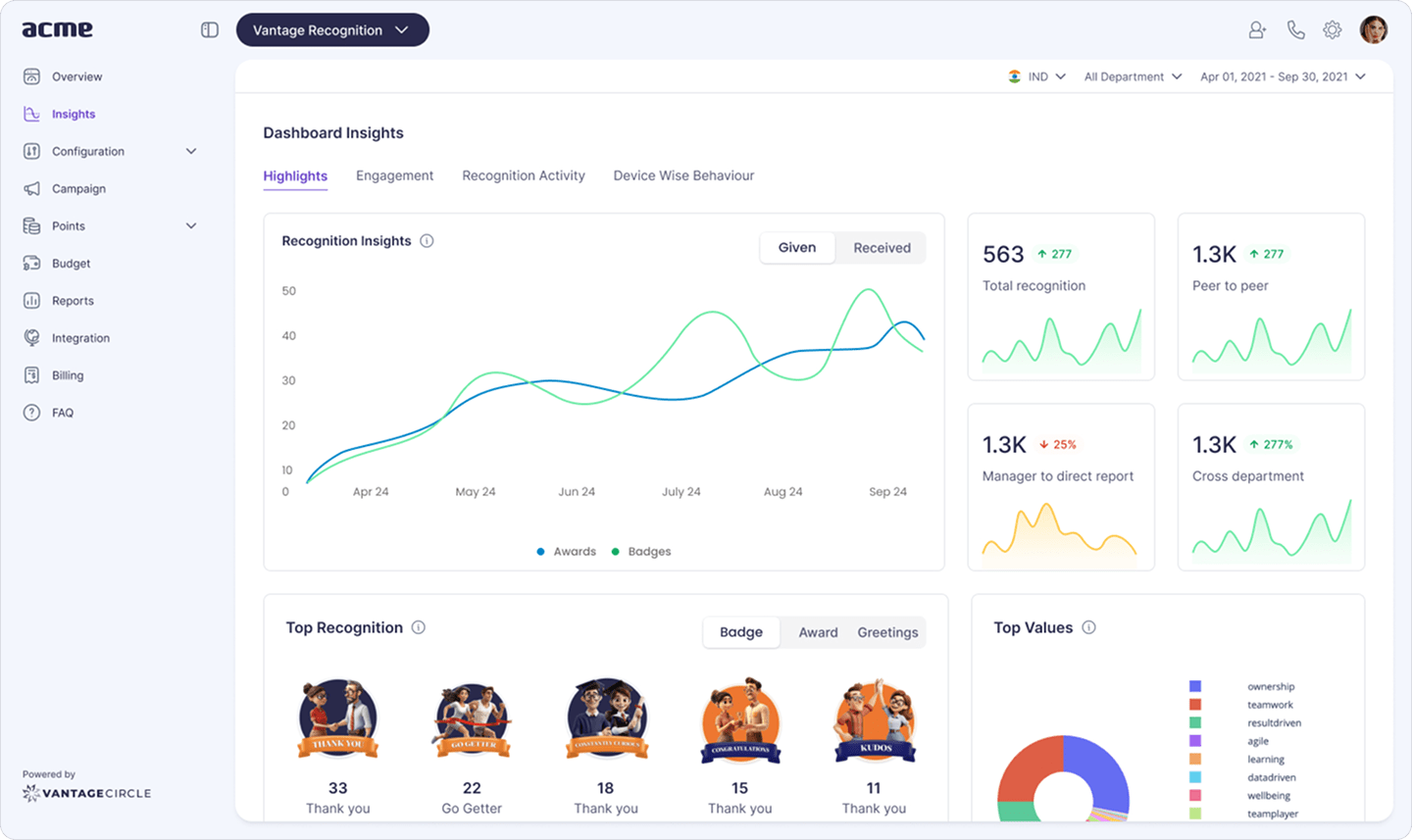
The program audit answers whether the problem is the platform or the program design. Pull your participation rate, recognition frequency by department, manager-to-peer ratio, budget utilization, and redemption rate. If participation is low but managers were never trained and the platform was never properly launched, you may have a program design problem that a new vendor will not fix. Know this before you sign a new contract.
A platform with built-in recognition analytics, like Vantage Rewards, makes this audit faster. Participation, budget, and values data sit in a live dashboard instead of requiring a manual export and spreadsheet build.
The contract audit is equally important and frequently skipped. Check your auto-renewal window (most contracts auto-renew 60-90 days before end of term), your data-export rights, your exit fee structure, and any points-liability clauses. Missing the auto-renewal window is one of the most common and expensive mistakes in a recognition platform switch.
Phase 2 — Build Replacement Criteria as an RFP
A good RFP is a decision filter, not a feature wishlist. Rank your criteria before you send it.
| Criterion | Why It Matters | Weight |
|---|---|---|
| HRIS/SSO Integration | Adoption depends on recognition living inside existing workflows | High |
| Slack/Teams Integration | Peer recognition must happen where work happens | High |
| Data Migration & Points Reconciliation | Vendor must own the migration, not hand it back to you | High |
| Global Rewards Catalog | Multi-currency redemption removes regional exclusion | Medium-High |
| Manager Workflow & Approval Controls | Budget accountability requires structured approval routing | Medium-High |
| Recognition Analytics & Reporting | ROI proof requires participation, budget, and values data | Medium-High |
| Core Values Alignment Tagging | Culture measurement requires recognition tied to specific values | Medium |
| Peer-to-Peer Recognition (P2P) | Bottom-up recognition drives organic adoption | Medium |
| eNPS / Engagement Survey Integration | Baseline and post-switch measurement requires a survey layer | Medium |
| Onboarding & Implementation Support | Dedicated migration support determines switch success rate | High |
The single biggest predictor of adoption after a platform switch is whether recognition lives inside the tools employees already use. Make native HRIS (Human Resource Information System) sync, SSO (Single Sign-On), and Slack or Microsoft Teams integration non-negotiable criteria, not nice-to-haves.
Phase 3 — Plan Data Migration and Points Reconciliation
Migration is where most switches stall.
Before committing to any vendor, get clear answers on four things: who owns the migration end-to-end, what happens to accrued unredeemed points, whether you can export your full recognition history in a portable format, and what the parallel-run plan looks like. Some vendors hand you a data export and step back. The difference between a vendor that owns migration and one that does not is the difference between a 90-day switch and a nine-month one.
Unspent points are a financial liability. The CFO who discovers mid-migration that employees have an unresolved points balance will not be pleased. Your finance and legal teams need to be in this conversation before you give notice.
Vantage Circle assigns a dedicated implementation team that handles points reconciliation and data import, so employees do not lose recognition history when the platform changes.
Phase 4 — Run a Parallel Pilot and Lead Change Management
A switch fails quietly when employees treat the new platform as just another tool. The parallel pilot period is your window to prevent that.
Identify two or three departments with engaged managers and run the new platform in those groups for 30-60 days before the full rollout. Capture what works. Fix what does not. Then bring those managers into the all-company launch as internal champions.
The change management is not the email announcement. The change management is the manager who posts the first recognition on the new feed. The team lead who explains to their direct report why their points balance transferred. The HR leader who runs a lunch session walking people through redemption before the old platform goes dark.
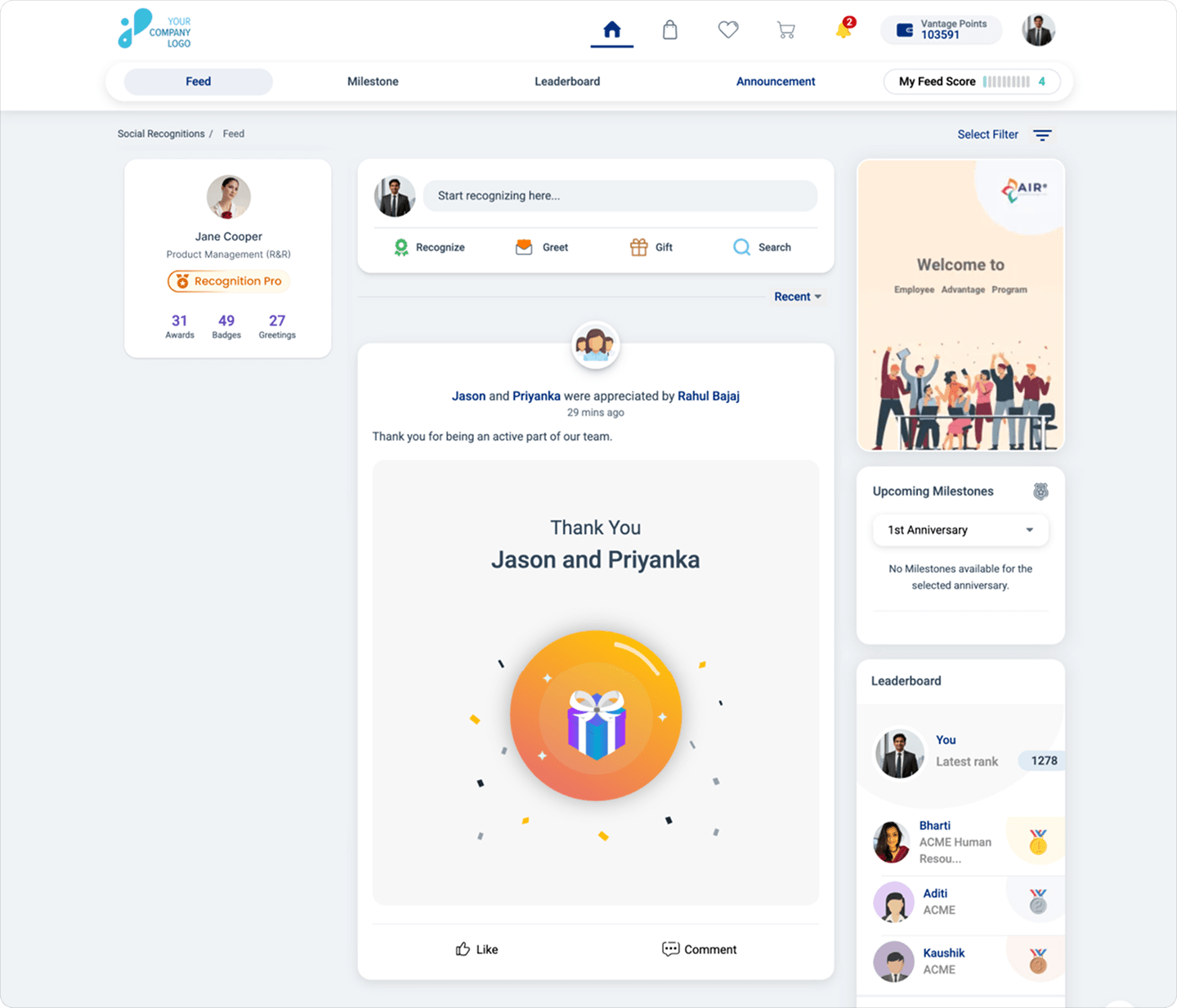
A visible, company-wide recognition feed creates early momentum during the pilot because appreciation becomes public and social rather than private and transactional. That social layer is not a feature preference. It is how you make the switch feel real to employees who have seen three "new tools" come and go.
Phase 5 — Relaunch, Measure Adoption, and Prove ROI
The relaunch is a program launch, not a platform launch. Lead with the recognition story, not the technology.
Set your 30, 60, and 90-day adoption targets before go-live. Participation rate, manager-to-peer ratio, values-tagged recognitions, and redemption rate are the four metrics that will tell you whether the switch is working. Vantage Circle's State of Recognition & Rewards 2025 study found that nine in ten high-effectiveness recognition programs actively track participation, frequency, and behavioral trends, and two in three run on a dedicated online platform. Measurement is not an afterthought of a strong program. It is a defining feature of one.
At 90 days, you need a board-ready number. Tagging every recognition to a company value makes culture quantifiable. Pairing that with participation and budget data lets HR show the lift the new platform delivered rather than just asserting it.
This is where the business case closes. Leadership approved the budget on a promise. A recognition and rewards platform with built-in analytics is how you show them what moved.
What Happens to Unspent Points and Recognition Data When You Switch
This is the question nobody asks until it becomes a problem.
Unspent points are a liability on paper. In some jurisdictions, unredeemed balances carry accounting implications depending on how the program is structured. Your finance team and legal counsel need to sign off on the transition plan before you give notice.
Three scenarios cover most situations. A direct balance transfer is the cleanest outcome: the new vendor imports the existing balance and employees continue spending without interruption. A redemption window gives employees 60-90 days to spend before the old platform closes, but carries the risk of a spike your current vendor will not appreciate. A write-off is the last resort. The employee trust cost far exceeds whatever budget you save.
Historical recognition data is a separate issue. Service anniversary records and long-service award history belong to your organization, not your vendor. Get the full data-portability terms in writing before you sign anything.
3 Questions to Ask Your Current Vendor Before You Give Notice
- What is the exact auto-renewal date in our contract, and what is the notice period required to cancel?
- What format will you export our historical recognition data, and how long will the export be available after contract end?
- How will unredeemed employee points be handled, and is there a redemption window or balance-transfer process available?
Recognition Platform Switching Timeline: A 30-60-90 Day Plan
| Phase | Days | Key Actions and Owner |
|---|---|---|
| Pre-Switch | Days 1-30 | Program and contract audit (HR); RFP build and vendor shortlist (HR + Procurement); Data-portability and points-liability review (Finance + Legal); Stakeholder briefing (HR Director + CFO) |
| Migration | Days 31-60 | Finalist demos and selection; Data-export request to current vendor; Migration planning with new vendor; Parallel pilot in 2-3 pilot departments; Manager champion identification and training |
| Relaunch | Days 61-90 | Full platform go-live; Employee comms campaign and manager briefings; Old platform sunset communication; 30-day adoption baseline measurement; Post-relaunch eNPS survey (60-90 days post-switch) |
Red Flags to Check in Your Current Vendor Contract
Contract terms end more recognition platform switches than vendor capability does. Before you start an RFP, read the following clauses carefully.
Auto-renewal windows are the most common trap. Most enterprise recognition contracts auto-renew 60-90 days before the end of the contract term. If you miss that window, you are locked in for another year. Check your contract today, not when you have selected a replacement.
Exit fees are real and occasionally significant. Some vendors charge a percentage of annual contract value as an exit fee. Others bundle in "implementation credits" that are clawed back on early termination. Model the true cost of exit before you finalize your switching decision.
Data-export clauses determine what you can take with you. A contract that gives the vendor ownership of recognition data, or that does not guarantee export in a portable format, is a negotiation you want to have before you are under time pressure. The time to fix this is the renewal conversation before you need to leave, not the exit meeting.
SLA (Service Level Agreement) gaps during transition matter more than people expect. Make sure your current contract covers you through your planned transition period, and confirm your new vendor's SLA terms before the old contract lapses.
How to Evaluate Vantage Circle as Your Replacement Platform
When you apply the 5-phase framework as your evaluation lens, a few things become non-negotiable fast.
The audit phase requires a platform with live analytics, not manual exports. Vantage Rewards gives HR participation rate, budget utilization, and values-tagged data in a single dashboard, which means your business case is built from evidence rather than assumptions.
The RFP phase will surface HRIS, SSO, and Slack or Microsoft Teams integration as high-weight criteria for almost every enterprise buyer. Vantage Circle's integration layer is built so recognition happens in the flow of work rather than in a separate tab employees forget to open.
Migration support is where most switches fail or drag. Vantage Circle assigns a dedicated implementation team that owns points reconciliation and data import end-to-end. The switch does not fall back on HR to manage.
The proof shows up in adoption numbers. When Wipro rebuilt its recognition program, Winners' Circle, with Vantage Circle, 57% of its 230,000-plus employees received recognition within a single year, and non-monetary awards rose 97.5% between 2021 and 2023. That is what a structured switch looks like at enterprise scale.
For global organizations, a multi-currency rewards catalog with localized redemption across 100-plus countries removes the regional-exclusion objection before it reaches the RFP stage.
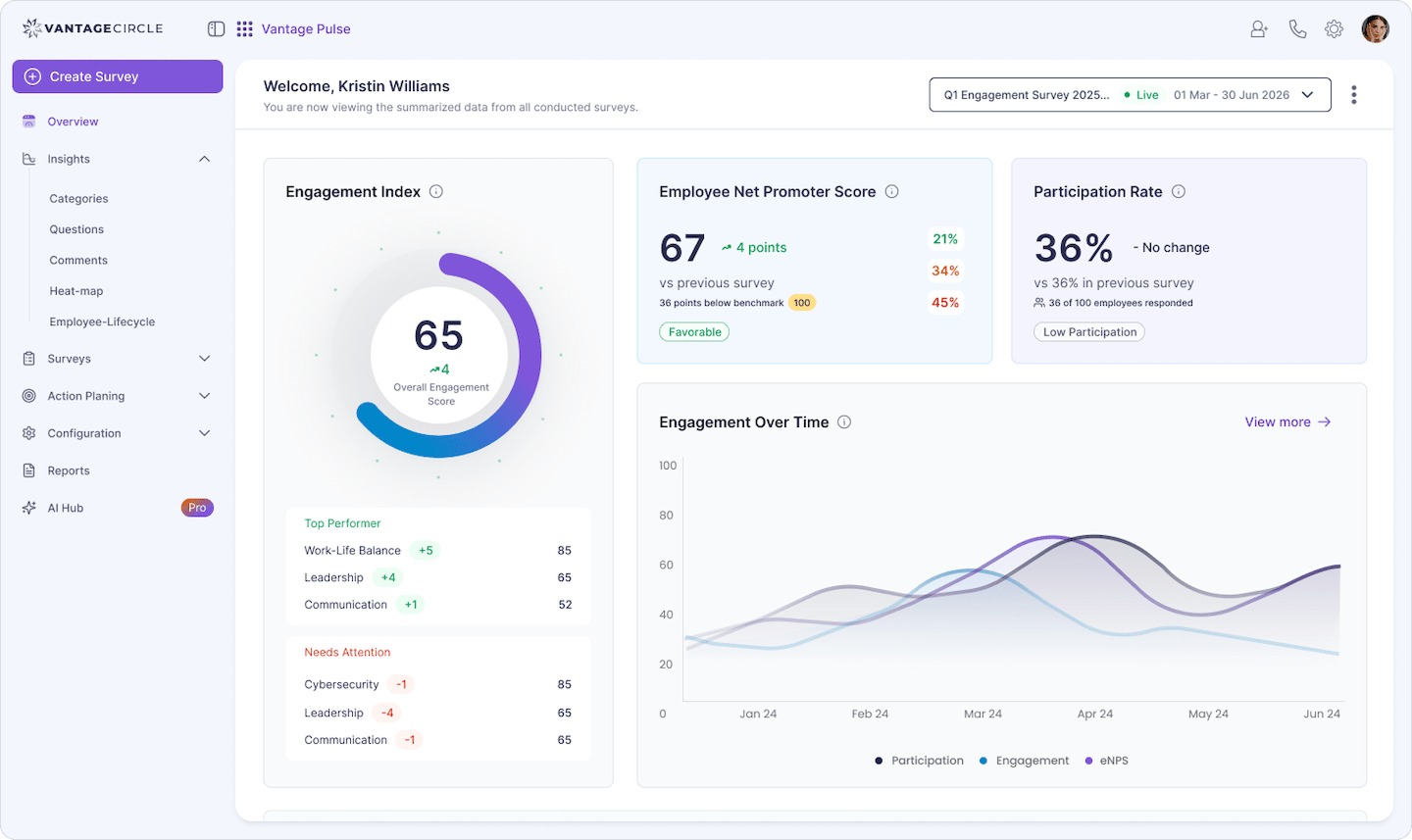
The eNPS (employee Net Promoter Score) survey layer in Vantage Pulse lets HR baseline engagement before migration and measure lift at 90 days post-relaunch. That before-and-after number is what turns a platform switch from a budget line into a business case.
The Switch Is a Decision. Run It Like One.
The HR leaders I have seen navigate platform switches well share one characteristic: they treated it as a project with a timeline and an owner, not as something that would eventually resolve itself.
Your current platform's shortcomings will not improve on their own. Low adoption does not become high adoption because another year passes.
The 5 sequential phases protect your data, your employees' points, and your program's adoption through the transition. The contract checklist prevents the mistakes that extend timelines by six months. The 30-60-90 day plan gives leadership a concrete view of what happens between today and go-live.
The only thing that makes a platform switch genuinely risky is running it without a process.
Frequently Asked Questions
Q1. What's the best employee recognition platform?
A. The best employee recognition platform is the one that integrates into the tools your employees already use, delivers a global rewards catalog that covers your workforce, and provides analytics that let HR prove ROI. Vantage Circle, Workhuman, and Achievers consistently rank among enterprise platforms for breadth of integration and program design support. The right choice depends on your organization's size, geography, and existing HR technology stack.
Q2. What are the 5 C's of retention?
A. The 5 C's of employee retention are Compensation, Career development, Connection, Conditions, and Culture. Recognition platforms directly support the Connection and Culture pillars by making appreciation visible, frequent, and tied to the values the organization claims to hold. Gallup's 2024 recognition research found that well-recognized employees were 45% less likely to have left their organization after two years.
Q3. What are the 3 R's of employee retention?
A. The 3 R's of employee retention are Recognition, Reward, and Respect. Recognition covers acknowledgment of effort and achievement. Reward covers the tangible or financial component of appreciation. Respect covers the broader experience of feeling valued by managers and peers. Recognition programs that collapse these three into a single mechanism tend to underperform because they conflate different employee needs.
Q4. What are the 4 types of recognition in the workplace?
A. The four primary types of recognition in the workplace are peer-to-peer recognition, manager recognition, milestone and tenure recognition, and performance-based recognition. Effective recognition programs use all four rather than relying on a single channel. O.C. Tanner's 2023 Global Culture Report found that when recognition is integrated across the organization rather than limited to a single channel, the odds of high engagement rise by 784% and employee attrition falls by 29%.
Q5. What is a common mistake in employee recognition programs?
A. The most common mistake in employee recognition programs is designing the program around the platform rather than around the behavior you want to reinforce. A recognition tool that is hard to use will sit unused. A program that recognizes the same five employees every quarter will disengage everyone else. The second most common mistake is launching without manager training. Managers are the highest-leverage recognition channel in any organization, and platforms without manager adoption have a ceiling.
Q6. What are the top 5 HRIS systems for employees?
A. The top HRIS (Human Resource Information System) systems used at enterprise scale are Workday, SAP SuccessFactors, Oracle HCM Cloud, ADP Workforce Now, and UKG Pro. The relevance for recognition platform selection: your recognition vendor's integration with your specific HRIS is more important than its overall feature list. A recognition platform that does not sync with your HRIS creates a data management burden that will eventually fall back on HR.
Thinking About Switching Recognition Platforms?
See how Vantage Circle runs a structured switch. A dedicated implementation team owns points reconciliation and data migration, so recognition history and employee point balances move across without loss. Book a walkthrough and we will map the switch to your current contract and timeline.

He has worked in the human resources environment and has elevated recognition and rewards through his insightful and detailed writing. He aims to enhance the practice of Recognition in the workplace with new ideas and innovation that will help shape the work culture. For any related queries, contact editor@vantagecircle.com