
Employee satisfaction is how content employees are with their job conditions, including pay, workload, environment, and management. It measures contentment, not effort. Research puts its correlation with job performance at roughly .30, which makes satisfaction a real but partial predictor of how people actually work.
That number is worth sitting with, because the advice around employee satisfaction splits into two camps.
One camp treats satisfaction as the thing that drives everything. Productivity, retention, customer experience, all of it. The other camp, with Gallup among the loudest voices, argues satisfaction is the wrong metric and you should be measuring employee engagement instead.
Both camps are reading the same evidence. Neither is quite right. What the research shows is more useful than either position, and it changes how you should build your program.
Key Takeaways
- Satisfaction predicts performance at a correlation of about .30. Real, but weaker than most vendor content implies.
- Satisfaction and dissatisfaction are separate dimensions, not two ends of one scale. Fixing pay stops complaints without creating satisfaction.
- Satisfaction measures contentment. Engagement measures discretionary effort. A workforce can be high on one and low on the other.
- Validated instruments like the Job Descriptive Index measure satisfaction by facet, which tells you where the problem sits. A single score does not.
- The factors that keep people from leaving are not the factors that make them give more.
What is Employee Satisfaction?
Employee satisfaction is the degree to which employees feel content with their job and the conditions around it. It reflects an appraisal of what the job gives them against what they expected from it.
That appraisal draws on several things at once:
- Pay and benefits
- Workload and working conditions
- Relationships with managers and peers
- Opportunities to grow
- Whether the work itself feels worth doing
Satisfaction sits alongside three terms that get used interchangeably and should not be. Employee morale describes the collective mood of a team rather than an individual's appraisal. Happiness describes a passing emotional state. Engagement describes effort. Satisfaction describes contentment with conditions.
The distinction matters operationally. A satisfied employee is one who has no strong complaint. That is a lower bar than it sounds, and it is one reason for a pattern most HR leaders recognize: satisfaction scores that look healthy while attrition climbs anyway.
Employee Satisfaction vs. Employee Engagement
Employee satisfaction measures how content people are with their conditions. Employee engagement measures how much discretionary effort they choose to give. The two move independently, which is why measuring only one produces a misleading picture.
| Dimension | Employee Satisfaction | Employee Engagement |
|---|---|---|
| What it measures | Contentment with job conditions | Emotional commitment and discretionary effort |
| What it predicts well | Complaint levels, short-term stability | Performance, initiative, advocacy |
| Typical instrument | Facet surveys, satisfaction indices | Engagement surveys, behavioral data |
| Time horizon | Reflects current conditions | Reflects sustained relationship with the work |
| What improves it | Removing friction, fixing conditions | Meaning, recognition, growth, autonomy |
| What it fails to predict | Discretionary effort and advocacy | Whether basic conditions are acceptable |
Gallup makes this argument forcefully, publishing a piece titled The Right Culture: Not About Employee Satisfaction. Its position is that satisfaction asks whether people are comfortable, which is not the same as asking whether they are contributing.
That critique lands. But it argues for measuring both, not for discarding satisfaction. Satisfaction data tells you whether your conditions are costing you people. Engagement data tells you whether your culture is earning their effort. If you want the fuller comparison, we cover how experience and engagement differ separately.
What the Research Actually Shows About Employee Satisfaction
The academic evidence on employee satisfaction is clearer than the vendor literature suggests, and it qualifies two claims that get repeated as settled fact.
The Satisfaction and Performance Link is Real but Moderate
Satisfied employees do perform better, but the effect is moderate rather than decisive. The most comprehensive review of this question found a mean true correlation of .30 between overall job satisfaction and overall job performance.
That figure comes from Judge, Thoresen, Bono, and Patton (2001), published in Psychological Bulletin, which meta-analyzed 312 samples with a combined sample of 54,417 people.
A correlation of .30 is meaningful. It is also far from total. It means satisfaction accounts for part of the variation in performance and leaves most of it to other causes such as capability, role clarity, management quality, and resourcing. If your performance problem is a resourcing problem, raising satisfaction will not fix it.
Satisfaction and Dissatisfaction are Not Opposites
Satisfaction and dissatisfaction are produced by different factors, so removing a source of unhappiness does not create happiness. This is the finding that changes program design, and almost nothing written about employee satisfaction mentions it.
Frederick Herzberg's research, summarized in his One More Time: How Do You Motivate Employees?, concluded that satisfaction and dissatisfaction are driven by different factors and operate on separate scales.
Herzberg split them into two groups:
- Hygiene factors cause dissatisfaction when they are missing or poor. Pay, company policy, working conditions, job security, supervision quality.
- Motivators create satisfaction when they are present. Achievement, recognition, responsibility, growth, the work itself.
The practical consequence is that removing a hygiene problem does not create satisfaction. It returns you to neutral.
If your satisfaction program is built entirely on pay, benefits, and working conditions, it will reduce complaints and then plateau. Those are hygiene factors. They stop people from being unhappy. They do not make people satisfied, and on their own they are unlikely to lift performance.
This explains a pattern that frustrates a lot of HR teams. Compensation gets reviewed, benefits get improved, the office gets refurbished, and the satisfaction score moves once and then flattens. The budget went into the column that prevents dissatisfaction, not the column that creates satisfaction.
What Drives Employee Satisfaction
Employee satisfaction is driven by two different categories of factor, and treating them as one list is the most common design mistake. Sorting your drivers into hygiene and motivators tells you which lever you are actually pulling.
Hygiene Factors: What Prevents Dissatisfaction
These are the conditions employees expect as a baseline. Meeting them removes a reason to leave. It does not give anyone a reason to stay.
- Competitive pay and benefits. Review against the market regularly. Pay that falls behind becomes a live complaint quickly.
- Working conditions and workload. Sustainable hours and adequate resourcing.
- Work-life balance. Flexible schedules, remote options, genuine permission to take time off.
- Supervision quality. A manager who is fair and available.
- Job security. Clarity about where the business and the role are going.
Motivators: What Creates Satisfaction
These are the factors that lift someone above neutral. They cost less than the hygiene list and get a fraction of the attention.
- Recognition. Being told, specifically and credibly, that the work mattered.
- Achievement. Finishing something difficult and knowing it landed.
- Responsibility. Ownership of outcomes rather than tasks.
- Growth. Employee training programs, stretch assignments, mentorship, and visible career paths.
- The work itself. Whether the job is interesting enough to hold attention.
When employees consistently feel Appreciated, Accepted, Validated, and Accomplished, motivation rises by 18 percentage points, intent to stay by 16, agility by 14, and customer excellence by 11, according to The State of Recognition & Rewards 2025 (Vantage Circle).
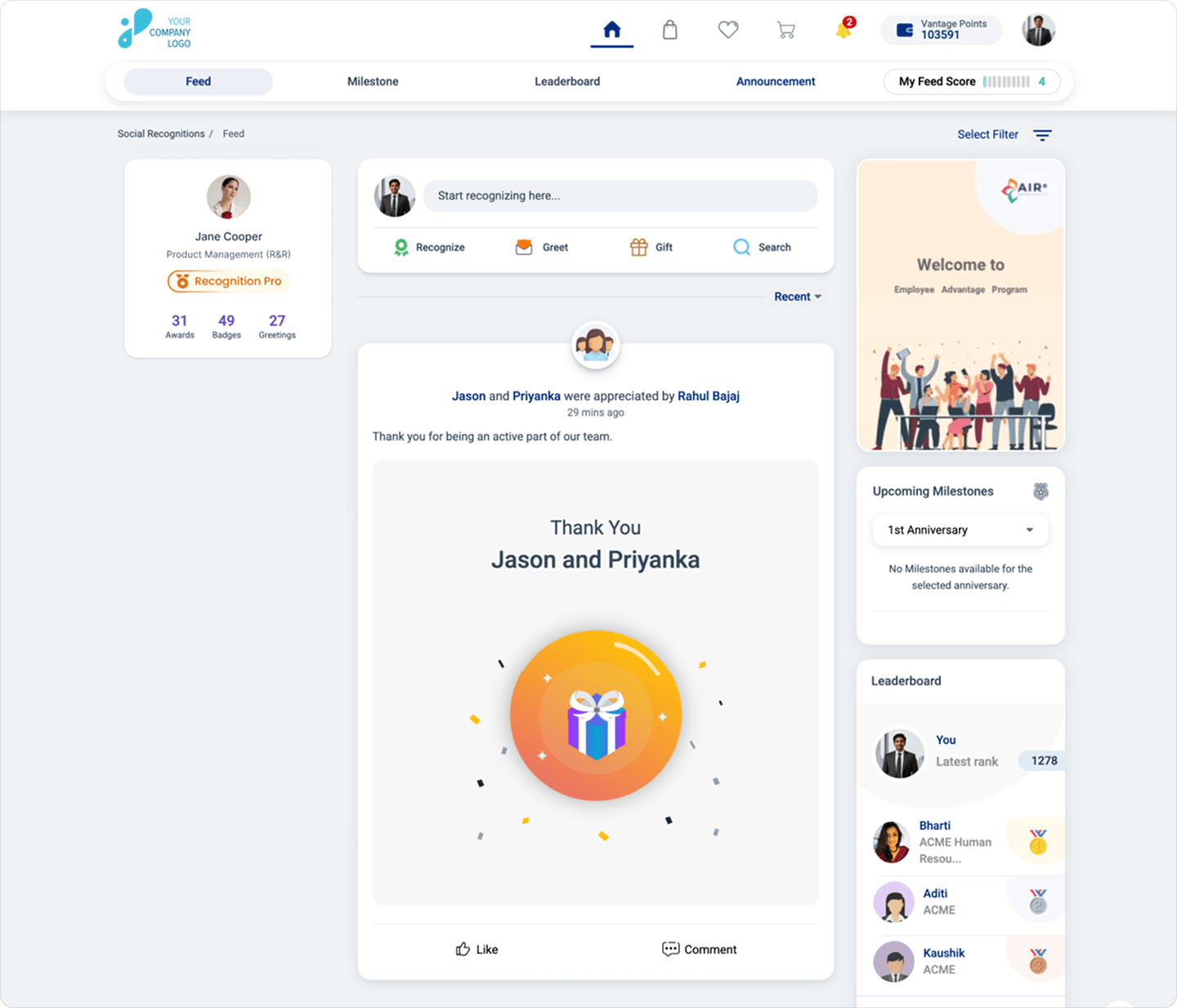
Recognition sits in the motivator column, which has an operational consequence worth naming. If only managers can recognize, the amount of recognition any employee can receive is capped by one person's attention. Peer-to-peer recognition lifts that ceiling, which is why platforms like Vantage Recognition, Vantage Circle's employee recognition platform, are built around giving everyone the ability to recognize rather than routing it all through the org chart.
How to Measure Employee Satisfaction
Employee satisfaction is measured through structured surveys, loyalty metrics, and qualitative methods, and no single instrument covers the ground on its own. Each one captures something different and fails in a different way.
| Method | What it captures | Cadence | Main failure mode |
|---|---|---|---|
| Facet survey (e.g., JDI) | Satisfaction split by specific area of the job | Annual or semiannual | Too long to run often |
| Employee Satisfaction Index | A single trackable score | Quarterly | Tells you the score moved, not why |
| eNPS | Willingness to recommend the employer | Monthly or quarterly | One number, no diagnosis |
| Pulse survey | Short-cycle movement on a few questions | Monthly | Survey fatigue if overused |
| Focus group | Reasons behind the numbers | As needed | Small sample, needs a skilled moderator |
| Exit interview | What finally broke the relationship | On departure | Arrives too late to act on |
Facet Instruments: The Job Descriptive Index
A facet instrument measures satisfaction separately for each part of the job, so a low overall score points you somewhere specific rather than leaving you guessing.
The Job Descriptive Index, owned and maintained by Bowling Green State University, is the best known of these. It measures satisfaction across five facets: the work itself, pay, promotion opportunities, supervision, and coworkers. It is free to download for research and workplace use, and scores can be compared against a nationally representative sample of United States workers.
That benchmark is the part most internal surveys cannot offer. Knowing your pay-satisfaction score is 3.2 means little. Knowing it sits below the national norm while your supervision score sits above it tells you where to spend.
Employee Satisfaction Index (ESI)
The Employee Satisfaction Index (ESI) converts three questions into a single score between 0 and 100, which makes it easy to track over time.
The three questions ask how satisfied employees are with the workplace, how well it meets their expectations, and how close it is to their ideal workplace. Each is answered on a 1 to 10 scale. The mean is then converted with a standard formula:
ESI = ((mean score − 1) ÷ 9) × 100
A mean of 8 produces an ESI of 77.8. The index is useful for trend lines and useless for diagnosis, which is why it belongs next to a facet instrument rather than instead of one.
Employee Net Promoter Score (eNPS)
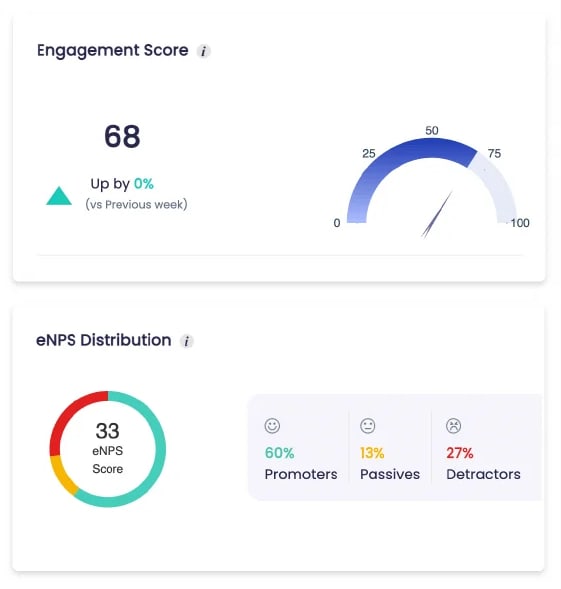
The employee Net Promoter Score (eNPS) asks one question: how likely are you to recommend this company as a place to work? It is the lightest-weight satisfaction signal available.
Responses are scored on a scale, then the percentage of detractors is subtracted from the percentage of promoters. Vantage Pulse, Vantage Circle's employee engagement and pulse survey tool, runs this on a repeating cycle so the number becomes a trend rather than a snapshot.
Surveys, Pulse Checks, and Exit Interviews
A full employee satisfaction survey goes deeper than a single index, using rating scales and open text to cover the whole experience. Pulse surveys run shorter and more often, catching movement between the long surveys.
Focus groups of six to twelve employees explain the numbers the surveys produce. Run them after a survey, not instead of one, and use a moderator people will speak honestly in front of.
Exit interviews capture what finally ended the relationship. They are also the least actionable, because the person is already gone. Treat them with some caution, since departing employees often soften their answers to protect a reference. Read patterns across many exits as the signal, not any single conversation.
Keep satisfaction surveys anonymous and short. Anonymity is what makes the answers worth collecting, and length is what kills your response rate.
How to Improve Employee Satisfaction
Improving employee satisfaction means working both columns at once: removing the conditions that generate complaints, then adding the factors that lift people above neutral. Here are five actions that do that.
1. Benchmark Compensation Before You Raise It
Review pay and benefits against market data on a fixed schedule rather than in response to resignations. Pay that has quietly fallen behind is one of the fastest-acting hygiene problems there is. Fixing it stops attrition driven by dissatisfaction, and it stops there.
2. Make Recognition Frequent and Peer-Driven
Recognition is a motivator, so it does work that compensation cannot. The constraint is usually frequency, not sincerity. Build it into the week rather than the quarter, and let peers give it as well as managers.
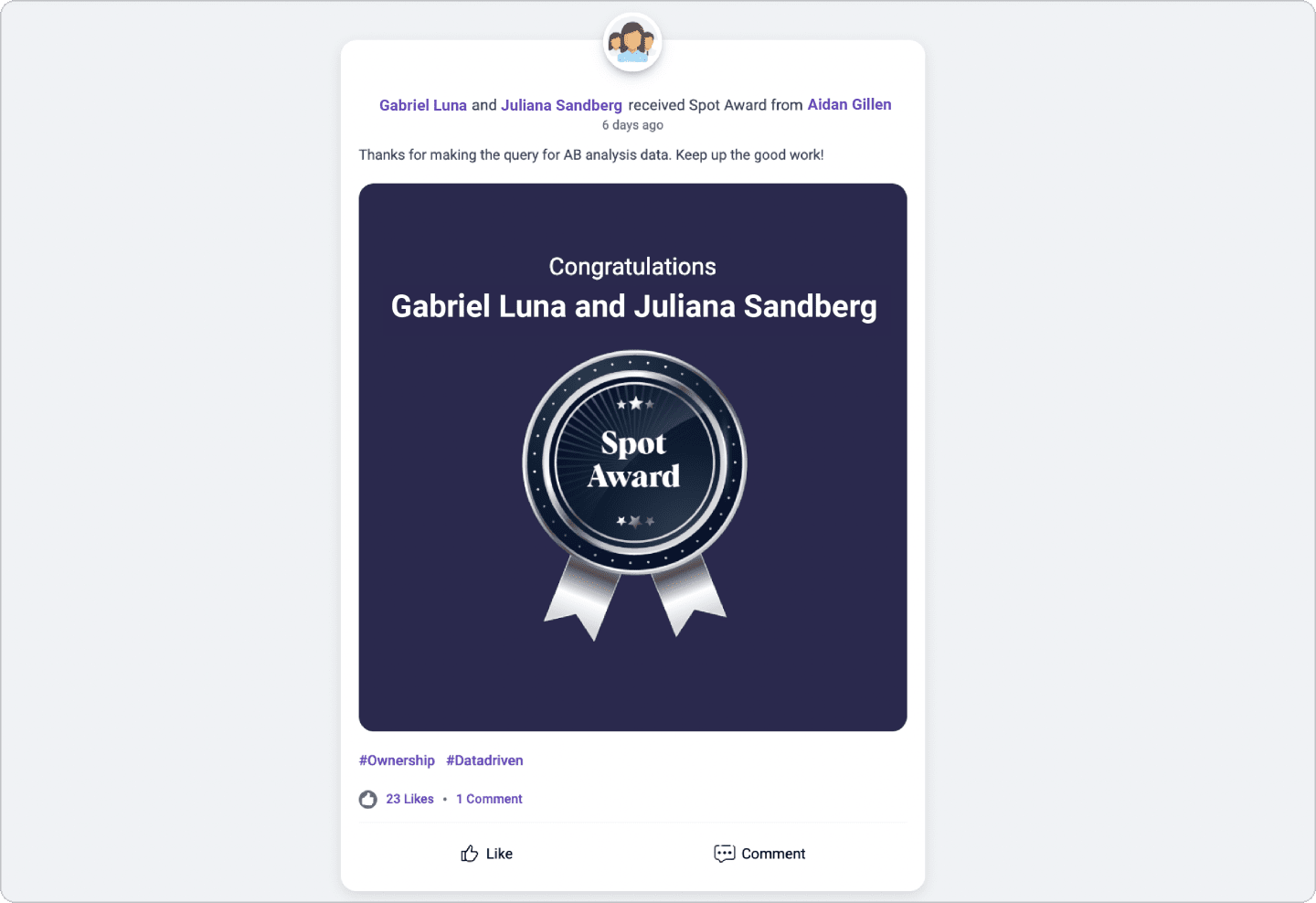
Spot awards work well here because they close the gap between the behavior and the acknowledgment. A thank-you three months later is a record. A thank-you the same week is a signal.
The expectations placed on recognition are high. Companies overwhelmingly cite engagement (92%), retention (90%), and productivity (89%) as objectives of their Recognition & Rewards programs, according to The State of Recognition & Rewards 2025 (Vantage Circle). Frequency is what decides whether a program gets anywhere near them.
3. Give People Ownership, Not Just Tasks
Responsibility is one of Herzberg's motivators and one of the cheapest to grant. Hand someone an outcome and the authority to reach it. Stretch assignments, project leadership, and decision rights all do this without a budget line.
4. Build Visible Career Paths
Employees are more satisfied when advancement looks possible rather than theoretical. Map the routes, name the skills each one requires, and make the next step legible. Training that leads nowhere visible reads as a perk, not a path.
5. Act on the Survey, Then Say So
The fastest way to depress satisfaction is to ask people what is wrong and change nothing. Close the loop out loud. Publish what you heard, what you are changing, and what you are not changing and why. That last part matters more than teams expect.
Recommended Resource: See how Vantage Circle supports recognition and employee listening.
Worth naming here: satisfaction improvements do not automatically reduce employee turnover. People leave satisfying jobs for better ones. Satisfaction removes a push factor. It does not remove the pull.
Where Satisfaction Measurement Goes Wrong
Most satisfaction measurement fails for three reasons, and each one maps to a failure mode in the methods table above.
Unreliable data. If employees believe responses can be traced back, they answer the question they think is safe. Anonymity is not a courtesy. It is what makes the instrument work. Survey fatigue does the same damage more slowly.
Low participation. A 30% response rate does not describe your workforce. It describes the 30% with an opinion strong enough to act on. Explain what the last survey changed, keep the current one short, and participation usually recovers.
Misread results. A single score moving tells you almost nothing about why. Pair quantitative results with employee feedback gathered in conversation, and resist reading a trend from one data point.
Open Communication in Practice
Open communication is one of the few interventions that work on hygiene and motivation at the same time, because it removes a source of frustration while giving people genuine responsibility.
Writing in 2018, Jacob Morgan described a practice he observed at Airbnb, where company-wide meetings made room for three categories of difficult topic:
- Elephants: the big issues nobody is raising.
- Dead fish: past grievances people have not moved past.
- Vomit: things people need to say out loud, with no resolution expected.
The mechanism is simple. Naming the categories gives people permission to raise what they would otherwise carry quietly. Morgan's account is now several years old and reflects one observer's view of one company, so treat it as an illustration of the principle rather than a benchmark.
Summing It Up
Employee satisfaction is worth measuring, and it is worth measuring honestly. It correlates with performance at about .30, which makes it one input among several rather than the whole story.
The practical takeaway is Herzberg's. The factors that stop people from being dissatisfied are not the factors that make them satisfied. Most programs spend heavily on the first column and wonder why the score plateaus.
Fix the conditions so nobody has a reason to complain. Then build the recognition, responsibility, and growth that give people a reason to stay. Measure both, with an instrument that tells you where the problem sits.
FAQ
What is meant by employee satisfaction?
Employee satisfaction is how content employees feel with their job and its conditions, including pay, workload, management, and environment. It reflects an appraisal of what the job delivers against what the employee expected from it. It measures contentment rather than effort.
What are the 5 keys to job satisfaction?
The five most consistently cited drivers are meaningful work, fair compensation and benefits, a supportive work environment, opportunities for growth and advancement, and work-life balance. Research suggests they do not all work the same way. Pay and conditions mainly prevent dissatisfaction, while meaningful work and growth actively create satisfaction.
What is the difference between employee satisfaction and engagement?
Satisfaction measures how content employees are with their conditions. Engagement measures the discretionary effort they choose to give. An employee can be satisfied and unengaged, which looks like someone who has no complaints and does exactly what the role requires.
How do you measure employee satisfaction?
Use a facet survey such as the Job Descriptive Index to see which parts of the job score poorly, a satisfaction index or eNPS to track movement over time, and focus groups to explain the numbers. No single method covers diagnosis and trend tracking at once.
What is a good employee satisfaction score?
On the Employee Satisfaction Index, scores above 70 are generally read as strong and scores below 50 as needing urgent attention. The more useful comparison is against your own trend and against a published benchmark for your market, rather than against a universal threshold.

Nilotpal M Saharia is an Assistant Manager, Content Marketing at Vantage Circle and a recognition-and-rewards (R&R) strategist with 9 years of experience spanning Marketing, HR, and content strategy. He helps HR leaders turn employee recognition and leadership research into practical workplace programs.
Connect with Nilotpal on LinkedIn.