

Organizations have never invested more in employee engagement.
Recognition programs, wellness benefits, learning opportunities, pulse surveys, manager training, flexible work policies, the list of employee engagement initiatives continues to grow.
Yet engagement remains a challenge.
Gallup's State of the Global Workplace 2026 report shows that 80% of the global workforce is either not engaged or actively disengaged at work, the lowest engagement level since 2020. At the same time, *The Recognition Effect* (Great Place to Work India x Vantage Circle, 2025), based on 5.7 million employee voices across 1,810+ organizations, found that only 55% of employees feel fully recognized at work.
The gap is revealing.
Most organizations aren't struggling because they lack engagement programs. They're struggling because employees don't consistently feel seen, heard, developed, or connected to their work.
The organizations getting engagement right focus on a handful of fundamentals: recognition, feedback, growth, trust, and belonging. When these elements work together, engagement becomes a measurable business advantage. Not just an HR goal.
In this guide, we'll explore 15 employee engagement initiatives that help organizations strengthen those fundamentals, along with practical tactics, research-backed insights, and ways to measure success.
Key Takeaways
- Why Companies Invest in Employee Engagement Initiatives
- 15 Proven Employee Engagement Initiatives
- How to Measure the Impact of Your Engagement Initiatives
What Are Employee Engagement Initiatives?
Employee engagement initiatives are structured programs, policies, and practices organizations put in place to strengthen employees' emotional connection to their work, team, and company. Unlike one-off perks, effective initiatives are consistent, measurable, and tied to business outcomes: from reducing turnover to improving productivity and innovation.
Why Companies Invest in Employee Engagement Initiatives

Disengaged employees are one of the costliest liabilities on any balance sheet. Gallup estimates that actively disengaged employees cost the global economy $8.8 trillion in lost productivity each year, equivalent to 9% of global GDP.
Employee turnover carries a steep additional price tag. Replacement costs range from 50% to 200% of annual salary per role (SHRM). Research also shows that employee satisfaction alone is not enough. 88% of satisfied employees still plan to leave within a year. The return on employee engagement is equally clear. Companies with highly engaged employees see:
- 23% higher profitability
- 41% lower absenteeism
- 18% higher productivity
- Up to 43% lower turnover in high-turnover industries
(Source: Gallup Q12 Meta-Analysis)
Engagement is no longer optional. It's a growth lever that separates market leaders from everyone else.
15 Proven Employee Engagement Initiatives

Each initiative below includes what it is, specific tactics, and one research-backed stat. Use the list to identify which initiatives match your current gaps.
1. Recognition and Reward Programs
Recognition is the fastest lever HR has for shifting engagement. When it's timely, visible, and genuine, it doesn't just feel good. It changes retention outcomes.
- Build peer-to-peer recognition platforms that let employees appreciate colleagues publicly
- Create spot awards tied to company values for real-time contributions
- Mix monetary (reward points, gift cards) and non-monetary (digital badges, certificates) recognition
- Post recognitions on a company-wide social feed so appreciation is visible, not buried in private emails
Recognition remains one of the most underutilized engagement levers. Most programs run intermittently, tied to performance reviews or manager discretion, rather than as a consistent daily practice. The Recognition Effect study (Great Place to Work India x Vantage Circle, 2025, 5.7M employee voices) measured the gap between high-recognition and emerging-recognition cultures across retention, motivation, and customer service. The difference isn't the size of the reward. It's the consistency, visibility, and meaning attached to recognition moments.
In high-recognition cultures, 92% of employees express intent to stay compared to 76% in organizations with emerging recognition culture. Motivation scores are 91% vs 73%, and customer service excellence reaches 94% vs 78%. (The Recognition Effect, Great Place to Work India x Vantage Circle, 2025, 5.7M employee voices)

2. Career Development and Learning Pathways
Employees don't just want compensation. They want a future they can see from where they're currently sitting.
- Build mentorship programs that connect emerging talent with senior leaders
- Create targeted learning pathways for technical upskilling and leadership readiness
- Make internal mobility opportunities transparent with open job boards and clear promotion criteria
- Offer personalized L&D budgets employees control for courses, certifications, and conferences
94% of employees say they would stay longer if their employer invested in their learning and growth (LinkedIn Workplace Learning Report, 2023).
AT&T invested $1 billion in its Future Ready reskilling initiative, partnering with Coursera and Georgia Tech to retrain 200,000+ employees in data science, cybersecurity, and Agile engineering. Employees who completed the program were four times more likely to earn a promotion (CNBC).
3. Employee Feedback and Pulse Surveys
You can't improve what you don't measure. Annual surveys are too slow to catch disengagement before it becomes attrition.
- Run quarterly or monthly pulse surveys (5 to 8 questions, anonymous, with eNPS scoring)
- Share results with employees and announce actions taken. Closing the loop is what builds trust, not the survey itself.
- Segment data by department, tenure, and manager to surface hidden gaps
- Pair survey scores with recognition frequency and turnover data for a fuller picture
Organizations that act on employee feedback see engagement improve significantly faster than those that collect data but never respond (Deloitte Human Capital Trends).
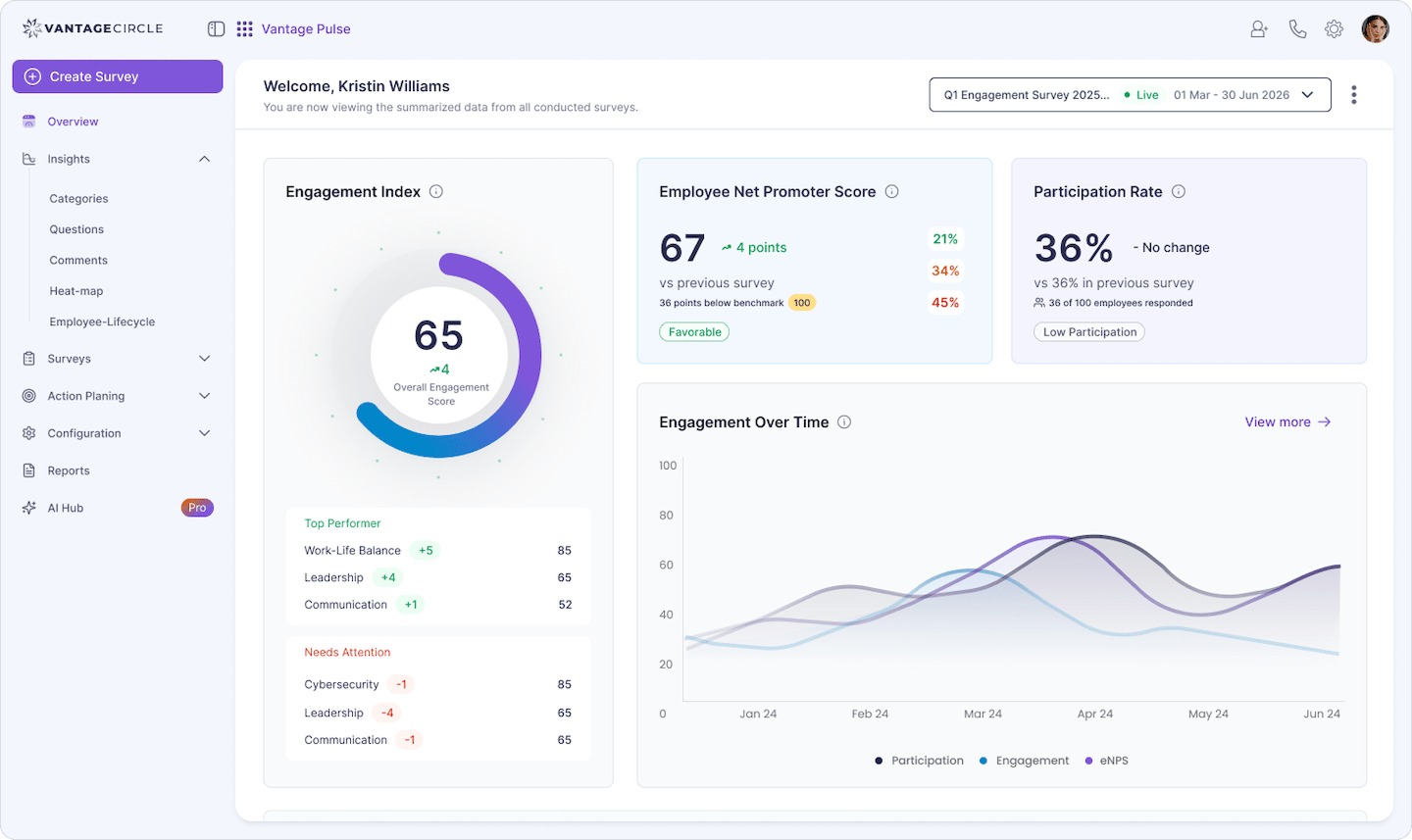
Vantage Pulse delivers anonymous eNPS-based surveys with visual dashboards. HR can see where engagement is slipping before it shows up in exit interviews.
4. Manager 1:1 and Coaching Programs
Employees don't leave companies. They leave managers. 70% of team engagement is determined by the direct manager (Gallup).
- Establish a weekly or biweekly 1:1 cadence as a company-wide standard, not an individual manager choice
- Train managers to coach rather than just supervise: active listening, goal-setting, recognition behaviors
- Use manager effectiveness scores from pulse surveys to identify coaching gaps early
- Build leadership pipelines that develop emotional intelligence alongside technical skills
High-potential employees are 3.7x more likely to leave within the year if their manager doesn't provide regular growth opportunities (DDI Global Leadership Forecast 2025).
Recognition, feedback, and manager coaching create the foundation of engagement. The next set of initiatives focuses on employee well-being and sustainability, ensuring people can perform without burning out.
5. Health and Wellness Programs
Burnout and poor health don't just affect individuals. They drain teams. The WHO estimates depression and anxiety cost the global economy $1 trillion a year in lost output.
- Provide mental health benefits: therapy access, Employee Assistance Programs (EAPs), stress management workshops
- Offer physical employee wellness programs: fitness subsidies, step challenges, on-site or virtual gym access
- Run proactive manager check-ins to monitor team well-being, not just performance metrics
- Set clear expectations around after-hours communication to protect recovery time
6. Work-Life Balance Initiatives
"Always on" culture doesn't produce high performers. It produces burned-out employees who are already mentally out the door.
- Offer flexible work options: remote, hybrid, flexible hours, or compressed workweeks
- Implement no-meeting windows or meeting-free days to protect focused work time
- Build family support into benefits: childcare assistance, generous parental leave, emergency backup care
- Normalize mental health days as a leadership behavior. When managers use them, it signals safety for everyone else.
7. Onboarding and 90-Day Engagement Programs
Engagement is won or lost in the first 90 days. New hires who feel overwhelmed or invisible early are the most likely to leave within a year.
- Assign a buddy or peer mentor to every new hire for the first 90 days
- Create structured check-ins at day 30, 60, and 90. Not just the first week orientation.
- Immerse new hires in culture deliberately: recognition norms, company values, team rituals
- Give managers a 90-day engagement playbook so the experience isn't improvised
Organizations with strong onboarding programs see 82% better new hire retention and 70% higher new hire productivity (Brandon Hall Group).
8. Transparency and Communication Programs
Employees who feel informed and included are 5x more likely to be engaged (Willis Towers Watson). Most organizations communicate strategy to leadership and hope it trickles down. It doesn't.
- Run regular all-hands meetings where leadership shares strategy updates and company performance data openly
- Create an AMA (Ask Me Anything) channel where employees can submit questions directly to executives
- Build two-way communication norms: listening sessions, skip-level meetings, anonymous suggestion channels
- Share wins, losses, and decisions openly. Transparency builds the trust that engagement runs on.
9. Social Connection and Community Building
Employees with strong workplace relationships are 12x more likely to be engaged (BetterUp). Gallup consistently finds that having a "best friend at work" is one of the strongest predictors of engagement and retention.
- Build affinity groups and Employee Resource Groups (ERGs) around shared interests or identities
- Create cross-functional project teams that connect people outside their day-to-day circles
- Design team rituals and milestone celebrations that reinforce collective identity
- Run community impact projects, volunteering, and CSR initiatives that build bonds while contributing to a larger purpose
10. Milestone and Service Anniversary Recognition
Tenure recognition is one of the highest-ROI recognition initiatives a company can run. It's also one of the most consistently neglected.
- Recognize years-of-service milestones at 1, 3, 5, 10, and 20+ years with meaningful rewards, not just a printed certificate
- Celebrate personal milestones too: promotions, work anniversaries, notable personal achievements
- Give frontline and field workers access to the same recognition experiences as desk employees
- Make milestone moments public and celebratory, not a quiet back-channel email from HR
Vantage Circle's Long Service Awards combine reward points, a digital yearbook, and physical certificates, with Phygital QR cards that extend recognition to workers without app access.
Once employees feel valued and connected internally, organizations can expand engagement through purpose, flexibility, and inclusion.
11. CSR and Volunteering Initiatives
Modern employees, especially Gen Z and Millennials, want their work to matter beyond profits. Purpose-driven programs drive engagement that salary alone cannot.
- Offer paid volunteer days employees choose how to use
- Run matching donation programs where the company doubles employee charitable giving
- Launch sustainability initiatives employees actively participate in, not just report on
- Create cause-based innovation challenges where teams solve real problems for nonprofits
39% of Gen Z employees have turned down job offers from employers that don't align with their values (Deloitte Gen Z and Millennial Survey, 2025).
12. Remote and Hybrid Engagement Programs
Remote and hybrid employees don't disengage because of distance. They disengage because their effort is invisible and the structure is absent.
- Create virtual team rituals: weekly standups, virtual coffees, online recognition moments
- Build async-first communication norms so remote employees aren't penalized for time zones
- Extend recognition programs to digital channels, Teams, Slack, email, so remote work is seen and acknowledged
- Offer home office stipends or virtual wellness allowances as a tangible signal of investment in remote employees
When Spotify launched its Work From Anywhere policy in 2021, attrition dropped 15% and time-to-hire fell 12.5%. Roughly half of all new hires that year were located outside Spotify's main office hubs (Fortune).
13. Financial Wellness Programs
Financial stress is one of the biggest drivers of distraction and disengagement at work, especially for hourly and frontline employees.
- Make pay equity and compensation band transparency standard practice, not an exception
- Include financial counseling and debt management resources inside your Employee Assistance Program
- Educate employees on equity, ESOP, and retirement benefits they already have but underutilize
- Offer emergency financial assistance or advance pay programs for frontline and hourly workers
76% of financially stressed employees say their money worries negatively affect their work productivity (Bank of America Workplace Benefits Report).
14. Diversity, Equity, and Inclusion (DE&I) Programs
Employees who feel included are 3.5x more likely to be engaged (Deloitte). Yet recognition data reveals a persistent equity gap that DE&I programs must address.
Research from *The Recognition Effect* (Great Place to Work India x Vantage Circle, 2025) shows that 30% of employees still feel unseen at work. The gap is unequal: 70% of men feel recognized vs 65% of women, Gen Z employees report just 64% recognition vs 78% for Gen X, and non-managerial employees feel recognized at lower rates than those in managerial roles. DE&I programs close these gaps when they're built into the recognition architecture, not bolted on top.
- Build transparent promotion criteria that remove bias from advancement decisions
- Run ERGs sponsored by senior leaders with real budget and influence, not symbolic ones
- Train managers on psychological safety: creating environments where employees can speak up without fear
- Measure inclusion separately from representation. Headcount diversity doesn't equal inclusion.
Companies in the top quartile for gender diversity are 39% more likely to financially outperform their peers (McKinsey, 2023).
15. Employee Engagement Action Plan
Individual initiatives work. A coordinated action plan makes them compound. Without one, programs run in silos and lose momentum.
- Run an annual engagement audit: survey scores, turnover data, recognition coverage, and program participation rates
- Prioritize 3 to 4 initiatives per quarter rather than launching everything at once and sustaining none
- Assign initiative ownership. HR architects it, managers execute it, leadership sponsors it publicly.
- Review quarterly against measurable KPIs: eNPS trend, voluntary turnover rate, absenteeism, and program participation
For a structured approach, see our guide on employee engagement strategies, which covers diagnosing current gaps and building a multi-quarter roadmap.
The AIRe Framework (Appreciation, Incentivization, Reinforcement, eMotional Connect) gives HR a diagnostic model to score their current program and identify exactly which levers are missing.
How to Measure the Impact of Your Engagement Initiatives

Running initiatives without measurement is activity, not strategy. Track these six metrics to know what's working:
| Metric | What it measures | Track how often |
|---|---|---|
| eNPS (Employee Net Promoter Score) | Likelihood to recommend the workplace | Quarterly |
| Pulse survey score | Real-time sentiment by team and department | Monthly |
| Voluntary turnover rate | Flight risk and retention signal | Monthly |
| Absenteeism rate | Disengagement and burnout proxy | Monthly |
| Program participation rate | Initiative uptake and adoption | Per program launch |
| Internal promotion rate | Growth and mobility signal | Bi-annually |
A healthy eNPS benchmark sits between +10 and +30 for most organizations. World-class cultures typically score above +40. If your score drops more than 5 points quarter-over-quarter within a specific department, that's an intervention signal, not a data point to log and revisit next quarter.
Research from the State of Recognition and Rewards 2025 (Vantage Circle, 352 R&R programs across North America, UAE, and India) found that among companies with highly effective recognition programs, 86% also report high effectiveness on productivity. Programs that build emotional connection and reinforce behaviors drive stronger business outcomes. Recognition is a multiplier, not just a morale tool.
Building an Engagement Program?
Vantage Circle's recognition, pulse survey, and wellness tools help HR teams execute and measure all 15 of these initiatives at scale. Get an AIRe Audit →
FAQs: What Else Do People Ask About Employee Engagement Initiatives?

What are employee engagement initiatives?
Employee engagement initiatives are structured programs and practices organizations use to strengthen employees' emotional connection to their work, team, and company. They differ from one-off perks because they are ongoing, measurable, and tied to business outcomes like retention, productivity, and innovation. Examples range from recognition programs and pulse surveys to career development pathways and manager coaching.
What are examples of employee engagement initiatives?
Strong examples include:
- Recognition and reward programs
- Pulse survey feedback loops
- Career development pathways
- Manager 1:1 coaching programs
- CSR volunteering days
- Health and wellness benefits
- Remote and hybrid engagement programs
The most effective are those aligned to what employees actually say they need, not what HR assumes they want.
What is an employee engagement action plan?
An employee engagement action plan is a coordinated annual framework that connects all engagement initiatives into one strategy. It includes an audit of current gaps (survey data, turnover trends, recognition coverage), prioritized initiatives by quarter, ownership assignments, and regular KPI reviews. Without a plan, individual initiatives run in silos and lose momentum.
How do you measure the success of employee engagement initiatives?
The core metrics are eNPS (quarterly), pulse survey scores (monthly), voluntary turnover rate, absenteeism rate, program participation rate, and internal promotion rate. Look for trends over time rather than single data points. Always close the feedback loop by sharing results with employees and announcing what actions were taken.
What is the most effective employee engagement initiative?
Recognition consistently ranks as the highest-impact employee engagement initiative. *The Recognition Effect* (Great Place to Work India x Vantage Circle, 5.7 million employee voices) found that organizations with strong recognition cultures are 4x more likely to achieve workplace excellence. Recognition is also the one initiative that directly affects multiple engagement drivers at once: belonging, visibility, growth feedback, and connection to company values.
Written by