
A company gives someone a $500 bonus and no one tells them why. A manager says "great work" in a hallway and never mentions it again. Both moments are supposed to make an employee feel valued. But neither does much on its own. The problem is that reward and recognition do different jobs, and treating them as interchangeable can leave a gap in how employees experience appreciation.
A reward is tangible: a bonus, a gift card, extra time off. Recognition is intangible: a specific thank-you, a peer shout-out, a moment where someone's effort is seen and named. Employees who receive only monetary rewards can feel seen for results but not necessarily for the effort or values behind them. Recognition fills that gap by making the contribution itself visible.
Here's what the motivational science tells us about both, what the data actually shows about their relationship with engagement, and how to design a program that uses each lever well.
What Is Reward and Recognition?
Reward and recognition describes two related but distinct ways organizations acknowledge employees, and the distinction determines which kind of motivation each one activates.
A reward is tangible and transactional. It has monetary or material value: a performance bonus, gift card, extra day off, or points redeemable through a rewards catalog. Rewards are primarily extrinsic motivators, meaning their power comes from outside the person rather than from the work itself.
Recognition is relational. It communicates that a person's contribution, behavior, or impact has been noticed and valued. It may be non-monetary, or it may accompany a monetary reward. Either way, it is the public shout-out in a team meeting, the peer badge that names a specific behavior, the message that says exactly what someone did and why it mattered. Recognition can strengthen intrinsic motivation by reinforcing meaning, competence, belonging, and connection to organizational values.
| Reward | Recognition | |
|---|---|---|
| Type | Tangible | Relational |
| Motivator | Extrinsic | Strengthens intrinsic motivation |
| Examples | Bonus, gift card, time off | Shout-out, peer badge, milestone note |
| Shelf life | Short (fades after redemption) | Longer (emotional resonance) |
| Best for | Celebrating results | Reinforcing behaviors and values |
Programs are often more effective when they use each for what it is best suited to do: rewards to mark outcomes, recognition to make the meaning of those outcomes explicit. Recognition without a tangible reward is not inherently weaker; its value comes from specificity, credibility, and timing.

The Science of Motivation: Intrinsic vs. Extrinsic Drivers
Most reward and recognition programs are designed from the outside in: decide the budget, pick the rewards, launch the platform. The problem is that employee motivation does not work from the outside in. It works from the inside out.
Understanding the two underlying drivers, extrinsic and intrinsic, changes how a reward and recognition program gets designed.
Strategic Use of Extrinsic Rewards: Quick Wins That Matter
Extrinsic rewards are external motivators: bonuses, raises, gift cards, experiences, benefits. They are effective at generating immediate behavior change and celebrating milestone achievement. WorldatWork's Incentive Pay Practices survey research consistently shows that financial incentives work best when they are:
- Performance-based: tied directly to a specific, named outcome or behavior, not given as a default
- Timely: delivered promptly after the behavior, not at an annual review
- Transparent: everyone understands what earns what
- Contextualized: paired with a recognition message explaining why the reward was given
The last point is where most programs lose effectiveness. A points award or gift card without an accompanying message reads as administrative, not appreciative. A reward changes the transaction. Recognition gives that reward meaning. When both travel together, the financial signal carries behavioral weight it cannot carry alone.
Cultivating Intrinsic Motivation: The Long Game
Intrinsic motivation is longer-lasting and harder to design for directly. It is driven by:
- Meaningful work: knowing one's role has actual impact beyond the task itself
- Growth opportunities: clear pathways to advancement and new challenge
- Autonomy: being trusted to make decisions within one's scope
- Belonging: feeling genuinely connected to colleagues and culture
- Public recognition: being celebrated specifically, not generically, in front of peers
- Alignment to purpose: seeing personal values reflected in organizational behavior
According to the Mercer Global Talent Trends 2026 report, only 44% of employees are thriving at work, down from 66% in 2024, the steepest recorded drop across 12,000 employees in 16 geographies. The research points to a consistent pattern: employees who feel their contributions are seen and their work is meaningful report significantly stronger engagement than those whose experience is driven by compensation alone.
Recognition that names a specific behavior and connects it to a value the employee believes in can reinforce intrinsic motivation. That sustained reinforcement is why recognition often outlasts the reward in terms of behavioral impact. A 2012 study by Cho and Perry, published in the Review of Public Personnel Administration, found that intrinsic motives were about three times more strongly related to employee engagement than extrinsic motives, with that relationship amplified when managers demonstrated trustworthiness and set clear goals.

Clarity: The Foundation of Effective Reward Systems
Neither extrinsic rewards nor intrinsic recognition work without clarity. High-performing programs share four structural elements:
- Transparent criteria: everyone knows what earns recognition and what earns a reward
- Challenging but achievable goals: motivating without being demoralizing
- Ongoing feedback: not just the annual performance review, but regular, in-the-moment signals
- Consistency: the same behavior earns the same recognition regardless of who performs it or who manages them
Inconsistency is one of the most common program killers. When employees perceive that recognition depends on personality fit with a manager rather than on actual behavior, the program loses credibility and participation drops.
Do Rewards Actually Improve Engagement? What the Data Shows
Yes, but the mechanism matters as much as the action. A reward alone does not reliably improve engagement. Recognition alone does not reliably improve retention. The combination, designed intentionally, does both.
The critical variable is not the size of the reward. It is whether recognition is becoming a consistent part of the employee experience, not simply whether a recognition program exists.
Vantage Circle's AIRe Research benchmark data, drawn from 700+ client organizations across 100+ countries, shows a clear association between recognition culture and retention: organizations classified as high-recognition report 92% employee retention compared with 76% in low-recognition organizations.
What makes this measurable is recognition analytics: real-time data on coverage, award-type distribution (monetary vs. non-monetary), value alignment, and manager participation rates. The question shifts from "did we run the program?" to "is the program reaching the people and behaviors that drive retention?"
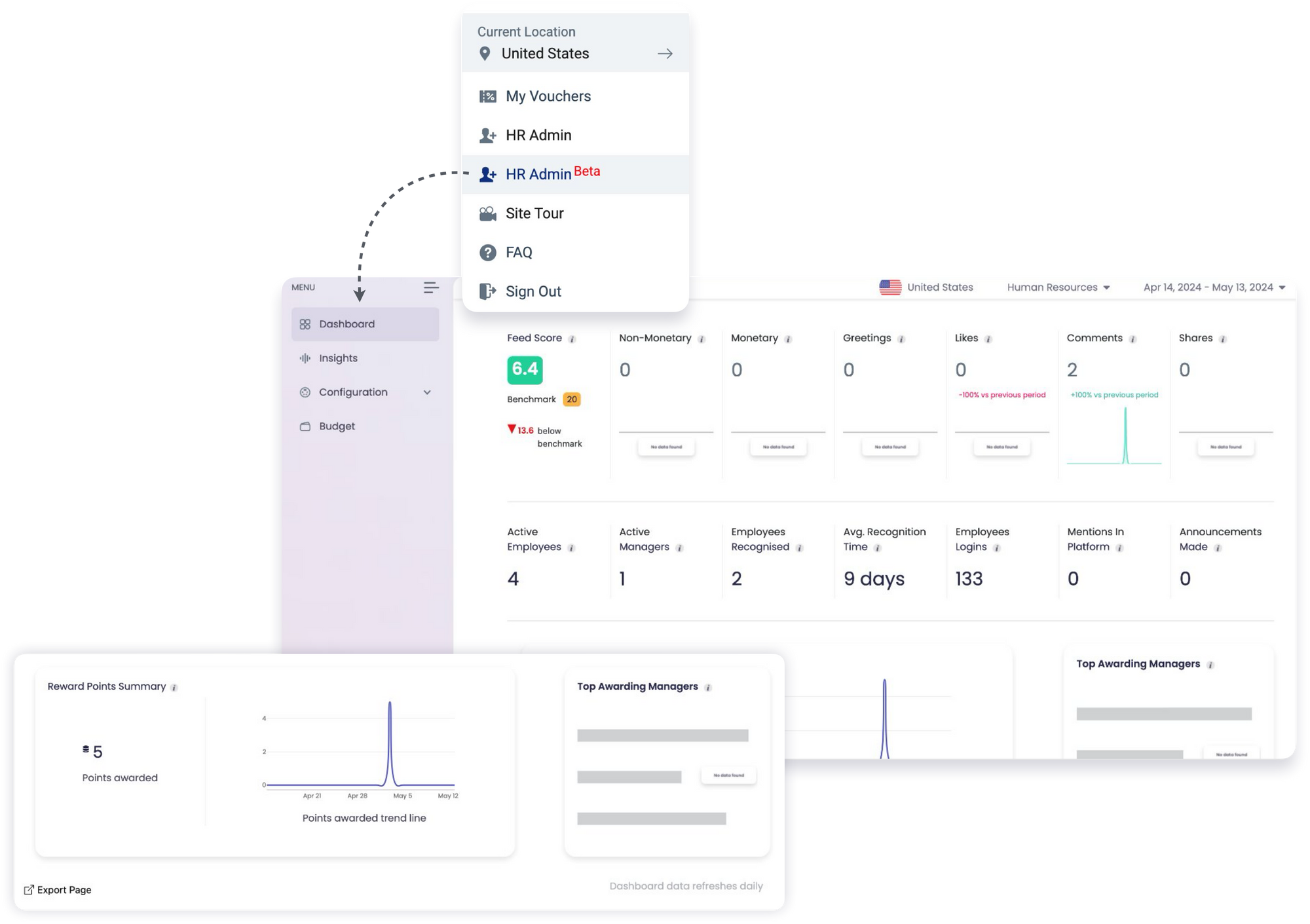
Source: Vantage Recognition
Recommended Read: How to Build an Employee Recognition Program That Actually Works
Building a Culture of Recognition and Appreciation
Building a recognition culture is not about launching a program. It is about making appreciation consistent enough that it becomes expected, and visible enough that everyone else can see what the organization actually values.
Most organizations start with top-down recognition: manager-to-employee, annual award cycles, leadership shout-outs at all-hands. These matter. But they are not sufficient on their own.
The Power of Non-Monetary Recognition
Non-monetary recognition often carries more emotional weight than its monetary counterpart, particularly when it is specific and immediate.
The specificity principle matters: "Great collaboration" is weak. "You pulled the product and sales teams together to resolve the client issue before launch" makes the behavior visible and gives everyone else something concrete to emulate.
According to The Recognition Effect (Vantage Circle x Great Place to Work India, 2025), 91% of employees in high-recognition cultures feel motivated compared to 73% in emerging recognition cultures. When employees experience all four recognition signals (Appreciation, Acceptance, Validation, and Accomplishment), 97% intend to stay with their organization.
Effective non-monetary recognition includes: peer badges tied to specific company values, personalized thank-you messages from leadership, milestone acknowledgments that name what someone has built over their tenure, and growth opportunities like being assigned a high-visibility project.
Peer-to-Peer Recognition
Peer recognition is intangible recognition at its most credible. It carries different weight than top-down appreciation because it comes from someone who understands the actual difficulty of the work.
The most effective peer recognition programs reduce friction to near zero: any employee can recognize a colleague from Slack, MS Teams, or a web app, with a badge tied to a company value and a message that posts to a public social feed. Visibility without requiring HR to manage the moment is what makes these programs self-sustaining.
From Wipro's Vantage Recognition deployment: peer recognition grew 97.5%, with recognition happening every 1.2 minutes across a workforce of 230,000 employees. The important shift was not simply more recognition. It was a shift from recognition being something managers administered to something employees actively gave one another. Recognition that flows laterally, not just top-down, sustains itself.

Source: Vantage Recognition
Aligning Rewards with Company Values
A reward program that does not visibly connect to what the company says it values reads as arbitrary. If the stated value is "innovation" but every recognition goes to whoever shipped on time, employees learn that the real value is predictability.
The structural fix is to require every recognition, whether a peer badge, manager award, or campaign badge, to be tagged to a specific company value before it can be sent. Over time, this builds a dataset of which values are actually being reinforced in day-to-day work, not just which ones appear on the career page.
When you give recognition, be clear about the connection: "Here's what you did. Here's the value it demonstrates. Here's why we want others to do the same."
Read More: Advantages and Disadvantages of Reward Systems for Employees
Designing an Effective Rewards Program

A program that launches strong but fades in three months is one of the most common HR failures in this category. The programs that sustain themselves share five design principles.
Define Clear and Transparent Criteria
Employees should know exactly what earns recognition and what earns a reward. Vague criteria produce two problems: managers use recognition as a personal preference tool rather than a cultural one, and employees who are not recognized for equivalent behavior stop trusting the program. Set criteria before launch, communicate them during onboarding, and revisit them annually.
Reinforce in Real Time
Recognition loses much of its behavioral value when delayed. A behavior recognized three months after the fact does not connect clearly to the action. Recognition delivered the same week creates a direct link between what the employee did and what the organization valued about it. Building in manager prompts or automated reminders that flag team members who have not been recognized recently keeps reinforcement consistent rather than dependent on a manager's memory alone.
Prioritize Personalization
A generic reward signals that the organization did not think about the person receiving it. Let employees choose their rewards from a broad catalog, or use onboarding data to make gift selection deliberate. Personalization increases the perceived value of a reward beyond its monetary amount.
Automating anniversary milestones while letting the employee choose their own reward from a catalog preserves both scheduling efficiency and personal relevance.
Promote Inclusion
Recognition should reach every employee, not just high performers or people with highly engaged managers. Every employee needs a mechanism to be recognized and to recognize others, across levels, departments, and geographies. Disengaged employees who stay inside a low-recognition environment are a measurable cost in lost productivity, absenteeism, and low morale.
Communicate and Celebrate Consistently
A program that goes quiet between award cycles loses momentum. Regular success stories, recognition highlights in team meetings, and monthly top-recognizer leaderboards keep the program visible and normalized as part of how the organization operates.
Types of Employee Rewards to Consider
Effective reward and recognition programs combine tangible and intangible elements rather than treating them as alternatives.
Monetary Rewards
Monetary rewards include performance bonuses, spot awards, raises, stock options, gift cards, and points redeemable through a rewards catalog. They send a clear financial signal that the behavior mattered, which matters particularly for milestone achievement and high-impact results.
Their limitation is shelf life. Once a bonus is spent or a gift card is redeemed, its motivational impact largely disappears.
Non-Monetary Rewards
Non-monetary rewards include paid time off, flexible scheduling, learning and development opportunities, mentor access, and experience-based rewards like team events or high-visibility project assignments. Their emotional resonance tends to outlast the moment of delivery.
Recognition
Recognition is distinct from non-monetary rewards in that it is not a benefit or perk. It is the act of naming what someone did and connecting it to why it mattered. A structured peer recognition moment, milestone acknowledgment, or leadership shout-out that names a specific behavior and connects it to a company value can carry more lasting impact than a one-time tangible reward.
Recognition examples include peer badges tied to company values, personalized messages from leadership, public shout-outs in team meetings, long service acknowledgments that name what someone has built over their tenure, and anniversary milestones that mark loyalty and growth.
One measurement gap worth separating out: tracking whether recognitions are being sent is not the same as tracking whether the recognition culture is landing. eNPS and pulse surveys give HR the perception data alongside the activity data, and treating both as part of the same measurement system is what surfaces the difference between a program that runs and a program that resonates.
Measuring the Impact of Rewards on Engagement

Reward and recognition programs that are not measured are programs that cannot improve. Three measurement categories matter. For a broader overview, see employee recognition statistics that benchmark what high-performing programs track.
Recognition Participation Metrics
Track the percentage of employees who give or receive recognition in a given month. Track manager participation rates separately: managers who never give recognition are a program risk. Track value alignment: what percentage of recognitions are tagged to a specific company value versus sent as a generic message.
These are leading indicators. They show whether the program is running before business outcomes change.
Engagement and Retention Data
Pulse surveys via Vantage Pulse provide real-time sentiment data on how employees feel about recognition, connection, and leadership. Tracking eNPS scores alongside recognition participation rates reveals whether program activity is actually translating into how employees experience the workplace.
For retention, compare voluntary turnover rates across high-recognition and low-recognition cohorts within the organization. Recognition participation can serve as an important leading indicator of retention risk.
Business Outcomes
Track productivity, absenteeism, and team-level performance alongside recognition program data. The goal is not to claim that recognition caused every positive outcome, but to build a transparent model showing that investment in reward and recognition activity correlates with measurable business improvement over time. Programs that evolve based on data, cutting what is not working and doubling down on what is, stay relevant longer than programs that launch and coast.
FAQs About Reward and Recognition
What is reward and recognition?
Reward refers to tangible, transactional acknowledgment: a bonus, a gift card, or extra time off. Recognition is intangible and relational: a peer shout-out, a specific thank-you, or a public celebration of effort or values-aligned behavior. Most effective programs combine both deliberately, treating them as two different levers rather than interchangeable terms.
How to reward and recognize employees?
Start by defining what behaviors and results your organization wants to reinforce. Pair a recognition message with every reward so employees understand why they are being acknowledged. Use a mix of peer-to-peer and manager-to-employee recognition, both monetary and non-monetary. Make recognition visible to the wider team through a public feed or team meeting shout-out. Deliver it promptly, ideally within days of the behavior, not at an annual review.
What are some examples of rewards and recognition?
Rewards include performance bonuses, gift cards, spot awards (points redeemable for items from a rewards catalog), extra paid time off, and experience-based incentives like team events or professional development. Recognition examples include peer badges tied to company values, manager thank-you notes, public shout-outs at team meetings, long service award acknowledgments, and leadership spotlights at all-hands events. Effective programs use examples from both categories.
What is the best reward system for employees?
The best reward system combines monetary and non-monetary recognition, delivers recognition in real time rather than at scheduled intervals, gives employees choice in how rewards are redeemed, and measures participation and coverage rather than just budget spend. It integrates with tools employees already use so recognition happens in the flow of work. Transparency, consistency, and explicit connection to company values are the structural elements that determine whether a system sustains itself over time.
Conclusion: Build a Workplace People Want to Stay In
Reward gets attention. Recognition gives that reward meaning.
The strongest employee engagement strategies know they need both. They use rewards to reinforce outcomes and recognition to reinforce the behaviors, values, and contributions that make those outcomes possible.
The organizations that get this right share a common pattern: they do not treat rewards and recognition as interchangeable. They design for both, they measure what is actually happening, and they iterate based on data rather than assumption.
When employees consistently know what they did, why it mattered, and that the organization noticed, engagement stops being a program HR runs and becomes part of how work gets done.
That is the difference between rewarding performance and building a culture people want to stay in.
Recommended Read: Top Six Employee Recognition Trends

Supriya is a Content Marketing Lead at Vantage Circle, where she writes on employee engagement, recognition, workplace communication, and culture. Her work on remote team recognition draws on primary research from Vantage Circle's platform data and customer deployments across distributed workforces. She spent the earlier part of her career in corporate communications at Burson, ESPN Star Sports, and CBRE, advising organizations on the messages employees actually hear.
Connect with Supriya on LinkedIn.