
Employee recognition criteria are the defined behaviors and results that qualify an employee for recognition. Good criteria do two things at once. They describe the behavior specifically enough that another employee could repeat it, and they tie that behavior to something the business actually needs. Vague criteria produce vague recognition.
Most employee recognition programs do not fail because nobody cares. They fail because nobody agreed on what counts. Two managers read the same nomination and reach different conclusions. Employees notice. The program quietly becomes a popularity contest.
That is a design problem. And design problems are fixable.
What Are Employee Recognition Criteria?
Employee recognition criteria are the written standards that decide who qualifies for recognition and why. They sit underneath every award, badge, and nomination in your program, whether you have written them down or not.
Here is the distinction that trips up most programs. Criteria are not the same as awards, and neither is the same as rewards.
Criteria define what qualifies. Award names signal the level of impact. Rewards are what the person receives. A program can have excellent rewards and still feel arbitrary, because the arbitrariness lives in the criteria.
The gap is real. Gallup found that only one in three U.S. workers strongly agree they received recognition or praise for good work in the past seven days. Most organizations are not short on goodwill. They are short on a shared definition of what deserves a mention.
The Two Tests Every Recognition Criterion Must Pass
A recognition criterion is only usable if it passes two tests: specificity and alignment. Both come from Reinforcement, one of the four dimensions in Vantage Circle's AIRe Framework, which covers Appreciation, Incentivization, Reinforcement, and eMotional Connect.
Reinforcement is the dimension that governs criteria design, and it is where good programs separate from average ones. It breaks into exactly two parts, and they happen to be the two parts a criterion is made of. Miss either one and what you have is a slogan, not a standard.
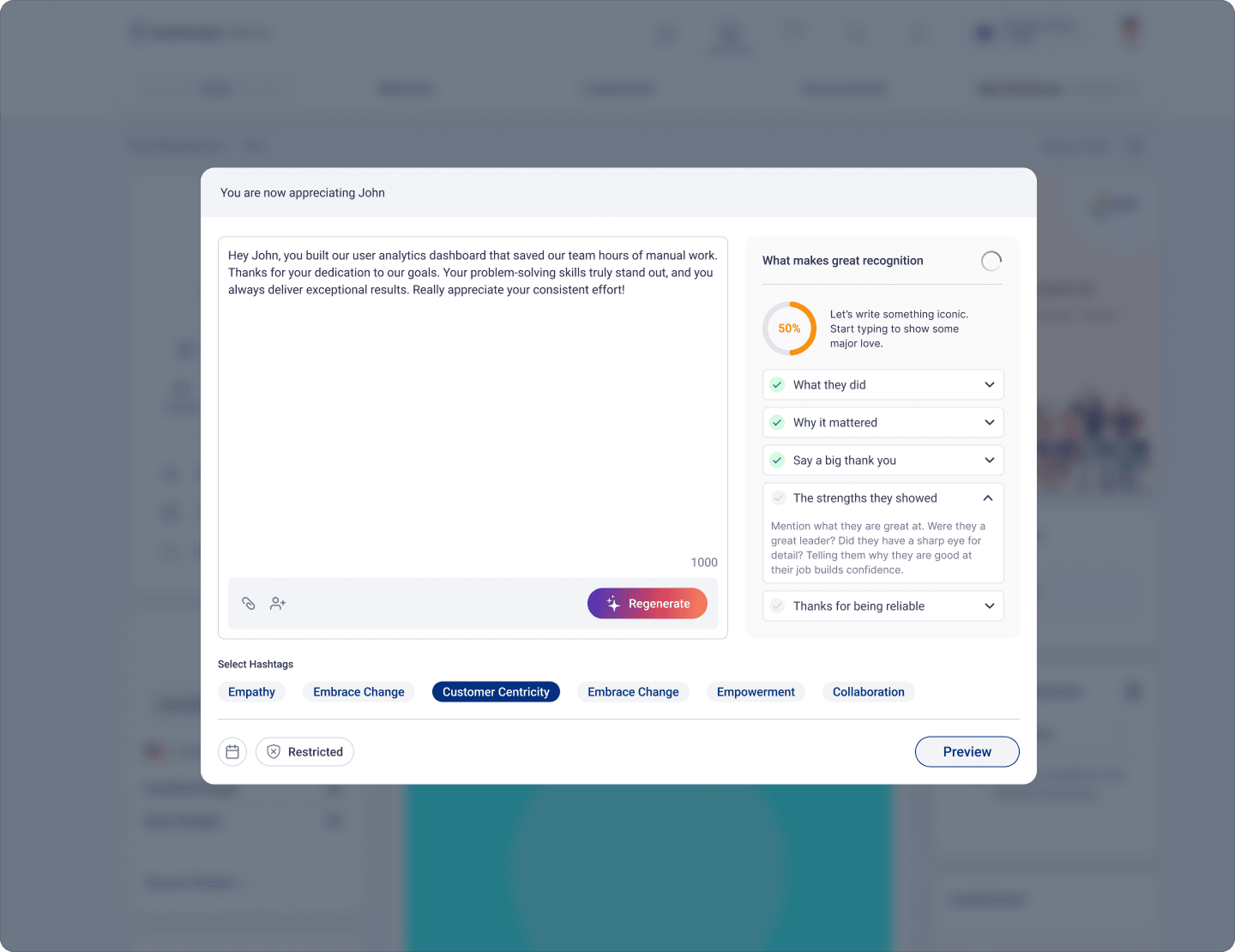
Specificity: Is the Behavior Defined Well Enough to Repeat?
Specificity asks a blunt question: how well defined are the behaviors or results that merit recognition? If a colleague read the criterion, could they work out what to actually do differently on Monday?
Most criteria fail here. "Demonstrates teamwork" is not a criterion. It is a category heading.
Compare the two:
- Vague: Demonstrates teamwork.
- Specific: Took on a teammate's workload during a critical delivery window without being asked, and the delivery date held.
The second version tells the giver what to look for, tells the reviewer what to check, and tells everyone else what to repeat. That is the whole job of giving recognition at work in a way that actually shapes behavior.
Alignment: Does the Behavior Move the Business?
Alignment asks how well those behaviors or results tie in with what the business considers important. A criterion can be perfectly specific and still be worth nothing if it rewards something the company does not need more of.
Most US companies already understand this in principle. 59% base recognition on both results and behaviors, while 19% still recognize results alone, according to the US AIRe Benchmarking Report 2023-24.
Kyle Chetty, an HR executive, put the point cleanly on the Vantage Influencers Podcast.
Vantage Influencers Podcast
"The goal of employee recognition in the workplace is really to reinforce particular behaviors, practices, activities that result in better performance and ultimately give us positive business results."
Kyle Chetty, HR Executive
Listen to the EpisodeRecognition that does not connect to a business result is still nice. It is just not a program.
8 Measurable Employee Recognition Criteria
A criterion is measurable when it names a trigger you can verify and evidence a reviewer can check. Everything else is a preference. These eight cover most of what an organization needs to recognize, written to that bar. Use them as a starting set, then cut the ones your business does not need.
| Criterion | What it actually means | A measurable trigger | Evidence a reviewer should look for |
|---|---|---|---|
| Performance above the bar | Sustained results beyond the role's stated expectations, not a single good quarter. | Exceeded a defined target across two or more consecutive review periods. | The target, the actual, and the period. All three. |
| Collaboration across boundaries | Work that made someone else's job possible, usually outside the person's own team. | Took on work outside their remit that unblocked another team's deliverable. | A named beneficiary who can describe what changed. |
| Innovation with an outcome | A new idea that shipped, not a new idea that was suggested. | Proposed and implemented a change that reduced time, cost, or error rate. | The before number and the after number. |
| Customer impact | A specific customer situation the person changed for the better. | Resolved an escalation or retained an account at risk. | Direct customer feedback, or the account status before and after. |
| Leadership without the title | Developing other people, whether or not the person manages anyone. | Mentored a colleague through a defined skill gap or onboarding period. | The mentee's own account of what they can now do. |
| Values in action | A decision where living the value cost the person something. | Chose the value-consistent option when the expedient option was available. | The named value, and what the easier alternative was. |
| Milestones and tenure | Time served, the one criterion that needs no judgment call. | Reached a defined service anniversary. | The date. Nothing else. |
| Safety and compliance | Protecting people or the organization, often by raising something uncomfortable. | Reported a hazard or a compliance risk before it caused harm. | The report, its date, and what was changed as a result. |
Notice what the fourth column does. It converts a criterion from an opinion into a claim someone can check. If a criterion has no evidence column, it will be applied inconsistently, and your award names will end up carrying meaning the criteria never earned.
How to Score a Nomination: A Recognition Criteria Rubric
Score each nomination against the named criteria on a five-point evidence scale, so two reviewers reading the same submission reach the same result. The scale measures evidence supplied, not how impressive the story sounds.
| Score | What it means | Evidence threshold |
|---|---|---|
| 1. Not demonstrated | The nomination describes the person, not the behavior. | No criterion met. |
| 2. Asserted | The behavior is claimed but not evidenced. | Evidence for 1 criterion. |
| 3. Evidenced | The behavior happened and can be verified. | Evidence for 2 criteria. |
| 4. Evidenced with impact | The behavior happened and something measurably changed. | Evidence for 3 criteria. |
| 5. Repeatable and aligned | The behavior is documented, tied to a business priority, and repeatable by others. | Evidence for all criteria in the category. |
Three design rules matter more than the scale itself, and they are the part most rubrics leave out.
Count evidence, not impression. A vivid story from a persuasive nominator will always beat a plain story from a quiet one, unless you score the evidence rather than the writing.
Four to six criteria per award, not ten. Every criterion you add dilutes the signal of the ones already there. If a reviewer cannot hold the list in their head, they will default to gut feel.
One rubric cannot serve every award. A spot award given the same afternoon and an annual award decided by a committee need different evidence thresholds. Applying the annual standard to a spot award kills the frequency that makes recognition work at all. Build the nomination process around whichever award it actually serves.
Which Criteria Belong to Which Award Type
High-frequency awards should run on behaviors. Low-frequency awards should shortlist on results, then use behaviors to decide the winner. Getting this split wrong is the most common structural error in recognition program design.
| Award type | Frequency | Criteria basis | Example criterion |
|---|---|---|---|
| Peer appreciation | Daily | Behavior only | Helped a colleague solve a problem outside their own priorities. |
| Spot award | Weekly to monthly | Behavior, lightly evidenced | Handled an unplanned escalation that protected a delivery. |
| Quarterly award | Quarterly | Results shortlist, behavior decides | Hit the quarter's target, and did it in a way others can copy. |
| Annual award | Yearly | Results shortlist, behavior decides, sustained | Delivered across all four quarters while developing others. |
| Long service award | On anniversary | Tenure only | Completed a defined number of years. |
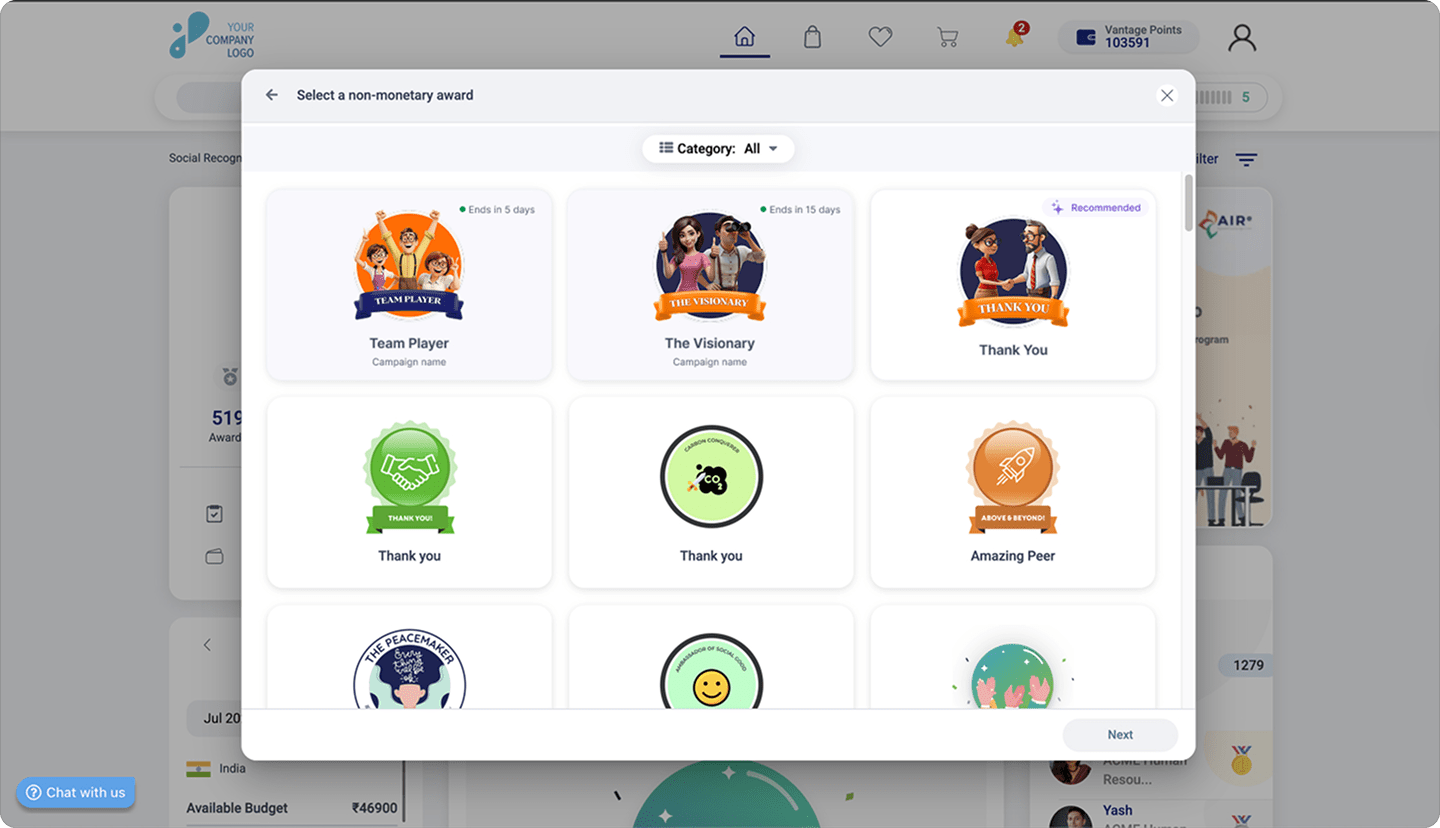
There is a frequency problem hiding in that table, and US benchmarking data traces it in three steps.
Where US Recognition Criteria Actually Sit
Source: Vantage Circle, AIRe Benchmarking Report (USA) 2023-24
Read those three numbers in order and the pattern is hard to miss. The criterion that is easiest to write is the one most companies lean on, and it is the one least able to change what anyone does. Tenure needs no judgment, no evidence, and no reviewer. It also reinforces nothing.
So if you are rebuilding your recognition program structure, the work is not at the podium. It is in the high-frequency behavioral layer where peer-to-peer recognition does its best work.
The Repeat-Performer Problem Most Criteria Miss
Criteria that do not distinguish consistent performers from one-time performers turn awards into a rotation. Everyone gets a turn, nobody has a reason to repeat the behavior, and the program stops reinforcing anything.
This is the majority position, not an edge case. 54% of US companies have no defined approach for recognizing consistent or repeated demonstration of a behavior, per the US AIRe Benchmarking Report 2023-24. The report is blunt about the cost. Companies lose the chance to create role models, and managers fall back on a round-robin approach of giving awards to team members in turn.
Differentiating levels of achievement is the same story. 32% of US companies have no defined approach for it at all. Among those that do, 26% use both award names and monetary value to signal a higher level, 24% use monetary value alone, and 18% use award names alone. Naming is a start, but a name only differentiates if the criteria behind it differentiate first.
Three ways to build repeat performance into your criteria. First, add a sustained-demonstration threshold to your top-tier awards, such as evidence across two or more periods. Second, make prior wins visible to reviewers instead of hiding them to seem fair. Third, create a separate tier for repeat demonstration so consistency has somewhere to go, rather than competing with first-time recognition.
What Well-Designed Criteria Look Like in Practice
Three Vantage Circle clients show what happens when criteria are defined properly, and each proves a different part of the argument.
L&T Technology Services proves that values can become criteria. LTTS translated five named core values, including Being Purposeful, Caring, and Results with Accountability, into a working recognition framework called ROAR. In 2023-24, 93% of registered employees participated, 83% of active platform users received recognition, and recognition happened on average every 35 minutes.
Wipro proves that specific criteria scale. "Over 57% of our associates received recognition in the last fiscal year," said Sunita Cherian, Senior VP and Chief Culture Officer at Wipro. "Considering our size, this coverage attests to the strong performance of our recognition program."
Tata Communications proves that criteria shift behavior, not just sentiment. Between FY 2020-21 and FY 2024-25, peer-to-peer non-monetary recognition rose 185% and managerial monetary recognition rose 26%.
Vantage Influencers Podcast
"Recognition is your company's culture in action. It shows what the company truly values and not what's just written in a handbook or on a plaque on a wall."
Courtney King, Senior Vice President of People & Culture, BeatBox Beverages
Listen to the EpisodeHow to Tell If Your Criteria Are Working
Three signals tell you whether criteria are being applied as designed: coverage, consistency across managers, and repeat behavior. All three are visible in program data before they show up in engagement scores.
Coverage answers whether the criteria reach beyond the usual names. If the same people qualify every cycle, your criteria are narrower in practice than they look on paper.
Consistency across managers is the one most programs never check. Round-robin awards and criteria drift usually appear as a per-manager pattern long before anyone raises it.
Repeat behavior is the real test. If a recognized behavior does not show up again, the criterion described an event rather than a standard.
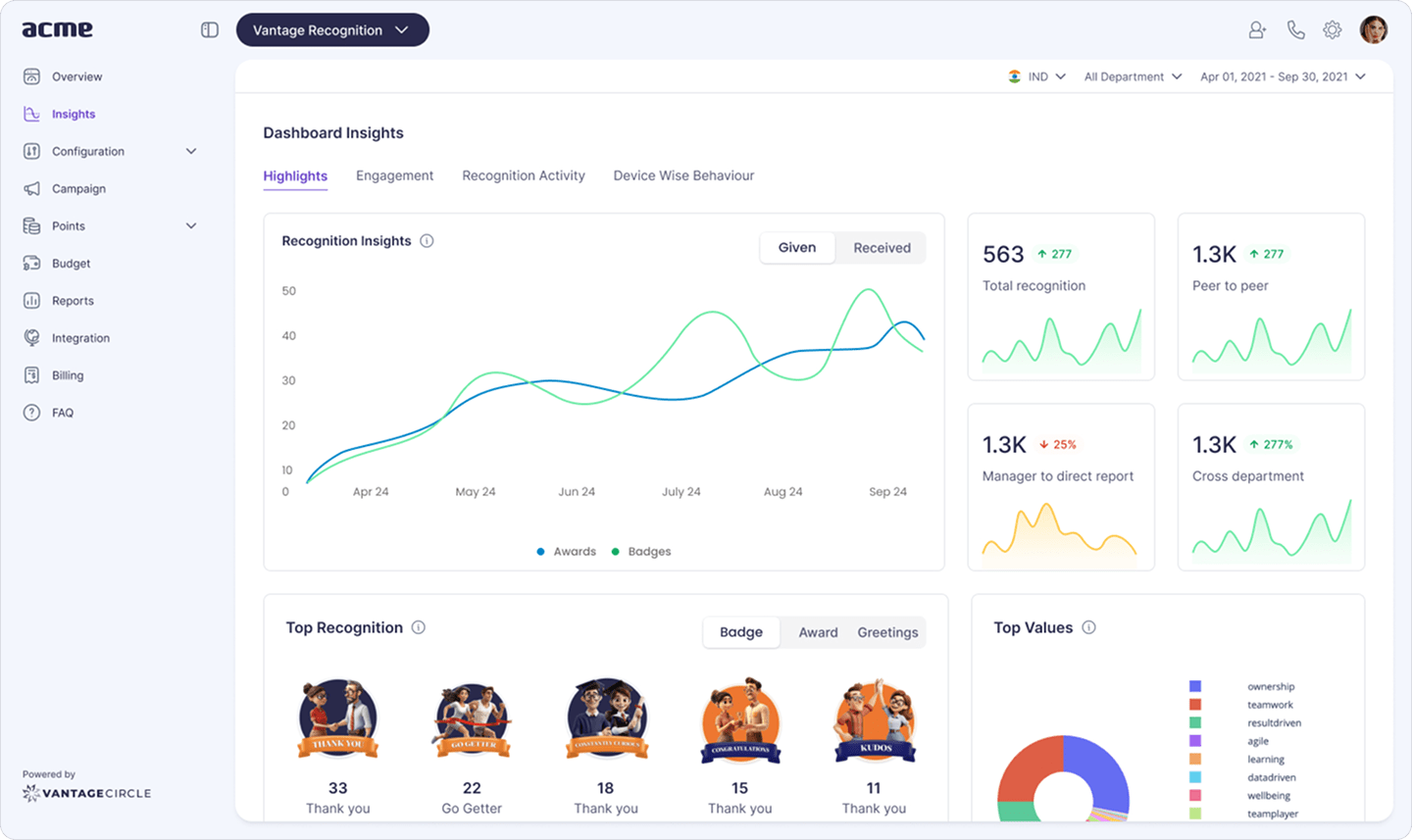
Well-designed criteria can still be perceived as unfair, which is a communication problem rather than a design one. A short survey through Vantage Pulse, Vantage Circle's employee engagement and pulse survey tool, separates the two. For the full metric set, see how to measure your recognition program.
Summing It Up
Recognition criteria are the difference between culture by design and culture by default. In a culture by default, some managers notice and others do not, and employees in one department feel valued while employees in the next feel invisible. Criteria are what make that difference deliberate.
Start with two tests. Is the behavior specific enough to repeat? Does it move something the business needs? Then score nominations on evidence, split your criteria by award type, and give consistency somewhere to go.
If you want to know where criteria design sits in your program today, the AIRe Assessment scores it across all four dimensions. Or book a demo to see how it works inside a live program.
FAQs
What are the 4 types of recognition in the workplace?
The four most common types are peer-to-peer recognition, manager-to-employee recognition, top-down or leadership recognition, and milestone or tenure recognition. Each needs its own criteria. Peer recognition works best on behaviors and high frequency, while milestone recognition needs no judgment call at all because tenure is a date.
What are the 5 pillars of strategic recognition?
There is no single industry standard set of five pillars, so treat any such list as one vendor's model rather than an agreed benchmark. Vantage Circle's answer is four rather than five: the AIRe Framework covers Appreciation, Incentivization, Reinforcement, and eMotional Connect. Criteria design sits inside Reinforcement, which breaks into specificity and alignment.
What are 5 qualities of a good employee?
Commonly recognized qualities are reliability, collaboration, initiative, accountability, and a willingness to develop others. The caution is that qualities are not criteria. "Reliable" describes a person, while "delivered against commitments across three consecutive sprints" describes a behavior someone can evidence and another person can repeat.
What are good employee recognition ideas?
The best ideas are the ones your criteria can actually support. Peer badges tied to named values, spot awards for behaviors, team-based awards that widen coverage, and service milestones all work well. An idea only becomes a program when it has a written criterion, a defined evidence threshold, and a frequency that matches the award type.
What criteria should I consider for employee recognition awards?
Start with four to six criteria per award, not ten. Cover performance, collaboration, innovation, customer impact, values, and tenure, and write each one with a measurable trigger and the evidence a reviewer should ask for. Then check that each criterion ties to something the business genuinely needs more of.

Nilotpal M Saharia is an Assistant Manager, Content Marketing at Vantage Circle and a recognition-and-rewards (R&R) strategist with 9 years of experience spanning Marketing, HR, and content strategy. He helps HR leaders turn employee recognition and leadership research into practical workplace programs.
Connect with Nilotpal on LinkedIn.