




What is Employee Involvement and How Does it Improve Workplace Performance?

A Global Employee Recognition and Wellness Platform
Your employees know exactly what's broken. They see the inefficiencies you miss from the executive suite. They understand where processes fail, where money gets wasted, and what actually needs to change.
But here's the reality: most organizations never ask them.
This isn't just a missed opportunity. It's leaving employee involvement on the table. According to Gallup, companies that meaningfully involve employees in decisions see 21% higher profitability and 17% higher productivity. Yet most businesses treat their workforce like order-takers, not problem-solvers.
So, what exactly is employee involvement? We define employee involvement as a management approach that encourages employees to participate in decisions that directly affect their work.
When employees are involved in decision-making, they feel valued and empowered, which directly leads to better performance. It's the foundation of genuine employee engagement. It's simple: involved employees bring more energy, creativity, and ownership to their roles. This involvement boosts motivation, enhances productivity, and develops a culture of accountability.
In this article, we’ll explore actionable steps to boost employee involvement in your organization. We’ll share real-life examples and provide measurement tools to help you track the success of your involvement initiatives.
What Does Employee Involvement Mean in the Workplace?
Employee involvement is more than just offering suggestions. It’s a management philosophy that actively encourages employees to participate in decisions that impact their work, responsibilities, and the organization’s goals. It’s about creating an environment where employees feel like their opinions and contributions truly matter.
In a workplace with strong employee involvement, teams are encouraged to share ideas, participate in meetings, and collaborate on problem-solving. It also fosters a sense of ownership in employees and aligns them with the organization’s objectives.
Core Principles of Effective Employee Involvement
To create an environment of employee involvement, certain core principles need to be in place. Do not consider them as mere guidelines and rather treat them as the foundation for building a culture of trust, collaboration, and shared responsibility.
1. Influence
Employees should have the genuine authority to influence decisions, not just provide suggestions. This means involving them in discussions that directly affect their roles and the organization’s direction.
2. Shared Responsibility
Effective employee involvement means sharing accountability for the decisions made. Shared responsibility creates commitment. It helps employees see their goals and the organization's goals as one and the same.
3. Transparency
For employees to make informed decisions, they need access to the necessary information. Leadership should provide open, transparent communication. One such example is “open-book management,” where employees have insight into key business data and organizational goals.
4. Support
Employees need the training, tools, and resources to contribute effectively. This includes problem-solving skills, leadership development, and ongoing support from managers.
How Is Employee Involvement Different from Employee Engagement and Employee Participation?
Understanding the distinctions between employee involvement, employee engagement, and employee participation is crucial for building a cohesive workforce. While they might seem similar, each term refers to a different aspect of how employees interact with their organization.
Here’s a quick comparison:
| Aspect | Employee Involvement | Employee Participation | Employee Engagement |
|---|---|---|---|
| Focus | Process that enables employees to influence decisions. | Actions taken by employees to engage in decisions. | Emotional connection and commitment to work. |
| Key Element | Encouraging input to help shape decisions. | Actively contributing to decisions and activities. | Passionate employees aligned with company goals. |
| Level of Action | Employees help shape organizational direction. | Employees actively contribute to tasks and decisions. | Employees are fully invested and driving results. |
| Decision-Making | Providing suggestions that influence key decisions. | Involvement in decision-making typically reserved for leadership. | Employees take ownership of success. |
| Collaboration | Promotes cross-team communication and input. | Encourages cross-functional cooperation on tasks. | Strong collaboration driven by a shared vision. |
| Autonomy | Provides opportunities for input in key decisions. | Greater autonomy in problem-solving and execution. | Employees take ownership and initiative in outcomes. |
| Example | Offering suggestions for workflow improvements. | Working in cross-functional teams on strategic initiatives. | Taking initiative to drive organizational success. |
Aspect: Focus
Employee Involvement: Process that enables employees to influence decisions.
Employee Participation: Actions taken by employees to engage in decisions.
Employee Engagement: Emotional connection and commitment to work.
Aspect: Key Element
Employee Involvement: Encouraging input to help shape decisions.
Employee Participation: Actively contributing to decisions and activities.
Employee Engagement: Passionate employees aligned with company goals.
Aspect: Level of Action
Employee Involvement: Employees help shape organizational direction.
Employee Participation: Employees actively contribute to tasks and decisions.
Employee Engagement: Employees are fully invested and driving results.
Aspect: Decision-Making
Employee Involvement: Providing suggestions that influence key decisions.
Employee Participation: Involvement in decision-making typically reserved for leadership.
Employee Engagement: Employees take ownership of success.
Aspect: Collaboration
Employee Involvement: Promotes cross-team communication and input.
Employee Participation: Encourages cross-functional cooperation on tasks.
Employee Engagement: Strong collaboration driven by a shared vision.
Aspect: Autonomy
Employee Involvement: Provides opportunities for input in key decisions.
Employee Participation: Greater autonomy in problem-solving and execution.
Employee Engagement: Employees take ownership and initiative in outcomes.
Aspect: Example
Employee Involvement: Offering suggestions for workflow improvements.
Employee Participation: Working in cross-functional teams on strategic initiatives.
Employee Engagement: Taking initiative to drive organizational success.
Why Is Employee Involvement So Important for Organizations?
Employee involvement is a critical factor for business success. When employees feel involved, they are motivated, productive, and committed to their roles. This creates a direct impact on organizational outcomes, from performance and morale to culture and innovation.
Let’s break down why employee involvement is so important for organizations.
How Does Employee Involvement Affect Productivity?
The link between employee involvement and productivity can be seen through:
-
Ownership (feeling valued): Employees who feel their contributions matter take more pride in their work.
-
Better Ideas (from front-line staff): When employees are empowered to offer solutions, they provide valuable insights that often improve processes and reduce inefficiencies.
-
Higher Efficiency (less waste/friction): Involved employees are better at identifying and removing obstacles, streamlining workflows, and optimizing resources.
-
Increased Productivity: This all leads to increased productivity, as employees are more aligned with company goals and motivated to meet them.
CIPD’s research on employee voice shows that giving people genuine influence over decisions is strongly and positively linked to job satisfaction, performance, and organisational productivity, making it a powerful driver of engagement.
How Does Employee Involvement Help Build Relationships at Work?
Employee involvement also plays a key role in building relationships across the organization. It helps establish a trust loop:
-
Transparency (from management): When leadership shares information openly, employees trust that decisions are being made with their best interests in mind.
-
Trust (from employees): Employees who trust their leadership are more likely to engage, collaborate, and offer solutions.
-
Collaboration (between teams): Involved employees actively contribute to team goals and foster cross-functional collaboration.
-
Belonging & Accountability (shared culture): When everyone feels included, a culture of belonging forms, driving greater accountability and team cohesion.
How Does Employee Involvement Impact Culture and Morale?
A culture built on involvement leads to higher morale and employee satisfaction. Here's how involvement builds stronger culture and morale:
-
Higher Job Satisfaction: Employees who contribute meaningfully to decisions feel more fulfilled and engaged in their daily work.
-
Reduced Turnover: When people feel valued and included, they're far less likely to leave. Retention improves naturally.
-
Emotional Investment: Employees involved don't just complete tasks. They care about outcomes and align themselves with organizational values.
-
Resilient Culture: A culture built on involvement withstands challenges better. Teams support each other and stay committed even during difficult times.
Deloitte’s 2025 Global Human Capital Trends research shows that organizations that deliberately empower workers, increasing their capacity to grow, imagine, and think deeply, are 1.8 times more likely to report better financial results and 1.6 times more likely to say they provide meaningful work, underscoring how shared decision‑making and empowerment strengthen connection and belonging.
How Can You Improve Employee Involvement in the Workplace?
Improving employee involvement doesn’t happen overnight. It requires a systematic approach. Here’s a 5-step framework to help you get started:
1. Open Information Sharing
Regularly sharing information about the company’s goals, challenges, and successes keeps employees informed and engaged. It also helps employees feel connected to the organization’s vision and direction.
Example: A company could hold quarterly town halls where leadership provides updates on key initiatives and future goals.
2. Manager Decision-Sharing
Involve managers in decision-making and train them to ask for input from their teams. When managers actively ask employees, “What do you think?” it promotes a collaborative decision-making culture. Gallup research shows managers account for 70% of the variance in team engagement, making their role in facilitating involvement pivotal.
Example: Managers can host bi-weekly meetings to discuss team challenges, gather suggestions, and make collective decisions.
3. Create Project & Idea Teams
Create cross-functional teams that can brainstorm and solve problems together. These “quality circles” or “continuous improvement teams” provide employees with the opportunity to actively shape processes and make improvements.
Example: Organize team workshops focused on improving specific business processes, with employees taking the lead on suggesting and implementing changes.
4. Use a Transparent Suggestion-Tracking Process
Implement a transparent suggestion system where employees can submit ideas and see how those ideas are reviewed and acted upon.
Example: A suggestion box (digital or physical) where all submissions are reviewed and shared with employees, explaining the decisions made.
5. Reward Initiative & Problem-Solving
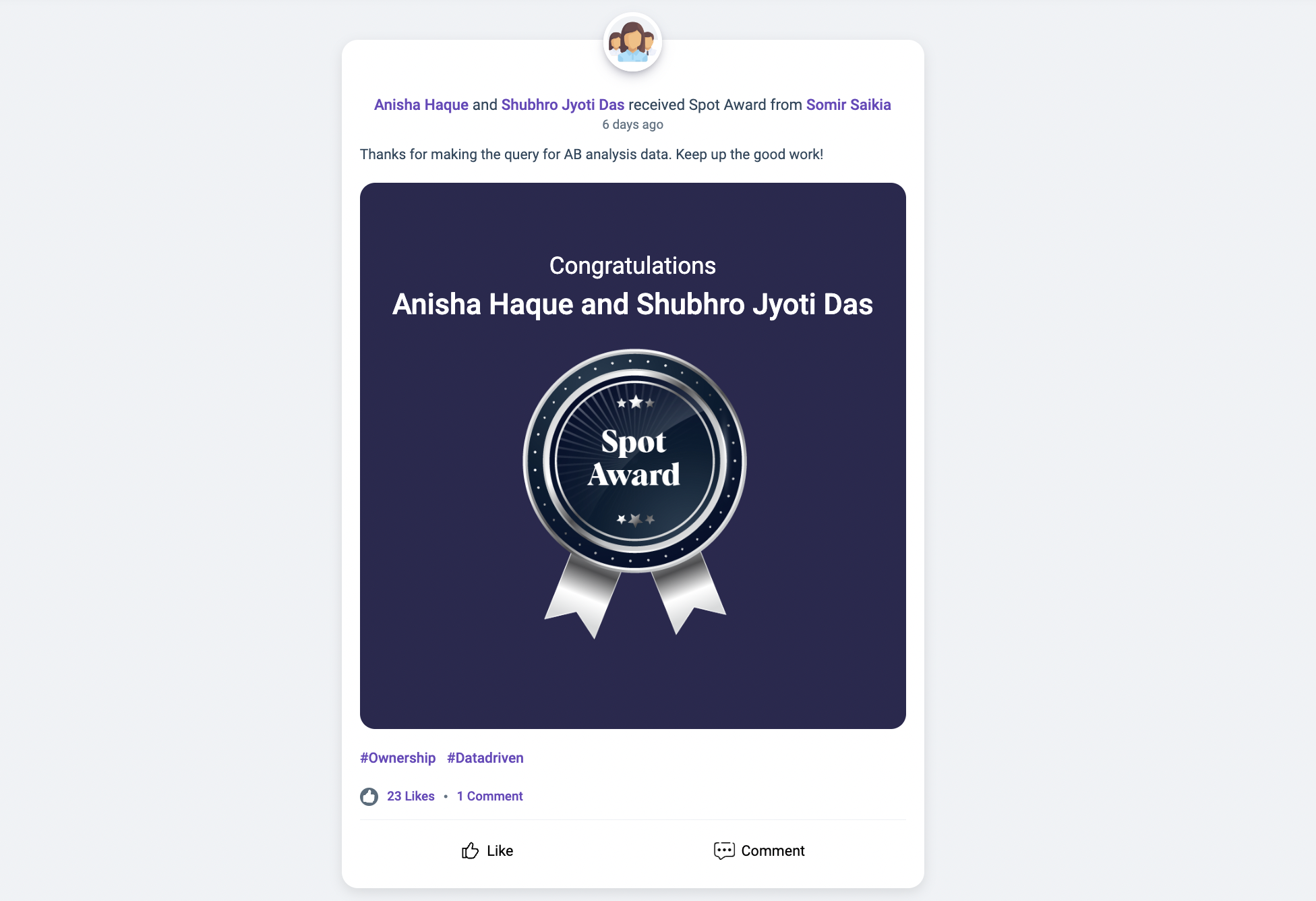
Recognize and reward employees who take the initiative to contribute ideas or solve problems. Publicly acknowledging contributions reinforces the behavior and motivates others to participate.
Example: Using your recognition platform to spotlight an employee who proposed a cost-saving initiative that was successfully implemented.
Source: Vantage Recognition
How Can Employee Involvement Measures Motivate Employees?
Tracking employee involvement also acts as a motivator. When employees see their efforts tracked and recognized, they feel valued and more engaged. This connects directly to key employee motivators:
-
Autonomy (you trust me): Employees feel trusted when their contributions are tracked and acknowledged.
-
Impact (my work matters): When employees see that their ideas make a real difference, it boosts their sense of purpose.
-
Recognition (my effort is seen): Publicly acknowledging employees’ involvement motivates them to keep contributing and reinforces the value of their work.
How Do Companies Track Employee Involvement?
We have already seen that tracking employee involvement is crucial for understanding the effectiveness of your strategies and for identifying areas for improvement. So far, we have seen the steps and frameworks. Now, let’s take a look at the metrics.
What Metrics Help Measure Employee Involvement Effectively?
To measure employee involvement, organizations should focus on both process metrics (to track engagement in activities) and outcome metrics (to measure the impact of involvement on organizational performance).
1. Process Metrics:
-
Percentage of employees participating in surveys/programs: Tracks the level of engagement with initiatives like feedback surveys or employee committees.
-
Number of suggestions submitted: Measures how actively employees contribute ideas for improvement.
-
Number of suggestions implemented: Tracks how many of those suggestions result in action and improvements.
-
Average time to respond to a suggestion: Measures how quickly the organization reacts to employee input.
2. Outcome Metrics:
-
Employee retention/turnover rates (by team): Indicates whether employees who are more involved stay longer.
-
Employee engagement scores: Tracks overall engagement and motivation levels across teams.
-
Productivity outcomes: Measures the impact of involvement on team performance and business results.
Related Resource: Employee Engagement Surveys Done Right: A Complete Guide to Design, Deliver and Action
What Does an Employee Involvement Scorecard Look Like?
An employee involvement scorecard helps track these metrics in a simple, organized way. Here’s an example:
| Metric | Last Quarter | Current Quarter | Goal |
|---|---|---|---|
| Employee Engagement Score | 72% | 76% | 80% |
| % Participation in Program | 40% | 55% | 70% |
| # Suggestions Implemented | 15 | 28 | 25 |
| Team Retention Rate | 90% | 92% | 95% |
Metric: Employee Engagement Score
Last Quarter: 72%
Current Quarter: 76%
Goal: 80%
Metric: % Participation in Program
Last Quarter: 40%
Current Quarter: 55%
Goal: 70%
Metric: # Suggestions Implemented
Last Quarter: 15
Current Quarter: 28
Goal: 25
Metric: Team Retention Rate
Last Quarter: 90%
Current Quarter: 92%
Goal: 95%
By using this scorecard, you can track progress over time and make data-driven decisions to improve employee involvement strategies.
How Does Employee Involvement Fit into Organizational Development?
Employee involvement is more than an HR initiative. It’s a key component of organizational development (OD). As organizations grow and face increasingly complex challenges, employee involvement provides the foundation for adaptability and continuous improvement.
By involving employees in decision-making, you create an environment where everyone is actively engaged in the organization’s growth and evolution. This drives innovation, promotes agility, and strengthens the organization's ability to adapt to changes in the marketplace.
Involvement also plays a critical role in leadership development. When employees are empowered to make decisions and contribute to key discussions, they develop the skills needed for future leadership roles. Employee involvement, therefore, is an investment in the long-term health and growth of the organization.
What Are Some Real Examples of Employee Involvement in Action?
To bring the concept of employee involvement to life, here are a few real-world examples that showcase how organizations have successfully implemented involvement strategies:
| Example | How It Works |
|---|---|
| Suggestion Systems | Employees submit ideas for improvement; management tracks and responds to each suggestion. |
| Quality Circles | Small groups of employees meet regularly to solve work-related problems, improving efficiency. |
| Hackathons | Teams collaborate intensively over a short period to develop new ideas or products. |
| 1:1 Mentorship | New hires are paired with senior employees for guidance, career development, and knowledge sharing. |
| Peer-to-Peer Recognition | Employees recognize each other’s contributions, fostering appreciation and teamwork. |
| Open-Book Management | Leadership shares financial and operational data so employees can make informed decisions. |
Example: Suggestion Systems
How It Works: Employees submit ideas for improvement, and management tracks and responds to each suggestion.
Example: Quality Circles
How It Works: Small groups of employees meet regularly to solve work-related problems and improve efficiency.
Example: Hackathons
How It Works: Teams collaborate intensively over a short period to develop new ideas or products.
Example: 1:1 Mentorship
How It Works: New hires are paired with senior employees for guidance, career development, and knowledge sharing.
Example: Peer-to-Peer Recognition
How It Works: Employees recognize each other’s contributions, fostering appreciation and teamwork.
Example: Open-Book Management
How It Works: Leadership shares financial and operational data to help employees make informed decisions.
What Does a Successful Employee Involvement Program Look Like?
A successful employee involvement program goes beyond just collecting feedback or suggestions. It creates a culture where employees are continuously engaged in the decision-making process and feel truly valued. Here are key markers of a successful program:
1. Active Leadership Support:
Leadership should champion employee involvement, setting the tone for the rest of the organization. When leaders model the behavior they want to see, employees are more likely to follow suit.
2. High Levels of Trust:
Trust is the cornerstone of employee involvement. Build trust by proving to employees that their input matters and leads to real action. Transparency in decision-making builds this trust and makes employees more comfortable sharing ideas.
3. Clear Communication:
Employees need to understand how their involvement contributes to the organization’s goals. Regular updates on the impact of their contributions keep them engaged and motivated.
4. Reward & Recognition Program:
Recognition should be part of the involvement process. Employees who contribute valuable ideas should be recognized on the spot and rewarded for their efforts, reinforcing the importance of their participation.
5. Tangible Business Results:
A successful program leads to measurable outcomes. For example, improved productivity, better decision-making, or higher employee retention. These results validate the effort of involving employees and demonstrate the program’s value to the organization.
What Is Not a Good Employee Involvement Program (and Why Does It Fail)?
Not every attempt at employee involvement is successful. There are several common pitfalls that organizations fall into when trying to implement involvement programs. Identifying these issues early on can help you avoid setbacks and ensure that your efforts are truly engaging employees.
| Failure Sign | Why It Happens | How to Fix It |
|---|---|---|
| Suggestion Black Hole | Employees submit ideas but never hear back. Suggestions are ignored, leading to disengagement. | Implement a tracking system. Respond to every idea, even when the answer is no, and explain why. |
| Burnout Program | Involvement feels like an added burden on top of existing workloads. | Integrate involvement into job roles. Allocate time and recognize it as part of performance. |
| Fake Involvement | Managers ask for feedback after decisions are already made, eroding credibility. | Train managers in participative leadership. Give them authority and budget to act on employee ideas. |
| Low Trust | Employees hesitate to speak up due to past mistreatment or lack of follow-through. | Start small. Build trust through transparency and consistently delivering on commitments. |
Failure Sign: Suggestion Black Hole
Why It Happens: Employees submit ideas but never hear back. Suggestions are ignored, making employees feel undervalued.
How to Fix It: Implement a tracking system. Respond to every idea, even if the answer is no, and clearly explain why.
Failure Sign: Burnout Program
Why It Happens: Involvement feels like an extra task added to already heavy workloads.
How to Fix It: Integrate involvement into job roles. Allocate dedicated time and reward it as part of performance.
Failure Sign: Fake Involvement
Why It Happens: Managers ask for feedback after decisions are already made, signaling that input does not matter.
How to Fix It: Train managers on participative leadership. Give them real authority and budget to act on employee ideas.
Failure Sign: Low Trust
Why It Happens: Employees hesitate to speak up due to past mistreatment or lack of follow-through.
How to Fix It: Start small. Build trust through transparency and consistently delivering on even small commitments.
Summing up: The Power of Employee Involvement
Employee involvement is a critical driver of organizational success. When employees are actively involved in decision-making, they feel valued, trusted, and motivated. This not only boosts individual performance but also enhances team collaboration, strengthens workplace relationships, and creates a culture of innovation.
As organizations strive to stay competitive, building an environment of involvement is essential. The benefits, such as improved productivity, higher morale, stronger relationships, and better overall performance, are undeniable. By following the strategies outlined in this article, organizations can create a sustainable framework for involvement, measure its impact, and continuously improve.
Remember, employee involvement is not a one-time initiative. It’s an ongoing effort to engage employees, build trust, and drive business success.
What Questions Do People Commonly Ask About Employee Involvement? (FAQs)
1. Can employee involvement work in a remote or hybrid team?
Yes, employee involvement can work in remote and hybrid teams. In fact, involving remote employees is even more crucial as they may otherwise feel disconnected. Virtual tools like video meetings, collaborative platforms, and online feedback systems allow remote teams to actively participate in decision-making. Regular check-ins and transparent communication are key to maintaining involvement and engagement in a virtual environment.
2. What's the difference between 'employee involvement' and 'employee empowerment'?
Employee involvement and empowerment are closely related but not the same. Employee involvement refers to actively engaging employees in decision-making processes, ensuring they have a voice in shaping their work environment. Employee empowerment, on the other hand, goes a step further by giving employees the authority to make decisions and take action without requiring approval. Empowerment is a deeper form of involvement, providing employees with the autonomy to act independently within their roles.
3. What is the manager's role in a successful involvement program?
Managers play a pivotal role in any employee involvement program. They are the bridge between organizational leadership and the workforce. Managers should foster an open, inclusive environment where employees feel comfortable sharing ideas. They must actively listen, provide constructive feedback, and ensure that suggestions are acted upon. Effective managers empower their teams by encouraging participation, celebrating input, and ensuring that involvement becomes a key aspect of the team’s culture.
4. How long does it take to see results from an employee involvement program?
The timeline for seeing results from an employee involvement program varies depending on the organization's size, culture, and how effectively the program is implemented. In general, some early indicators of success, such as increased survey participation or more idea submissions, can be seen within a few months. However, long-term changes, like improved productivity and reduced turnover, may take six months to a year to materialize as employees become more engaged and involved.

Nilotpal M Saharia is a Senior Content Marketing Specialist and Recognition & Rewards Strategist at Vantage Circle, where he transforms complex HR and marketing concepts into compelling content that drives engagement. With an MBA and seven years of cross-functional experience spanning marketing, content strategy, entrepreneurship, and human resources, Nilotpal brings a unique multidisciplinary perspective to his writing. His insights have reached audiences beyond Vantage Circle, with featured work on Select Software Reviews.
Connect with Nilotpal on LinkedIn and X, or reach out to editor@vantagecircle.com for inquiries.