
Most companies say they want engaged employees. But fewer stop to ask whether their people are even satisfied in the first place. The number state that only about one-third of U.S. employees report feeling truly engaged, while disengagement drains nearly $1.9 trillion in productivity from the economy every year.
So, what’s going wrong? Part of the problem lies in a fundamental misunderstanding. Job satisfaction and employee engagement are often used interchangeably. They shouldn’t be. One is about stability. The other is about momentum. One keeps people from checking out. The other pushes them to show up fully.
Get this distinction wrong, and you end up with flashy engagement programs layered on top of frustrated, burned-out teams. Get it right, and you build a workforce that doesn’t just stay but advocates for your organization.
In this blog, we’ll break down the real differences between job satisfaction and employee engagement, how each impacts performance, retention, and culture, and why high-performing companies invest in both instead of choosing sides.
Difference Between Job Satisfaction and Employee Engagement
| Aspect | Job Satisfaction | Employee Engagement |
|---|---|---|
| Definition | Reflects how happy or content employees feel about their job role, compensation, work environment, and basic expectations. | Reflects the level of emotional, cognitive, and behavioral investment employees have in their work and the organization. |
| Focus | Personal comfort and fulfillment. | Motivation and involvement. |
| Nature | Passive. | Active. |
| Behavioral Impact | Employees do what is required but seldom go beyond their role. | Employees willingly put in discretionary effort. |
| Measurement | Job satisfaction surveys, exit interviews, and periodic feedback forms. | Engagement surveys, pulse surveys, eNPS, and behavioral indicators. |
| Business Outcome | Helps reduce dissatisfaction. | Drives retention, performance, and advocacy. |
Relationship Between Employee Engagement and Job Satisfaction
Most of us treat job satisfaction and employee engagement like they're interchangeable terms. But they are not. Job satisfaction is the foundation while employee engagement is what you build on top of it.
You can't have truly engaged employees if they're fundamentally unsatisfied with their jobs. It's like trying to build a house on sand, no matter how great your plans are, the whole thing's going to collapse.
Job satisfaction comes first. When people feel good about their pay, their work-life balance, their security, and their growth potential, you've laid the groundwork. They're not actively looking to leave or just survive until Friday.
But satisfaction alone isn't enough. Plenty of people are perfectly satisfied with their jobs and still just go through the motions. They're content, not committed. Comfortable, not driven.
That's where employee engagement acts as the multiplier. Once people are satisfied, engagement transforms that baseline contentment into something more powerful, such as enthusiasm, ownership, and initiative.
Impact of Job Satisfaction on Employee Performance
Job satisfaction is a performance driver with measurable, bottom-line impact. When people are satisfied with their jobs, the effects show up in four critical areas:
1. Productivity
Higher job satisfaction reduces cognitive stress, enabling employees to focus better and perform more consistently. When you're not frustrated about unfair pay, a terrible manager, or burnout from overwork, you focus more on your job. The result? You complete tasks faster, make fewer mistakes, and produce higher-quality output without needing constant supervision.
2. Absenteeism
Dissatisfied employees call in sick more often, show up late, and look for excuses to avoid work. Not because they’re lazy but because they’re trying to escape a job that makes them miserable.
Satisfied employees, on the other hand, are less stressed and mentally healthier. It’s because their job doesn’t feel like a punishment. They stop treating it like something they need to run from.
3. Quality of Work
Job satisfaction creates emotional investment, which drives employees to take ownership of their work and hold themselves to a higher standard, even when no one is watching. They double-check their work, think ahead about potential problems, and look for ways to improve results instead of just hitting deadlines.
4. Retention
Satisfied employees don’t spend their energy job hunting or preparing exit plans. They invest that energy into their work. Over time, this creates deep role expertise, smoother collaboration, and fewer operational mistakes. Teams stop resetting every few months and start building momentum instead.
Impact of Employee Engagement on Job Satisfaction
Yes, satisfaction creates the foundation for engagement. But engagement, when done right, actually deepens satisfaction. When employees are genuinely engaged, three things happen that boost their overall job satisfaction:
- Recognition becomes real: Engaged employees contribute more visibly. They volunteer for projects, share ideas, and solve problems. Thus, creating natural moments for meaningful recognition.
- Autonomy expands: Engaged employees earn trust faster, which means fewer check-ins, less micromanagement, and more room to work the way they work best. That autonomy or the ability to control how, when, and where you work, is one of the strongest drivers of job satisfaction.
- Purpose driven: Engaged employees see how their work connects to bigger outcomes. As a result, the satisfaction levels deepen because their work feels meaningful, not just mandatory.
Why Engagement Efforts Fail Without Job Satisfaction?
It is important to notice that you cannot boost engagement while ignoring fundamental satisfaction issues. It’s like asking people to get excited about redecorating a house that’s already on fire.
Engagement initiatives fail because:
- Fake emotional buy-in: You can’t manufacture commitment from employees who feel underpaid, overworked, or disrespected. Recognition campaigns and appreciation days feel hollow when people haven’t seen a raise in years or are drowning in unrealistic workloads.
- Surface-level perks: Team-building activities don’t fix bad management just like ping-pong tables don’t solve burnouts. Purpose statements don’t matter when flexibility, fair policies, supportive leadership, and job security are off the table.
- Performative Culture: When engagement efforts exist only to make leadership feel proactive, employees disengage even faster. Employees become skeptical of surveys, town halls, and “culture initiatives” because they rarely see meaningful follow-through.
- Lack of psychological safety: Fear-based cultures silence creativity and initiative. People may show up physically, but mentally they disengage to protect themselves. True engagement requires an environment where employees feel respected, heard, and supported.
Key Factors That Influence Job Satisfaction
Career Growth and Learning Opportunities
For many U.S. employees, job satisfaction is closely tied to one question and that is, "Am I growing here?”
For them, a job isn’t just a paycheck, it’s a path forward. Which is why they want clear career paths, access to upskilling, and opportunities to take on meaningful challenges that move them forward professionally. And if your organization isn’t helping them grow, LinkedIn is more than happy to introduce them to the one that will.
Therefore, in order to keep top talent engaged and moving forward, you need to intentionally create multiple paths for growth, that goes beyond titles and tenure. You can do that by providing:
- Clear promotion paths and advancement opportunities
- Ongoing training and upskilling programs
- Meaningful mentorship and coaching
- Support for side projects or passion work
- Job rotations that build new skills
- Dedicated professional development budgets
Job Security in an Uncertain Economy
Job security has become a defining factor of job satisfaction in an era marked by layoffs, economic uncertainty, and rapid organizational change. In the U.S., where employment is often “at-will,” employees are attracted to companies that offer real stability, not just empty promises.
They want to feel secure in their job rather than live paycheck to paycheck and search for the next gig. And when that sense of stability exists, they can channel their energy into doing great work instead of worrying about what comes next.
Work-Life Balance
The modern American workers, especially younger generations, won't settle for jobs that consume their entire lives. The days of glorifying 80-hour work weeks are over, and we are here for it.
Remote and hybrid work options, flexible schedules, and respect for personal time play a major role today. When employees are given autonomy over when and where they work, they feel trusted, and that trust drives employee satisfaction.
Organizations that actively support work-life balance tend to see higher morale, lower turnover, and stronger emotional commitment. For example, 63% of employees rate good work-life balance as a key priority, and flexible work options can reduce turnover by around 25%.
Manager Support and Leadership Quality
Good managers do more than delegate tasks and approve time-off requests. They create clarity when things feel chaotic. They run interference when bureaucracy gets stupid. They fight for your promotion when you're not in the room. They remember you're a human being with a life outside work.
And in today's remote and hybrid world? That support matters even more. When you're working from home, you need a manager who trusts you without surveillance software. Who sets clear expectations and then gets out of your way. Who doesn't interpret "not online at 8:47 AM" as "clearly slacking off."
People don't leave jobs over minor frustrations. They leave when they realize their manager will never have their back. When communication feels like a minefield. When they're exhausted from managing up instead of just doing their actual job.
Key Factors That Influence Employee Engagement
Company Culture
Culture sets the tone for everything else. It determines whether people feel safe speaking up, taking ownership, and showing up fully at work. A strong company culture builds trust, accountability, and shared purpose, that drive sustained engagement.
When culture is healthy, employees collaborate more openly, adapt faster to change, and stay committed even when work gets difficult. That cultural foundation turns engagement into a long-term advantage instead of a short-term morale boost.
Recognition and Appreciation
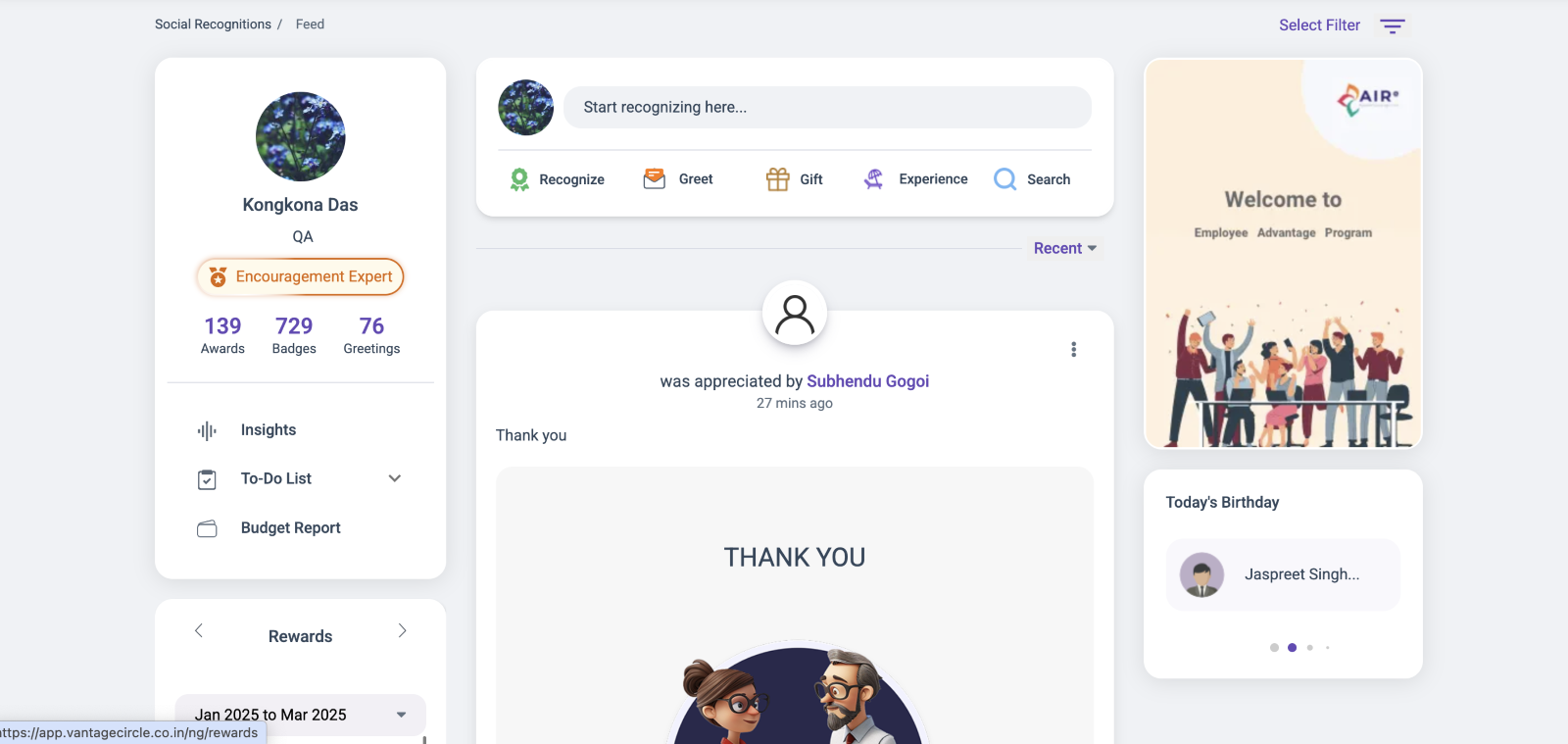
Recognition directs behavior. What you reward is what gets repeated. When employees see that their effort and initiative are consistently acknowledged, they’re more likely to raise their performance bar. Over time, it strengthens the entire performance culture.
This is where initiatives like profile badging quietly do powerful work. When achievements are visible on employee profiles, whether it’s for demonstrating leadership behaviors, or imbibing company values, recognition becomes more than a private “thank you.” It becomes public, persistent, and socially reinforcing.
Work Environment
Your work environment isn't just desks and lighting. It's the entire ecosystem where your people spend most of their waking hours. And it’s worth pausing to ask whether that environment is actually helping them do their best work.
Is your office a creativity-killer with fluorescent lights and zero privacy? Is your remote setup a chaotic mess of too many tools and not enough structure? Do people have what they actually need to do their jobs, or are they constantly fighting broken processes and outdated technology?
Engaged employees need environments that enable great work, not obstruct it. They need spaces that support natural collaboration and allow for focused work. And when the environment supports how people actually work, performance follows.
Employee Benefits
In America, life is expensive and complicated. Student loans hang over your head like a storm cloud. Childcare costs can rival your mortgage. Parents age, mental health needs rise, and navigating healthcare feels like trying to read War and Peace in a foreign language.
What actually makes employees pause, and stay, is when benefits feel human. Benefits that acknowledge these realities. From student loan repayment help, flexible schedules for caregiving, real mental health support, paid family leave that doesn’t punish your career. It tells employees that they matter more than a productivity metric.
When employees feel genuinely seen and supported, they brag about it. They become the ones telling friends over coffee, “Seriously, you should work here. They actually take care of people.”
To Know More. Read: Employee Benefits Guide for HR Professionals
Which Should HR Leaders Focus On—Engagement or Satisfaction?
Job satisfaction prevents disengagement. While employee engagement drives performance. That’s the simplest way to understand the difference and why choosing one over the other is wrong.
High-performing companies don’t treat satisfaction and engagement as competing priorities. They treat them as sequential investments. Satisfaction stabilizes the workforce. Engagement accelerates results. One protects the floor. The other raises the ceiling.
When organizations focus only on engagement without fixing pay inequities, burnout, poor management, or job insecurity, they build flashy programs on unstable ground. The result is surface-level participation and long-term cynicism.
The real performance advantage comes from doing both, in the right order.
Why High-Performing Companies Invest in Both?
Top-performing organizations understand that sustainable performance comes from balance. They first eliminate friction by addressing core satisfaction drivers like fair compensation, manageable workloads, job security, and healthy work environments. This creates emotional safety and stability.
Then they layer in engagement strategies such as recognition platforms, growth opportunities, culture-building, and leadership development. That’s when employees stop doing the bare minimum and start contributing ideas, solving problems, and advocating for the company.
The result isn’t just happier employees. It’s lower turnover, stronger team performance, faster execution, and a workforce that actually wants to stay and grow with the organization.
Conclusion
The companies winning right now aren't choosing between satisfaction and engagement. They're investing in both, strategically, in the right order. They know that satisfied employees stay. Engaged employees perform. And when you have both? That's when you build teams that dominate.
So, stop asking which one matters more. Start asking whether you're actually delivering on either. Because your employees already know the answer. And so does your competition.

Shikha Gogoi is a Content Marketing Specialist focused on SEO-driven content around employee engagement, recognition, and workplace culture, helping build people-first workplaces.
Connect with Shikha on LinkedIn.