




John Maxwell's 5 Levels of Leadership: A Complete Guide for Leaders at Every Level

A Global Employee Recognition and Wellness Platform
Most organizations promote their best performers into leadership roles and then quietly hope for the best. They hand them a new title and a larger team, assuming the skills that made them a strong individual contributor will naturally translate into effective leadership.
But leadership rarely works that way. Technical expertise and personal performance may earn the promotion, yet leading people requires a completely different set of capabilities. Without a clear roadmap, many new leaders are left figuring it out through trial and error.
This is exactly where structured leadership frameworks become valuable. One framework that has helped millions of leaders understand and improve their influence is the 5 Levels of Leadership developed by John C. Maxwell.
As Maxwell famously puts it, “Leadership is not about titles, positions, or flowcharts. It is about one life influencing another.”
In other words, leadership isn’t something you are given, it’s something you build. A job title may give you authority, but real leadership comes from the ability to inspire trust, deliver results, and develop others.
In this guide, we’ll break down Maxwell’s 5 leadership levels and explore how leaders can move from positional authority to lasting influence.
What Are the 5 Levels of Leadership?
The 5 Levels of Leadership is a leadership development framework that explains how influence grows over time. Rather than treating leadership as a title or position, the model presents it as a progressive journey of influence, trust, and impact.
The concept was introduced by John C. Maxwell in his book The 5 Levels of Leadership. In it, Maxwell argues that leadership is not something you are simply given through a promotion. Instead, it evolves as leaders build credibility, relationships, results, and ultimately the ability to develop others.
Before we unpack each level in depth, here's a bird's-eye view of how the framework is structured. The pyramid below illustrates a key truth embedded in Maxwell's model:

One critical nuance that you need to understand is that these levels are not permanent achievements. Maxwell is explicit that a leader can hold different levels with different people simultaneously.
Leadership Level 1: Position (Rights)

Level 1 is where every leader begins. At this stage, a person's authority derives entirely from their organizational title. They mostly get their work done through positional power. They are the ones who control the workload, the schedule, and in many cases, the performance review that determines raises and promotions.
What Level 1 Leadership Looks Like in the Workplace?
Common behavioral markers of a Level 1 leader:
- Decisions are top-down with little to no input from the team
- Team members do what is required and there is little discretionary effort
- High dependency on policy, rules, and HR escalation to handle interpersonal issues
- Employees feel monitored rather than supported
- Feedback flows one way. From manager to employee and is rarely the reverse
How to Move Beyond Positional Leadership?
The shift beyond Level 1 is more about earning influence. Leaders grow by redirecting their focus from control to connection:
- Take time to understand people as individuals, not just roles or resources
- Listen with intent, not just to respond or correct
- Invite perspectives before making decisions, especially from those closest to the work
- Communicate the reason behind expectations to create meaning, not just alignment
- Be consistent, fair, and predictable. Credibility is built through everyday actions
- Do what you say you will do, especially when it’s inconvenient
Progress to the next level begins when people choose to follow you even when they don’t have to. That choice of voluntary trust over enforced compliance is the true signal that leadership has moved beyond position and into influence.
Leadership Level 2: Permission (Relationships)

Permission is the second stage where people will follow you because they want to. People here aren’t forced to follow you, but instead, they follow as a personal choice.
At Level 2, people give you permission to lead them. Why? Because they like you as their leader and value the dynamics you share with them. At this level, you realize that leadership is more than just authority. You understand the importance of personal connections to develop influence.
Workplace Examples of Permission-Based Leadership
Permission-based leadership shows up differently depending on the industry and team context. Here are a few common workplace examples:
Indra Nooyi at PepsiCo
Indra Nooyi at PepsiCo wrote personal letters to the parents of her senior executives every year, thanking them for their child's contribution. She also kept a practice of staying in conversations until the person across from her felt truly heard.
Under her leadership, PepsiCo's revenue grew by 80% , and her approval ratings among employees remained among the highest of any Fortune 500 CEO of her era.
Howard Schultz at Starbucks
Howard Schultz built Starbucks into one of the most recognized brands in the world. He built his competitive advantage not on coffee but on relationships. He extended healthcare to part-time employees, called them "partners," and visited stores regularly, not to inspect but to connect. The trust that was created got translated into discretionary effort that no competitor could replicate.
How to Build Trust and Earn Permission?
-
Listen to Understand: Practice active listening and make sure you truly understand what’s being said before sharing your own perspective. This matters most during performance conversations, where feeling heard can change the entire outcome.
-
Be Consistent across People: Trust erodes quickly when people sense favoritism or uneven standards. Research on psychological safety consistently shows that inconsistency is one of the fastest ways to lose credibility. Apply the same expectations, attention, and accountability across your team.
-
Follow up on What People Share: When someone shares something with you in a one-on-one meeting, remember it. Follow up on it later without being prompted. Such behaviors build trust faster.
Leadership Level 3: Production (Results)

Level 3 is where leadership gains real organizational weight. At this stage, people follow you not because they like you, but because they've watched you deliver. You've moved from being someone who manages work to someone who drives outcomes. Here your track record becomes a form of influence that no title can manufacture, and no relationship alone can substitute for.
Nothing speaks like results. If you want to build the kind of credibility that connects with people, then deliver results before you deliver a message.
– John C. Maxwell
Why Results Accelerate Leadership Credibility
Credibility is the foundation that everything in leadership is built on. You can be trusted, well-liked, and genuinely invested in your people but without a track record of results, your influence has a ceiling.
Here's why results accelerate credibility in ways that relationships alone cannot:
-
Results Create Proof: Results-based credibility is built on evidence. When you consistently deliver, solve tough problems, or turn around failing initiatives, your track record speaks for itself.
-
Results Attract Talent: High performers want to work for leaders who win. When a team led you consistently wins, it becomes a place people want to be. Over time, this creates momentum and results in attracting talents that produce greater results.
-
Results Give Credibility to Challenge Status Quo: In most organizations, the permission to advocate for significant change is informally tied to your track record. Leaders who haven't yet demonstrated consistent delivery are often dismissed as insufficiently experienced. However, leaders with a strong production record can make the same argument and get a genuine hearing.
Balancing Production with People
The leaders who rise fastest are almost always exceptional producers. They're the ones who outwork everyone, solve the hardest problems, and deliver results that get noticed. As a result, the organization rewards that behavior with more scope, more visibility, and more responsibility.
Here’s what balancing production with people looks like:
The Rescue Reflex
When someone on your team struggles, it’s tempting to jump in and fix the problem yourself. It feels efficient and in the short term, it is. Over time, capability stalls and dependency grows.
In order to balance it out, you need to resist the urge to rescue and shift into coaching mode. Ask questions before offering solutions. Help people think through options, trade-offs, and consequences. Stay accountable for outcomes, but let team members own the path to get there.
The Bottleneck Leader
When your sense of value is tied to personal output, decisions start waiting on you. Approvals slow down. Work stalls when you’re unavailable. The team performs well only when you’re present and creates a serious risk the moment you step away.
The solution is not to work harder, but to let go deliberately. Start by identifying which decisions truly need your input and which don’t. Push decision-making closer to the work. Be clear about boundaries, priorities, and non-negotiables, then trust your team to operate within them.
Recognition Blindness
When you’re intensely focused on results, it’s easy to overlook recognition, because you’re moving fast and measuring success by output. Meanwhile, people who feel unseen begin to disengage quietly.
That’s why recognition needs to be part of your operating rhythm, not an afterthought. Call out contributions as they happen. Be specific about what you’re recognizing and why it matters.

Source: Vantage Recognition
Leadership Level 4: People Development (Reproduction)

Level 4 is where leadership stops being about personal performance and starts being about permanent impact. Maxwell calls it the Reproduction level, and the word choice is deliberate.
Leaders at Level 4 don't just develop people. They reproduce leadership itself, creating new leaders who go on to develop others, and others after them.
Yet despite its strategic value, this stage in leadership is genuinely rare. It requires a complete rethinking of what leadership success means. They begin to identify what people are good at and provide training for the skills they lack.
How Level 4 Leaders Build Other Leaders
This stage of leadership is a systematic and intentional commitment to identifying potential by creating development opportunities. Here the leader is accountable for other people's growth the same way you hold yourself accountable for business results.
Here's what that looks like in practice:
Identify Potential before it's Obvious
Instead of focusing only on proven performers, you start paying attention to early signals of leadership potential. The team member who asks unusually thoughtful questions. The individual contributor who steps in to help others without being asked.
This kind of potential is quieter. It doesn’t always come with polish or visibility. But it’s often a stronger indicator of future leadership than current performance alone.
Create Stretch Opportunities
Development doesn't happen in comfort. Leaders at this stage understand that real growth comes from well-designed challenges that stretch people beyond what they already know how to do.
Before assigning challenges, set clear expectations. Explain why the assignment matters, what skills it is meant to build, and what success will look like. During the challenge, stay accessible but resist the urge to step in and take over.
Give Away Your Best Opportunities
When a high-visibility opportunity appears, leaders at this stage pause and ask a different question: Who on my team would grow the most from this opportunity?
They don’t do it as an act of performative generosity. Giving away opportunities at this level doesn’t feel like self-sacrifice. It’s a strategic decision. One that signals confidence, builds bench strength, and tells the organization you are building leaders.
Mentorship and Coaching Strategies for Level 4
Mentorship is guidance based on experience. A mentor shares what they've learned, opens doors, offers perspective on career decisions, and provides a long view that the mentee can't yet see from their current vantage point. It works best when there's genuine chemistry, shared values, and a level of psychological safety that allows the mentee to bring their real challenges.
However, coaching is inquiry-based development. A coach doesn't primarily share their own experience. Instead, they ask questions that help the person being coached to build their own thinking, identify their own blind spots, and develop their own solutions.
Here's a practical framework for navigating that choice:
-
Use mentorship when the person needs context they don't have yet. It could be organizational dynamics, career navigation, or industry knowledge.
-
Use coaching when the person wants to build their confidence and develop their thinking process rather than solve an immediate problem.
Leadership Level 5: Pinnacle (Respect)

Maxwell calls it the Pinnacle, the highest level of leadership a person can reach. It is the natural culmination of everything a leader has become across all four preceding levels.
At this stage, people will follow you because of who you are and the quality you have. Because being around you makes people want to be better leaders themselves. Because they represent, what leadership at its fullest expression actually looks like.
When people respect you as a person, they admire you. When they respect you as a friend, they love you. When they respect you as a leader, they follow you.
– John C. Maxwell
Characteristics of Pinnacle Leaders
They Lead from Values, Not Circumstances
Most leaders adapt their behavior to the demands of the moment. It could be a tough quarter, a nervous board, or a difficult employee issue. However, Pinnacle leaders maintain a consistency of character that doesn't shift with circumstances. Their teams know exactly what they stand for because they've seen it demonstrated under comfortable conditions and under pressure alike
Their Ambition is Directed Outward, Not Inward
This is one of the most defining traits of Pinnacle leadership. In a culture that often equates leadership with personal achievement, these leaders have made a deeper psychological shift.
For them success is no longer measured by what they accomplish themselves, but by what others accomplish because of them. Maxwell identifies this shift as a prerequisite for reaching Level 5.
They Operate with a Long-time Horizon
Pinnacle leaders think in decades, not quarters. They make decisions about people, culture, and strategy with patience that runs counter to most modern organizational pressures. It’s also what allows these leaders to invest in people and systems that compound over time.
They Create Safety for Others to Lead
Teams shaped by these leaders demonstrate high psychological safety. People challenge ideas openly, surface problems early, take intelligent risks, and recover from failure without fear of lasting consequences.
5 Levels of Leadership Self-Assessment
Reading about the 5 Levels is one thing. Knowing where you stand is another. This self-assessment is designed to close that gap.
A few ground rules before you begin:
- Answer based on what you actually do, not what you intend to do or believe you should do.
- Answer based on your most recent 90 days of leadership behavior
- Resist the urge to answer based on your strongest relationships
- Think about your full team, including the people you find most challenging to lead
Quick Assessment: What Level Are You At?
Rate each statement on the following scale:
1 = Rarely or never | 2 = Sometimes | 3 = Often | 4 = Almost always
Section A: Position (Level 1)
- My authority primarily comes from my title or role.
- Team members follow processes because I enforce them.
- If I were removed from this role, my influence would significantly drop.
- People rarely challenge my decisions openly.
- Compliance is strong, but discretionary effort varies.
Add your score for Level 1: ______
Section B: Permission (Level 2)
- My team feels comfortable approaching me with concerns or ideas.
- I prioritize relationship-building alongside performance.
- People trust my intentions, even when decisions are tough.
- I actively listen before making conclusions.
- Team morale remains stable during pressure because of relational trust.
Add your score for Level 2: ______
Section C: Production (Level 3)
- My team consistently meets or exceeds key performance targets.
- I am known for delivering measurable results.
- I model a strong work ethic and accountability.
- Performance improves when I am directly involved.
- Other leaders respect me for what I accomplish.
Add your score for Level 3: ______
Section D: People Development (Level 4)
- I actively mentor high-potential team members.
- Several people I’ve led have been promoted or grown significantly.
- I delegate meaningful responsibilities to develop others.
- I invest time in coaching, not just directing.
- My success is measured by the growth of my people.
Add your score for Level 4: ______
Section E: Pinnacle (Level 5)
- Leaders I’ve developed are now developing others successfully.
- My influence extends beyond my immediate team or organization.
- People seek my guidance even when I have no formal authority.
- My leadership reputation is built on integrity and long-term impact.
- I focus on legacy more than position or short-term wins.
Add your score for Level 5: ______
Scoring & Interpretation
Each level has a maximum score of 25. The section where you scored the highest reflects your dominant leadership level.
Use This Guide to Interpret
20–25: You are strongly operating at this level.
15–19: You are developing consistency at this level.
10–14: You show emerging traits of this level.
Below 10: This level is not yet a primary strength.
What Your Results Mean
If Level 1 is Highest: You rely heavily on positional authority. Your growth opportunity lies in building deeper trust.
If Level 2 is Highest: You’ve built trust. The next step is translating relationships into results.
If Level 3 is Highest: You drive performance. Now focus on multiplying yourself through others.
If Level 4 is Highest: You are developing leaders. Continue expanding your influence and legacy.
If Level 5 is Highest: You are operating at rare air. Your responsibility now is stewardship and long-term leadership impact.
5 Levels of Leadership vs. Other Leadership Frameworks
Maxwell's Model vs. Situational Leadership
Situational Leadership, developed by Paul Hersey and Ken Blanchard in the late 1960s, is one of the most widely taught leadership frameworks in US corporate training programs. The framework identifies four leadership styles. They are Directing, Coaching, Supporting, and Delegating.
Both the framework are quite different from each other. Maxwell’s model is developmental and sequential. Leaders move upward through levels. Situational Leadership, on the other hand, is adaptive and fluid. Leaders shift styles moment to moment depending on the needs of the individual and the task.
| Aspect | Maxwell's Model | Situational Leadership |
|---|---|---|
| Core Focus | Leader's growth journey over time | Leader's style adaptation in the moment |
| Primary Question | What level of influence have I earned? | What does this person need from me right now? |
| Time Horizon | Long-term. Years and decades | Short-term. Conversation by conversation |
| Strength | Provides a clear developmental roadmap for leaders | Provides a practical in-the-moment decision tool |
| Best Used For | Leadership pipeline planning and long-term development | Day-to-day manager coaching and team effectiveness |
Maxwell's Model vs. Servant Leadership
Servant Leadership has roots that trace back to Robert Greenleaf's 1970 essay, “The Servant as Leader”. The framework's central proposition is a deliberate inversion of the traditional leadership hierarchy. Instead of the organization existing to serve the leader, the leader exists to serve the organization, the team, and the individuals within it.
Servant leaders prioritize the growth, wellbeing, and autonomy of the people they lead over their own advancement, recognition, or authority.
| Aspect | Maxwell's Model | Servant Leadership |
|---|---|---|
| Core Focus | Leadership is earned influence that grows through progressive levels | Leadership's primary role is to serve others |
| Motivation for Leading | Evolves from positional authority toward genuine influence and legacy | Rooted in a fundamental orientation of service from the beginning |
| Entry Point | Every leader starts at Level 1 regardless of orientation | Can be practiced at any level |
| Strength | Provides structure and a clear growth pathway | Provides a values foundation and a people-first leadership philosophy |
| Best Used For | Developmental road mapping, pipeline planning, performance conversations | Culture-building, values alignment, leadership philosophy development |
How HR Leaders Can Apply the 5 Levels Framework
Using Leadership Levels for Manager Development Programs
1. Map Where Your Managers Actually Are
Before designing a leadership program, first understand how managers are currently leading. Ask a simple question: Why do people follow this manager?
- If the answer is because they’re the boss, they’re likely at Level 1.
- If it’s because people trust them, they’re closer to Level 2.
- If it’s because they deliver results, that’s Level 3.
- If they’re growing future leaders, that signals Level 4.
This quick diagnostic often reveals something surprising: most organizations have far more Level 1 and Level 2 leaders than they assume. That insight should shape how development programs are designed.
2. Design Programs Around Leadership Transitions
The real growth in Maxwell’s model happens between levels, not within them. Instead of teaching generic leadership skills, build programs that help managers move through key transitions:
-
Level 1 → Level 2: Focus on relationship-building, listening skills, and trust-building.
-
Level 2 → Level 3: Develop execution credibility through stretch projects and business accountability.
-
Level 3 → Level 4: Shift the mindset from personal performance to developing other leaders.
When programs are built around these transitions, learning becomes far more practical and relevant.
3. Use the Framework in Succession Planning
Most succession planning focuses on past performance. But leadership readiness is about development trajectory.
Maxwell’s model helps leaders ask better questions:
- Is this manager consistently delivering results (Level 3)?
- Are they actively developing others (Level 4)?
- Are they building influence beyond their immediate team?
This makes succession discussions more precise and forward-looking.
4. Validate Leadership Levels With Employee Feedback
Self-perception and team perception often don’t match. Leaders frequently believe they’ve built trust or psychological safety, but their teams may feel differently.
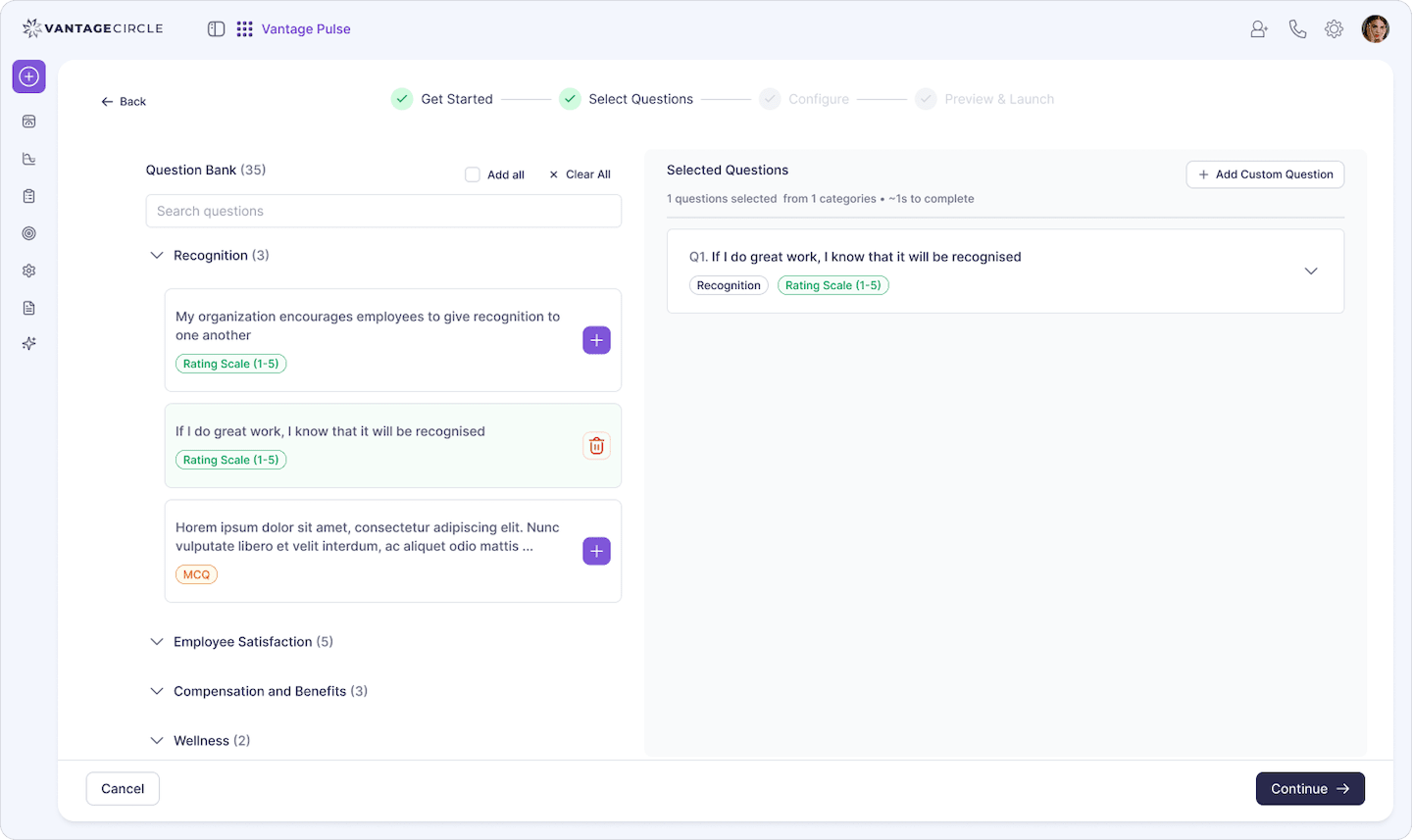
Regular employee feedback through tools like Vantage Pulse helps close that gap. Pulse surveys allow organizations to see how leadership is actually experienced at the team level.
Conclusion
Maxwell's 5 Levels framework has endured for decades not because it flatters leaders, but because it tells them the truth. The framework isn't a checklist to complete. It's a mirror. It shows you where your influence actually comes from, where it falls short, and what the next stage of growth demands from you.
Whether you're a first-time manager just stepping into Level 1, or a senior leader with the potential to reach the Pinnacle, the path forward is the same. Earn trust, deliver results, invest in people, and lead with enough humility to make yourself unnecessary.
FAQs
1. What are the 5 levels of leadership according to John Maxwell?
According to John C. Maxwell, there are 5 levels of leadership. They are Position, Permission, Production, People Development and Pinnacle.
2. What is John Maxwell's Rule of 5?
John C. Maxwell’s Rule of 5 states that small, consistent actions compound over time. Just as five steady swings of an axe each day will eventually cut down a tree. The principle emphasizes consistency over intensity.
3. What is the concept of Level 5 leadership?
Level 5 leadership represents the highest stage in Maxwell’s framework. At this level, influence is rooted in character, credibility, and legacy.

This article is written by Shikha Gogoi, a Content Marketing Specialist at Vantage Circle, where she has spent years crafting insightful, SEO-driven content on employee engagement, recognition, and workplace culture. With a strong foundation in content strategy and storytelling, Shikha is passionate about helping HR leaders and organizations build people-first workplaces through impactful content.
Connect with Shikha on LinkedIn, or reach out to editor@vantagecircle.com for inquiries.