












Acquisitions look great on paper. But most of them fail where it actually matters- people, culture, and execution. And that’s where HR is usually brought in too late. More as a support function, not a strategic one.
Today’s conversation is about flipping that narrative.
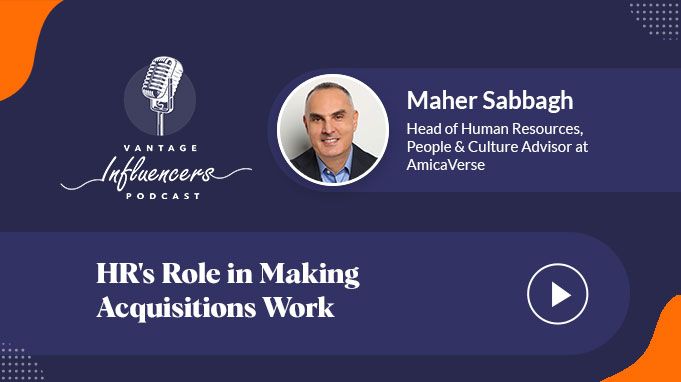
We’re talking about why HR should lead integration and performance after an acquisition.
Joining us for this conversation is Maher Sabbagh, Head of Human Resources and People & Culture Advisor at AmicaVerse. With deep experience across acquisitions, integration, and culture-led transformations, Maher has worked closely with leadership teams to turn complex people challenges into performance outcomes.
Host of this Episode: Shabana
Guest Bio
Maher Sabbagh is a seasoned global HR leader with nearly three decades of experience driving large-scale people transformations across the Middle East, Africa, South Asia, and Europe. He has held senior HR leadership roles with leading multinational organizations, most notably Japan Tobacco International (JTI), where he supported major market expansions, high-value acquisitions, and complex workforce transformations across Jordan, Iran, Dubai, Sudan, and Bangladesh.
Most recently, Maher served as Head of People & Performance at EDGNEX Data Centers (DAMAC Group), leading HR strategy across MENA, EU, and AP regions, advising executive leadership, and advancing DEI and talent development agendas. His expertise spans M&A integration, leadership development, organizational design, and building HR functions from the ground up.
Connect with Maher Sabbagh: Linkedin
Timestamps
(01:59) Maher's professional journey so far.
(03:51) When is HR brought in? If too late, then what does it cost the deal?
(06:19) Do most acquisitions lose the culture battle in the first 90 days?
(08:57) What happens when leaders aren’t aligned and can HR fix it?
(10:50) When uncertainty erodes employee trust, can HR truly rebuild it?
(13:31) Can people strategy really turn around business performance?
(15:16) What’s the one integration mistake you never forget?
(17:21) Final Thoughts