





Top Reasons for Employee Attrition (and What You Can Do About Them)

A Global Employee Recognition and Wellness Platform
I recall that exact moment when the star product manager of our organization walked straight into the office one fine day and handed in her resignation letter. Four more followed three weeks later.
Within a quarter, we lost a chunk of our workforce, not due to a recession or layoffs, but to voluntary attrition. This created a significant gap in the form of:
-
Replacement expenses.
-
Damage to team morale, and
-
Tarnished reputation in the market.
This gradual workforce reduction through voluntary resignations, retirements, and natural departures, known as employee attrition, has evolved from an HR metric into a strategic crisis for organizations worldwide.
It is no longer just about filling positions, but more about preserving institutional knowledge, maintaining competitive advantage, and protecting your employer brand.
With increasing competition in talent markets and employees prioritizing purpose, flexibility, and growth over tenure, attrition rates are challenging even the established companies.
But here’s what I’ve learned by virtue of working alongside organizational leaders: High attrition is not inevitable but preventable. Gallup particularly points out that 42% of employee turnover is preventable but often ignored.
The question is not whether you will face retention challenges, but how willing or proactive you are to address them.
Through this blog, let me share insights into why employees leave, and more importantly, what you can actually do about it.
Why Should We Address Attrition?

Before we dive into solutions, let’s be honest about what’s at risk. I’ve witnessed many conversations where attrition is sidelined as “part of doing business.”
This perspective can cost you more than you can imagine. Here’s why:
1. Financial Impact
According to SHRM, the cost of replacing an employee can range from 50% to 200% of their annual salary, depending on their level.
Financial impact is an unavoidable cost resulting from attrition. That’s just a visible aspect. However, there are underlying aspects that attrition may inflict. They are:
- Direct costs: Recruitment fees, job advertising, background checks, and onboarding programs.
- Productivity losses: The 6-8 month period before a new hire reaches full productivity.
- Knowledge drain: Undocumented processes, client relationships, and institutional memory walking out the door.
- Training investment: All those development programs, certifications, and mentorships that are now benefiting your competitor.
For a company losing 50 employees annually at an average salary of $75,000, it's about losing $3.75 million to $7.5 million in turnover costs.
That capital could have funded innovation, expansion, or retention programs that would have prevented the exodus in the first place.
2. Impact on Morale
There is something engagement surveys miss: attrition is contagious. The moment a respected colleague leaves, it sows seeds of doubt among the remaining employees, which begins to affect their morale.
This has become a repeated phenomenon, where one departure leads to hushed conversations, and before you know it, you’re dealing with “turnover contagion”. Here, every departure increases the likelihood that others will follow.
The remaining employees not only take on extra work, but they also face uncertainty, gripped by fear and growing suspicion that they are on a sinking ship. That's how a chain reaction works, where you lose entire teams, not just individuals.
3. Challenges in Recruitment
The recruitment landscape has undergone a drastic change. Your future candidates indulge in some homework. Before submitting applications, they check your attrition rates on Glassdoor, analyze your LinkedIn turnover patterns, and read exit interview testimonials on anonymous forums.
High attrition creates a vicious cycle, where:
- Top talent avoids you, sensing instability
- You're forced to lower hiring standards to fill urgent gaps
- Quality dilution leads to performance issues
- More tenured employees leave, frustrated with declining standards
- Your reputation takes another hit, and the cycle repeats
4. Cultural and Brand Damage
High attrition damages culture. You cannot build meaningful relationships, shared experiences, or institutional memory when people keep leaving. In the end, what remains is a transactional environment where no one invests deeply.
Externally, the consequence is just as real. Customers, partners, and investors notice the constant turnover. Every new account manager and loss of institutional knowledge signals instability, which they remember.
5. Legal and Compliance Risks
High attrition is subject to legal and compliance risks, which most leaders overlook until it’s too late. Attrition in particular demographics and departments can expose you to discrimination claims and regulatory scrutiny.
Beyond lawsuits, there are operational compliance risks. Departing employees carry critical knowledge of regulatory requirements, protocols, and quality standards.
This can expose organizations to FDA warnings, compliance violations, and data breaches that could have been prevented in the first place.
6. Long-Term Goals
Let’s be honest, high attrition sabotages your long-term strategy. Investors and board members increasingly view retention as a key indicator of whether you can actually execute your plans.
You cannot execute multi-year strategies when people keep leaving. Product roadmaps stall, client relationships reset with every departure, and innovation dies because no one stays long enough to supervise ideas’ move from conception to implementation.
In a nutshell, attrition doesn't just affect today's operations; it steals your future.
Top Reasons for Employee Attrition
Now that our eyes have opened to what’s at stake, let’s examine the root cause behind why employees leave.
1. Lack of Career Growth Opportunities

Research shows that 70% of employees are somewhat likely to leave their current job to work for an organization known for investing in employee development and learning.
We are made to believe that employees leave organizations for promotions. That is anything but true. They leave when they stop seeing a future with the company, where the path ahead to career development is opaque, blocked, or non-existent.
Here's what I've observed drives this:
- Flat organizational structures with limited upward mobility
- Lack of lateral movement options that expand skills and keep work interesting
- No visible succession planning that shows employees you're investing in their future
- Generic development conversations that don't result in concrete opportunities
A more interesting point is that many organizations do have growth opportunities, but they are invisible. Departments operate in silos, roles aren't clearly defined, and potential paths aren't communicated.
In short, your employees aren't seeking a promotion every year; they want to see a future worth staying for.
2. Poor Leadership and Management
People leave managers not companies.
– Marcus Buckinghum
This may sound harsh, but it’s the ultimate truth. This is particularly relevant to leaders who have promoted high performers without providing them with leadership training.
Exit interviews tend to reveal how, beyond polite scripts, poor management is a critical factor in driving employees out. It is reflected through:
- Micromanagement
- Inconsistent feedback and surprise performance reviews
- Favoritism
- Information hoarding and poor communication
- Failure to advocate for the team
The solution isn’t firing managers; it’s investing in leadership development before the promotion, and not after the employees have fled.
In fact, reveals that 56% of human resources managers consider training and development essential to business.
3. Inadequate Recognition and Rewards
Recognition boils down to psychology and fairness. When employees deliver exceptional effort that drives better results, the reward must match that effort. Otherwise, you're teaching high performers that going above and beyond is pointless.
In fact, Forbes study reveals that 66% of employees would quit their jobs if they didn't feel appreciated.
The recognition gap appears in the following ways:
- Delayed bonuses that arrive too late to matter
- Identical work getting wildly different recognition
- Empty thank-yous without tangible rewards
- Leadership is capturing value while frontline teams get token gestures.
Employees understand budget constraints, but what they resent is exploitation: working more while leadership reaps the gains.
On the other hand, companies that retain talent abide by the following rules:
- Make recognition timely, specific, and meaningful.
- Encourage peer-to-peer recognition to incorporate recognition into the daily fabric of work.

Source: Vantage Recognition - Match the reward to the contribution, whether that's money, growth opportunities, or genuine autonomy.
A study reveals that the top 20% of companies with a “recognition-rich culture” have a 31% lower voluntary turnover rate.
4. Low Compensation and Benefits
Let’s face the truth: if you’re losing people to competitors who are paying 20-30% more, then you have a compensation problem and not an engagement problem.
Companies often hold placards of claims where they brag about having “great culture”, “mission-driven work”, and “providing flexibility”. Undoubtedly, these are valuable, but in reality, they do not pay bills. Culture can only retain employees when the pay is equally competitive.
Here are some common compensation failures that need your attention:
- Outdated salary bands that ignore inflation and market rates
- New hires earning more than loyal veterans
- Weak benefits concerning healthcare, parental leave, and retirement
- Pay disparities in remote teams that breed resentment.
Fixing this issue isn’t about matching the offer to that of your competitor; it is more about:
- Running regular market compensation audits
- Being transparent about your pay philosophy
- Ensuring fairness across demographics and tenure
- Offering competitive total rewards and not just base salary
And if budget constraints are real, make sure to compensate through other dimensions such as flexibility, growth opportunities, or equity.
5. Toxic Work Environment

Toxic environments hardly look toxic from the top. They fester in specific teams or departments where their bad behavior often goes unchecked.
Here are some common patterns that flow through toxic environments:
- Incivility, such as sarcasm, public criticism, and aggression, is excused as "direct feedback".
- High performers whose toxic behavior gets excused
- A pack that creates insiders and outsiders
- Blame cultures where mistakes mean punishment, not learning
- Pressure to cut corners or ignore problems
Toxic culture does not surface in surveys. People fear retaliation and hence decide to stay quiet and privately search for jobs. By the time you witness mass resignation, the damage is already done.
Having said that, the solution requires courage. There should be zero tolerance for toxicity regardless of performance, real reporting systems with follow-through, and treating culture violations as seriously as financial ones.
6. Burnout and Work-Life Imbalance
Burnout is a critical issue that has shifted from an individual problem to an organizational crisis. The pandemic accelerated what was already happening: always-on cultures, disappearing boundaries, and workloads that keep expanding without additional resources.
Burnout isn't because of weaknesses but the result of unsustainable systems. Watch out for these signs:
- Chronic understaffing with no relief
- Hero culture that celebrates overwork
- Meeting overload that kills productivity
- Zero boundaries and constant after-hours contact
- No recovery time between intense cycles
- No control over schedules or workload
Burnout tends to target your highest performers first. These are conscientious and quality-driven employees who push themselves until they break. They end up leaving for lower-stress roles, taking their expertise with them.
Hence, the solution is not limited to wellness apps. The system and pattern have to break.
- Realistic workloads,
- Adequate staffing,
- Enforced time off,
- Leadership modeling boundaries, and
- Rejection of the idea that exhaustion proves commitment.
7. Mismatch of Role Expectations
This is the "bait and switch" problem, which is often unintentional but can cause damage. Employees accept roles based on a set of expectations, only to discover the reality is entirely different.
Some of the common mismatches are:
- Job descriptions that don't match reality
- Expanding responsibilities without adjusted pay or title
- Talented people doing work below their skill level
- Promised projects that never happened
- Company values that don't reflect the actual culture
The challenge is that mismatches emerge gradually. Employees do not realize their mistake immediately; it steadily dawns upon them what they signed up for. And by the time they speak up, they are mentally drained.
Prevention requires companies to be honest in recruiting (show the real job, not the ideal one), provide clear role definitions that stick, and have regular check-ins to catch mismatches early.
8. Lack of Engagement and Purpose
This attrition driver cuts deepest because it is about meaning. There are employees with good pay, great managers, and clear paths forward who still leave because their work feels empty, and they are not engaged.
According to a study, companies with a clear mission have a 49% lower attrition rate than those that don’t.
This is one of the human tendencies where we seek purpose and meaning in every work we engage in. We need to understand how our efforts contribute to something meaningful beyond profits.
This is how disengagement appears:
- Employees can't explain how their work matters
- Bureaucracy hides its impact behind processes
- Work feels transactional, not meaningful
- Days blur into repetitive tasks
- No voice or influence
The solution has nothing to do with motivational talks. It’s about showing how individual work creates tangible outcomes, giving people control over their work, and building a community around shared purpose.
A Gallup study reveals that enterprises with higher engagement levels have 18% lower turnover compared to companies that have lower engagement and more than 40% turnover every year.
HR's Role in Shaping Attrition Triggers: Proactive Measures
Now that we have thoroughly discussed and understood the reasons behind employees’ departures, it’s time to shift our stance and take proactive measures to curb attrition.
As organizations, you should not wait for exit interviews to grasp the problems; instead, build or design systems that prevent attrition triggers from forming in the very first place.
Consider the following approaches:
Incorporate Empathy into HR Processes
Empathy might sound soft, but it’s more strategic. Traditional HR processes prioritize organizational efficiency, like workflows, compliance, and risk mitigation. They weren't built around employee experience.
View your systems through your employees’ perspectives:
- Does your performance review feel confrontational or collaborative?
- Does parental leave treat family needs as an inconvenience?
- Is promotion transparent and fair, or political and opaque?
- Do benefits require navigating bureaucratic complexity?
Empathy does not indicate that you’re abandoning standards. It means that you are designing processes that aim to achieve business objectives while simultaneously respecting dignity and individual circumstances.
It means building flexibility into systems, training managers in emotional intelligence, and creating support structures for life's inevitable challenges.
The companies that get this right witness transformative retention because employees feel genuinely valued and not processed.
Leverage AI and Data Analytics

Now, let’s shift our focus to data analytics, which is shaping the evolving future of workplaces.
Predictive analytics helps identify employees who are at risk of leaving by tracking patterns in engagement data, performance changes, compensation competitiveness, promotion history, manager interactions, and team collaboration dynamics.
The goal is early intervention. When the data identifies someone as a flight risk, it prompts action, leading managers to have conversations, HR to schedule development discussions, and compensation to be reviewed. In short, technology spots the problem; humans solve it.
Additionally, analytics also reveal systemic issues. Sentiment analysis detects dissatisfaction spreading across teams. Pay audits catch compensation inequities. Exit interview analysis uncovers patterns that individual reviews miss.
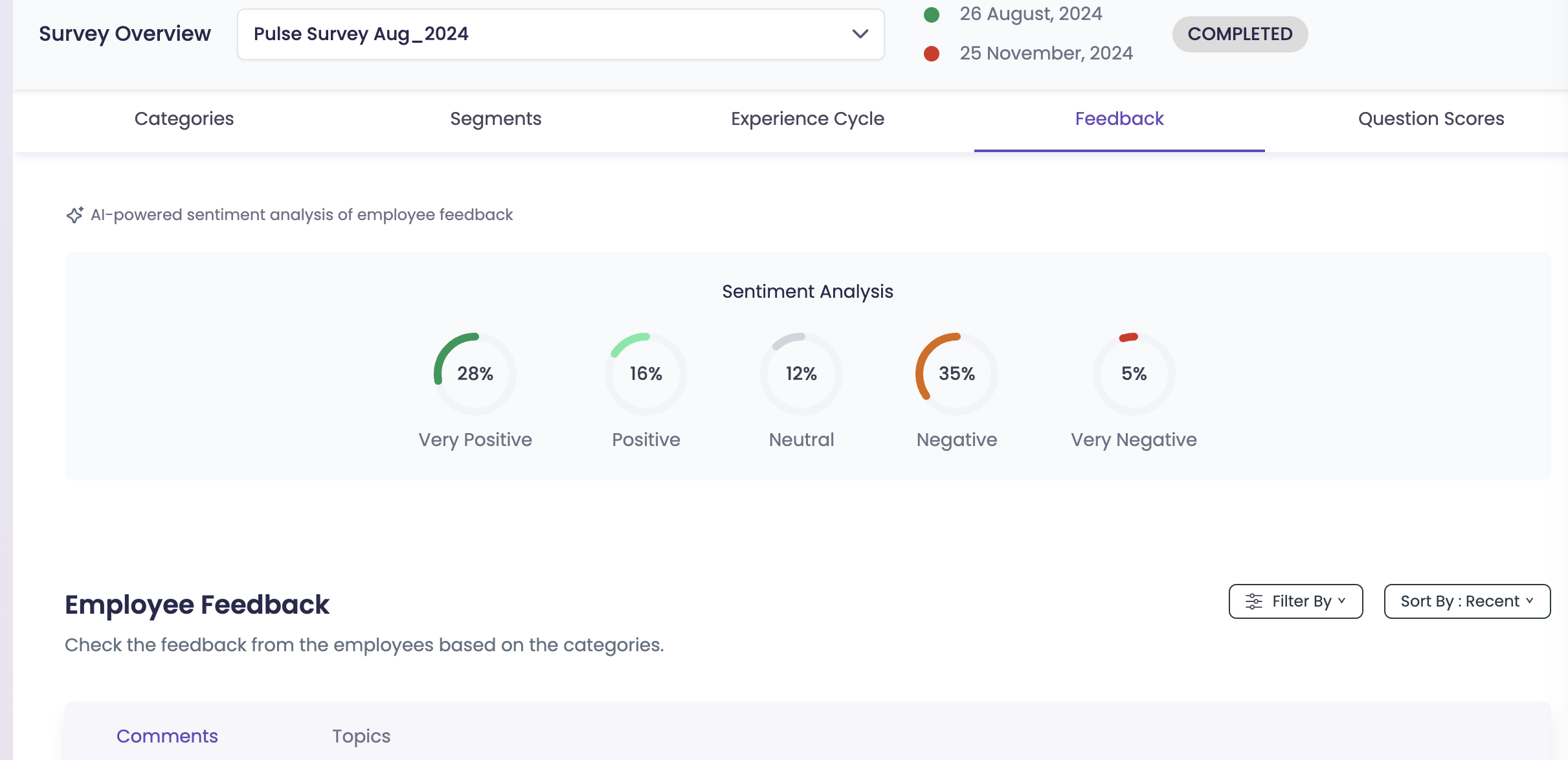
Source: Vantage Pulse
The key here is transparency. Employees should understand what’s being measured and why. Position these tools as support mechanisms and not surveillance systems.
When used ethically, predictive analytics transforms HR from reactive problem-solving to proactive talent retention.
Conclusion
After examining the drivers of attrition, the risks it creates, and the proactive measures that work, you should now have clarity on your gaps and opportunities for improvement.
The critical takeaway: treat retention as a strategic priority, not an HR issue to delegate. When leadership applies the same rigor to attrition as they do to revenue or product quality, organizations transform.
Act before cracks start developing, or you may reach a point where you cannot undo them. The choices you make will determine your future outcomes.

Riha Jaishi is a Content Marketing Specialist at Vantage Circle and host of the HR Vantage Influencers podcast, where she champions recognition-rich, people-first workplace cultures. Through her dual expertise in content creation and podcast hosting, Riha delivers thought-provoking insights that bridge theory with real-world application. Her engaging conversations with global HR leaders and compelling blog content consistently spotlight critical industry perspectives, empowering organizations worldwide to build more impactful, employee-centric environments.
Connect with Riha on LinkedIn and X, or reach out to editor@vantagecircle.com for inquiries.