There is a moment, somewhere around the 10,000-employee mark, when a company's recognition program stops being a people problem and becomes an infrastructure problem, and the shift is easy to miss because nothing dramatic marks it.
The thank-yous are still happening, and managers are still trying, but the system underneath them, built for a company half the size, is quietly coming apart at the seams. Human Resources Information System (HRIS) platforms have multiplied across acquisitions, compliance has graduated from an HR concern to a boardroom one, and the culture in Singapore is nothing like the culture in São Paulo, even as the recognition program goes on treating them as identical.
This is the scaling trap that nobody in HR talks about, and it is one that almost nobody survives cleanly.
What follows is a blueprint for building an employee recognition platform that is built to survive that scale, one organized around five scale tiers, a multi-region operational architecture, and the six-phase rollout that Vantage Circle deploys with its largest enterprise clients, and it is a blueprint that addresses what actually breaks at scale, and how to anticipate it before it does.
Running through all of it is a single proof of concept, Wipro's Winners' Circle program, which spans 230,000+ employees across 66 countries, generates one recognition every 1.2 minutes, and reaches 57% of the entire workforce, making it the largest single-platform deployment in the industry, by some distance.
At that scale, recognition is no longer a gesture, it is infrastructure, and that infrastructure has five distinct tiers, each with its own breaking point, and its own fix.
Key Insights
- Why Recognition Programs Break When You Cross 10,000 Employees
- Case Study: How Wipro Runs Recognition Across 230,000 Employees, 66 Countries
- The 5 Scale Tiers: How Recognition Programs Change Every 50,000 Employees
- The Multi-Region Operational Architecture: What Most Vendors Don't Cover
- The 6-Phase Enterprise Rollout Roadmap
- How to Measure Recognition Success at Enterprise Scale
- The Vendor Evaluation Rubric for 10,000+ Employee Programs
- Bottom Line: Scale Is an Architecture Problem, Not an HR Problem
Why Recognition Programs Break When You Cross 10,000 Employees
Recognition programs fail at 10,000 employees not because effort drops, but because the model was never built for that weight. Past a certain headcount, what worked as a cultural habit becomes an operational liability. It breaks in three specific ways.
Manager bandwidth ceiling. A manager with 8 direct reports can recognize contributions frequently. A manager with 8 direct reports inside a company with 300 managers across 12 time zones cannot maintain meaningful coverage without a structural mechanism beyond their own effort. Gallup's research on employee recognition found that only 1 in 3 U.S. workers strongly agree they received recognition for good work in the last 7 days. That number has barely moved in years, and it's directly tied to the structural limits of manager-only program design.
Geo-cultural drift. What reads as meaningful recognition in the United States reads as performative in Japan, transactional in Germany, or insufficient in India. Without a platform that localizes both the recognition experience and the reward catalog by region, the program achieves compliance in some geographies and active resentment in others.
System integration debt. Large enterprises rarely run a single Human Resources Information System (HRIS). Growth, acquisition, and regional expansion leave most organizations managing several identity systems at once. A recognition program that isn't integrated with that infrastructure creates manual overhead that breaks the administrator experience and introduces data lag that employees notice before HR does.
The data reflects how widespread this problem is. Across 5.7 million employees and 2,000 organizations, only 55% feel truly recognized, leaving half the workforce in a recognition blind spot (The Recognition Effect, 2025). At scale, the root cause is almost never a lack of intention. It is a lack of architecture.
For how this plays out at the team level, see the breakdown of the recognition gap and what triggers it. For the fundamentals underneath all of this, see the complete guide to employee recognition.
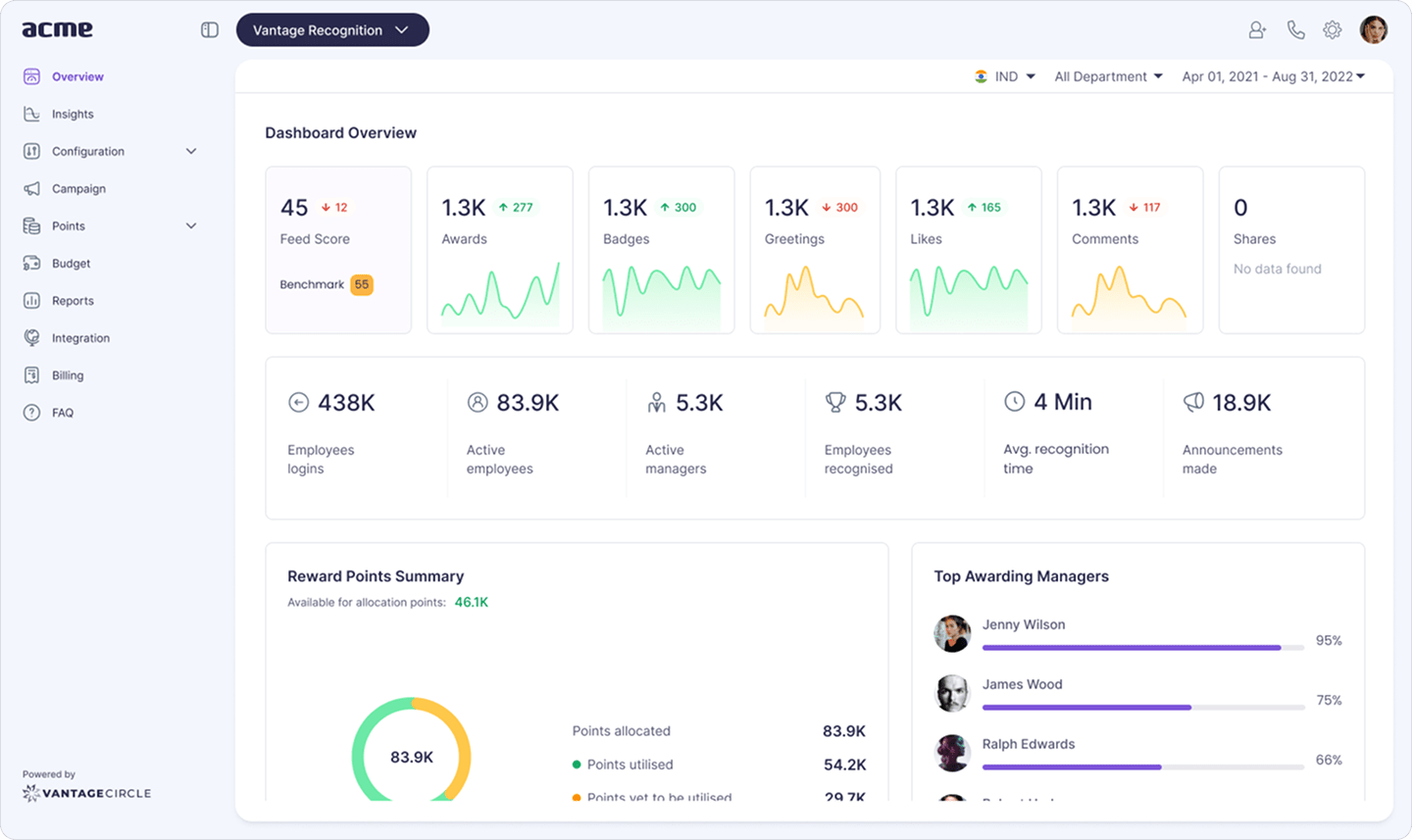
Source: Vantage Recognition and Rewards Platform
Case Study: How Wipro Runs Recognition Across 230,000 Employees, 66 Countries
Wipro Limited spans 230,000+ employees across 66 countries, every time zone, and multiple regulatory frameworks, all running simultaneously. Keeping recognition consistent and values-aligned at that scale is not an HR initiative. It is an infrastructure problem.
Before partnering with Vantage Circle, Wipro faced 3 structural problems that most large-enterprise recognition programs eventually hit: building a consistent recognition culture across a dispersed global workforce, integrating their core cultural values (Wipro's 5 Habits of Culture: Being Respectful, Being Responsive, Always Communicating, Demonstrating Stewardship, and Building Trust) into the recognition framework, and maintaining full compliance with GDPR and regional data privacy requirements across 66 countries.
What the program architecture looks like today:
The Wipro Winners' Circle program runs on Vantage Rewards, with peer-to-peer recognition as the primary driver of coverage. The platform integrates with Wipro's HRIS and SSO infrastructure across regions, supports multi-currency reward redemption, and manages service anniversary automation for thousands of employees reaching milestones simultaneously. Business units can customize their local recognition frameworks within the global program structure, which is the governance design that makes consistency and regional flexibility coexist.
Vantage Circle built the infrastructure. The numbers below show what that looks like in practice.
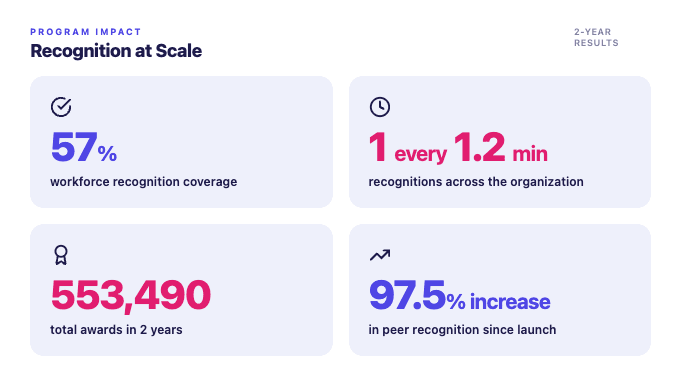
The results, by the numbers:
- 57% workforce recognition coverage in the most recent fiscal year
- 1 recognition every 1.2 minutes across the organization
- 553,490 total awards delivered in 2 years
- 97.5% increase in peer recognition since program launch
These numbers are not the outcome of a campaign. They are what a recognition infrastructure produces when peer-to-peer recognition is the default mechanism, not an add-on.
Do Give a Read: Wipro implemented an award-winning R&R program for their massive workforce in partnership with Vantage Circle
The 5 Scale Tiers: How Recognition Programs Change Every 50,000 Employees
The 5 scale tiers below are not about platform features. They are about what breaks first at each headcount level and what architectural change resolves it. Every tier has a primary constraint, a minimum system requirement, and a recognition target. Solving for the constraint, rather than adding features, is what determines whether a recognition program survives scale.
| Scale Tier | Breaking Point | System Requirements | Success Target |
|---|---|---|---|
| 🏗️ 10K – 25K | Manager bandwidth ceiling | Peer-to-peer recognition, SSO, HRIS integration | 70% coverage in 90 days |
| 🌍 25K – 50K | Geo-cultural drift | Multi-language UI, regional reward catalogs, localized values | 75% coverage · 2x recognitions/user/month |
| ⚙️ 50K – 100K | System integration debt | SCIM provisioning, HRIS sync, country-level data residency | 80% coverage · 2.5x frequency · 99.9% uptime |
| 🛡️ 100K – 200K | Governance and compliance | SOC 2 Type 2, GDPR, full audit log, regional admin delegation | 80%+ coverage · zero compliance incidents |
| 🌐 200K+ | 24/7 global availability | Multi-region cloud, SLA-backed support, dedicated CSM | Sustained global coverage · measurable eNPS lift |
Tier 1: 10,000 to 25,000 Employees: The Manager-Ceiling Problem
At this tier, manager-only recognition tops out at 20 to 30% workforce coverage because no manager has enough bandwidth to recognize every contribution that deserves it.
The primary constraint is manager bandwidth concentration. The employees who receive the most recognition are the ones sitting closest to managers in the reporting structure. Everyone further away goes largely unrecognized, regardless of how committed the manager population is.
System requirement: Peer-to-peer recognition module plus Single Sign-On (SSO) integration with the primary HRIS.
Recognition target: 70% workforce coverage within 90 days, 1.5 recognitions per active user per month.
Vantage Rewards' peer-to-peer recognition module adds the lateral layer that makes 70% coverage achievable, distributing recognition beyond the manager-to-direct-report channel without replacing it.
Tier 2: 25,000 to 50,000 Employees: The Geo-Cultural Drift Problem
At this tier, recognition norms diverge across regions. What lands as genuinely meaningful recognition in one geography falls flat or creates friction in another, and the program's credibility erodes in the regions where the experience feels imported rather than local. The primary constraint is multi-region cultural calibration combined with language localization.
System requirement: Multi-language UI, region-specific reward catalogs, local-language values tagging for recognition messages.
Recognition target: 75% workforce coverage, 2.0x recognition frequency, with no more than 10% variance in recognition rates across major regions.
Translating the platform interface is the starting point, not the solution. The deeper challenge is reward relevance. Vantage Rewards' catalog across 100+ countries localizes both reward options and the recognition experience by region.
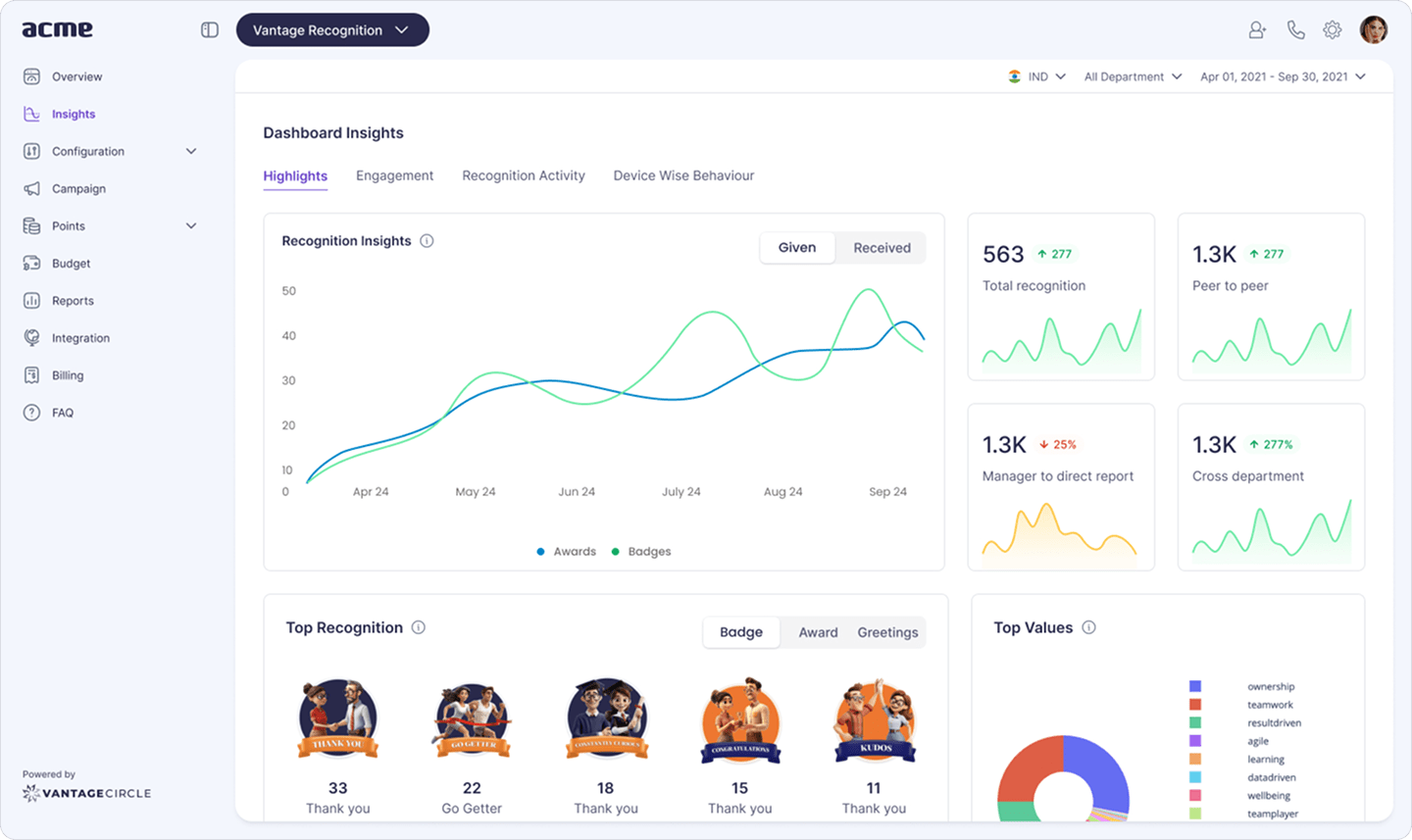
Source: Vantage Recognition and Rewards Platform
Tier 3: 50,000 to 100,000 Employees: The System-Integration Debt Problem
This is where most programs collapse. HRIS fragmentation, identity sprawl, and tax or payroll complexity all hit at the same tier, and they hit simultaneously.
The primary constraint is integration depth across HRIS, identity, and compliance systems.
System requirement: System for Cross-domain Identity Management (SCIM) provisioning, SSO integration with Workday, SAP SuccessFactors, or Oracle HCM, tax-aware reward catalogs, and country-level data residency.
Recognition target: 80% workforce coverage, 2.5x recognition frequency, platform integration uptime at or above 99.9%.
Without HRIS integration, employee data is always slightly stale and manual reconciliation creates the kind of quiet overhead that program managers start cutting corners on. SCIM handles automatic sync when employees join, transfer, or exit. SSO authenticates through the company's identity provider, removing a separate recognition credential from the equation.
Tier 4: 100,000 to 200,000 Employees: The Governance and Compliance Problem
Above 100,000 employees, recognition becomes a governance problem more than an HR program. The platform holds sensitive employee identity data subject to multiple jurisdictions, reward redemptions carry tax implications that vary by country, and the audit trail requirements are enterprise-grade.
The primary constraint is regional compliance: GDPR in Europe, country-specific tax treatment of recognition awards, and audit trail requirements for procurement and legal review.
System requirement: SOC 2 Type 2 certification, General Data Protection Regulation (GDPR)-compliant data architecture, full audit log at the individual recognition event level, and regional admin delegation with role-based access controls.
Recognition target: 80%+ workforce coverage maintained across all regions, zero compliance incidents.
Award redemptions carry different tax implications in every jurisdiction. A platform without country-specific tax-aware reward types creates employer liability that surfaces in finance long before HR notices it.
Tier 5: 200,000+ Employees: The Wipro Frontier
At 230,000+ employees across time zones that collectively span every hour of the day, a recognition platform that goes down for 2 hours at 2am UTC is down during prime business hours somewhere in Asia Pacific. Recognition programs at this scale operate like critical infrastructure, not HR tools.
The primary constraint is 24x7 global availability with enterprise-grade support.
System requirement: Multi-region cloud architecture, SLA-backed support with defined uptime commitments, a dedicated Customer Success Manager (CSM) with named enterprise-account oversight, and an executive-level program governance structure.
Recognition target: Sustained recognition coverage and frequency across all regions, with measurable employee Net Promoter Score (eNPS) correlation as the program matures.
This is the tier where Wipro operates today. The platform architecture running behind it: 24x7 uptime across Vantage Circle's multi-region cloud infrastructure, a dedicated CSM model, and a governance structure that allows Wipro's business units to run their own recognition frameworks within the global program. See the full Vantage Rewards platform for enterprise-scale specifications.
The Multi-Region Operational Architecture: What Most Vendors Don't Cover
Multi-region recognition is an architecture problem, not a configuration step. The 5 operational requirements below are completely absent from most vendor comparison conversations, yet every one of them becomes a program-stopping constraint the first time an enterprise rolls recognition out to a new region without addressing it.
| Operational Concern | Minimum Requirement | Vantage Circle Capability |
|---|---|---|
| Currency support and FX conversion | Multi-currency reward catalog with country-specific pricing | 70+ currencies, country-specific catalogs with local market pricing |
| Language localization | Full UI translation plus recognition message templates in local languages | 30+ language support including values-tagged recognition in regional languages |
| Tax and perquisite treatment | Country-specific tax-aware reward types; employer reporting alerts by jurisdiction | Configurable tax-aware reward catalog by country |
| Data residency and compliance | GDPR, Digital Personal Data Protection Act (DPDPA), and Lei Geral de Proteção de Dados (LGPD)-compliant architecture; regional data centers | SOC 2 Type 2 certified; regional data residency options |
| SSO + SCIM + HRIS integration topology | SAML-based SSO, SCIM provisioning, native HRIS connectors | Workday, SAP SuccessFactors, Oracle HCM, Microsoft Teams, Slack |
Currency Support and FX Conversion
Most recognition platforms price rewards in a single currency and apply the same point values globally. That creates a quiet equity problem. An employee in India redeeming 500 points gets a meaningfully different reward experience than an employee in Germany. That is because purchasing power varies significantly across countries and markets. Vantage Rewards addresses this with support for 70+ currencies and country-specific catalog pricing, so the same point balance delivers comparable real value regardless of where an employee is based.
Language Localization Beyond UI Translation
Translating the platform interface is the starting line. The real challenge is recognition messages and values tags. A message auto-translated into Japanese loses the cultural register that gives recognition its meaning. Vantage Rewards supports recognition templates and values-tagged recognition aligned to local norms in each region.
Tax and Perquisite Treatment by Country
In the UK, reward redemptions above certain thresholds are taxable benefits. In India, perquisite tax rules apply. In Germany, works council notification requirements can apply to certain reward structures. A platform without country-specific tax-aware reward types creates employer liability that finance will flag long before HR does.
Data Residency and Compliance
Data privacy regulation varies significantly by region. The General Data Protection Regulation (GDPR) governs employee data in Europe, while India's Digital Personal Data Protection Act (DPDPA) sets the rules for operations on the subcontinent. Each creates distinct requirements for how employee data is stored, transferred, and deleted. Vantage Circle is ISO 27001:2013 certified for information security management and holds ISO 27701:2019 certification for privacy information management, with dedicated compliance frameworks for both GDPR and DPDPA.
SSO + SCIM + HRIS Integration Topology
The integration architecture has three layers, each solving a different operational problem. Security Assertion Markup Language (SAML)-based Single Sign-On handles identity. Employees log into the recognition platform using the same credentials they use for everything else, with no separate login to manage. SCIM handles automatic user provisioning, meaning when an employee joins, transfers, or exits, the recognition platform updates without manual HR intervention. Native connectors to Workday, SAP SuccessFactors, and Oracle HCM ensure recognition data flows directly into existing reporting systems, so program analytics don't require a separate export step.
The 6-Phase Enterprise Rollout Roadmap
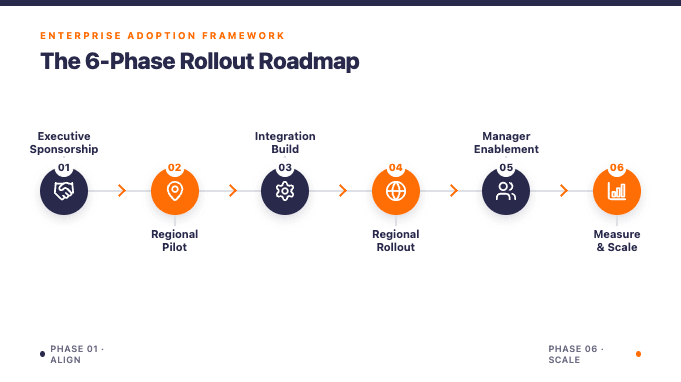
A 6-phase rollout is not about slowing down the program launch. It's about avoiding the pattern where a recognition platform goes live simultaneously for 15,000 employees, creates friction in 3 regions on day 1, and loses executive sponsorship by week 6.
Phase 1: Executive Sponsorship and Program Charter (Weeks 1 to 4)
Secure a named executive sponsor tied to a specific business objective, whether that is voluntary turnover in a high-risk cohort, engagement in a specific BU, or recognition coverage as an eNPS leading indicator. Write a one-page program charter with the goal, primary metric, and governance structure. Without it, every disagreement in Phase 4 restarts the goal-setting conversation from zero.
Phase 2: Regional Pilot in 1 to 2 Business Units (Weeks 5 to 12)
Run the platform live in 1 to 2 BUs before the full-workforce launch, choosing teams with strong manager engagement and geographic diversity. Pull participation rate and recognition reach at 30 and 60 days. The pilot's job is to find the problems a demo environment never surfaces.
Phase 3: Integration Build and SSO/HRIS Connection (Weeks 8 to 16)
Run this in parallel with Phase 2, not after it. SSO and HRIS integration can take 6 to 10 weeks when enterprise IT security review is involved, and starting it after the pilot pushes the full rollout date by the same amount. Deliver SCIM provisioning, SSO verification, bidirectional HRIS data flow, and country-specific tax configuration by Phase 3 close.
Phase 4: Phased Regional Rollout (Weeks 16 to 36)
Roll out in waves of 2 to 3 regions simultaneously, each with a pre-launch manager briefing, employee communication, and a 30-day activation sprint. Sequential regional rollouts extend time-to-full-deployment by 12 to 18 months for a 50,000+ employee organization, and leadership patience for unfinished rollouts has a fixed shelf life.
Phase 5: Manager and Peer Enablement at Scale (Weeks 20 to 40)
Enablement at scale is a recognition behavior curriculum, not a platform training webinar. It covers why recognition drives the business outcomes the sponsor cares about, what specific recognition looks like in practice, and how to use the platform. Deliver it by cross-BU manager cohort so recognition practices spread across team boundaries.
Phase 6: Measure, Refine, and Scale to Full Workforce (Weeks 40+)
At the 12-month mark, pull five metrics: participation rate, recognition reach, recognition frequency, eNPS shift, and voluntary turnover delta for recognized versus non-recognized cohorts. Use the AIRe Report 2024-25 as the benchmark reference. Run a recovery sprint for bottom-quartile BUs. Repeat quarterly.
Source: Vantage Recognition and Rewards Platform
How to Measure Recognition Success at Enterprise Scale
Most enterprise recognition programs track two numbers, total recognitions sent and platform login rate, and call it measurement. Those numbers tell you whether the platform is being used. They do not tell you whether the program is working.
Five metrics actually reveal program health at enterprise scale. Each addresses a different failure mode, and together they give a complete picture of whether recognition is reaching the right employees, at the right frequency, with the right results.
1. Recognition Coverage Rate
Coverage rate is the percentage of employees who received at least one recognition in a given period, measured by region and business unit, not organization-wide.
How to track it: Pull from your platform's analytics dashboard monthly. Segment by BU and region. An organization-wide 65% coverage rate can hide a specific region sitting at 30% and a business unit at 20%.
What good looks like: 70% or above for organizations between 10,000 and 25,000 employees. 80% or above for organizations above 50,000. Any BU or region running below 50% for two consecutive quarters needs a named recovery plan, not a reminder email. For benchmark ranges by program maturity, see the recognition program benchmarks guide.
2. Recognition Frequency Per Active User
Frequency measures how often active users are giving recognition, not just receiving it. A program where 80% of recognitions come from 10% of users is not a recognition culture. It is a habit held by a small group.
How to track it: Divide total recognitions given by the number of active users in the same period. Review monthly.
What good looks like: 1.5 recognitions per active user per month at program launch. Programs sustaining 2.0x or higher at the 12-month mark have embedded recognition as a behavior, not just a platform feature.
3. Employee Net Promoter Score Shift at 90 Days
Employee Net Promoter Score (eNPS) measures how likely employees are to recommend their workplace. It is the fastest available proxy for whether recognition activity is translating into employee sentiment.
How to track it: Run a baseline eNPS survey before launch and a follow-up at 90 days post-launch. A 3 to 5 point positive shift in 90 days is a realistic target for a well-activated program.
Why it matters: The Recognition Effect (2025), covering 5.7 million employees across 2,000 organizations, found that when employees experience all four emotional recognition signals (Appreciation, Acceptance, Validation, and Accomplishment), 97% report intent to stay. When they experience none of the four, that number falls to 29%. A 68-percentage-point gap in retention intent, driven entirely by recognition completeness, shows up in eNPS before it shows up in turnover data.
4. Time-to-First-Recognition for New Hires
This is the metric almost no enterprise recognition program tracks, and it is one of the strongest leading indicators of year-one retention.
How to track it: Filter your platform data for employees with fewer than 90 days of tenure. Check when each received their first recognition. Calculate the median days-to-first-recognition for each monthly cohort.
What good looks like: First recognition within 30 days of joining. Employees who go 60 days without a single structured recognition are significantly more likely to leave in their first year than those recognized in week two. At scale, this gap compounds. A 10,000-person organization onboarding 200 employees a month has a measurable retention problem if recognition is not built into the first 30 days by design.
5. Voluntary Turnover Delta: Recognized vs. Non-Recognized Cohorts
At 12 months, compare voluntary turnover rates between employees who received regular recognition and those who did not. This is the metric that moves a recognition program from an HR initiative into a CFO conversation.
How to track it: Pull a recognized cohort (employees who received four or more recognitions in the year) and a non-recognized cohort (zero recognitions). Compare 12-month voluntary turnover rates across both groups. Control for tenure and department where possible.
What good looks like: High-recognition cultures produce 92% employee retention versus 76% in low-recognition environments, a 16-percentage-point spread large enough to appear in cost-per-hire analysis. The AIRe Report 2024-25 found that organizations conducting a detailed R&R program ROI evaluation see 2 to 3x higher impact across key recognition objectives compared to those that skip measurement entirely. Measurement is not administrative overhead. It is the multiplier.
Review Cadence
Pull all five metrics quarterly. For any metric that declines for two consecutive quarters, run a recovery sprint: identify the bottom-quartile BU or region, schedule a manager enablement session, and set a 30-day re-activation target. Measurement without a recovery protocol is reporting, not management.
As AI increasingly shapes how these five metrics get captured and analyzed, see how AI in employee recognition is changing this measurement layer.
The Vendor Evaluation Rubric for 10,000+ Employee Programs
8 criteria separate enterprise-ready employee recognition platform vendors from those that will require significant workarounds past 10,000 employees. Evaluate against all 8, not just the 3 that appear in most RFP templates.
The vendors who satisfy all 8 criteria are a short list. Vantage Circle's Wipro program, running at 230,000+ employees across 66 countries with peer-to-peer recognition as the primary coverage mechanism, is the most detailed public evidence of what "scale proven" looks like in practice.
For a full software comparison, see employee recognition software for large organizations.
Frequently Asked Questions
How do you scale an employee recognition program across multiple countries?
Run it on a platform with multi-currency reward catalogs, multi-language support, and country-level HRIS integration. For each new region: configure a local reward catalog, verify SSO with the regional identity provider, and apply country-specific tax treatment. Start with a 1 to 2 region pilot to surface configuration gaps before they become program-wide problems.
What are the best practices for employee recognition at large enterprises?
Five practices separate programs that survive scale from those that don't: activate peer-to-peer recognition as the primary coverage mechanism; integrate with HRIS and SSO for real-time employee data; localize the reward catalog by region; measure coverage at the BU and region level, not just organization-wide; and run quarterly reviews with named recovery actions when any metric trends down for two consecutive quarters.
How do you maintain recognition culture at 10,000+ employees?
Design recognition into everyday workflows, not just milestone programs. That means peer-to-peer recognition inside Slack and Microsoft Teams, service anniversary automation that runs without manual HR input, and values-tagged recognition that connects daily behavior to company culture at the moment it happens. At this scale, culture is a systems design problem, not a motivation problem.
How long does it take to roll out enterprise recognition?
For 10,000 to 25,000 employees, plan for 6 to 9 months from contract to full-workforce launch. For 50,000+, plan for 9 to 18 months. The primary driver is IT integration complexity, specifically SSO, SCIM, and HRIS build, not platform configuration. Organizations that run integration in parallel with the pilot phase consistently land at the faster end.
What integrations does enterprise recognition software need?
Five are non-negotiable: SAML-based SSO, SCIM provisioning from the HRIS, native connectors to Workday, SAP SuccessFactors, or Oracle HCM, collaboration tool integration for in-channel recognition, and an analytics export to the HRIS reporting stack. Any vendor treating three or more of these as custom professional services engagements will slow every future configuration change.
How much does enterprise recognition software cost?
Pricing typically follows a per-employee-per-month licensing model with a separate award budget for redemptions. Request itemized pricing covering platform licensing, implementation fees, and per-employee award budget at your expected participation rate. Watch for per-recognition transaction fees, as they create budget unpredictability as program activity scales.
What is an example of a 100,000+ employee recognition program?
Wipro's Winners' Circle, powered by Vantage Rewards, is the most detailed public example at this scale: 230,000+ employees across 66 countries, 57% recognition coverage, 1 recognition every 1.2 minutes, and a 97.5% increase in peer recognition since launch. Full details are in the Wipro case study.
How do you measure recognition success at enterprise scale?
Track four metrics: recognition coverage by region and BU, recognition frequency per active user per month, eNPS shift at 90 days post-launch, and voluntary turnover delta between recognized and non-recognized cohorts at 12 months. Review quarterly with a pre-defined recovery protocol for any metric that declines two periods in a row. The AIRe Report 2024-25 provides benchmark ranges by program maturity.
Bottom Line: Scale Is an Architecture Problem, Not an HR Problem
The recognition programs that survive past 10,000 employees treat recognition as infrastructure, not as initiative. That means peer-to-peer recognition as the primary coverage mechanism instead of manager-only programs. It means HRIS and SSO integration as a standard requirement, not an optional add-on. It means regional reward catalogs, localized recognition experiences, and compliance postures that match the jurisdictions where employees actually work.
The Wipro Winners' Circle program, is the proof point that this architecture works at full scale. The 57% coverage rate, the 553,490 awards over 2 years, and the 97.5% increase in peer recognition are not outcomes of a recognition campaign. They are outcomes of a recognition infrastructure designed to scale.
Building recognition at 10,000+ employees?
Vantage Circle's enterprise team will walk you through the architecture, the rollout timeline, and what it takes to hit 80%+ coverage at your scale.
Book a Consult
Shaoni Gupta is a content marketing specialist at Vantage Circle, with expertise in scriptwriting and copywriting in the field of employee rewards and recognition.
Connect with Shaoni on LinkedIn.