




How to Communicate Employee Survey Results to Employees (Without Losing Their Trust)

A Global Employee Recognition and Wellness Platform
There comes a time in everyone’s life when we need to communicate something important to someone, and we have no idea how, or we straight-up dread it. This exact phenomenon plays out in the corporate world every single quarter, especially when the employee survey results hit your inbox.
You’ve already done the hard part. You ran the employee survey, collected the responses, and now you have the truth sitting right in front of you. Now comes the moment most HR teams quietly dread, not because the results are bad, but because no one ever taught them what to actually say when the numbers (and the feelings behind them) are staring back.
Most organizations communicate survey results by showing scores. A slide deck. A few bar charts. A "thank you for your feedback." The room nods. The meeting ends. Three months later, participation drops.
The scores were shared. The feedback wasn't heard. Those are different things, and employees know the difference.
In this article, let’s discuss exactly how to tackle this situation—so you can turn those results into real conversations, real trust, and real change.
Why Most Result-Sharing Fails
The problem has nothing to do with presentation skills or choosing the wrong format. The problem is a fundamental misunderstanding of what employees are actually waiting to hear.
When an employee fills out a survey, they're making a small bet. They're betting that someone will read their answers, take them seriously, and do something different as a result. Every time you share results without showing what changed, or even what you're thinking about changing, you lose that bet for them.
Only 8% of employees strongly agree that their organization takes action on survey results, according to Gallup. That number describes the default expectation employees walk into your all-hands with. They're already skeptical before you say a word. If employee satisfaction was one of the themes you measured, that skepticism shows up directly in the data you're about to present.
This is the exact dynamic that drives survey fatigue. Employees stop responding not because they've been surveyed too many times, but because responding has never visibly changed anything. The communication failure comes before the next survey even launches.
The answer to that skepticism has nothing to do with packaging results more attractively. Communicating them honestly, including the parts where you don't have a solution yet, is what actually rebuilds trust.
Three Decisions to Make Before You Share Anything
The communication breakdown usually starts before anyone gets in a room. Most HR teams jump straight to building the deck without settling three questions first.
1. Who gets what level of detail?
The all-hands gets the headline themes: two or three things that came through loudest across the organization. Managers get their team-level data and need it before the all-hands, not after. Senior leadership gets the breakdown by department or function so they can own the parts that belong to them.
This tiered approach matters even more when you're running employee lifecycle surveys. Onboarding results belong with the hiring team, exit data belongs with leadership, and engagement scores belong with every manager who had a direct hand in them.
Flattening everything into one communication is how results stop feeling relevant. A marketing manager doesn't need the engineering team's scores. An employee in a regional office doesn't need headquarters data. Give each audience the lens that actually applies to them.
2. What's the honest story?
Look beyond the scores. If career development came up in 60% of open-text responses but scored a 3.8 out of 5, the number undersells what employees are actually saying. The loudest themes are not always the lowest scores. Find the signal, not just the average.
This is where analyzing your engagement survey results properly pays off. Reading the numbers is only part of it; understanding what themes cluster together and which ones are being understated by the rating scale is where the real story lives.
Turn Insight into Action: How To Analyze Employee Engagement Surveys Effectively
Pick two or three themes that genuinely came through. Not the most positive ones. The most prominent ones.
3. What will you actually do?
Don't schedule the company meeting before you can answer this. Even a partial answer is better than none. "We heard X, we're starting Y in May, and Z is still under discussion" is infinitely more credible than "we're reviewing all feedback and determining next steps."
If you have nothing concrete to share yet, delay the communication by a week and figure out at least one thing. One specific, owned, time-bound action. The employee engagement survey questions you asked will usually point you directly at which themes had the most intensity behind them, start there.
The Three Communication Formats and When to Use Each
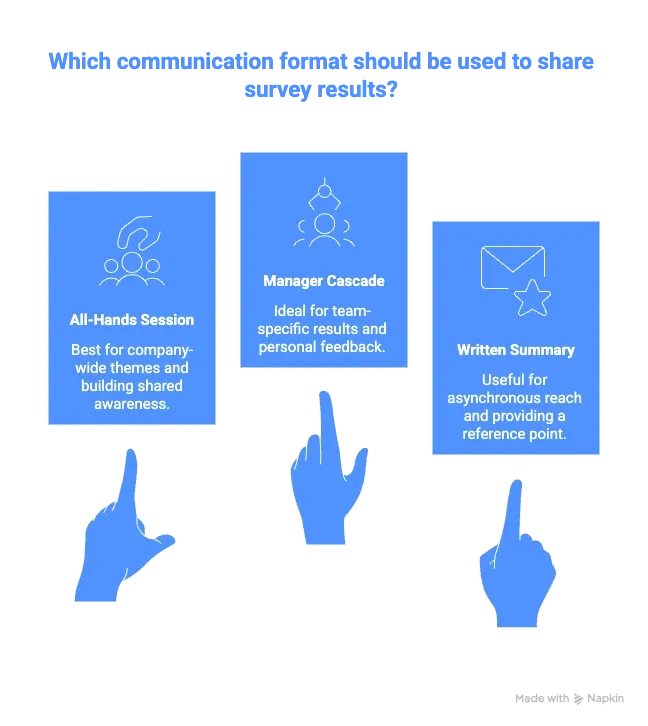
There's no single right format for sharing results. The right choice depends on your audience, your organization's size, and, to be direct about it, how difficult the scores are.
1. The All-Hands Session
Best for: company-wide themes, showing leadership's response, building shared awareness.
The all-hands is where you tell the story, not where you read the data. Lead with what you heard, not what you scored. Start with the themes employees raised most frequently, acknowledge what the data says plainly, and spend more time on what's happening next than on the numbers themselves.
The mistake most leaders make is over-indexing on the positive scores because the room feels safer that way. Employees notice. According to Gartner, only 33% of employees believe their organization actually delivers on its promises. Burying the difficult results in slide 14 after eight charts of green scores is exactly the behavior that earns that lack of trust.
Keep it to 30 minutes. Show three themes. Tell them what you're doing about each one. Open for questions and actually answer them. Done consistently, this turns your survey from a data-gathering exercise into a bridge that actually connects leadership back to the team.
2. The Manager Cascade
Best for: team-specific results, local action, making feedback feel personal.
This is the most powerful format and the one most organizations handle worst. Managers are handed their team's scores, told to "have a conversation," and sent in without preparation. They get defensive, they explain the scores away, or they schedule a meeting that becomes a one-way readout. Employees leave feeling worse than before.
The fix is simple: managers need a briefing before they talk to their teams, not after. Give them the talking points, the specific data for their team, and a clear structure for the conversation. More on that structure in the section below.
One thing worth doing before that briefing: look at the employee survey questions about management your team included in the survey. Managers will land this conversation better if they understand exactly which questions their team answered and what those questions were designed to measure.
3. The Written Summary
Best for: asynchronous reach, giving people time to digest, as a companion to a live session.
A written summary, whether via email, or internal newsletter, is useful when you want employees to have a reference point they can return to. A written summary works alongside a live conversation, not instead of one.
Keep it short. Three paragraphs. What you heard. What you're doing. When you'll update them again. If it runs longer than 300 words, cut it. Long summaries get skimmed and the important parts get lost.
For organizations running anonymous employee surveys, the written summary also serves a specific purpose: it reassures employees that results were aggregated, not attributed, which matters for trust in future cycles.
How to Handle Bad Scores
Bad scores are not a communications crisis. They are data.
The instinct to soften negative results, contextualise them heavily, or bury them in the middle of a presentation is precisely what erodes trust in survey programs over time. Employees who shared that feedback know what they said. When they see it minimised in the readout, they draw the obvious conclusion.
Name the difficult results first, don't bury it in slide 11. Not with three slides of positive context before you get to them. If manager effectiveness is your problem score, lead with it. If employee morale dropped across departments, say that before you show anything else.
Turn the Tide on Morale: What is Employee Morale: Signs, Strategies, and Solutions
Then separate what you can fix from what you can't, and say so clearly.
"Compensation is below market and we don't have budget to change the pay bands this year" is an honest sentence. "We are reviewing all elements of our total rewards package" says nothing and sounds like exactly what it is: an attempt to avoid saying something real.
Employees don't expect you to fix everything. They expect you to be straight with them about what you're going to fix and what you're not. That honesty, stated plainly and without spin, builds more credibility than a polished presentation ever will. It also directly affects whether people stay: employee retention survey data consistently shows that feeling unheard is one of the top reasons people start looking elsewhere.
A workable framework for any difficult result:

- Name the finding clearly
- Explain what's driving it, if you know
- State what you can address and the timeline
- State what you can't address right now and why
- Commit to when you'll revisit it
That's five sentences. Most difficult results can be handled in five honest sentences.
The Manager Conversation: A Practical Structure
Managers dread this conversation for a reason. If their team's scores are low, the implication is that they contributed to it. Often, they did. That's not a reason to avoid the conversation. It's a reason to structure it so it doesn't collapse into defensiveness.
Here's a structure that works in 20 minutes:
-
Start by thanking the team for being honest. Not for participating. For being honest. "Thank you for completing the survey" is HR-speak. "Thank you for telling us what's actually going on" is human.
-
Share two or three themes from the team's results. Not a score readout. Not a chart. Two or three things that came through: "What came up most was workload, a lot of you are feeling stretched. The second thing was clarity around goals. Those are the two things I want to focus on."
-
Ask one question: "Is there anything in these results I might have read wrong?" This opens the conversation without making it a free-for-all. It signals that the manager is listening, not just presenting.
-
Close with a date. When will they hear more from HR. When will the manager follow up. Not "we'll keep you posted" but a specific date on the calendar.
The goal of this conversation is not to make employees feel good about the scores. It's to make them feel the scores were actually read. That's the more achievable goal, and it's the one that matters for next cycle's participation.
If this is a pulse survey debrief rather than an annual one, the conversation can be even shorter: 10 minutes, one theme, one action. The cadence of pulse surveys is specifically designed to make these conversations smaller and more frequent, which means each one carries less pressure.
Timing
How fast you share results signals how seriously you take them.
Deliver the findings within three to four weeks after a survey is closed, never two months later or “once we’ve fully analysed everything.” A delay makes the feedback feel outdated and disconnected, while speed proves you value employee candor and drives higher participation next time.
After the initial communication, send one short 30-day update: “Here’s the one thing we committed to — here’s where it stands and what’s next.” That single message often builds more trust than the first announcement.
Closing the Loop Is a System, Not a One-Off
The biggest reason survey communication fails is that most organisations treat it as a single event: results are shared, then everything goes quiet until the next cycle.
That silence is exactly where trust dies.
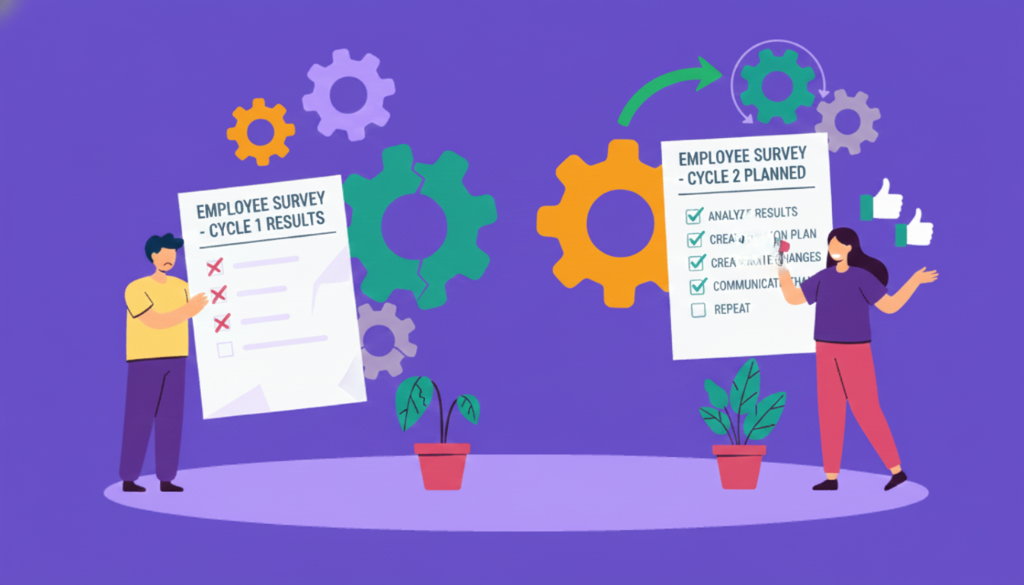
Closing the loop is a repeatable system: share results quickly, assign clear owners to every action, give regular progress updates at fixed intervals, and openly admit when something didn’t happen as planned. The simple “You said, we did” format works because it’s easy to maintain consistently — and the companies that use it see the highest ongoing participation rates.
This steady rhythm turns sentiment tracking into something powerful. You’re no longer just capturing how people feel at one moment; you’re measuring whether your communication and actions actually change how they feel between surveys. If sentiment rises after you close the loop, you’re doing it right. If it doesn’t, the message never landed.
For teams whose survey programme has lost momentum, the communication approach here is the essential first layer. Real follow-through and accountability sit on top of it.
What Vantage Pulse Does With This
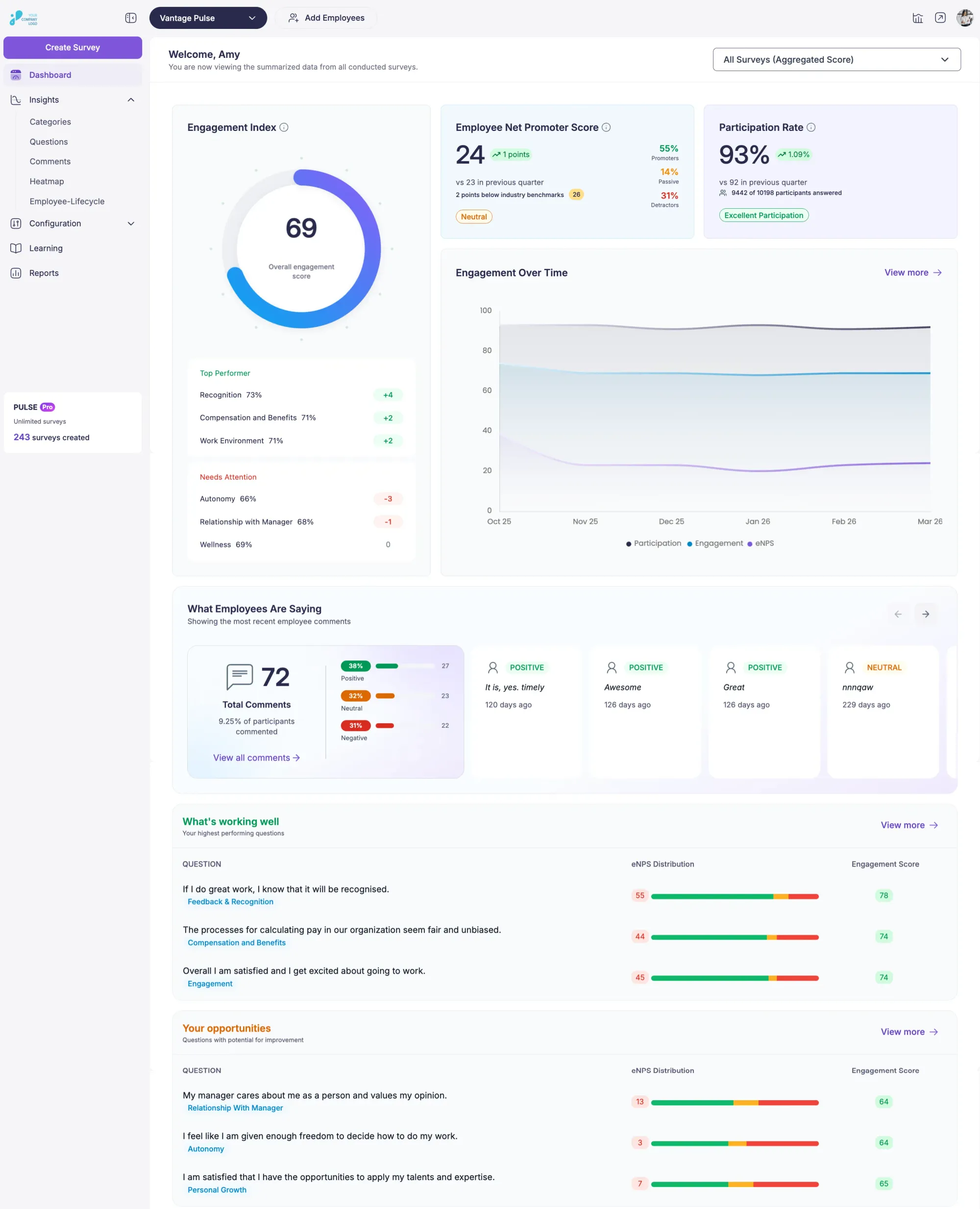
One of the practical challenges in all of this is that building a shareable results summary from raw survey data takes time: time most HR teams don't have in the days before an all-hands.
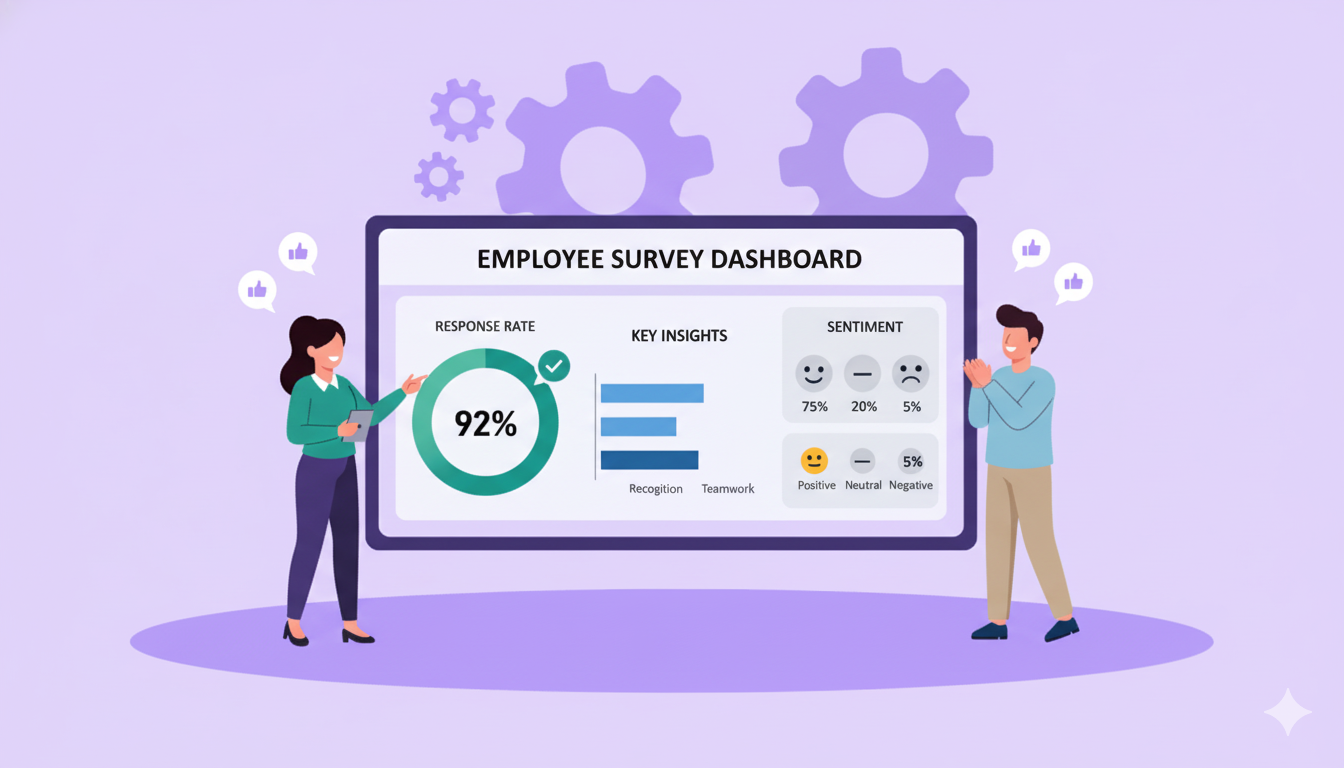
Vantage Pulse automatically segments results by team, department, role, and tenure, so the output is already structured for different audiences. The employee survey dashboard shows exactly what that view looks like in practice, including how team-level results surface separately from organization-wide scores so managers can see their data without wading through the full report.
The action tracking feature lets you assign owners, set timelines, and monitor progress in the same platform where the data lives. So the "you said, we did" update doesn't require a separate project management tool. If you're weighing up options, the top employee survey tools comparison covers what to look for when action tracking is a priority.
If you want to see what your results would look like before your next communication, structured across every team and audience level, a 15-minute demo will show you the results view live.
The One Number Worth Tracking
Most HR teams track survey participation rates and treat a high number as a sign the program is working. It's a reasonable proxy, but participation measures whether employees opened the survey, not whether they trust the process.
The number worth tracking is this: after you share results and announce actions, does participation in the following survey go up or down?
That movement is your feedback on the feedback process. It tells you whether employees believed what you told them. Whether they're betting on the process again. Whether the communication actually landed.
Scores tell you what's wrong. That trend tells you whether you're fixing it.
FAQs
Q: How soon should you share survey results?
Within three to four weeks of closing. Any longer and the issues employees raised feel stale, and the communication reads as obligatory rather than responsive. Organizations that share within two weeks consistently see higher participation in the next cycle.
Q: Should you share negative results openly?
Yes, and lead with them. Burying low scores after eight slides of green charts is the fastest way to confirm what skeptical employees already suspect: that the survey was performative. Employees who gave difficult feedback know what they said. Seeing it minimised tells them exactly what to expect next time.
Q: What if you don't have any actions ready yet?
Wait a week and find at least one. One specific, owned, time-bound action is more credible than "we are reviewing all feedback and will share next steps soon." Sharing results with no response signals that the data was collected but not acted on, which is the exact pattern that kills participation in the next cycle.

Sahil Khan is a member of the Content team at Vantage Circle. He has a keen interest in movies, music, and the dynamic world of marketing. He enjoys exploring the relationship between SEO and content, blending creativity with strategy to understand how ideas reach audiences effectively. For any related queries, contact editor@vantagecircle.com