




15 Low-Cost Employee Benefits That Fix What Salary Can’t

A Global Employee Recognition and Wellness Platform
Today, employees aren’t just clocking in for a paycheck. They’re looking for an environment that supports their well-being, growth, and everyday happiness. But here’s the real challenge: not everyone is a Fortune 500 giant with deep pockets. Most organizations have to be smart, intentional, and creative with their employee benefits strategy.
And the pressure is only growing. A global survey by Willis Towers Watson (WTW) found that rising costs and tight talent markets are pushing nearly half of all employers to rethink their benefits strategy entirely. And for good reason - according to a 2024 Grant Thornton survey, 33% of HR leaders say benefits are now the primary reason employees join or stay, outranking even bonuses or location.
So the big questions leaders quietly ask themselves are:
Do employees really value perks over salary?
And can low-cost employee benefits actually move the needle on productivity?
Surprisingly, yes. When perks genuinely solve everyday employee needs - recognition, flexibility, learning, community, they create a work experience that feels personal and meaningful. Even low-cost perks can spark motivation and loyalty when done intentionally.
So before assuming great benefits require a huge budget, it’s worth seeing how affordable, high-impact perks can reshape culture, strengthen engagement, and deliver real results, without stretching a growing company thin.
Let’s dive into the perks employees love - each one framed as a key question you, as a leader, need to ask yourself:
Which Free and Zero-Cost Perks Actually Improve Morale?
Honestly, not every company has the budget to roll out spa Fridays, mental-health retreats, or team vacations in Bali. But here’s the good news : employees don’t only care about big perks. They care about real perks. The kind that actually makes their day smoother, their workload lighter, and their life a little less chaotic.
And many of those cost exactly 0.
Below are some free benefits leaders underestimate, but employees absolutely love.
1. Why should you offer flexible work and "life" schedules?
Work is just one piece of the bigger picture. Employees juggle kids to pick up, doctor appointments, power outages, sick pets, and those days when life just hits fast. Allowing employees to adjust their hours shows a simple but powerful message: “We trust you.”
Flexibility doesn’t just boost morale - it boosts ownership. When adults are treated like adults, they step up. They deliver better, they plan better, and they stop wasting energy worrying about whether their manager thinks they're “online enough.”
This is the cheapest perk with the highest return.
2. How does a "No-Meeting Day" reduce burnout?
Meetings are the biggest silent productivity killers. One day a week without meetings gives people something rare: uninterrupted focus. It’s a mini mental reset - no camera, no context switching.
Leaders who adopt no-meeting days often find that:
-
work gets done faster,
-
teams feel less drained, and
-
creativity finally has space to breathe.
And again, zero cost. Just discipline.
Companies like HubSpot have officially banned internal meetings on Fridays to give employees uninterrupted time for deep work, planning, or just to recharge — helping reduce Zoom fatigue and fight burnout while boosting focus and productivity.
3. Is a casual dress code still effective?
Absolutely. High-quality work doesn’t depend on a rigid dress code. A relaxed approach reduces daily friction, letting employees be more comfortable and authentic as they show up as themselves. When a team feels at ease, collaboration improves naturally. With less energy spent on “looking formal,” people can focus more on thinking clearly and doing their best work.
4. Can “Bring Your Pet to Work” days boost engagement?
Surprisingly, yes - and more than you’d expect. Pets instantly change the office energy. They reduce stress and make the workplace feel warm instead of corporate cold.
You don’t need a full dog-friendly office. Even one day a month can lift moods, encourage bonding, and make your workplace feel human.
Plus, pets are natural icebreakers. Teams that struggle to talk suddenly bond over a wagging tail.
Amazon openly encourages employees to bring their dogs to work, believing pets create calmer, more connected teams - proof that culture isn’t built only through policies, but through everyday experiences.
What Are the Best Affordable Perks Under $50 Per Employee?
When perks are chosen intentionally, not just copied from a trend list, even something under $50 per person can generate a boost in goodwill.
Here are four low-cost ideas that actually work and feel meaningful, not gimmicky.
5. How does peer-to-peer recognition drive culture?
Recognition hits differently when it comes from peers. A small, structured recognition program - even something as simple as monthly “shout-out cards,” digital kudos boards, or rotating appreciation badges can completely shift team energy.
- reinforces positive behaviors,
- builds stronger relationships, and
- creates a culture where appreciation becomes a habit, not a quarterly event.
And the cost? Usually under $20 to run. But the cultural ROI is huge.
And if you want to make peer-to-peer appreciation effortless, platforms like Vantage Circle take the lead. Take a look-
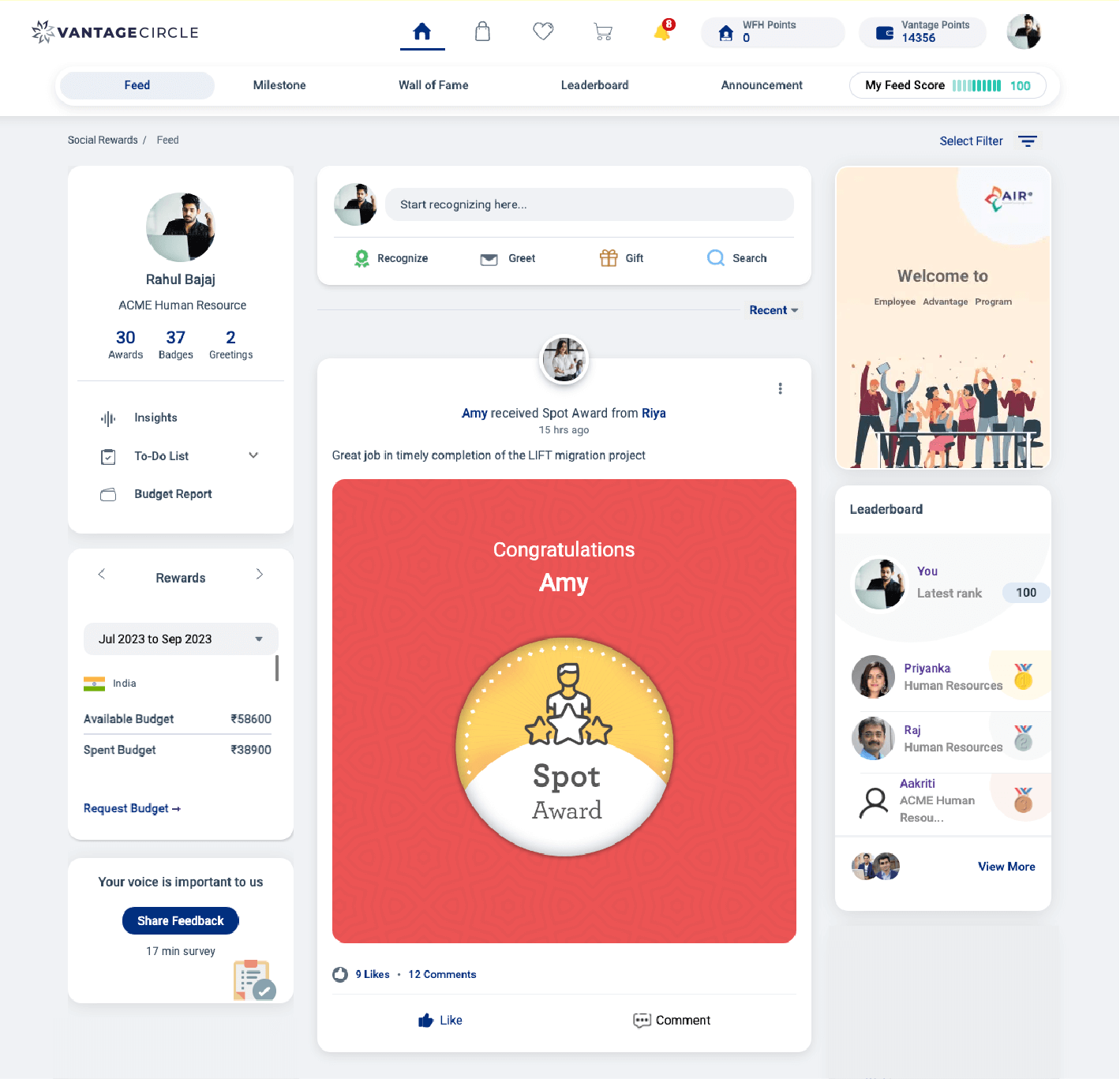
With features like real-time appreciation feeds, and reward points employees can give each other, it turns recognition into a daily habit. It’s simple, scalable, and helps teams build a culture where acknowledgment flows naturally in every direction.
6. Are micro-learning stipends worth the cost?
A $20–$50 learning stipend sounds tiny, until you see how employees use it.
Micro-learning is booming :
- short courses,
- audio lessons,
- bite-sized skill boosters, ebooks, newsletters.
A small stipend tells employees, “We care about your growth - even if it’s one skill at a time.”
These small investments:
-
keep curiosity alive,
-
improve job performance in subtle but steady ways, and
-
make people feel supported without sending them to a week-long intensive.
7. Can “Food Fridays” or healthy snacks really make a difference?
Absolutely, food is morale’s cheat code.
You don’t need a massive pantry or free lunch daily. Even simple, low-cost options like:
-
fruits,
-
peanut butter sandwiches,
-
energy bars,
-
homemade snacks,
-
or a weekly “Food Friday” potluck can create an instant sense of community.
People gather, talk, laugh, decompress, all without a formal team-building activity. Food builds micro-moments of connection, and those moments stack up.
Plus, it’s one of the perks employees notice immediately.
8. What is the value of occasional “Surprise and Delight” treats?
Humans love surprises - even tiny ones.
Occasionally dropping a small, unexpected treat (like a cupcake, a desk plant, a handwritten note, a chocolate bar, or even a personalized meme material) creates a burst of positive emotion that employees genuinely remember.
The key is not the cost. It’s the thoughtfulness.
These micro-surprises:
-
break routine,
-
show appreciation without ceremony,
-
and make people feel seen.
Leaders are often shocked at how far a ₹200–₹400 surprise can go in making someone’s day.
9. How can you provide strategic health and financial support affordably?
Health benefits are something employees deeply value and for good reasons.
However, for small and mid-sized organizations, traditional group health insurance feels heavy, expensive, and honestly, out of reach.
The good news? You still have smart, affordable ways to support your team’s health without burning through your budget.
One of the simplest tools is a Health Reimbursement Arrangement (HRA).
With an HRA, you set aside a monthly allowance, and employees use it for everyday medical needs - doctor visits, dental care, eye checkups, preventive services, and even individual health insurance premiums.
It’s flexible. It’s tax-free. And you stay fully in control of costs.
There are two options leaders should know:
1. QSEHRA (Qualified Small Employer Health Reimbursement Arrangement)
QSEHRA is designed for small teams, with fewer than 50 employees.
The IRS (Internal Revenue Service) sets yearly contribution limits, so costs stay predictable for your organization.
Employees simply need a basic health plan to use it, and you reimburse them for the medical expenses they actually use.
Why it saves money:
You’re not buying an expensive group policy.
You’re simply reimbursing people for what they actually use, up to the amount you decide.
2. ICHRA (Individual Coverage Health Reimbursement Arrangement)
ICHRA is available for teams of any size.
You can offer different allowances to different employee groups.
Employees buy their own individual plan, and you reimburse them.
If your workforce includes contractors or international employees, HRAs won’t apply - but a simple health stipend works beautifully.
It’s taxable, but incredibly flexible and easy to manage.
The heart of it?
You don’t need a massive health insurance budget to show your people you care.
10. Can you offer student loan assistance on a budget?
Offering a modest monthly contribution, say $50–$100, helps employees' chip away their student debt.
For recent graduates, this isn’t just money. It’s relief, support, and a reason to choose your organization over others.
Small, consistent support like this shows you understand their challenges and that you’re willing to invest in their future
11. Are financial wellness programs expensive?
Not necessarily.
You don’t have to roll out a big, complex program to support your employees’ financial wellness goals.
A simple place to start is partnering with a local credit union or financial advisor. Many of them offer free or low-cost financial counseling sessions for budgeting help, debt guidance, saving strategies, and basic planning.
What Creative and Unique Perks Do Modern Employees Want?
12. Life Leave .. Why is everyone talking about it?
Traditional leave buckets don’t match real life. It’s hard for employees to always schedule their personal chaos around HR policies.
Life Leave fixes that gap.
It gives employees a few days a year they can use for anything : mental reset, childcare emergencies, waiting for a repair technician, and so on.
No long explanations. No approvals that feel like interrogation.
It’s trending because it signals a mature culture:
We trust you. Handle your life, then bring your best to work.
13. Safe ride - small perk, but invaluable
Employees may finish work at 6, but safety concerns don’t.
A Safe Ride perk ensures people get home securely during late hours, bad weather, or unexpected overtime.
This is one of those perks where the cost is tiny, but the message is massive:
Your wellbeing doesn’t end when you leave the building.
Modern teams love it because it removes tension, and that mental calculation of “Is it even safe to go?”
14. Innovation Hours or Culture Credits
Everyone says they want innovation. Few actually create space for it.
Innovation Hours make it official.
A few hours every month where employees can work on problems not tied to their daily tasks. It can be anything they’re curious about, want to fix, or want to prototype.
At the same time, Culture Credits widen the scope:
Employees can use the time to volunteer, run a small workshop, or build anything that adds value.
It’s structured freedom.
And it sends a clear message:
You’re not here to just execute. You’re here to think.
15. New parent support - beyond the standard policy
Parental leave is the baseline now. What modern employees look for is what happens after the leave ends.
Support can look like:
-
A ramp-back period with lighter hours
-
Access to lactation consultants
-
A small stipend for newborn essentials
-
Backup childcare partnerships
-
A few “transition days” with flexible timing
These perks matter because the first months of parenthood aren’t predictable.
Companies that help employees through that chaos win long-term commitment in return.
This is no longer a “nice-to-have.” It has become a culture differentiator.
How Do You Implement an Effective and Affordable Benefits Strategy?
A smart benefits strategy is built on listening, balancing, and communicating, with a few extra moves to make it practical and budget friendly.
Step 1: Ask employees what they want
Survey your team to rank their top priorities. This prevents wasted spending and ensures your investments go where they matter most.
Step 2: Balance individual and team perks
Mix personal support with group-focused initiatives. The right balance keeps employees feeling valued as individuals while fostering team connection.
Step 3: Communicate the “Hidden Paycheck”
Employees often focus only on their salary. Regularly highlight the total value of their benefits package to boost recognition and retention.
Step 4: Set budget boundaries upfront
Decide your total benefits budget early. Clear limits keep decisions strategic and avoid overspending.
Step 5: Pilot before rolling out
Test new perks with a small group first. It’s a low-risk way to see what works before a full launch.
Step 6: Track actual usage
Usage data tells you what employees truly value. Cut underused perks and redirect resources to what drives impact.
Step 7: Refresh annually
Employee needs, budgets, and priorities change. An annual review keeps your benefits program relevant, effective, and affordable.
FAQs
1. Are employee gift cards taxable?
Yes, but it depends on the value and the country:
United States: Cash or cash-equivalent gifts (like gift cards) are taxable unless they are very small, “de minimis” benefits.
India: Gifts from an employer are taxable as a perquisite if the total value exceeds ₹5,000 in a financial year.
2. Can small businesses afford health benefits?
Yes. Small businesses can manage costs using Health Reimbursement Arrangements (HRAs), which set up a fixed budget for reimbursements instead of paying unpredictable group premiums.

Susmita Sarma is a seasoned Digital Marketer at Vantage Circle, specializing in content strategy, employer branding, and HR thought leadership. Passionate about creating recognition-driven and people-first workplace cultures, she blends data, storytelling, and empathy to drive meaningful engagement. Connect with Susmita on Linkedin or reach out at editor@vantagecircle.com for inquiries.