
For decades, compensation sat at the center of the employee motivation equation. Pay people well, the thinking went, and performance would follow. But today’s workplace tells a more complicated story.
Competitive salaries may get talent in the door, but they rarely sustain engagement on their own. What increasingly differentiates high-performing organizations is how they motivate effort, recognize contribution, and signal that employees truly matter to the organization’s success.
The companies winning the retention and engagement game understand this shift. They are not simply spending more on compensation. They are investing more thoughtfully in incentives that reinforce the behaviors, values, and outcomes they want to see.
The data reinforces the point. Research consistently shows that 81% of employees report feeling more motivated when their work is genuinely appreciated. At the same time, global engagement levels remain stubbornly low. Gallup estimates that disengagement costs businesses nearly $8.9 trillion in lost productivity worldwide.
In this blog, we’ll explore some of the best employee incentive examples and ideas designed for the modern workforce. Plus, we’ll break down how to implement them effectively to boost retention and drive productivity.
What Are Employee Incentives? (And Why HR Leaders Get Them Wrong)
Employee incentives are structured rewards designed to reinforce specific behaviors, drive performance, and make employees feel genuinely valued. Think performance bonuses, recognition awards, wellness perks, career development opportunities, and experiential rewards.
Simple enough in theory. But here's where most HR leaders get it wrong. Their mistake is treating incentives as another layer of employee benefits.
Benefits represent the baseline of the employee value proposition. Health insurance, retirement plans, and paid leave are not designed to motivate performance but to provide stability and security.
In fact, research from the SHRM consistently shows that employees largely view benefits as expected components of employment rather than drivers of engagement.
Incentives, on the other hand, are dynamic and performance-linked. They create a direct psychological connection between effort and reward.
Yet many organizations blur this distinction and treat their incentive programs as an extension of their benefits package. Over time, employees stop seeing incentives as signals of achievement and begin to view them as routine perks.
The Data: Why Most Incentive Programs Fail by Quarter 2
According to Vantage Circle's AIRe Benchmarking Report, companies are investing $46 billion on R&R programs. On paper, the commitment is substantial. Yet the outcomes often tell a different story.
The root cause is rarely the investment itself; it’s the design behind it.
Many programs rely too heavily on short-term rewards or one-time campaigns. Others fail to align incentives with everyday employee behaviors. And in some cases, the rewards themselves simply don't resonate with what employees actually value.
The 25 examples in this blog are organized with these gaps in mind. Each one is designed to help you build incentive programs that can be measured, refined, and sustained over time.
Businesses in U.S. collectively spend $176 billion on incentives, recognition, rewards, incentive travel, and corporate gifting.
5 Categories of Employee Incentives: A Selection Framework for HR
Before jumping to a list of examples, it's worth understanding the five core categories of employee incentives and what each one is actually built to do. Think of this as a selection framework.
The right incentive for boosting short-term sales performance is very different from the right one for reducing burnout or retaining a high-potential employee. Knowing the category helps you match the tool to the problem.
| Categories | Primary Goal | Best For | Time to Impact | Cost Range |
|---|---|---|---|---|
| Monetary Incentives | Drive performance, reward outcomes | Sales teams, high-output roles | Immediate | Medium to High |
| Recognition-based Incentive | Build culture, reinforce behavior | All employees | Immediate to Short-term | Low to Medium |
| Professional Growth Incentive | Retention, Skill Development | High-potential employees, new workforce | Medium to Long-term | Medium |
| Wellness & Lifestyle Incentive | Reduce burnout, improve wellbeing | Stressed, hybrid, or remote teams | Short to Medium term | Low to Medium |
| Experiential & Social Impact Incentives | Deepen engagement, build belonging | Purpose-driven employees, Millennials, Gen Z | Medium term | Variable |
Monetary Incentives
Monetary incentives are designed to motivate employees by offering financial rewards for achieving specific goals or demonstrating desired behaviors. It works best for roles with clear and measurable output such as sales teams, customer support representatives, and production staff.

1. Performance Bonuses
Performance bonuses are financial rewards given to employees for achieving specific goals, targets, or milestones. They come in the form of annual or quarterly performance bonuses to incentivize employee performance.
2. Profit Sharing
Profit-sharing programs can be a persuasive tool to incentivize employees as they foster a sense of shared ownership. Under this plan, a portion of the company's profits are distributed to employees as cash bonuses. It also creates a culture of transparency in the organization.
3. Spot Awards
Spot awards are a hugely effective and fun way to reward your employees for their contribution. It can take many forms, including cash incentives, redeemable points, or even gift vouchers, making them versatile and easy to implement.

Source: Vantage Recognition
4. Incentive Stock Options (ISO)
Incentive Stock Options (ISOs) are a type of equity compensation that gives employees the chance to buy company shares at a set exercise price (also called the strike price). The best part? This price is often lower than the stock’s market value.
5. Gift Cards
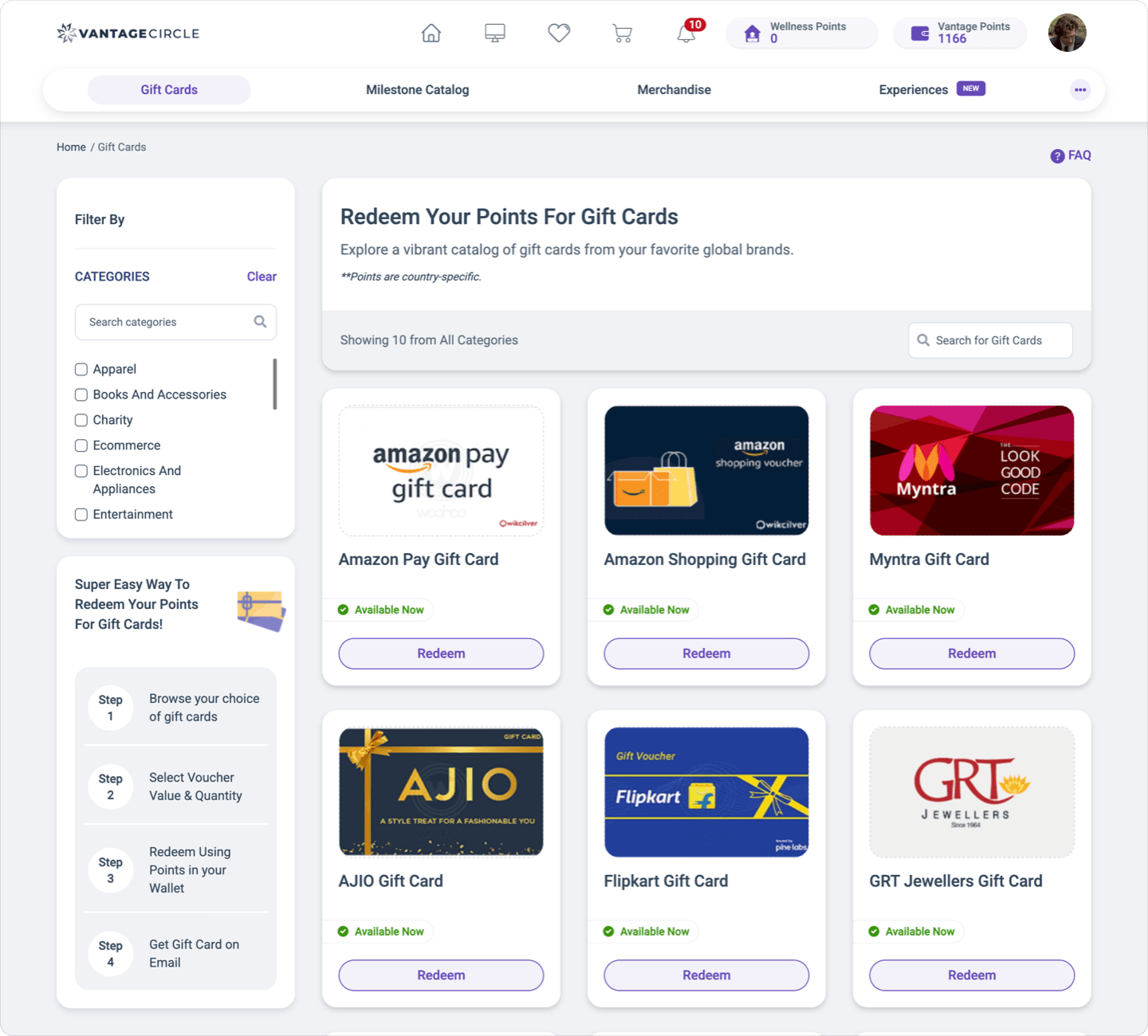
Gift cards remain one of the most flexible and widely appreciated ways to reward employees. By providing access to a global catalog of gift cards, spanning retail, dining and digital platforms, you give employees the freedom to choose what feels most meaningful to them.
Source: Vantage Recognition
6. Home Office Stipends
A well-designed workspace can significantly improve focus, comfort, and productivity throughout the workday. By offering stipends for essentials like ergonomic chairs, dual monitors, standing desks, improved lighting, or high-speed internet upgrades, you can empower employees to create a work environment that lets them give their best.
Recognition-Based Incentives

Non-monetary incentives are centered on acknowledgment, such as public praise, peer-to-peer recognition, awards, badges, and leadership shout-outs. They tend to have an outsized impact relative to their cost, particularly when they are timely, specific, and sincere.
7. Public Shout-out
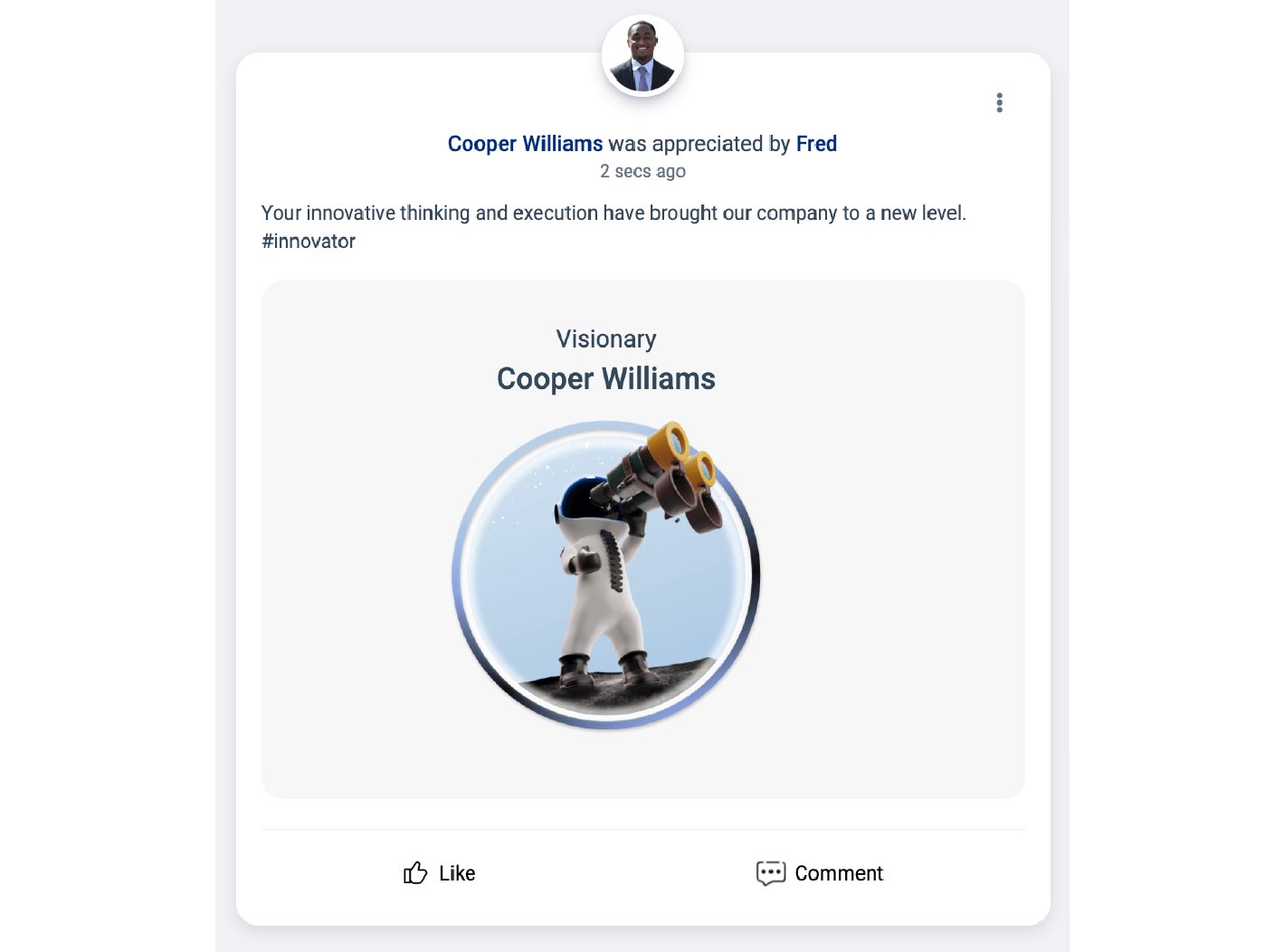
Public recognition is a simple yet powerful way to celebrate employee contributions and build a culture of appreciation. Encouraging peer-to-peer recognition program makes it even more impactful, allowing employees to acknowledge each other’s efforts in real time.
Platforms like Vantage Recognition help make this process seamless by enabling employees to share appreciation easily across teams and locations.
Source: Vantage Recognition
8. Recognition Badges
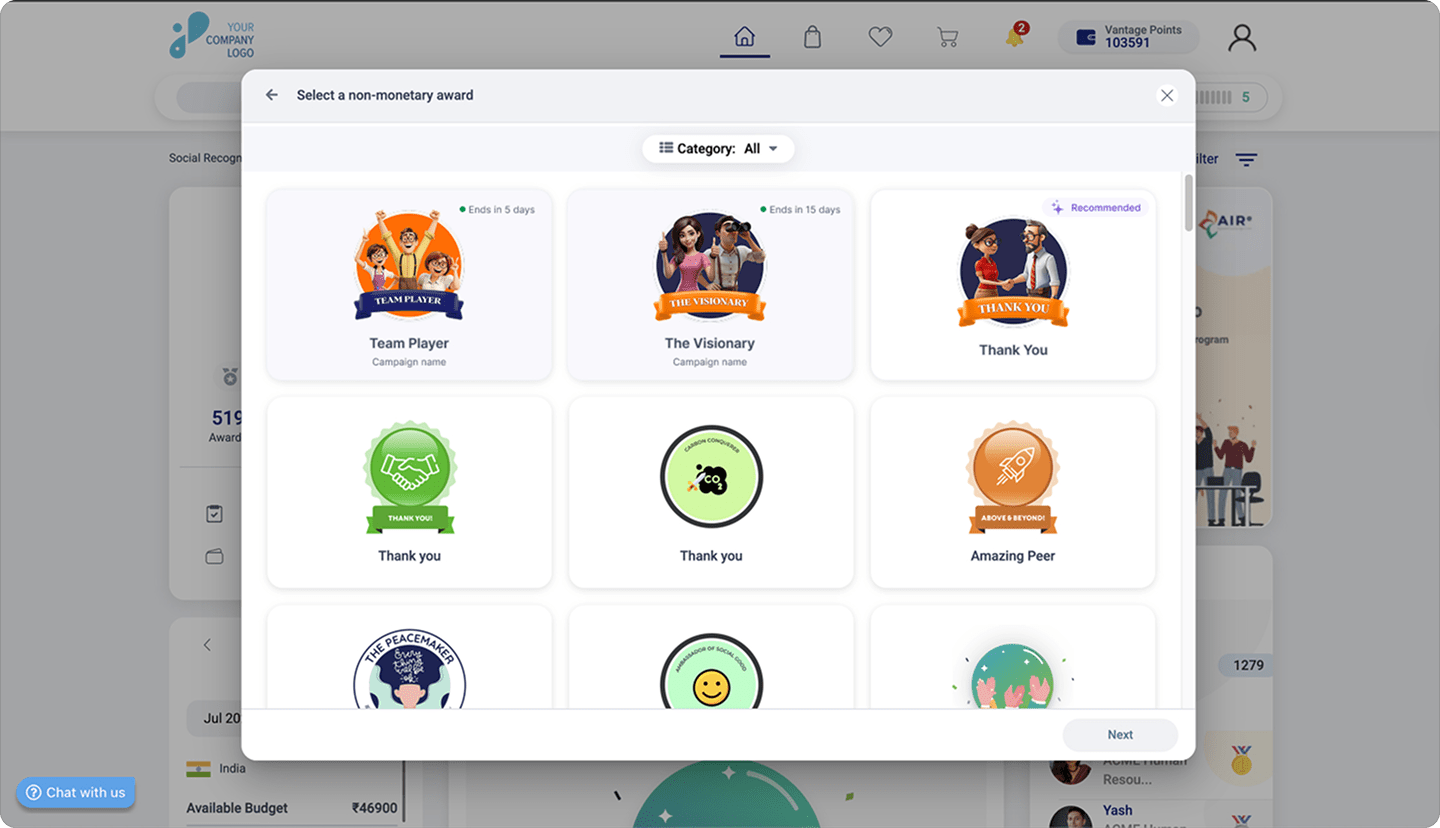
Badges are a highly effective way to recognize specific competencies, behaviors, or achievements in a tangible, repeatable format. With Vantage Recognition, organizations can create fully customized badge libraries tied to their specific values and cultural priorities, making every badge a reflection of what actually matters to the business.
Source: Vantage Recognition
9. Personalized Thank-you Notes
Personalized thank-you notes from managers, executives, or even the CEO show employees that their hard work is truly seen and appreciated. Unlike generic emails or mass messages, a handwritten note adds a personal touch.
10. Milestone and Anniversary Awards
Service anniversaries and career milestones represent some of the highest-impact recognition moments available to an organization.
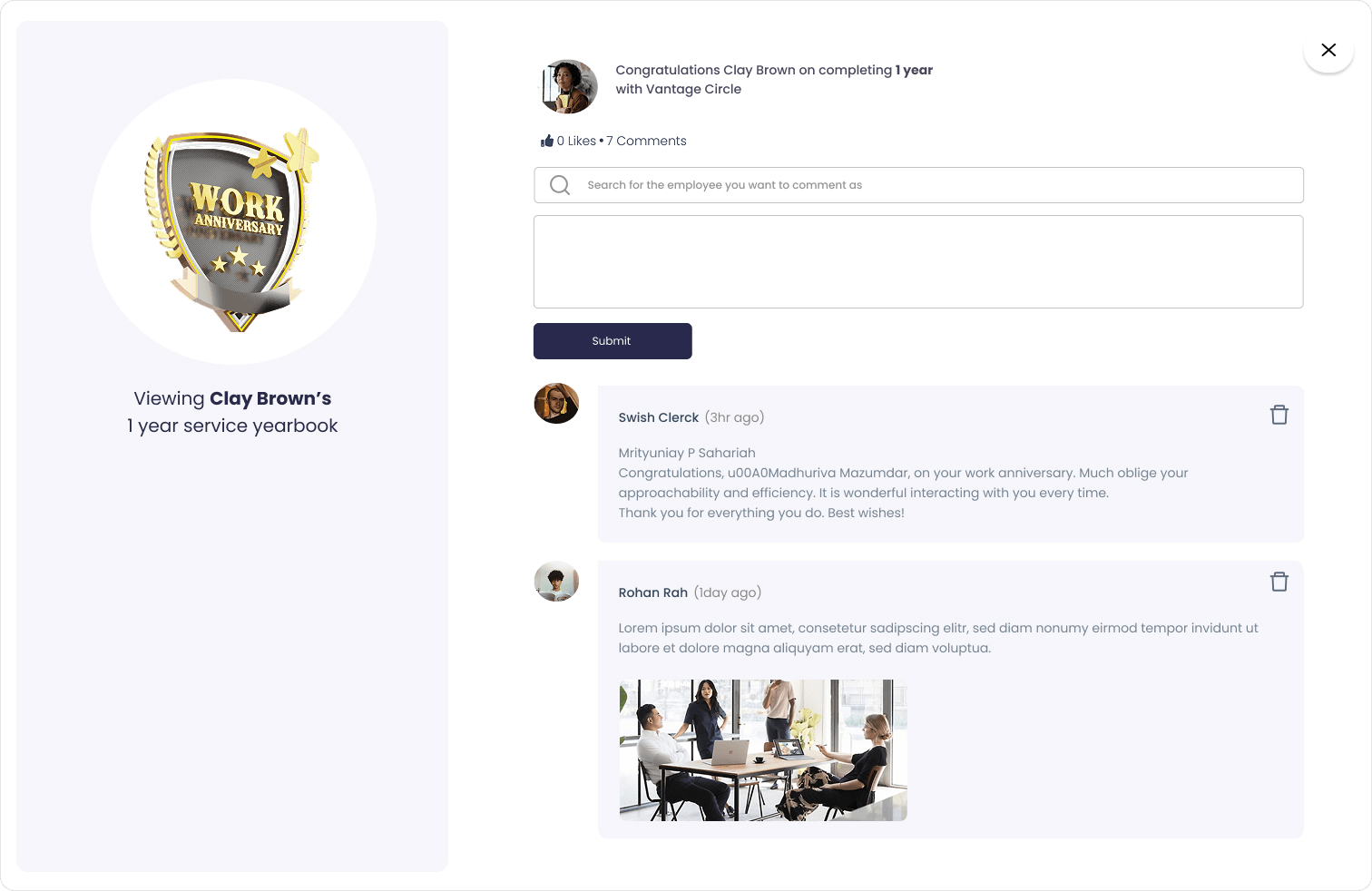
Vantage Recognition's Celebrations feature automates birthday and work anniversary recognition with personalized messages and reward points, ensuring no milestone goes unnoticed.
Source: Vantage Recognition
For longer-service milestones, the platform also offers an exclusive digital catalog sourced live through Amazon, making the reward feel genuinely personal rather than formulaic.
Professional Development Incentives
This category has become increasingly powerful as workforce priorities shift. Employees today consistently rank career development among their top reasons for staying with or leaving an employer. Offering genuine growth opportunities signals long-term investment in the individual, not just their current output.
11. Tuition Reimbursement
Tuition reimbursement incentives are designed to cover employees' education expenses, either partially or entirely. These incentives help employees gain new skills or build on existing ones so they can continue to excel and become even better prepared to succeed in their roles.
12. Sponsored Professional Certifications
Cover the cost of industry certifications such as project management, data analytics, cybersecurity, or HR credentials. These incentives reward employees who actively invest in their expertise.
13. Conference and Industry Event Sponsorship
Reward employees with the opportunity to attend industry conferences, seminars, or leadership summits. These events expose employees to new ideas while recognizing their contributions.
Wellness and Lifestyle Incentives
With 83% of U.S. workers reporting work-related stress according to OSHA, wellness incentives have become a strategic retention lever. Employees who feel their employer genuinely supports their well-being are more productive, take fewer sick days, and stay longer.
14. Fitness Reward Points
Rather than simply offering a gym membership and hoping employees use it, fitness reward points tie physical activity directly to tangible rewards.
Employees earn points for completing measurable health actions such hitting a daily step goal, finishing a workout, logging hydration, and completing a mindfulness session.
15. Team-Based Step Challenges
A step challenge by itself is a nice idea. A step challenge where your team's collective progress is tracked on a live leaderboard against other departments is a different experience.
Team-based challenges add social accountability, friendly competition, and shared purpose to individual health goals. Employees who would never enter a solo fitness challenge will show up for their team. The result is broader participation across the workforce.
16. Mental Wellness Incentives
Rewarding participation in mental wellness activities protects privacy while still encouraging engagement. Vantage Fit integrates mental well-being tracking, mood logging, and mindfulness content into the same rewards ecosystem as physical challenges. This way employees can earn points and recognition for mental wellness activity just as they would for a step challenge.
17. Paid Wellness Days
Some organizations provide dedicated wellness days separate from regular PTO. These days allow employees to take time off specifically to recharge, focus on personal health, or manage stress without feeling guilty about using vacation time.
18. Wellness Stipends
Provide employees with a yearly or monthly wellness allowance that can be used for gym memberships, fitness classes, meditation apps, ergonomic home office equipment, or other health-related expenses. This flexible approach allows employees to invest in wellness activities that suit them best.
19. On-Site Fitness Classes
Having a Wednesday morning yoga class right in the office can be a convenient way to let your employees stay active without needing to hit the gym after work. And for fully remote teams, virtual fitness challenges or gym membership reimbursements work just as well!
Experiential and Social Impact Incentives
Memorable experiences and purpose-driven opportunities resonate most strongly with employees who are motivated by meaning over money. Experiences create emotional memories that outlast any cash bonus, while social impact incentives connect employees' daily work to something larger than themselves.
20. Company-Sponsored Travel Rewards
Few incentives make a lasting impression quite like an all-expenses-paid trip. Travel rewards, whether a weekend getaway for top performers, or an international retreat for a high-achieving team create experiences employees genuinely talk about and remember for years.
For organizations tracking and recognizing performance consistently, Vantage Recognition's points-based reward system can be structured so that accumulated points unlock travel reward tiers.
21. Exclusive Team Experiences
The distinction between a good team experience and a forgettable one usually comes down to employee choice. When teams are given a shortlist of experiences to vote on, participation and enthusiasm increase significantly. People engage more deeply with an experience they helped select than one they were assigned to attend.
22. VIP Event Access
Access to exclusive events such as industry conferences, sporting events, concerts, gala dinners, or private networking evenings, carries a status and novelty that standard rewards can't replicate. It works well as a reward for standout individual contributions, where the immediacy of the reward reinforces the specific behavior being recognized.
23. Paid Volunteer Days
Giving employees dedicated, paid time to volunteer for causes they personally care about is one of the simplest and most impactful social incentives available. It costs the organization a day of productivity and returns significantly more in engagement, loyalty, and employer brand perception.
24. Skills-Based Volunteering
Unlike traditional volunteering activities, skills-based volunteering allows employees to use their professional expertise to support nonprofits. This approach allows employees to contribute their professional skills to a social cause, often leaving them with a stronger sense of purpose and impact.
25. Company Matching Donation
Organizations match employees’ charitable donations to approved nonprofits, often doubling the impact of their contributions. This encourages employees to support causes they care about while reinforcing the company’s commitment to social responsibility.
How to Build an Incentive Program That Lasts Beyond Quarter 1
Most incentive programs don't fail because of budget constraints or lack of effort. They fail because they were built without a framework. Building a program that sustains engagement well past the initial excitement requires a structured, repeatable approach.
The steps below combine proven implementation principles with Vantage Circle's AIRe Framework to give you a blueprint that actually holds up over time.
The AIRe Framework organizes effective recognition and incentive design around four pillars. Think of these not as sequential steps but as four lenses through which every incentive decision should be evaluated.
- Appreciation is the acknowledgment of employee contributions, not only for extraordinary results, but for day-to-day efforts and teamwork.
- Incentivization is the practice of building tangible rewards into the system to motivate the workforce, both monetary and non-monetary.
- Reinforcement is the consistency with which recognized behaviors are tied to specific outcomes the organization wants to drive.
- eMotional Connect is the driving force that binds all three, the degree to which recognition feels personal, meaningful, and human rather than transactional.
With that foundation in place, here is how to build the program itself.
Step 1: Define Objectives Tied to Business Outcomes
Before selecting a single incentive type, get specific about what you are trying to move. Map each incentive category to a measurable business outcome.
For instance, recognition-based incentives for engagement scores, monetary incentives for performance metrics and sales targets, wellness incentives for absenteeism, and experiential incentives for employer brand and team cohesion.
Step 2: Audit What You Already Have
Before introducing new incentives, take a step back and assess your current landscape. What incentives are already in place? Which employee groups feel underserved? And where are the gaps in how recognition and rewards are delivered?
Tools like Vantage Circle’s free AIRe Score Assessment can make this process easier. It benchmarks your existing program against global best practices and highlights the specific areas that need improvement first.
Step 3: Understand What Your Employees Actually Want
This step is where most programs go wrong. HR leaders design incentive programs based on what they think employees want, rather than what their current workforce values.
According to SHRM, 99% of employees have unique reward preferences. The only reliable way to build a program that resonates is to ask directly. Start with open-ended pulse surveys that allow employees to name their ideal incentives without constraints. And try to revisit preferences annually.
Step 4: Build a Balanced Incentive Mix
Design your mix with deliberate coverage in mind. Ask what percentage of our workforce does each incentive type realistically reach? A sustainable incentive program covers all five categories outlined earlier in this blog.
Step 5: Set Clear, Transparent Criteria
Incentive programs erode trust faster than almost any other HR initiative when they feel arbitrary or inconsistent. Employees need to understand three things with complete clarity:
- who is eligible
- what actions or achievements qualify
- how rewards are earned and redeemed
Document eligibility, criteria, and redemption processes in a format that every employee can access.
Step 6: Launch With Momentum, Not Just an Announcement
The difference between a program that generates buzz and one that quietly fades by February often comes down to the launch strategy. A company-wide email is not a launch, it is a notification.
That is why the emotional connect pillar of the AIRe Framework is most vulnerable at launch. If the first experience an employee has with the program feels cold or bureaucratic, the perception sticks. Design the launch experience to feel like a celebration, not a policy rollout.
Step 7: Track and Optimize Performance
Implementing an employee incentive program is just the beginning. To ensure its success, organizations must regularly track its progress and make necessary adjustments.
Start by identifying and monitoring key metrics that indicate success. These could include productivity levels, engagement scores, retention rates, or even employee satisfaction.
Analyzing these metrics allows you to understand whether the program is meeting its objectives and where improvements might be needed.
Measuring Incentive Program ROI: The Metrics That Matter
Building an incentive program is the visible work. Measuring whether it's actually working is where most organizations fall short. The metrics below are organized into three tiers:
North Star Metric: Employee Engagement Score
Every incentive program ultimately exists to drive one thing, a workforce that is engaged, motivated, and committed to the organization. Your employee engagement score, measured through regular pulse surveys or an eNPS-based tool like Vantage Pulse, is the single metric that most directly reflects whether your incentive program is working as a system.
Set a baseline engagement score before your program launches. Measure it quarterly in the first year. If your incentive program is well-designed and consistently executed, you should see meaningful movement within two to three quarters.
Program Execution Metrics
These metrics tell you whether your incentive program is actually being used and by whom. They are the earliest indicators of program health, visible within weeks of launch rather than quarters.
Recognition Frequency
Recognition frequency is one of the most sensitive leading indicators of program health because it captures behavior, not just sentiment.
Track recognition frequency at both the organization level and the team level. Significant variance between teams often points to a manager's engagement problem rather than an employee engagement problem.
Recognition Coverage Rate
Coverage rate measures the percentage of employees who have received at least one recognition in a rolling 30-day period. A healthy coverage rate benchmark to target is 80% or above on a monthly basis.
Program Participation Rate
Track not just the number of recognitions sent, but the percentage of people sending recognition and the percentage of managers participating. A low participation rate in the first 90 days is a strong predictor of the Q2 drop-off pattern described earlier in this guide.
Business Outcome Metrics
These metrics connect incentive program activity to the financial and operational outcomes that make the business case to the C-Suite.
Voluntary Turnover Rate
Track voluntary turnover among employees who are actively recognized versus those who are not. This cohort comparison is one of the most compelling data points you can bring to a budget conversation with senior leadership.
Absenteeism Rate
Track employee absenteeism rates before and after program launch, and segment by team where possible to identify whether higher-recognition teams show measurably lower absenteeism than lower-recognition ones.
Productivity and Performance Metrics
Track productivity metrics relevant to your business and correlate them with recognition activity data from your platform. The goal is not to prove causation in a single quarter, but to build a pattern of evidence over time that shows engaged, recognized employees consistently outperforming their less-recognized counterparts.
Conclusion
The most successful employee incentives are the ones that strike the perfect balance between monetary and non-monetary rewards. Companies need to design incentive programs that cater to the diverse needs of their workforce! After all, when employees feel genuinely appreciated, they show up motivated, inspired, and ready to give their best.
FAQ
1. What is the difference between Employee Incentives and Employee Benefits?
Employee benefits are standard offerings like health insurance, retirement plans, and paid leave. While employee incentives are performance-based rewards designed to motivate specific behaviors and recognize achievements.
2. How do you Choose the right Employee Incentive Examples for your Workforce?
Choose the right incentives for your employees by understanding what motivates them through surveys, feedback, and engagement data.
3. Are Employee Incentives Taxable?
Tax treatment of employee incentives depends on the type and value of the reward.
In the U.S., any employee incentive that has monetary value is generally taxable, including prizes and cash awards. However, the IRS classifies certain small rewards as de minimis fringe benefits such as occasional snacks, holiday gifts, or tickets to entertainment events.

Shikha Gogoi is a Content Marketing Specialist focused on SEO-driven content around employee engagement, recognition, and workplace culture, helping build people-first workplaces.
Connect with Shikha on LinkedIn.


