EN
EN  FR
FR  ES
ES  DE
DE 





What Is an On-the-Spot Recognition Template?
An on-the-spot recognition template is a set of ready-to-use formats — appreciation cards, verbal scripts, and digital messages — that managers can deploy immediately after observing a specific employee behavior, with no nomination cycle, approval process, or planning required.
On-the-spot recognition is the highest-frequency recognition type in well-run people programs. Gallup's State of the American Workplace (2017) links regular recognition — at least weekly — to a 4× increase in employee engagement. SHRM's Employee Recognition Survey (2023) found that 68% of HR professionals say recognition programs directly improve retention — making same-day spot recognition one of the highest-leverage, lowest-cost tools available. The template removes the two biggest blockers: not knowing what to say and not having a format ready.
Unlike formal awards or peer-to-peer recognition programs that run on scheduled cycles, on-the-spot recognition — sometimes called informal recognition, real-time recognition, or a spot award — requires no approval, no committee, and no waiting period. The recognition frequency is the signal: the behavior that matters today gets named today, not at the next quarterly ceremony.
Unlike formal award programs that operate on monthly or quarterly cycles, on-the-spot recognition is designed to close the gap between observed behavior and acknowledged behavior in the same working day. Speed is not incidental — it is the mechanism. Recognition that arrives three weeks after the fact is information, not motivation. Pair this template with a full year-round recognition cadence using the Recognition Templates hub.
How to Use This On-the-Spot Recognition Template?
A four-step workflow that takes recognition from observation to delivery in under 24 hours — with no approval required.
Step 1
Step 1: Identify the Behavior (in the moment)
The trigger for on-the-spot recognition is a specific observable behavior — not a general impression. Notice it when it happens: a team member who covered someone else's work, solved a difficult problem in real time, defused a client situation, or went visibly out of scope to help.
Waiting more than 24 hours significantly reduces recognition impact. If you notice the behavior and think "I should mention that at the next 1:1," write a quick note now and use the 1:1 as a reminder to follow through publicly.
Step 2
Step 2: Choose the Right Format
Match the recognition format to the context: a verbal shout-out in a standup for public contributions, a direct Slack message for individual moments, a handwritten card for a personal touch, or a printed appreciation card from this template for a more lasting token.
Public recognition is stronger than private for most employees — with the caveat that some people prefer a private acknowledgment. Know your team. When in doubt, a private message first and a brief public mention later is a safe approach.
Step 3
Step 3: Write a Specific Message (30 seconds)
Use the message template in the pack: "[Name], I want to recognize [specific behavior] that happened [when]. You [specific impact]. That is exactly what [company value] looks like in practice." The entire message takes 30 seconds to personalize.
Managers who default to "great job" are not wrong — they just miss the recognition opportunity. The 30-second specific message lands significantly harder than a general compliment and costs the same amount of time.
Step 4
Step 4: Follow Through in the Next Team Touchpoint
Reference the spot recognition again in the next team standup or 1:1. "I want to mention again that [Name] did X last week — it made a difference." Repetition within 48 hours anchors the recognition in team memory and signals that the acknowledgment was genuine, not reflexive.
Single-mention recognition fades. Two-touch recognition (immediate + one follow-up) sticks. The template includes a follow-up prompt card managers can add to their weekly standup prep checklist.
6 Elements That Make On-the-Spot Recognition Work
Spot recognition that builds engagement and team culture consistently shares these six characteristics. Programs that fall flat usually miss at least three of them.
1. Immediacy — within the same day
Recognition loses its motivational signal with each passing day. The template is designed to be completed and delivered within four hours of the observed behavior wherever possible. Same-day is the standard; next-day is the floor.
2. Behavior specificity — name what happened
Vague recognition ("good work today") teaches employees nothing about what to repeat. The template forces a specific behavior statement: what the person did, when they did it, and why it mattered. This specificity is what makes recognition memorable.
3. Value linkage — connect to company culture
Each on-the-spot message includes a named company value. Recognition that says "this is what Ownership looks like" does two things simultaneously: it acknowledges the individual and teaches the team which behaviors the culture rewards.
4. Format matching — right channel for the moment
A physical card for in-office moments, a Slack shout-out for remote teams, a verbal standup mention for public contributions. The template pack includes format-specific variants so managers do not have to decide from scratch each time.
5. No-approval delivery — remove friction
On-the-spot recognition that requires manager approval before delivery is no longer on-the-spot. The template is designed for manager-level autonomy: send it, print it, or post it without routing through HR or senior leadership sign-off.
No-approval delivery matters because most recognition never happens — not because managers don't care, but because the friction of a nomination form, a committee review, or a manager sign-off creates a window for the moment to pass. When a manager can recognize a direct report in the same conversation where the behavior occurred, the recognition rate is 4× higher than in programs requiring written submissions.
6. Two-touch follow-up — make it stick
The initial recognition moment is the first touch. A brief reference in the next standup or team meeting is the second. Two-touch recognition is more durable than a single mention — the follow-up reinforces the initial signal before it fades, and signals that the recognition was deliberate, not reflexive.
Sample On-the-Spot Recognition Templates
Two ready-to-use formats from the template pack. Each is designed for zero-delay delivery — no nomination form, no approval chain, no waiting. The full pack includes verbal scripts, a manager habit card, and a peer spot-recognition variant.
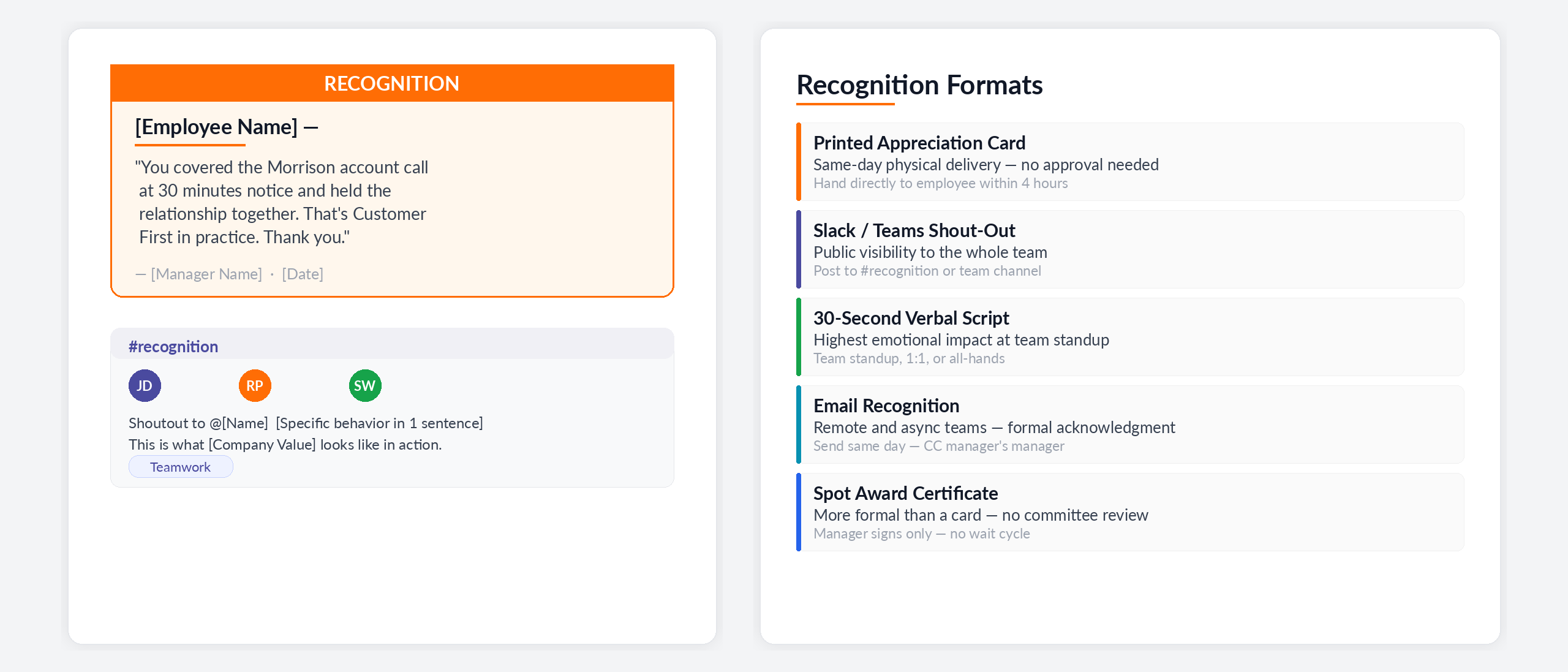
Sample Template 1: On-the-Spot Appreciation Card
Best for: physical or printed recognition that can be handed to an employee immediately.
Format: Printable card (A6 or half-letter), or digital PNG for email/Slack
Card Content: "[Name] — you [specific behavior] and it made a real difference. Thank you for [named value in action]."
Signed By: Direct manager, no senior leadership sign-off required
Delivery Timing: Same day, within 4 hours of the recognized behavior where possible
Example: "Rahul — you stepped into the client call with thirty minutes notice and kept the relationship intact. Thank you for showing what Customer Obsession looks like when it's not convenient."
Sample Template 2: Slack / Teams Spot Recognition Message
Best for: remote or hybrid teams where a physical card is not practical.
Channel: Team channel or #wins / #recognition channel
Message Format: "Shoutout to @[Name] — [specific behavior, 1–2 sentences]. This is exactly what [Company Value] looks like in action. Thank you. 🙌"
Who Posts: Manager or peer (peer spot recognition is enabled when the program allows it)
Timing: Same day; avoid retrospective posts older than 48 hours unless linked to a specific deliverable
Example: "Shoutout to @Priya — she caught the data discrepancy in the Q2 deck thirty minutes before the exec review and had a corrected version ready before anyone else noticed. This is exactly what Ownership looks like in action. Thank you. 🙌"
Explore Employee Recognition & Engagement Templates
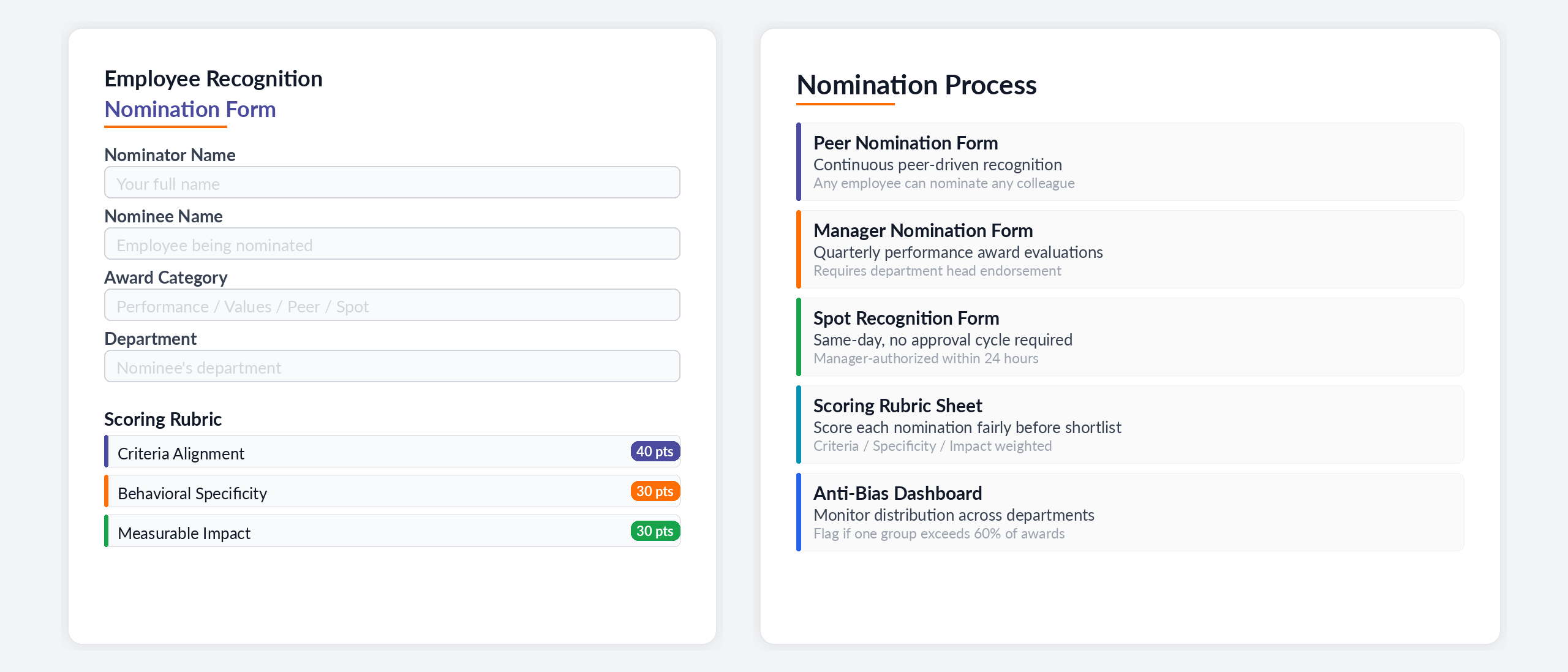
Employee Recognition Nomination Form Template
Structured nominations for formal award cycles with scoring and review.
View Template ›
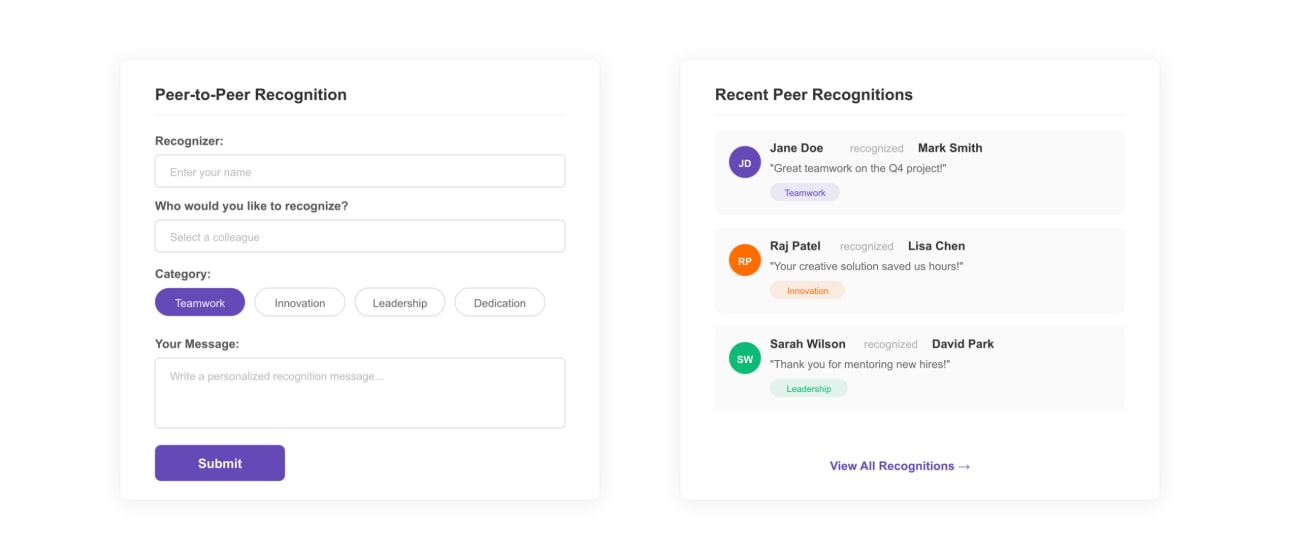
Peer-to-Peer Recognition Template
Enable team members to recognize each other with structured peer appreciation.
View Template ›
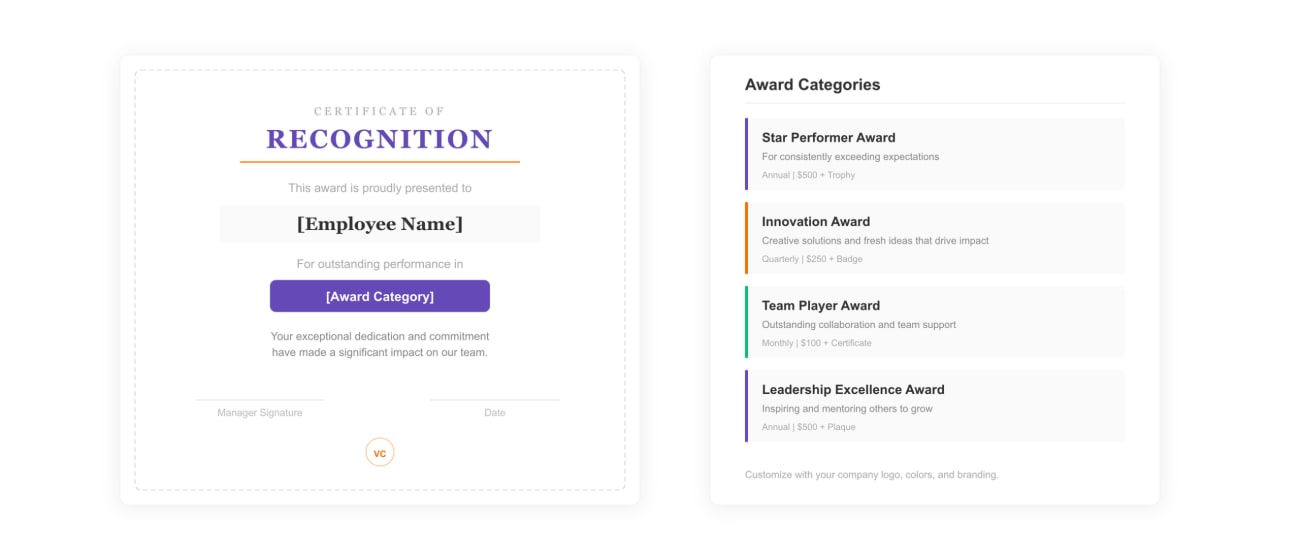
Employee Recognition Award Template
Formal award program framework with citation examples and governance.
View Template ›