EN
EN  FR
FR  ES
ES  DE
DE 





What Is an Employee Recognition Nomination Form Template?
An employee recognition nomination form template is a structured framework that collects consistent, evidence-based nominations for award programs — so HR teams can evaluate candidates fairly rather than relying on manager memory or political influence.
Most recognition programs fail not because of bad intentions but because the nomination process is underdefined. A structured nomination form with specific fields produces nominations strong enough to make award decisions confidently — while a vague form produces vague nominations that are nearly impossible to evaluate in a bias-free way.
The nomination form is the front door of any award program. When it asks the right questions — specific behavior, named impact, values alignment — the rest of the process runs cleanly. When it asks the wrong questions ("Why do you think this person deserves an award?"), the output is generalities that make fair evaluation impossible. Pair this template with the full award governance tools from the Recognition Templates hub.
How to Use This Employee Recognition Nomination Form Template?
A four-step process that turns a blank nomination cycle into a fair, repeatable, evidence-based selection.
Step 1
Step 1: Define the Award Categories Before Opening Nominations
Publish the award categories and eligibility criteria before the nomination window opens. Nominators cannot write strong nominations for awards they do not understand. The template includes a one-page criteria reference nominators can keep open while writing.
Unclear criteria produce generic nominations ("for being a great team player") that do not support fair award decisions. Criteria specificity is the single biggest driver of nomination quality.
Step 2
Step 2: Set the Nomination Window
Open nominations for 7–14 days. Shorter windows produce fewer nominations; longer windows produce procrastination. Publish the open-date, close-date, and expected announcement date in a single calendar invite to the full team.
Last-minute nominations are typically less specific and harder to evaluate. A clear, short window with a published announcement date creates the urgency to complete nominations early.
Step 3
Step 3: Collect, Score, and Review
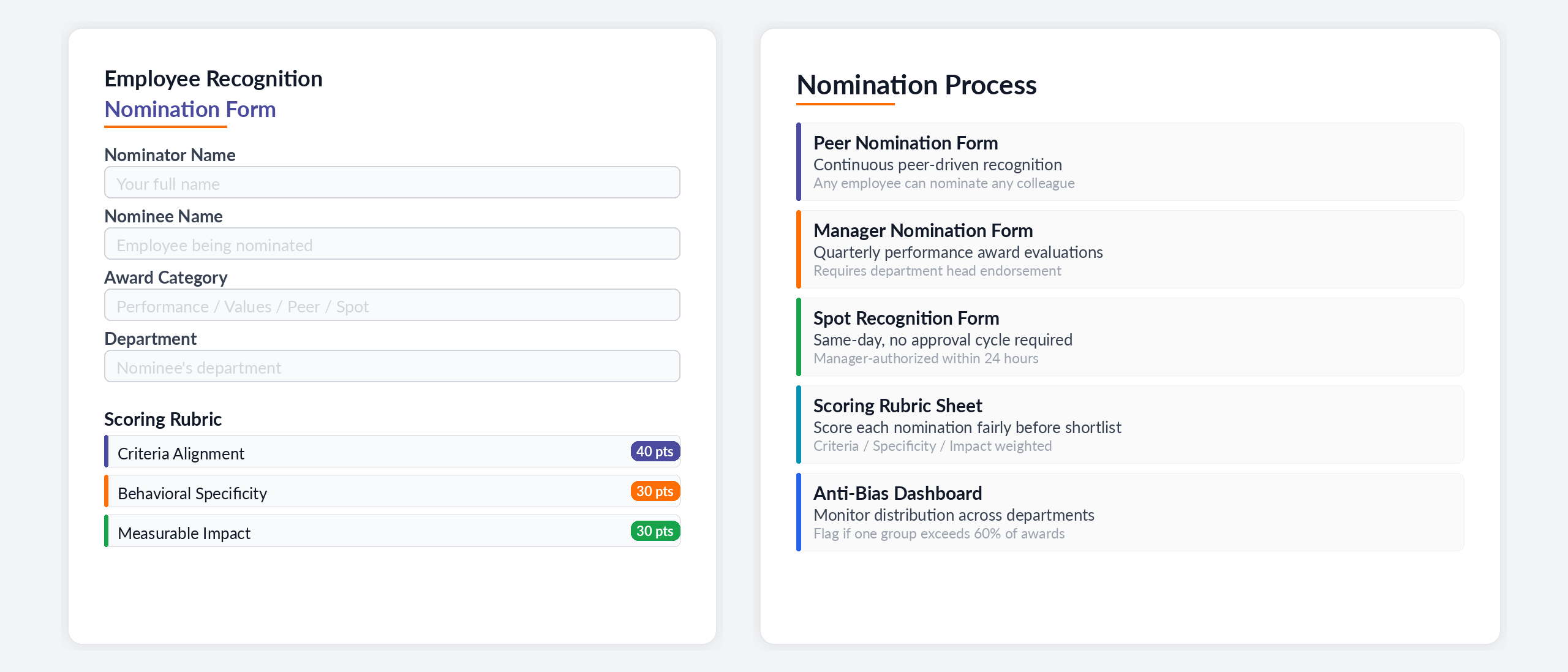
HR or the culture committee reviews all nominations against the scoring rubric included in the template pack. Score on criteria alignment (40%), behavioral specificity (30%), and demonstrated impact (30%). Compile a shortlist for leadership sign-off.
The scoring rubric is the fairness mechanism. Without it, award decisions default to recency bias (recent contributions outweigh consistent ones) and visibility bias (louder roles beat quieter ones).
Step 4
Step 4: Announce With the Nomination Story
When announcing the award, share a summary of the nomination narrative — not just the winner's name. The nomination story is what makes the award credible to the rest of the team. Keep it specific, keep it behavioral, keep it brief (2–3 paragraphs).
Awards without public rationale look political. Awards with a specific, published rationale look earned. The difference is one paragraph read aloud at an all-hands.
The 6 Essential Fields Every Nomination Form Needs
A nomination form is only as strong as the fields it asks nominators to complete. These six fields are the difference between a nomination strong enough to make a fair award decision and one that cannot be evaluated objectively. Each is included in the template pack.
1. Nominator identity and role
Name, title, and relationship to the nominee. This field is not about accountability — it is about context. A peer nomination for cross-team collaboration carries different weight than a manager nomination for the same behavior. Anonymous nominations remove this signal entirely.
2. Nominee name, department, and award category
Nominee identity plus the specific award being nominated for. Without a named award category, HR cannot route the nomination correctly or evaluate it against the right criteria. One form per nomination, one award category per form.
3. Nomination narrative (100–300 words)
A written account of the specific behavior or contribution being recognized. The word-count floor (100 words) prevents one-line submissions that provide no evaluable evidence. The ceiling (300 words) prevents essay-length narratives that favor verbose nominators over concise ones.
4. Measurable impact statement
At least one quantified outcome: a number, percentage, revenue figure, time saved, or customer metric. Nominations without a measurable impact statement are significantly harder to evaluate fairly against nominations that include one. The template includes impact-prompting guidance.
5. Values alignment
Which named company value does the nomination demonstrate? A single drop-down or short text field. This field does double work: it routes nominations to the right award category and it trains nominators to connect behavior to values — the same connection the final award citation will need to make.
6. Nominator declaration
A brief checkbox confirming the nominator witnessed or has first-hand knowledge of the contribution described. This is the anti-bias checkpoint — it prevents nominations written from hearsay or based on tenure and seniority rather than observed behavior. One checkbox; significant fairness impact.
Sample Employee Recognition Nomination Form Templates
Two ready-to-deploy nomination form frameworks. Each specifies the nominator type, required fields, review approach, and cycle cadence. The full pack includes the scoring rubric, anti-bias checklist, and a manager nomination guide.
Sample Template 1: Peer Nomination Form
Best for: continuous peer-driven recognition with a low barrier to nomination.
Nominator: Any team member (peer, cross-functional)
Award Category: Values Champion / Peer Recognition
Required Fields:
- Nominee name and specific behavior (100+ words)
- Values alignment (named company value)
- One measurable impact statement
- Nominator first-hand knowledge declaration
Review: HR validation for values alignment; no scoring rubric required for peer awards
Cycle: Rolling (continuous) or monthly batch
Design note: Keep the peer form short — five fields maximum. Longer forms reduce peer participation. The goal is removing the barrier to nominating, not creating a comprehensive evaluation document at the nomination stage.
Sample Template 2: Manager Nomination Form (Performance Award)
Best for: structured quarterly performance award programs requiring scored evaluation.
Nominator: Direct manager only
Award Category: Performance Excellence
Required Fields:
- Nominee name and contribution narrative (150+ words)
- Quantified impact (metric required)
- Values tie-in (named company value)
- Department head endorsement
- Nominator first-hand knowledge declaration
Review: Scoring rubric — criteria alignment (40%), behavioral specificity (30%), measurable impact (30%)
Cycle: Quarterly, with 10-day nomination window
Design note: The department head endorsement field is the governance checkpoint that prevents single-manager favoritism. It routes nominations through a second set of eyes before HR review — without adding a full committee stage at the nomination phase.
Explore Employee Recognition & Engagement Templates
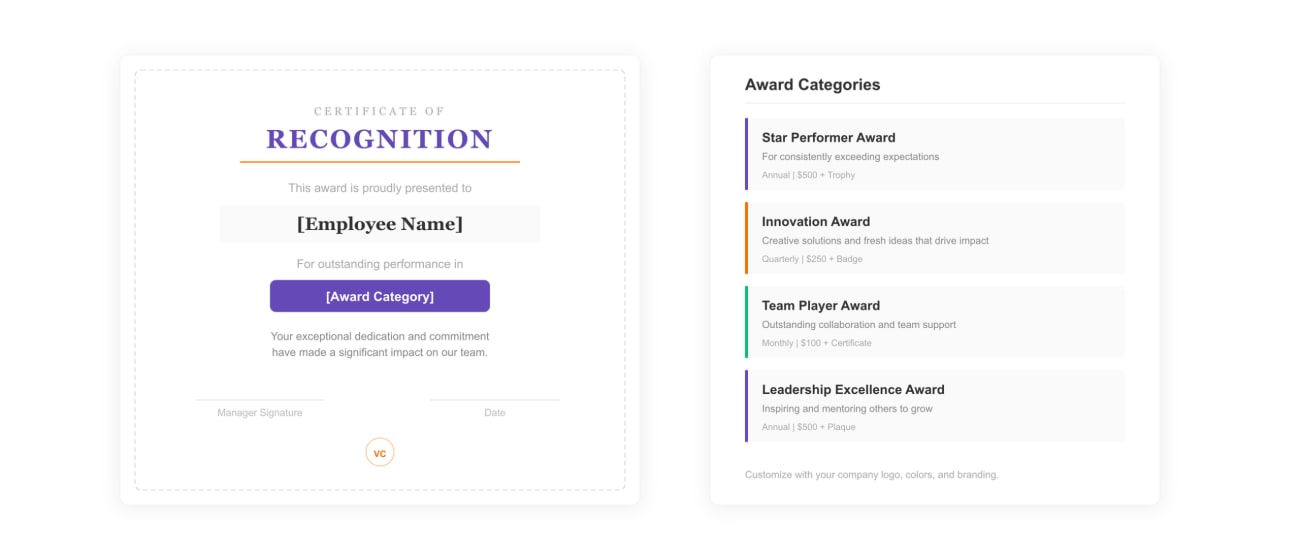
Employee Recognition Award Template
Full award program framework with citation examples and governance.
View Template ›
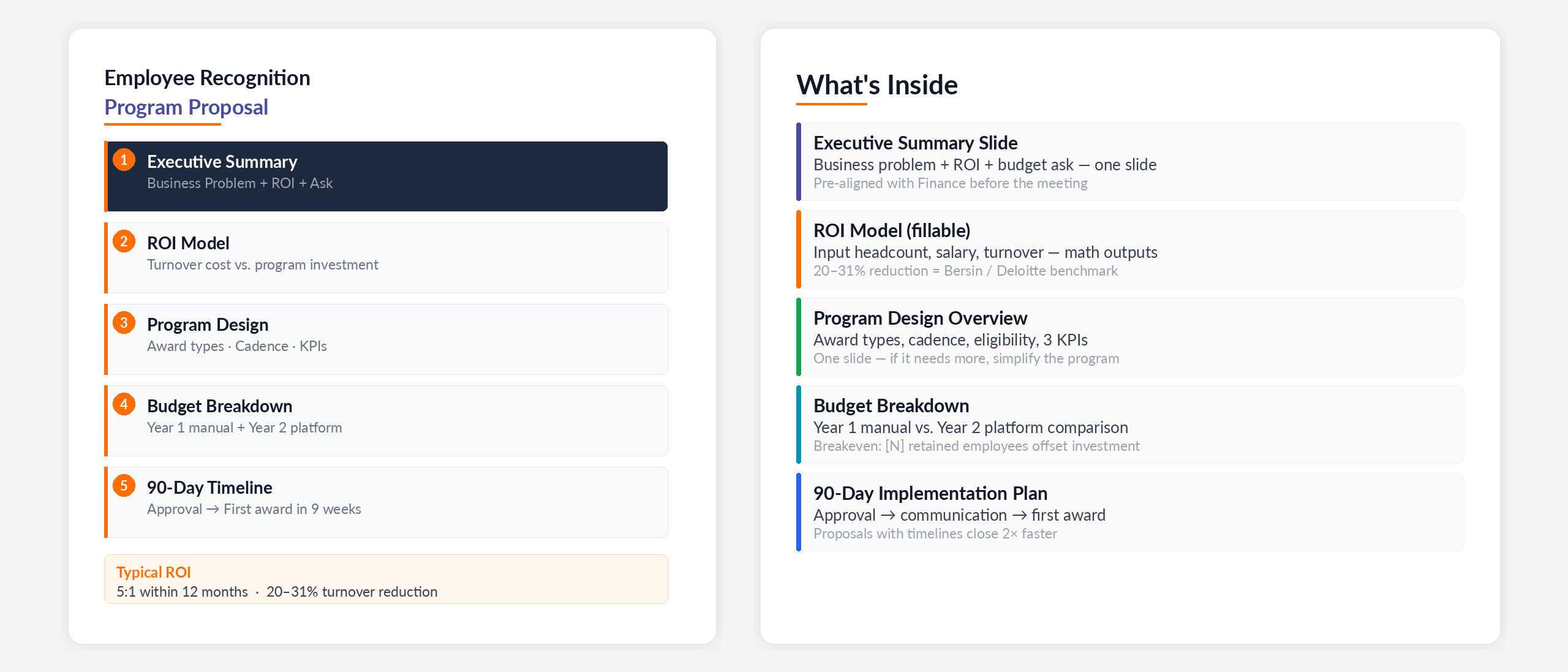
Employee Recognition Program Proposal Template
Build the business case and budget framework for your full recognition program.
View Template ›
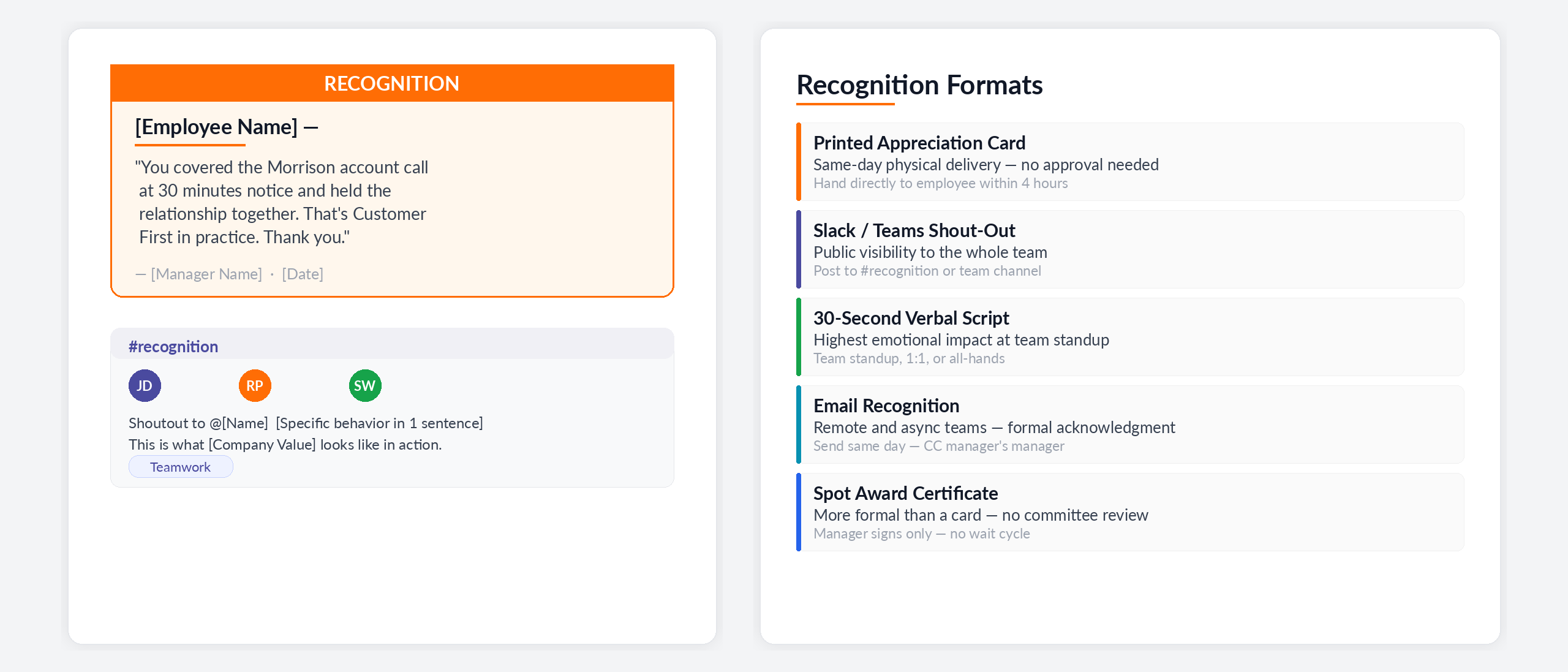
On-the-Spot Recognition Template
Instant recognition tools for managers to acknowledge in the moment.
View Template ›