

Listen to this article:
High impact employee recognition programs 0:00/11:331×
Employee recognition isn’t underperforming because leaders don’t value it. It’s underperforming because most organizations treat it as a cultural accessory, not a business mechanism.
Across companies, recognition has become predictable and procedural. Employees are thanked, awards are distributed, and milestones are marked. Yet engagement remains volatile, attrition stubborn, and performance uneven. The gap isn't a lack of intent; it's a failure of design and execution.
A new global study, The State of Recognition & Rewards 2025, reveals the truth. When employees consistently feel appreciated, accepted, validated, and accomplished through recognition, motivation surges by 18 percentage points, intent to stay rises by 16 points, agility improves by 14, and customer excellence by 11.
Recognition works only when it is experienced as credible and consistent. When those emotional signals weaken, workplace sentiment falls from 98% to 83%, motivation and retention plummet over 20 points, and discretionary effort nearly halves. High-impact programs don't just recognize; they strategically design recognition to drive culture and results.
This blog distills key findings from the report, analyzing 352 programs across North America, the UAE, and India. It spotlights "Leaders," aka companies that rate their programs highly effective on engagement, behavioral reinforcement, and productivity, and contrasts them with "Others."
Using Vantage Circle's AIRᵉ framework, you'll see exactly what sets high-effectiveness programs apart: double the design maturity, stronger execution, and a focus on behaviors over outcomes. HR leaders can apply these insights immediately to turn recognition from a perk into a performance lever.
Why Recognition is Now a Strategic Lever

From Feel-Good to Performance Driver
Recognition has evolved beyond HR calendars and occasional awards. It is a deliberate design choice that channels appreciation into energy, alignment, and sustained performance. Recognition-rich cultures consistently outperform on these core metrics: higher motivation, loyalty, agility, and customer excellence, and not just feel-good morale boosts.
Recognition still drives engagement, retention, and productivity. But nearly 9 in 10 companies (89%) have now expanded beyond these traditional goals to use recognition to reinforce behaviors and shape culture. This shift transforms recognition into something bigger, an operating system that energizes people while reinforcing the behaviors and values that matter most.
The Foundation: Four Emotional Signals That Change Everything
At the heart lie four emotional outcomes:
- Appreciated: "I am noticed for who I am, not just my role."
- Accepted: "I can show up as myself."
- Validated: "What I do has real meaning."
- Accomplished: "I see the difference I make."
When all four signals are strong, business outcomes accelerate. But they're interdependent: remove one, and the entire effect crumbles. The chain effect proves it. Among companies highly effective at engagement and behavioral reinforcement, 86% also achieve high productivity results.
Leaders embed these signals at three levels:
- organizational systems that ensure consistency,
- leadership behaviors that demonstrate authenticity, and
- cultural practices like equitable rewards that reinforce values.
When leaders model authenticity, design for inclusivity, and build systems for continuity, recognition turns from a symbolic act into a sustained source of energy and alignment.
– Partha Neog (CEO, Vantage Circle)
What High-Effectiveness Programs Do Differently

High-impact programs don't just have recognition. They leverage Vantage Circle’s AIRᵉ framework as a core lens to evaluate recognition program maturity, making it easier to see why some programs work and others don’t.
- Appreciation is about acknowledging contributions and worth, not just big wins.
- Incentivization covers the rewards and signals that motivate people to keep giving their best.
- Reinforcement focuses on clearly signaling which behaviors the organization wants more of.
- eMotional Connect ensures recognition strengthens belonging, pride, and connection, not just wallets.
Leaders with a high-impact program design and execute it with twice the maturity of others, scoring an average AIRᵉ of 64 versus 34.
Nearly 40% of Leaders even cross a "modern design" threshold of 70%, shifting from transactional awards to relational, daily practices that weave appreciation into work itself.
Execution follows suit: these programs lean on online platforms (2 in 3 use them), track participation and frequency (9 in 10 do), and measure ROI or strategic impact, treating recognition as accountable business muscle.
Here's how Leaders excel across each AIRᵉ pillar today -
Appreciation: Broader Mechanisms, Higher Reach
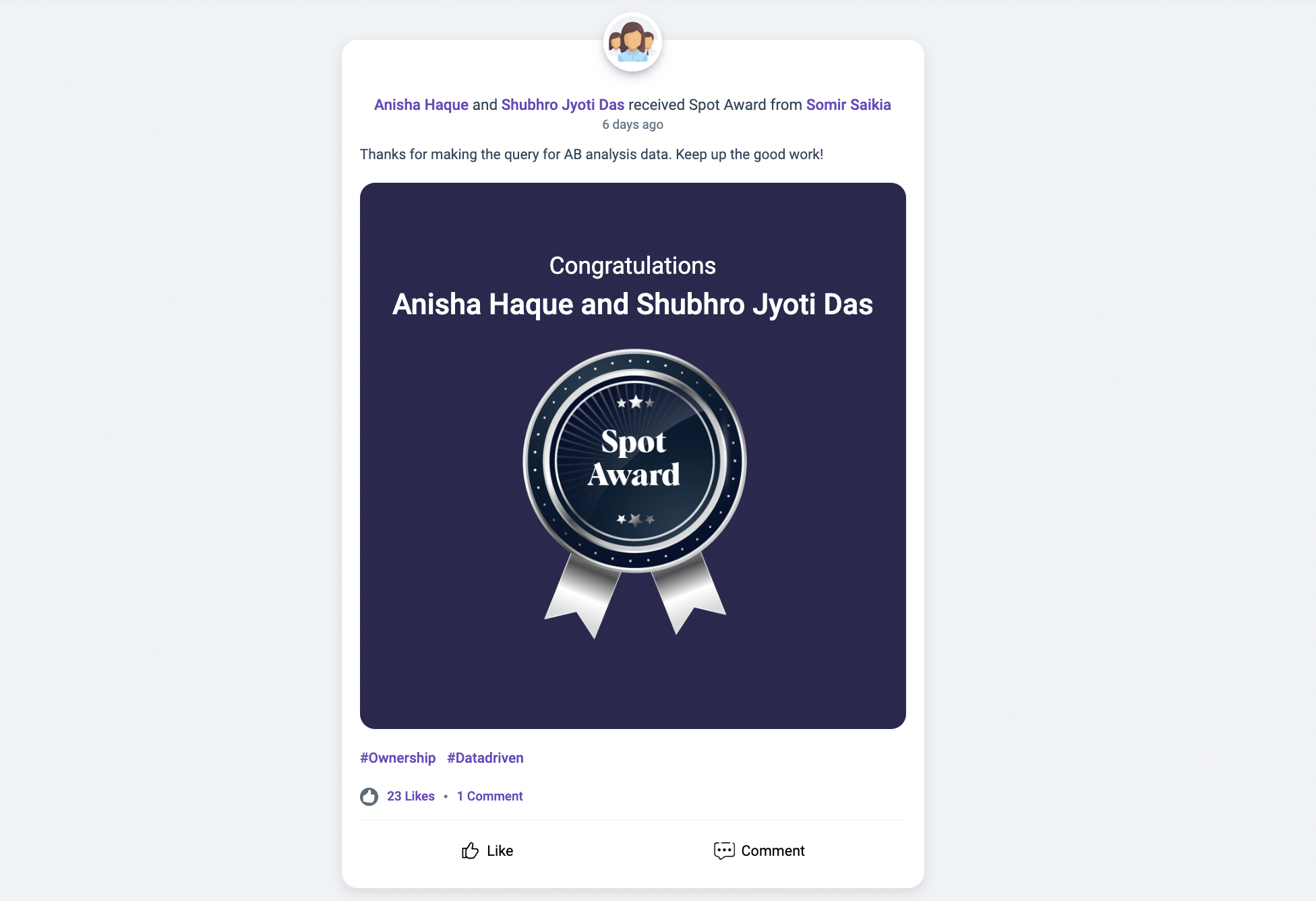
Leaders deploy up to 2x more recognition types across the employee lifecycle, from onboarding and spot awards to peer-to-peer shout-outs, quarterly honors, and loyalty milestones.
Source: Vantage Recognition
The adoption gaps are striking. Leaders far outpace others in deploying year-round spot awards, peer recognition, and quarterly honors.
This "always-on" approach ensures far more employees get formally recognized annually, turning appreciation culture-wide rather than manager-dependent. Recognition becomes predictable and inclusive, catching real work in real time.
Incentivization: Clear Criteria, Modest Budgets, Stronger Impact
Leaders are 2–3x more likely to codify and communicate recognition criteria via documentation, manager talks, platform integration, campaigns, and storytelling. Over 90% of leaders build excitement this way, compared with over 60% of others (non-leaders) lacking structure.
Budgets stay lean (often under USD 100 per employee per year, with modest average award values), yet impact soars through frequent, emotionally charged rewards over rare big ones. Clarity builds trust; frequency amplifies motivation.
Reinforcement: Behaviors as the New Metric
77% of Leaders recognize behaviors (how work gets done), rather than just outcomes. This makes success accessible to everyone, regardless of their role. They also reinforce consistency: 60% use a combination of escalating rewards, badges, or titles to differentiate employees who repeatedly display desired behaviors.
Leaders avoid false choices to maintain a balance. 79% recognize both teams and standout individuals on collective wins, proving you don't have to choose between collaboration and individual excellence. Behaviors become habits; culture gets wired in.
eMotional Connect: Meaningful Rewards, Amplified Moments
Leaders prioritize relational rewards: symbolic mementos, selective spending like gift cards, experiential outings, and leadership interactions like mentoring chats. These create memories, not just transactions.
Leaders don't let recognition happen in private. 80% amplify it through town halls, 72% through formal events, turning individual moments into cultural momentum. Recognition lands emotionally, then scales socially.
The State of Recognition & Rewards study links AIRᵉ to Ecological Systems Theory (every reward sends signals that ripple across the workplace), Symbolic Interactionism (who recognizes you and how shapes the meaning of that moment), and Vroom’s Expectancy Theory (people are motivated when they believe effort leads to performance and performance leads to valuable rewards).
From Insight to Action: How HR Can Apply This

High-impact recognition isn't accidental; it's engineered. Here are targeted steps drawn directly from what Leader programs do, organized by AIRᵉ pillars for easy implementation.
1. Design for meaning, not magnitude
Shift budgets from infrequent big awards to smaller, frequent ones that carry emotional weight. For example, consider spot awards under USD 100 per employee annually. Codify clear criteria (behaviors over outcomes) and communicate them via manager training, platform guides, and campaigns to build trust and excitement.
2. Build systems for consistency and scale
Adopt or optimize a tech platform for real-time recognition, peer-to-peer features, and tracking participation/frequency metrics. Measure ROI alongside engagement and behavioral shifts. Treat recognition as a strategic investment, not a cost center.
3. Reinforce behaviors that drive your priorities
Link recognition to specific actions like collaboration, innovation, DE&I, or sustainability, using badges for repeat performers and balanced team/individual shout-outs. Make it lifecycle-wide: onboarding, milestones, daily spots.
4. Amplify emotional resonance
Favor symbolic (plaques), experiential (outings), and relational rewards (leadership chats), then broadcast via town halls and storytelling to turn individual moments into culture fuel.
A Practical Example: Rethinking Your Budget
Instead of: Annual $500 awards for top 10 performers (total spend: $5,000, reaching 10 employees)
Try: Monthly $50 spot awards for anyone demonstrating collaboration, innovation, or customer focus (8 awards per month = $4,800 annually, reaching 60-80 employees throughout the year vs. just 10)
Result: Lower total cost, 8x more employees recognized, continuous reinforcement of desired behaviors, and a culture where everyone can see themselves winning.
Your Next Move: From Intent to Impact
The 2025 study proves it: well-designed recognition delivers a motivation lift, retention boost, and chain effects to productivity when engagement and behaviors align. Leaders achieve this with double the AIRᵉ maturity, proving recognition thrives on thoughtful design over spend.
Which AIRᵉ pillar is your weakest link? Without intentional design, even well-meaning recognition programs fail to deliver real results. Don't let yours be one of them.
Take action today:
- Request a free AIRᵉ assessment to identify gaps in your current program design and execution.
- Download the full report to dive deeper into market-specific benchmarks and best practices.

This article is written by Nilotpal M Saharia. Nilotpal M Saharia is a Senior Content Marketing Specialist & R&R Strategist at Vantage Circle, with 7 years of expertise in marketing, HR, and content strategy.
Connect with Nilotpal on LinkedIn.
You might also like

How Leadership’s Role Shape Employee Recognition?
Discover Why most Employee Recognition Programs fail and how to fix them from HR expert Dave Ulrich. ...

Building a People-First Workplace: Lessons on Recognition, Gratitude, and Growth
Explore how recognition, gratitude, and empathy shape people-first workplaces, strengthen culture, and drive performance in a hybrid, AI-driven world....

How Micro-Cultures Shape Employee Experience
Is your organizational culture failing to retain employees? Discover the Power of Micro-cultures. Learn how micro-culture shapes employee experience....