









Building a People-First Workplace: Lessons on Recognition, Gratitude, and Growth

A Global Employee Recognition and Wellness Platform
Listen to this article:
The gap between what leaders think motivates people and what actually does has never been wider.
Traditional management frameworks are cracking under the weight of hybrid work, AI disruption, and rising employee expectations. The old ‘command-and-control' model doesn't work on people who want purpose, flexibility, and genuine recognition.
The data makes this painfully clear. Gallup’s 2024 State of the Global Workplace report found that disengagement costs the global economy nearly $1.9 trillion in lost productivity every year. Another Deloitte study revealed that organizations with strong recognition cultures see a 31% lower turnover rate. The link is undeniable. When employees feel appreciated, they stay, contribute, and thrive.
Leadership experts Chester Elton and Matt Burns have shared and emphasized these insights in the Vantage Circle podcast. Their insights reinforced what many forward-thinking leaders already know: employee recognition and gratitude aren’t perks. They are essential leadership tools that define how organizations attract, engage, and retain talent in a fast-changing world.
The future of leadership won’t be built on technology alone. It will be shaped by leaders who understand that people are the real competitive advantage, and recognition paired with gratitude is the foundation that keeps them connected.
This foundation becomes stronger only when recognition means something to the people receiving it. That meaning begins with purpose; the deeper reason employees show up every day.
The Interconnectedness of Purpose and Recognition
Employees today want more than a paycheck. They want a purpose.
When people understand how their work contributes to something larger, motivation changes. Tasks feel meaningful. Effort turns into ownership. And that sense of purpose grows stronger when it’s seen and recognized.
Recognition is how leaders say, “I see what you did, and it matters.” It connects effort to impact. In teams where appreciation is consistent, employees report higher commitment, creativity, and trust.
Research supports this link. According to McKinsey’s 2024 Employee Experience Report, 70 percent of employees say their sense of purpose is defined by their work. Yet only 18 percent strongly agree that they feel recognized for it. That’s the gap modern leaders must close.
Recognition platforms make it easier for leaders and employees to close this gap by sharing appreciation across teams and time zones. With platforms like Vantage Recognition, organizations can make this process consistent and effortless, enabling leaders and peers to celebrate contributions in real time.
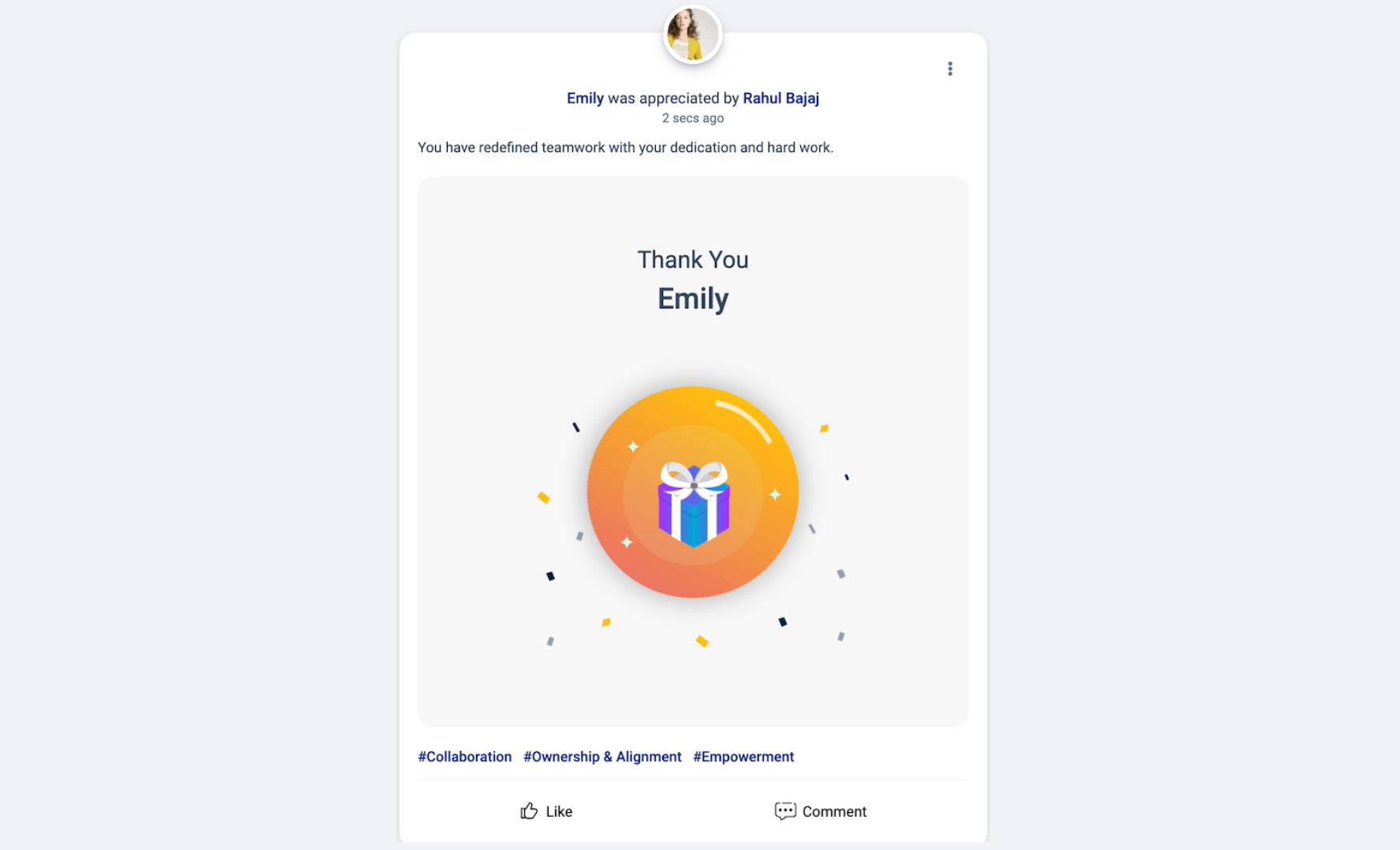
Source: Vantage Recognition
These moments of appreciation build loyalty that compensation alone can’t buy. Purpose tells employees why they matter. Recognition proves it.
When recognition is consistent and purposeful, it moves beyond morale and directly strengthens business performance. The next step is to understand how appreciation translates into measurable results.
Recognition as a Strategic Business Lever
Recognition cannot be just a feel-good practice; it’s equally a performance driver.
When employees feel seen and valued, they contribute more to the company. The impact shows up in numbers. According to Gallup, organizations with highly engaged employees experience 21% higher profitability and 17% higher productivity than those with low engagement.
These aren’t isolated results. They’re proof that recognition is a measurable business strategy.
However, the mistake many organizations make is treating recognition as an HR initiative instead of a leadership responsibility. Strategic recognition doesn’t always mean rewards or bonuses. It means aligning appreciation with actions that reflect company goals and values. When leaders do this consistently, recognition turns into reinforcement, shaping not just morale, but performance outcomes.
And when recognition becomes a shared language across the organization, something deeper takes root, i.e., a culture of gratitude. It’s that culture that turns short-term engagement into long-term commitment.
Why Gratitude is the Foundation of Great Culture
It’s not written in the policy manuals or measured on dashboards. However, you can see it and feel it in every thriving organization. It’s called gratitude. It is how people treat each other, how leaders listen, and how teams celebrate progress, not just results. Gratitude shapes company culture in ways metrics can’t.
Research by the Greater Good Science Center at UC Berkeley found that employees who feel appreciated are more than 50% more productive, more loyal, and significantly less stressed. Gratitude doesn’t just make people happier. It builds trust, strengthens collaboration, and creates a sense of belonging that can’t be faked.
Some organizations already lead by example.
- WD-40, known for its “tribal” culture, treats mistakes as learning moments, not failures.
- American Express continues to show how recognition and empathy can scale across geographies.
- At Texas Roadhouse, gratitude flows from executives to servers, creating a workplace where people genuinely want to stay.
These cultures don’t emerge by accident. They grow from leaders who model appreciation every day. It can be as simple as a quick thank-you in a meeting, a handwritten note after a project milestone, or simply calling out effort in front of peers. Each act reinforces that gratitude is part of how the company operates.
The common thread through all the great leaders and teams we looked at was gratitude. They said people were their most important asset — and they meant it.
– Chester Elton
Gratitude turns recognition from an event into a habit. Over time, that habit becomes identity. It’s what employees talk about when they describe why they love where they work.
But sustaining this kind of culture can become more complex. As hybrid and remote work become the norm, leaders face a new challenge of keeping gratitude visible when teams are miles apart.
Related: National Gratitude Month: 20 Ways To Celebrate It At Work
Rethinking Culture in the Hybrid World
Hybrid and remote work has reshaped how teams connect, collaborate, and communicate. The spontaneous “thank you” in the office kitchen has been replaced by Slack messages and Zoom check-ins. And while flexibility has improved work-life balance, it’s also made belonging harder to build.
SHRM notes that one of the primary difficulties for leaders in hybrid work environments is maintaining culture and connection among team members working remotely and onsite.
Gratitude can’t rely on proximity anymore. It has to be designed into the way work happens. Virtual recognition boards, shoutouts in team channels, and digital rewards are small ways to make appreciation visible. But the real work lies in consistency. Employees don’t need grand gestures; they need frequent signals that they’re seen.
Hybrid culture thrives on shared rituals. Weekly check-ins that start with appreciation. End-of-month reflections that highlight team wins. Managers who take time to write quick notes of thanks. These moments close the distance between people and purpose.
The best hybrid cultures don’t replicate the office; they redefine connection. Recognition becomes the thread that ties everyone together, whether they’re working from home, a café, or a global headquarters.
And as technology continues to evolve, the need for human connection will only grow stronger.
Gratitude in the Age of AI
Artificial intelligence is reshaping how we work, learn, and lead. From predicting employee turnover to personalizing learning paths and even automating recognition reminders, AI is transforming the workplace. But here's the truth: while technology can enhance recognition, it can never replace the human touch.
As AI integrates into more aspects of work, the risk is that organizations may rely too heavily on data and automation, forgetting what drives genuine engagement. McKinsey estimates that by 2030, automation could impact up to 30% of global work hours, making efficiency easier but potentially stripping away the human connection that fuels creativity and collaboration.
This is where gratitude and empathy come in. As tasks become automated, it’s human leaders who will continue to shape meaningful connections. AI can highlight patterns of burnout, but only a leader can step in and offer emotional support that makes employees feel seen and valued.
In a world where algorithms are fast replacing routine tasks, gratitude will remain as the leadership skill that technology can’t replicate. It’s the bridge between data-driven decisions and human-centered leadership that turns metrics into meaningful relationships.
AI is going to disrupt everything we know, but I still see the future being very people-focused. Relationships will always matter.
– Chester Elton
As AI reshapes work, the future won’t belong to the most automated companies. It will belong to those who learns to balance technology with empathy and connection.
Leading with Empathy and Positive Intent
When leaders take time to listen, understand, and respond with intent, they create psychological safety. That safety is what gives teams the courage to take risks, share ideas, and learn from mistakes.
According to Deloitte’s Global Human Capital Trends research, empathy has emerged as one of the most critical leadership capabilities for driving innovation and engagement in modern organizations. The reason is simple. People follow leaders who see them, not just their job titles.
Leading with empathy also means assuming positive intent. Most employees don’t come to work to fail. They come to contribute. When leaders ask 'what happened?' instead of 'who's at fault?', they replace blame with curiosity. Accountability becomes shared, not feared.
This mindset shift is powerful. It builds trust faster than any recognition program or benefit plan. It shows that leadership isn’t about perfection; it’s about presence.
Summing Up
The future of leadership won’t be defined by technology, strategy, or speed. It will be defined by humanity.
Recognition, gratitude, and empathy aren’t new ideas. But in a world shaped by constant change, they’ve become the anchors that keep organizations grounded. When employees feel seen, trusted, and valued, they feel that they belong. And belonging is what turns a company into a community.
This is where leadership evolves from managing tasks to elevating people. Recognition connects purpose to performance. Gratitude keeps cultures strong through disruption. Empathy ensures that even in an AI-driven world, leadership remains human.
Because in the end, technology will change everything about how we work, but gratitude will always define why.

Nilotpal M Saharia is a Senior Content Marketing Specialist and Recognition & Rewards Strategist at Vantage Circle, where he transforms complex HR and marketing concepts into compelling content that drives engagement. With an MBA and nearly a decade of cross-functional experience spanning marketing, content strategy, entrepreneurship, and human resources, Nilotpal brings a unique multidisciplinary perspective to his writing. His insights have reached audiences beyond Vantage Circle, with featured work on Select Software Reviews.
Connect with Nilotpal on LinkedIn and X, or reach out to editor@vantagecircle.com for inquiries.