



Consolidation of Recognition Programs: Why It Matters and How to Do It Right

A Global Employee Recognition and Wellness Platform
Most companies appreciate their people, but in scattered ways. Spot awards happen randomly, milestone certificates come from old systems, peer shout-outs get lost in chat, and festival gifts are handled separately by different teams. Together, it creates a mixed, uneven experience.
Employees notice the gaps. HR ends up juggling too many tools and vendors. Leaders see the cost but not the full picture of what’s working. The problem isn’t appreciation , it’s that everything is happening separately.
That’s why many CHROs are moving to one unified recognition platform. It brings every award, milestone, and thank-you into one place, making appreciation clearer, more consistent, and easier to manage.
Here's why consolidation matters and what it changes for modern HR.
Why HR Leaders Are Moving Toward Consolidation
For years, recognition programs expanded organically: a new team launches a spot-award scheme, a Business Unit starts its own peer recognition, long-service awards become a process, and managers improvise celebrations.
Consulting research has long warned of the risks:
-
Gartner identifies "experience fragmentation" as a top inhibitor of employee engagement, a warning that disconnected tools and scattered programs erode organizational cohesion.
-
As workplaces become more hybrid and digital, disconnected experiences contribute to lower engagement, less collaboration, and weakened culture across distributed teams - Gartner
-
McKinsey notes that employees experience culture as a continuous system rather than scattered touchpoints.
When recognition is fragmented, three things break:
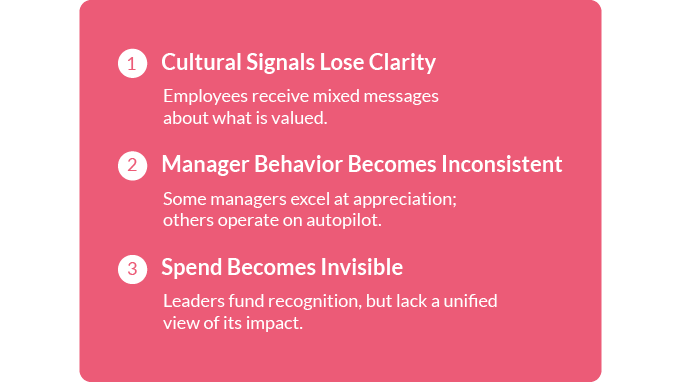
Consolidation addresses all three. Let's dwell on this more.
What Is Consolidation of Recognition Programs?

Consolidation simply means bringing all your recognition efforts, formal, informal, social, and reward-based, into one integrated system instead of scattering them across tools, vendors, and teams.
It includes combining peer-to-peer recognition, spot awards, long-service or milestone programs, manager-driven awards, and rewards/redemption into one consistent, centralized ecosystem.
Example:
Instead of employees using Slack for shoutouts, email for birthdays, a separate portal for points, and manual processes for service anniversaries, everything moves into a single unified platform with shared workflows, budgets, analytics, and governance.
This approach is gaining traction because hybrid work, digital transformation, and rising cost pressures demand scalable, cohesive, and data-driven solutions. With workforce dynamics shifting rapidly, with remote and hybrid work increasing, and technology fatigue rising, unified platforms help organizations maintain culture and engagement - Gartner
Why Organizations Need to Consolidate Recognition Programs

• Fragmented culture
When each department or manager celebrates employees differently, recognition feels arbitrary. Employees perceive inconsistency, which erodes trust and fairness.
• Administrative overload
HR teams manage multiple vendors, portals, budgets, and communication cycles increasing complexity without increasing impact.
• No unified data
Recognition trends remain invisible: who gets recognized, who is left out, which teams engage more, and where bias creeps in. Without a single data source, it's impossible to correlate recognition with engagement or retention.
• Low engagement
Employees quickly lose interest in tools they rarely use or don't understand. Multiple systems dilute adoption and reduce cultural visibility.
Credible insight: Deloitte's Human Capital research notes that organizations with integrated recognition systems are 12x more likely to have strong employee engagement, primarily because consistency builds trust and participation.
Also Worth Reading: The Complete Guide to Employee Recognition in 2025: Using the AIRe Framework
Benefits of Consolidating Recognition Programs

1. Unified Culture
A single recognition ecosystem ensures that employees experience the same values, standards, and appreciation frequency regardless of manager, team, or location.
Business impact: When cultural signals are aligned, recognition reinforces the behaviors the organization wants more of, not the habits of individual managers.
2. Data-Driven Insights
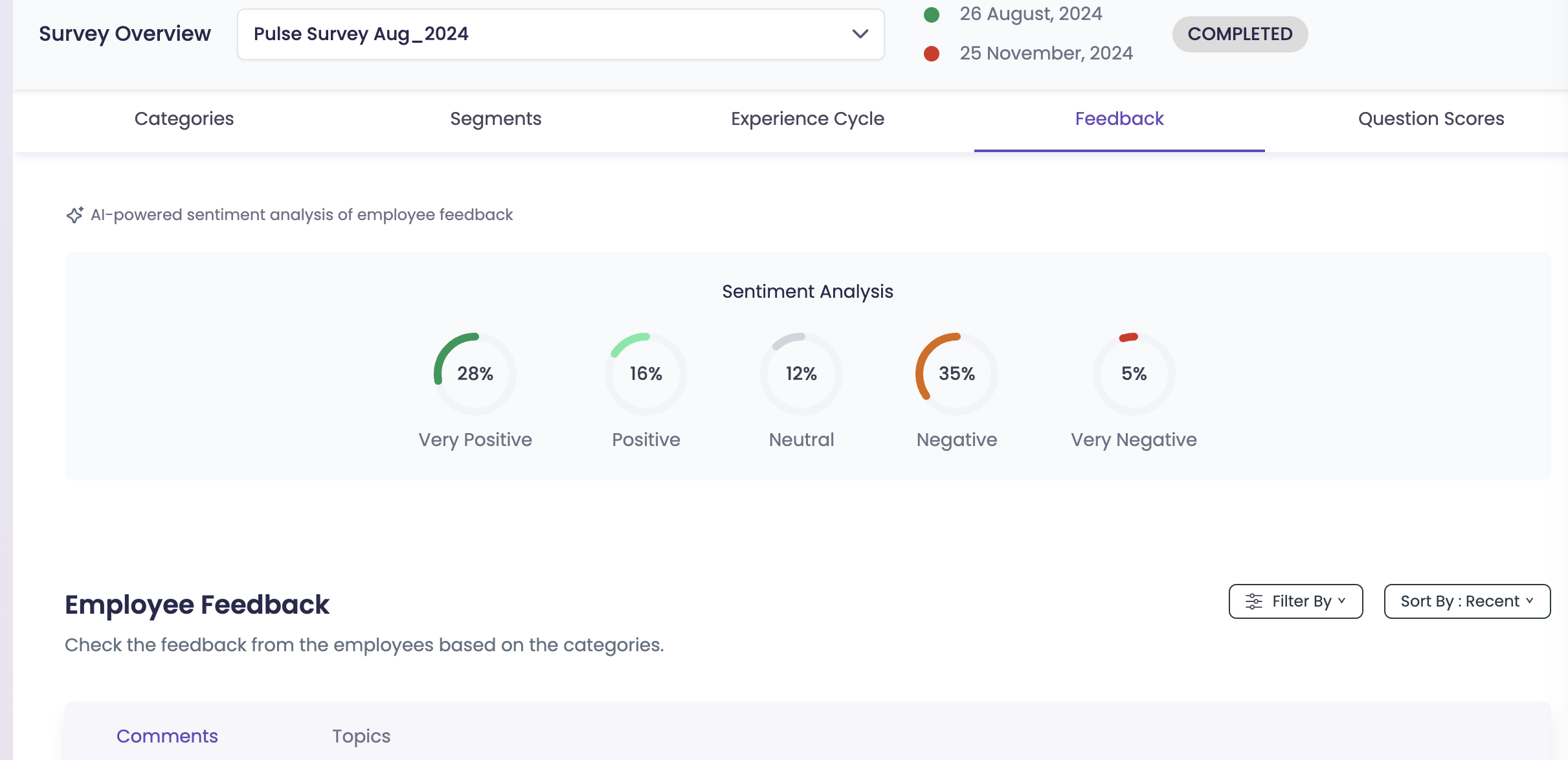
Consolidated systems compile every recognition moment into a single analytics layer capturing frequency, coverage, team-level trends, bias patterns, and alignment with values.
Integrated recognition data is one of the fastest ways to feed early signals into People Analytics dashboards, including correlations to retention, performance, and engagement. Several platforms like Vantage Circle, Culture Amp, etc, help achieve that with ease nowadays.
Instance: If a sales team shows lower recognition coverage and lower quarterly performance, HR can intervene with manager enablement versus guessing.
Business impact: Better decisions, fewer blind spots, and a more equitable culture.
Source: Vantage Pulse
3. Simplified Management
Instead of maintaining multiple portals, manual workflows, and vendor contracts, HR manages a single system under central governance. This brings structure to budgets, policies, communication, and compliance.
Business impact: More time for strategic work and fewer administrative hours, something many HR teams cite as their most significant constraint.
4. Cost Efficiency
One can expect considerable savings when organizations consolidate overlapping HR tools, primarily due to reduced vendor sprawl, lower licensing fees, and fewer hidden costs such as reward procurement and manual admin.
Fewer vendors mean fewer contracts, minimized tech overhead, and the elimination of duplicate spending, all while improving ROI.
Instance: A company using four tools (social recognition, milestones, gifting, points redemption) often pays separate fees for each tool; a unified platform eliminates duplication.
Business impact: Higher ROI with lower operational spending.
5. Better Adoption
Employees engage more when they only need to learn one system. Usage becomes habitual, visibility increases, and recognition becomes a daily cultural cue rather than an occasional event.
Business impact: Higher adoption = higher recognition frequency = higher engagement.
6. Stronger Manager Enablement
Managers receive nudges, workflows, templates, and reminders that make recognition easier and more consistent.
Business impact: When managers improve their recognition habits, overall team engagement rises.
A unified approach creates a visible, continuous feedback loop that connects recognition directly to culture, performance, and retention.
Real-World Examples of Successful Consolidation
Background: Meridian is one of Canada's largest credit unions, with a distributed workforce spanning branches and corporate offices.
Challenge: Their recognition efforts were fragmented, with different teams using distinct processes for peer appreciation, milestones, and awards, resulting in inconsistent experiences and limited visibility into engagement outcomes.
What they did: They moved to a unified recognition ecosystem by consolidating peer recognition, milestone programs, and awards into a single digital platform, thereby standardizing recognition across the organization.
Result: As a result of this integrated approach, Meridian was named one of the 50 Most Engaged Workplaces®, by an external, industry organisation that validates the strength of its engagement and recognition culture.
How to Consolidate Recognition Programs: Step-by-Step Guide

1. Audit existing programs and vendors
Identify every recognition touchpoint, tool, vendor, and budget. Map overlaps and redundancies. This clarifies what should be retained, improved, or retired.
2. Align goals with culture
Define the behaviors, values, and performance outcomes your recognition should reinforce. Consolidation works best when the cultural and business intent is clear.
3. Select the right platform
Choose a system that supports scalability, multi-country operations, analytics, integrations, rewards, and policy consistency. Look for mobile readiness and manager enablement tools.
"A consolidated platform such as Vantage Circle brings peer recognition, milestones, rewards, and analytics into one ecosystem, making it easier for HR teams to manage programs from a single source of truth."
4. Engage stakeholders early
Bring HR, IT, procurement, finance, and business leaders into the decision-making process. Early buy-in accelerates adoption and compliance.
5. Communicate and train employees
Create simple, clear messaging. Train managers on how to recognize effectively. Ensure employees know where to go, how to use the system, and why it matters.
6. Measure and iterate
Track adoption, recognition frequency, coverage, sentiment, and impact. Use the data to refine programs, adjust budgets, and expand recognition categories.
Consolidation should evolve with your culture and not remain a one-time project.
Common Challenges and How to Overcome Them

Even the most forward-thinking organizations hit resistance when centralizing recognition. Here are the challenges CHROs encounter most often and the pragmatic fixes that keep momentum intact.
a. Resistance to Change
People are attached to familiar processes, even when they’re inefficient. Managers fear losing autonomy; employees worry recognition will feel “corporate” or scripted.
Solution: Anchor your rollout in strong internal communication, leadership advocacy, and visible early wins. Share stories, not just instructions. Build belief before you build usage.
b. Data & System Migration Complexity
Moving data from multiple tools, spreadsheets, and legacy workflows can feel risky especially when HRIS and IT bandwidth is stretched.
Solution: Choose a vendor with proven integration experience, phased migration capabilities, and transparent data-mapping processes. Start with low-risk groups, validate accuracy, and expand in waves.
c. Budget Concerns & Competing Priorities
When budgets tighten, recognition consolidation can look like an add on expense and not a priority. Leaders may question the ROI of replacing multiple systems with one.
Solution: It is critical to frame consolidation as a smart way to cut costs: one vendor instead of many, fewer contracts to manage, centralized data, and reduced admin time. The efficiency pays for itself.
d. Balancing Global Consistency with Local Relevance
Global companies struggle with a generic model. Local teams want autonomy, cultural flavor, and locally redeemable rewards.
Solution: Build a unified global framework; values, governance, analytics while giving regions flexibility in reward types, languages, currencies, and celebrations.
Measuring ROI After Consolidation

Measuring ROI is what turns consolidation from a "platform shift" into a business case for culture, productivity, and retention. CHROs increasingly evaluate recognition systems with the same rigor as other talent investments.
Key Metrics to Track Post-Consolidation
1. Platform Adoption Rate
Percentage of employees and managers actively using the system weekly or monthly.
2. Recognition Frequency
How often recognition occurs per employee or per manager.
A healthy benchmark is 1–2 meaningful recognition moments per person per month.
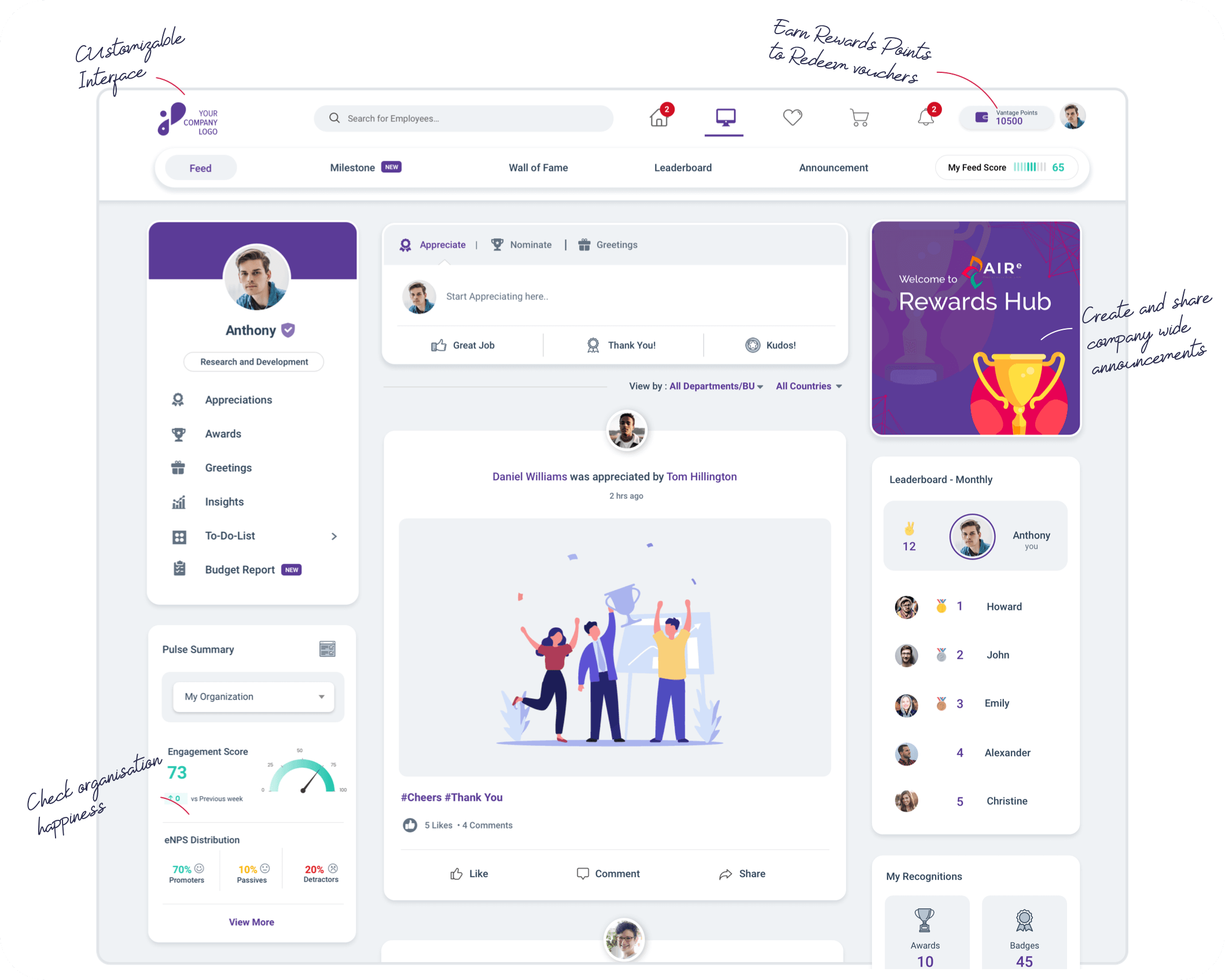
(Source: Vantage Recognition)
3. Coverage Rate
What percentage of employees received at least one recognition in the last 30 or 90 days?
This metric is increasingly used in consulting diagnostics to flag under-recognized teams or bias.
4. Manager Participation Rate
The percentage of managers giving recognition consistently is often the strongest predictor of cultural activation.
5. Engagement Scores
Especially around belonging, happiness, and feeling valued.
 Source: Vantage Pulse
6. Retention of Recognized Employees
Organizations often see materially higher retention among employees with consistent recognition, making this a critical business case metric.
7. eNPS Movement
A standard post-implementation indicator of improved employee sentiment.

Source: Vantage Pulse
8. Administrative Time Saved
Measure reductions in manual workflows, emails, vendor coordination, and policy enforcement.
Real client examples often show a 30–40% reduction in HR admin hours within the first year.
9. Vendor Spend Consolidation
Total savings from eliminating redundant platforms, procurement cycles, and licensing fees.
Did you know: Longitudinal research by Gallup shows that employees receiving high-quality recognition were 45% less likely to leave over two years , a strong signal that recognition directly impacts retention and organizational stability.
Conclusion
Consolidation isn't just a technology upgrade; it's a cultural and strategic shift that brings consistency, clarity, and purpose to how organizations celebrate their people. When done well, it strengthens culture, streamlines operations, saves costs, and creates a recognition experience employee actually trust and use.
As more organizations prepare for the future of work, unified recognition ecosystems will become the backbone of high-engagement, high-performance cultures.

Supriya Gupta leads the Content team at Vantage Circle where she drives strategy and thought leadership across digital channels.With over a decade of experience in corporate and marketing communications, she specializes in storytelling that connects brand purpose with audience engagement. Her bylined work at Vantage Circle has been featured in platforms like Comp and Benefits Today, while her ghostwritten contributions—crafted in her role as a communications expert—have supported global brands across tech, media, and FMCG sectors, including Intel, ESPN, Pepsi, and the World Bank. Connect with Supriya on LinkedIn and X, or reach out to editor@vantagecircle.com for inquiries.